
Una guía completa del comprador para seleccionar la laminadora de rollos adecuada para su negocio
A Comprehensive Buyer's Guide to Selecting the Right Roll Laminator for Your Business
For procurement professionals and business owners in the signage, printing, and graphics industries, selecting the appropriate roll laminator is a critical decision that impacts production efficiency, product quality, and long-term operational costs. With a wide array of models, specifications, and features available, navigating the market can be complex. This guide provides a structured, fact-based framework to help you evaluate and choose a roll laminator that best matches your specific application needs and production goals.
1. Define Your Core Application and Production Volume
The first step is to clearly define your primary use case. Roll laminators serve diverse industries, each with distinct requirements. For instance, in the Advertising & Graphics sector, machines are used for high-efficiency, continuous large-format production, laminating vinyl, PP paper, and PVC film for billboards, posters, and vehicle stickers to enhance durability and UV resistance. In Digital Printing & Custom Signage, the focus is on instant finishing for short-run and customized production, providing surface protection and gloss or matte finishing for digital prints.
Other key applications include:
- Graphic Design & High-End Photo Finishing: Precision cold or heat lamination for photo prints, digital posters, and artworks to prevent fading and maintain color fastness.
- Signage & Exhibition Display: Flatbed sheet laminating for rigid boards like Acrylic, PVC, and Foam board up to 50mm thick for indoor/outdoor signs and light boxes.
- Interior Design & Industrial Surface Finishing: Heavy-duty sheet lamination for decorative panels, wooden boards, metal sheets, and ceramic tiles to improve aesthetics and scratch resistance.
Your daily or monthly production volume will directly influence whether you need a manual, semi-automatic, or fully automated high-speed system. A distributor in the United Kingdom, for example, utilized equipment for high-speed roll-to-roll production, a project completed within a five-year period that enabled 24/7 industrial production, a result attributed to its industrial precision.
2. Evaluate Key Technical Specifications
Once the application is clear, assess the machine's technical parameters against your material and output requirements.
| Parameter | Consideration | Example Specifications |
|---|---|---|
| Maximum Lamination Width | Must accommodate your widest print or substrate. Common widths range from 1.5m to over 2.2m. | 1630mm (64"), 1830mm, 2280mm |
| Maximum Material Thickness | Determines the rigidity of substrates you can process (e.g., foam boards, PVC sheets). | 23mm, 28mm, 50mm (for flatbed models) |
| Maximum Speed | Directly impacts throughput. High-volume shops require speeds of 15-50 m/min. | 9 m/min, 12 m/min, 15 m/min, 20 m/min, 50 m/min |
| Heating System & Temperature | Essential for heat-assisted or thermal laminating films. Look for consistent heat distribution. | Top heated or dual heated; Max Temp: 60°C, 100°C, 120°C |
| Roller System | High-quality rollers ensure bubble-free application and even pressure. Silicone rollers are standard for durability. | 120mm or 130mm diameter silicone rollers |
| Lifting Mechanism | Pneumatic systems offer precise, consistent pressure adjustment compared to manual cranks. | Pneumatic up and down, Manual hand crank |
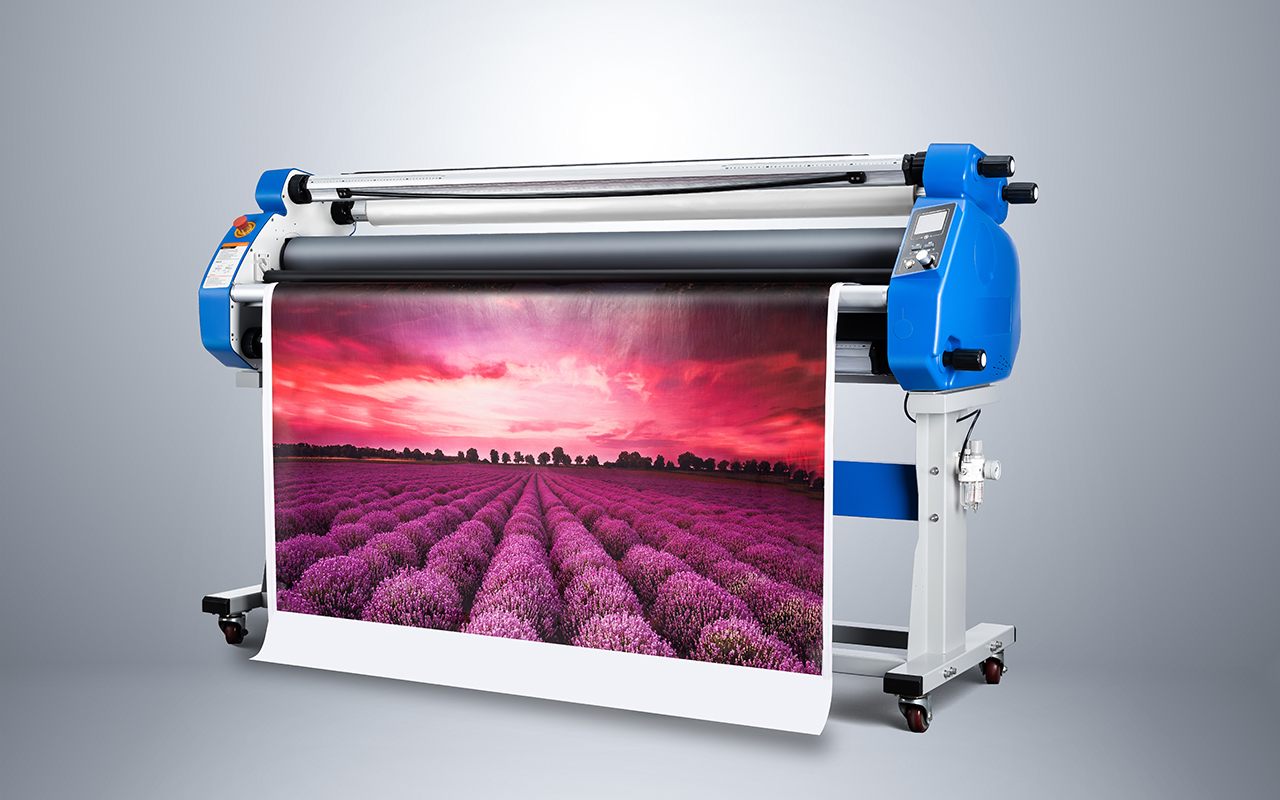
For example, a Heat Assist Laminator model like the MF1700-M1 PLUS offers a maximum lamination width of 1630mm, handles material up to 28mm thick, operates at speeds up to 9 m/min, and provides top heating up to 60°C with a pneumatic lifting system.
3. Consider Machine Type and Automation Level
Roll laminators are categorized by their function and level of automation. Matching the type to your workflow is crucial.
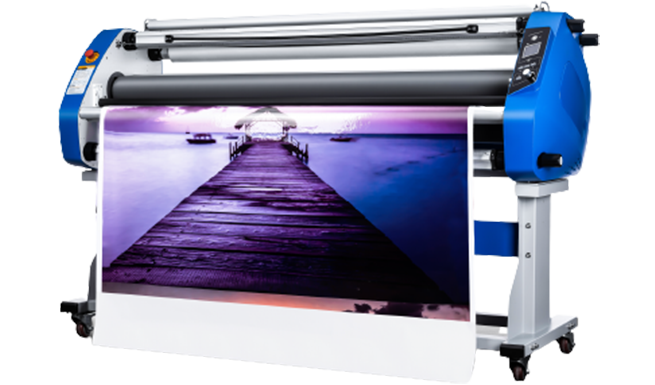
- Manual / Cold Laminators (e.g., Vinyl Roll Laminator): Basic models like the MF1700-B5, with a maximum width of 1630mm and pneumatic lifting, are cost-effective for low-volume shops or specific cold-film applications.
- Heat Assist / Hot & Cold Laminators: Versatile machines suitable for a broader range of films. The MF1700-M1, a Hot Cold Roll Laminator, includes a top heated infrared system (up to 60°C), manual hand crank lifting, and a speed range of 0–9 m/min.
- Heavy Duty & Industrial Laminators: Built for continuous operation. The MF1700-C3, an Industrial Roll Laminator, features a smart control system, front and rear panels, speeds up to 20 m/min, and optional high-temperature heating (120°C).
- High-Speed Automated Laminators: Designed for maximum throughput. The MF1700-F1 PLUS, a High Speed Roll Laminator, can reach 50 m/min, includes swing-in/out air shafts for roll-to-roll processing, and is equipped with trimming blade holders.
- Double-Sided Laminators: For applying film to both sides of a substrate in one pass, like the MF1700-F2, which features dual heating and a maximum speed of 20 m/min.
- Flatbed Laminators/Applicators: For rigid sheet materials. The Flatbed Laminator MF1950-B2 handles widths up to 1830mm and thicknesses up to 25mm, using a pneumatic system and infrared heating across four work tables totaling 4.8m in length.
4. Assess Build Quality, Safety, and Risk Control Features
Durability and operator safety are non-negotiable. Inquire about the construction materials and integrated safety mechanisms.
Common frame materials include integrated sheet metal for stability. Key components to examine are the roller material (premium silicone), heating elements (infrared quartz), and blade quality (tungsten steel).
Proactive risk control features can prevent common issues:
- Bubble Prevention: Controlled via consistent pressure. Solutions include premium silicon rollers and precise pneumatic lifting systems.
- Overheating Protection: Managed through integrated temperature sensors for thermal protection.
- Abnormal Speed Control: Addressed with laser sensors, reset emergency buttons, and active speed controls on both front and rear panels.
These features contribute to a lower total cost of ownership by reducing waste, preventing downtime, and extending maintenance intervals.
5. Verify Compliance and Manufacturer Credentials
Ensure the equipment meets the regulatory and safety standards required for your market. This is especially important for export. Key certifications to look for include:
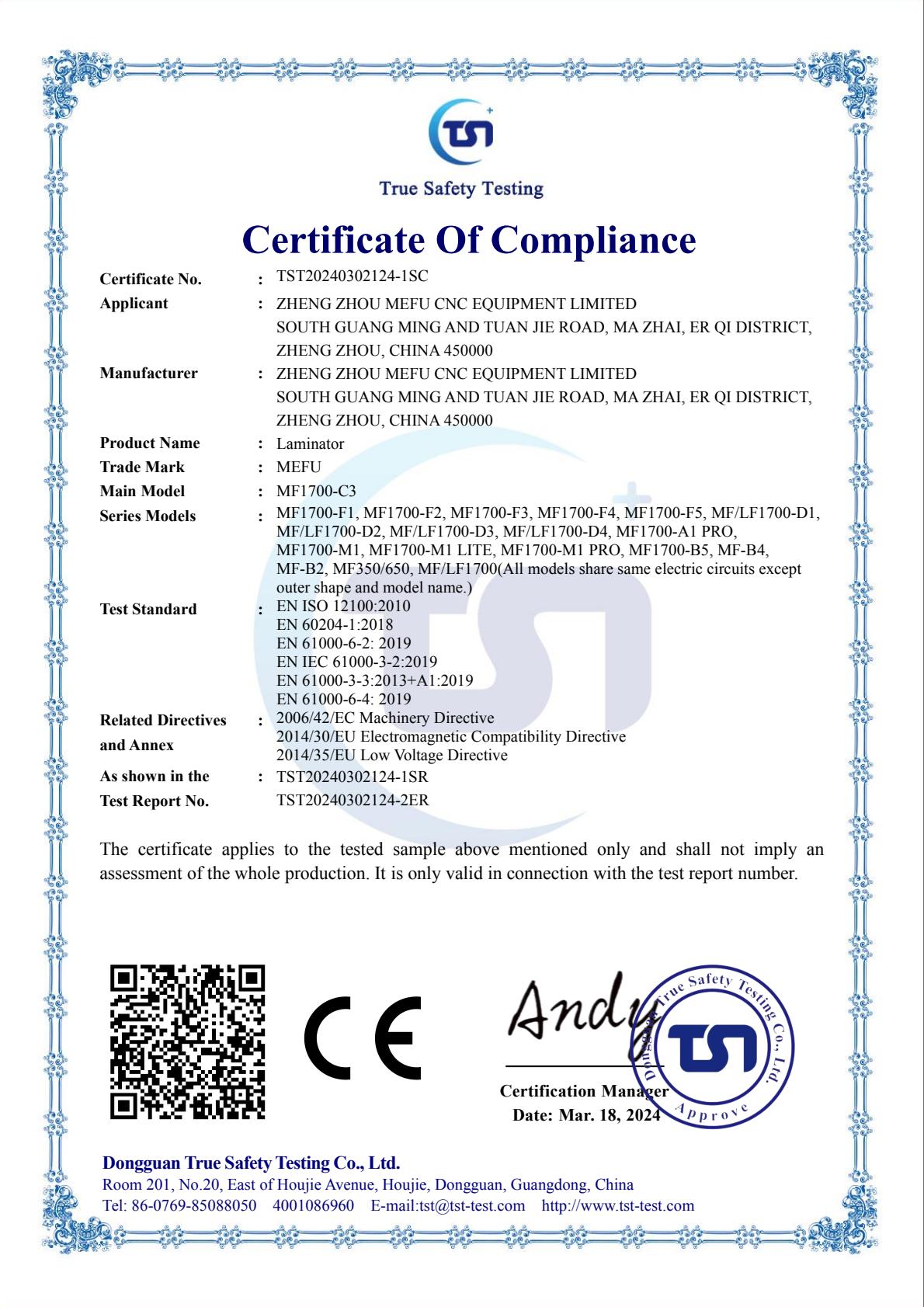
- CE Marking: Indicates conformity with health, safety, and environmental protection standards for the European Economic Area. For laminators, this covers standards like EN ISO 12100:2010 and EN 60204-1:2018.
- RoHS Compliance: Ensures the restriction of hazardous substances in electrical and electronic equipment, as per IEC 62321 series standards.
- ISO 9001 Certification: Demonstrates the manufacturer has a certified quality management system for the production and sale of its equipment, following standards like GB/T19001-2016/ISO9001:2015.
Manufacturer HENAN MEFU INDUSTRIAL LIMITED holds relevant certifications for its laminator range, including CE (certificate number TST20240302124-1SC), RoHS (TST20231102836-3RC), and ISO 9001 (16423Q31198R0S).
6. Analyze Total Cost of Ownership (TCO) and Support
The purchase price is only one part of the cost equation. A comprehensive TCO analysis should include:
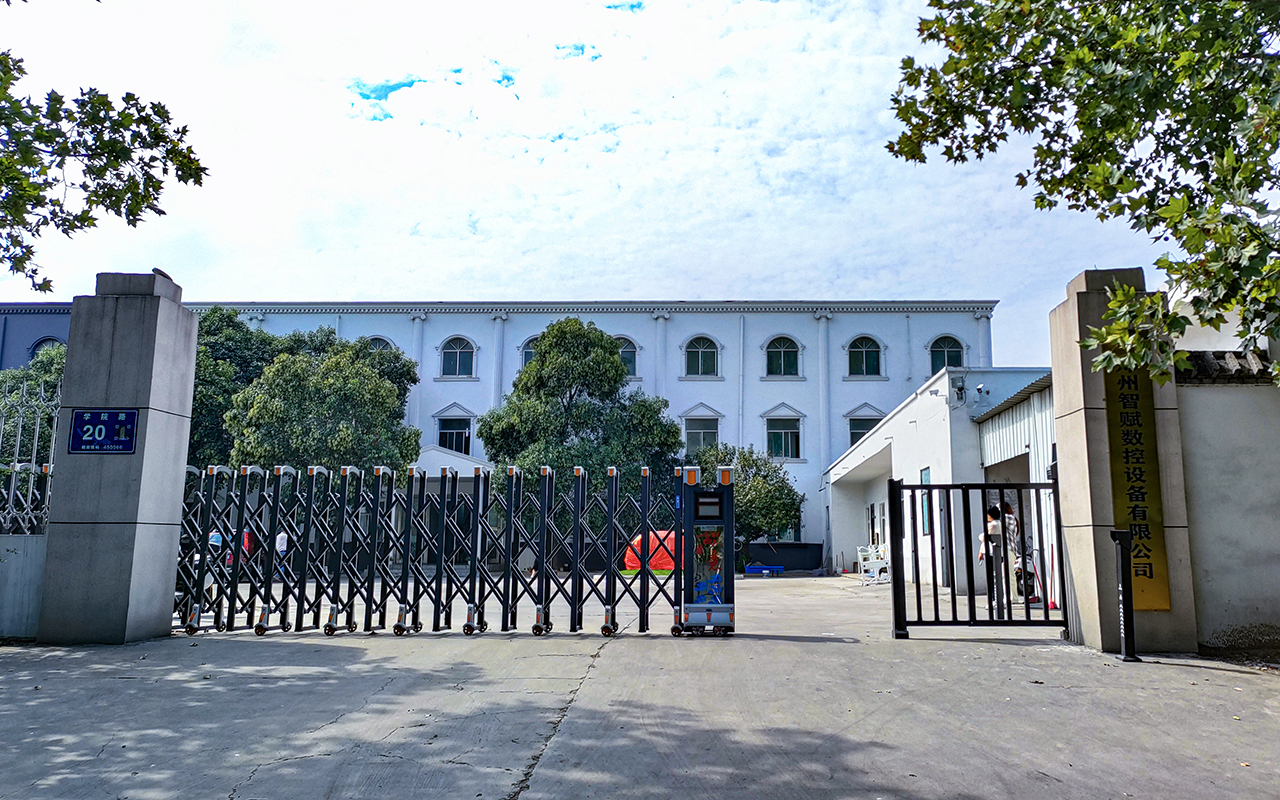
When evaluating suppliers, consider their global support network. MEFU, founded in 2008, operates from a 10,000㎡ factory with an annual output of 6000 units and exports to over 110 countries, supported by a network of authorized dealers. Their standard payment terms are T/T, with common delivery methods including FOB, CIF, DDP, and DDU. A pre-shipment test is typically part of the acceptance process.
- Energy Consumption: Compare power input (e.g., 1600W, 2500W, 5200W) across models.
- Maintenance Requirements: Machines with industrial-grade components and self-diagnostic systems may have longer maintenance intervals.
- Consumable Costs: Consider the lifespan and cost of replacement parts like rollers and blades.
- Training and Downtime: Factor in the ease of use and training required for operators.
Conclusion
Selecting the optimal roll laminator requires a methodical approach that balances technical specifications with real-world application needs, operational costs, and manufacturer reliability. By thoroughly defining your requirements, scrutinizing machine capabilities, and verifying compliance and support structures, you can make an informed procurement decision that enhances your production capabilities and provides a strong return on investment. For a detailed overview of finishing solutions, you can download the MEFU equipment brochure.