
A Vertical Sourcing Guide: Matching Specialized Disposable Wooden Cutlery Suppliers to Your Industry Needs (2026)
Industry-Specific Requirements for Disposable Wooden Cutlery

Eco-Friendly Disposable Cutlery for Takeaway Food Scenario
Procuring disposable wooden cutlery requires a clear understanding of the distinct requirements across different sectors. The core demands vary significantly from one industry to another.
Food Service & Hospitality: For restaurants, hotels, and catering services, the primary requirements are food-grade safety, compliance with regulations like FDA 21 CFR 178 and LFGB, and a splinter-free, smooth finish to ensure customer safety. Products must be odorless and suitable for both hot and cold foods.
Takeaway & Quick-Service Restaurants (QSR): Durability for transport, heat resistance, and compatibility with common packaging are crucial. Suppliers must offer products that are robust enough to handle sauces and oils without breaking down.
Supermarkets & Retail: For B2C sales, visual appeal, clear branding opportunities (custom logos), and consumer-friendly packaging (like individual wrapping) are key. Products must also carry recognized certifications (FSC, BPI) that resonate with eco-conscious shoppers.
Outdoor & Event Catering (Camping, Parties): Suppliers need to provide cutlery that is lightweight, easy to transport in bulk, and reliably biodegradable in various disposal environments, including home composting systems.
Supplier Selection Criteria: 3 Essential Capabilities
Selecting a supplier who can meet these specialized needs involves evaluating three core capabilities beyond basic manufacturing.
- Industry-Specific Customization and Experience: A capable supplier should demonstrate a history of serving your specific vertical. For instance, a manufacturer like Greenwood - Dalian Industrial Co., Ltd. offers OEM, ODM, and customization services, including LOGO printing on products and packaging, and customized shapes or new designs. This experience translates into understanding nuanced needs, such as the correct length (e.g., 140mm for dessert spoons, 180mm for main courses) and packaging formats for different channels.
- Comprehensive Compliance and Certification Portfolio: Regulatory compliance is non-negotiable. A qualified supplier must hold a portfolio of valid, internationally recognized certifications. These are not just badges but verifiable commitments to safety and sustainability.
FDA 21 CFR 178LFGBFSC (SA-COC-013128)BRCGS PackagingISO 9001BSCI
Certifications like FSC (certificate number SA-COC-013128, issued by Soil Association) ensure raw material traceability from sustainably managed forests, which is increasingly mandated by regulations like the EU Deforestation Regulation (EUDR).
- Robust Quality Control and Scalable Capacity: The ability to maintain consistent, high-quality output at scale is critical. This involves advanced quality control measures. For example, some manufacturers employ AI camera scanning systems to detect splinters or cracks, ensuring every piece meets safety standards. Furthermore, evaluate production parameters: a supplier with a daily output capacity of 10 million pieces and a typical lead time of 20 days can support large-scale, time-sensitive orders for global supermarket chains or event planners. A minimum order quantity (MOQ) of 100,000 pieces is a common industry benchmark for serious B2B engagements.
Success Story: A Supplier Solution for Supermarkets
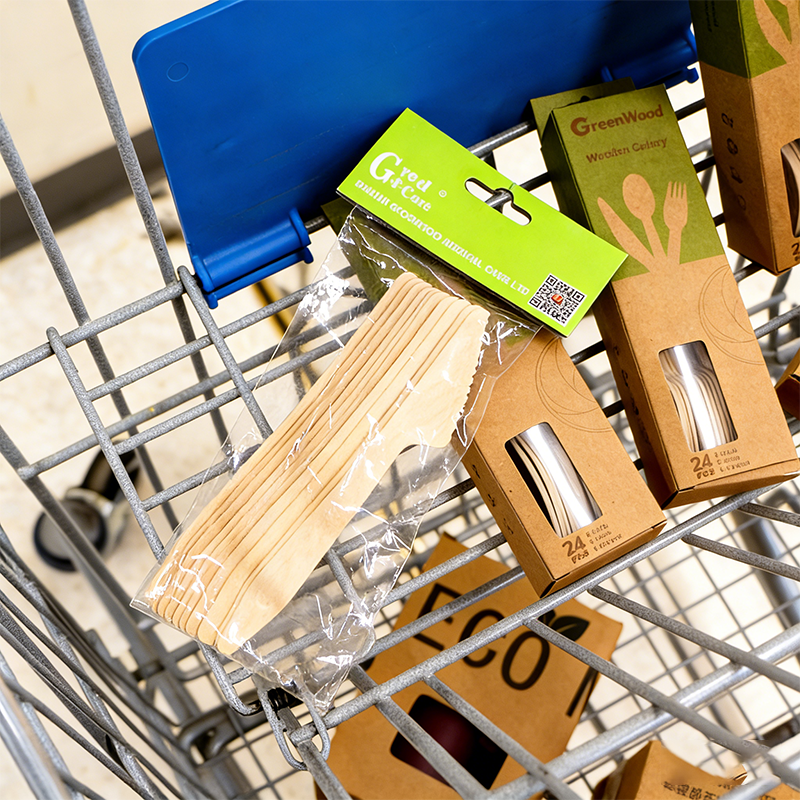
Disposable Wooden Cutlery in Supermarket Setting
A practical example illustrates how a specialized supplier addresses complex industry needs. A major supermarket chain in Germany and the USA sought to replace traditional plastic cutlery with a certified, eco-friendly alternative to boost sales among environmentally conscious consumers.
The supplier, Greenwood, provided a solution involving FSC-certified birch wooden cutlery. The products were designed to be 100% biodegradable and compostable, meeting strict EU and US food contact standards. The solution included custom-branded packaging suitable for retail shelves. The partnership, lasting over three years and involving an annual order value in the millions of dollars, successfully helped the retailer phase out plastic options and capitalize on the growing demand for sustainable products.
This case highlights the importance of a supplier's ability to provide compliant products, customization for retail, and reliable volume supply over a long-term contract.
Key Collaboration Points for Procurement Success
Establishing a successful partnership with a disposable wooden cutlery supplier requires attention to several practical steps.
- Define Industry Standards Upfront: Clearly communicate all applicable standards (FDA, LFGB, EUDR, BPI for compostability) and require the supplier to provide current, valid certificates (e.g., FDA No. R0723000394, FSC until 2028-04-02). Discuss testing protocols, including pre-shipment tests or third-party inspections by organizations like SGS.
- Conduct a Supplier Capability Assessment: Verify the supplier's production scale (e.g., 5 factories, 500 employees), export experience (95% export ratio to markets like Europe, ANZ, USA), and logistical setup (overseas warehouses in the USA, Bangladesh, Ukraine). Discuss their quality control process, specifically inquiring about measures to prevent splinters or cracks.
- Clarify Commercial and Logistics Terms: Agree on clear order parameters: MOQ (100,000 pieces), lead time (20 days), payment terms (e.g., 30% T/T in advance, 70% against B/L copy), and Incoterms (FOB Dalian or DAP). Ensure packaging design support is included in the service scope.
- Plan for Contingencies and After-Sales: Establish protocols for quality issues, including replacement policies. Confirm the supplier's after-sales support, which may include logistics coordination and packaging design assistance. For large orders, consider phased deliveries to manage inventory risk.
By focusing on these collaboration points, procurement teams can mitigate risk and build a stable, compliant supply chain for disposable wooden cutlery tailored to their specific industry vertical.
For a detailed overview of technical specifications, certifications, and company capabilities, download the official supplier brochure: Download Company Brochure (PDF)