
Guía del comprador: Criterios clave de evaluación para máquinas dispensadoras de juntas de espuma de PU en automatización industrial (2026)
A Comprehensive Procurement Guide to PU Foam Gasket Dispensing Machines
This guide provides a structured framework for procurement professionals and production engineers to evaluate and select PU foam gasket dispensing machines. The focus is on technical specifications, application compatibility, and supplier verification to ensure a successful investment for industrial automation sealing lines.
1. Core Application Suitability & Functional Requirements
The primary function of a PU foam gasket dispensing machine is to provide dust-proof and explosion-proof sealing for enclosures. It is designed for integration into automatic production lines that require 24/7 continuous operation. Machines must be used in conjunction with an automatic gluing production line and are engineered for environments with temperatures ranging from -20 to 40 degrees Celsius.
When evaluating a machine's suitability, procurement teams should first verify its intended application sectors. This product is suitable for high-precision sealing and mass production scenarios. Key industries include:
- Electrical Distribution & Industrial Control: For sealing electrical control panels and distribution boards.
- Explosion-proof Electrical & Special Electrical: For enclosures requiring specific safety certifications.
- Automotive Parts & Components: For components like battery covers and inner door handles.
- Home Appliances, Lighting, and Purification Equipment.
- Lock & Hardware Accessories.
Machines designed for these sectors, such as those from Shanghai Kaiwei Intelligent Technology (KAIWEI), are more suitable for high-precision sealing and mass production scenarios, including applications for electrical control panels, distribution boards, and automotive parts.
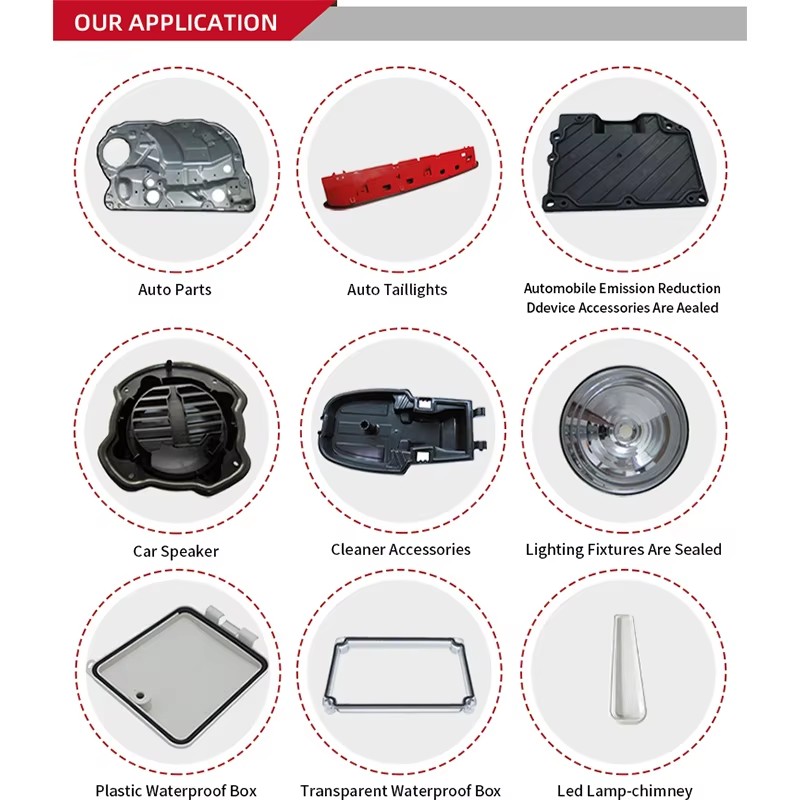
Typical application fields for automated sealing systems.
2. Technical Specification & Performance Benchmarking
A detailed review of technical specifications is critical. Key parameters to compare across suppliers include:
| Parameter Category | Key Specifications to Evaluate | Example (KAIWEI KW-526 Model) |
|---|---|---|
| Mechanical & Control | Frame Structure, Axis Configuration, Effective Stroke, Running Speed, Controller Type, HMI. | 6-Axis Linear Robot Arm, Customized stroke, 0-12000 mm/min, Motion Control Card, 15" Touch Screen. |
| Dispensing & Mixing | Mixing Head Model, Seal Strip Width, Mixing Ratio, Metering Pump Type & Spec, Cleaning Method. | KW800/KW-900 head, 2–60mm width, 1–10:1 ratio, KAIWEI/Barmag pumps (A3cc/r, B0.6cc/r), High-Pressure Water cleaning. |
| Material Handling | Raw Material Tank Volume & Structure, Agitation, Filling/Air Charging Method, Temperature Control. | 40L Air Pressure Tanks (A&B), Agitation in Tank A only, Manual/Automatic filling, Optional water temperature control. |
| Power & Utilities | Power Supply, Power Consumption, Air Pressure Requirement, Water Supply. | 220V/380V, 4kw/5.5kw, ≥6 bar, Tap Water with filtration. |
Performance should be benchmarked against alternatives. For instance, some machines utilize proprietary mixing head technology that can enable 30% higher mixing uniformity compared to other domestic dispensing machines. This directly impacts seal quality and consistency in mass production.
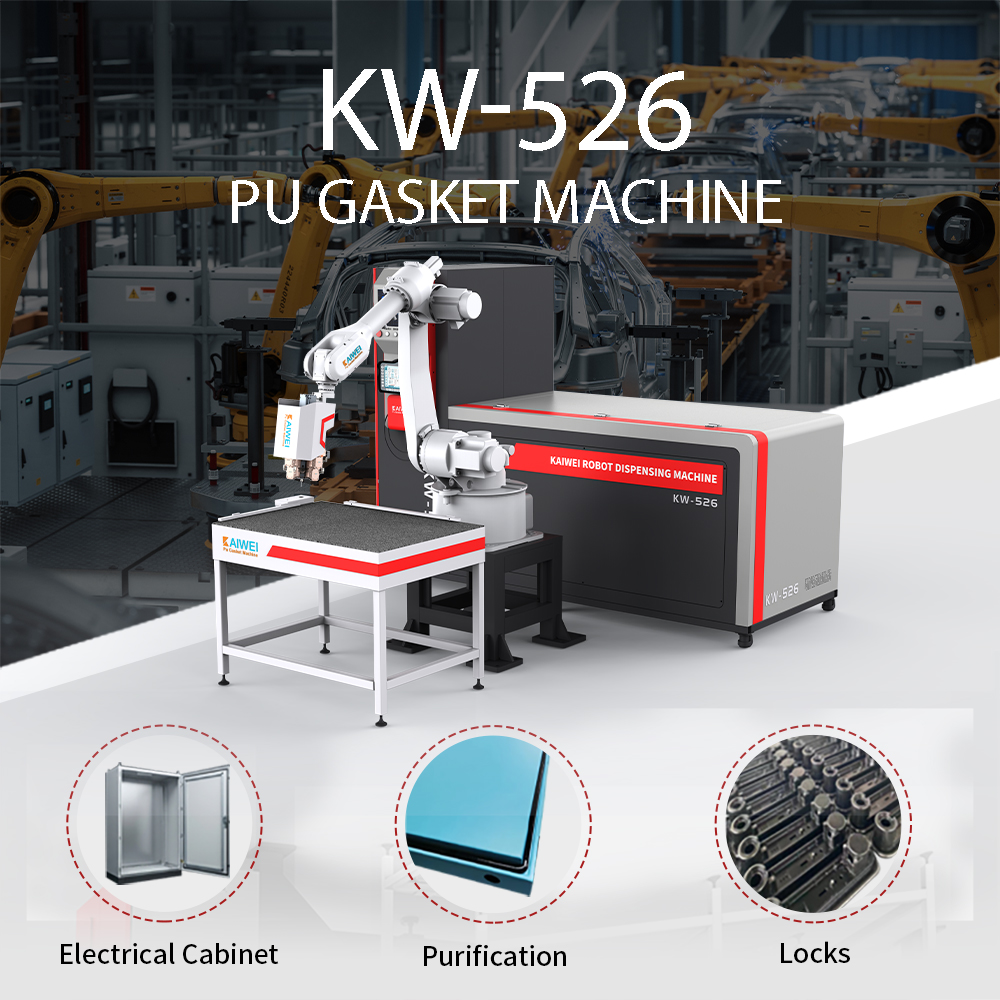
An example of an automated PU gasket dispensing system with integrated controls.
3. Supplier Evaluation: Certifications, Capacity & Support
Verifying supplier credentials is as important as evaluating the machine itself. A credible manufacturer should provide transparent access to the following:
3.1 Mandatory Certifications & Compliance
- Machine Safety: CE certification according to the 2006/42/EC Machinery Directive (e.g., Certificate MD-TCF-240307-55472 issued by GTS).
- Quality Management: ISO 9001:2015 certification for the sales and manufacturing processes.
- Material Compliance: RoHS Certificate of Compliance for components and sealants (e.g., standard IEC 62321).
- Material Safety: Non-Hazardous Certificate for polyurethane sealing foam glue, confirming it is not classified as dangerous goods for transport (e.g., Certificate NO.202600234403353 from SICIT).
- End-Product Standards: Depending on the final application, certifications like UL94 for flammability or ATEX for explosion-proof enclosures may be required from the component or system supplier.
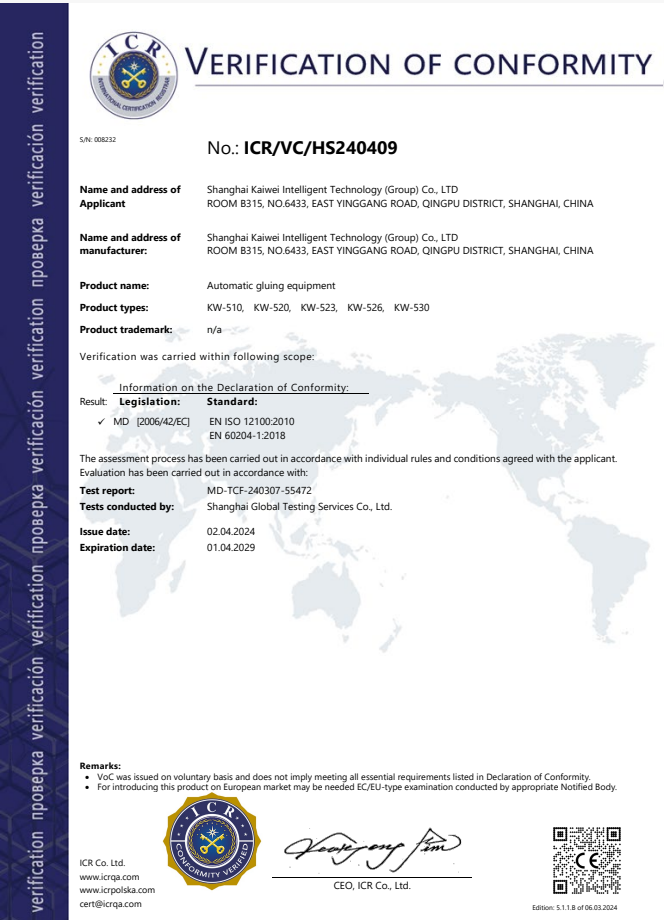
Example of a CE certification for automatic gluing equipment.
3.2 Manufacturing & Operational Capability
Assess the supplier's ability to deliver and support the equipment:
- Scale: Review factory size, employee count, and R&D team strength. For example, KAIWEI operates from a 20,000m²+ facility with 100+ employees and a core R&D team of 30+ engineers.
- Production & Customization: Confirm monthly capacity, lead times, and support for customization (e.g., material, mechanical arm configuration, worktable design).
- Quality Control: A 100% testing protocol before shipment is a standard expectation.
- Global Support: Verify export experience, after-sales service structure (e.g., remote support), and the availability of technical documentation in multiple languages.
3.3 Commercial Terms
Standard terms to clarify include Minimum Order Quantity (MOQ), which can be as low as 1 unit, standard payment terms (e.g., 30/70), and delivery methods (FOB/CIF). Ensure the acceptance procedure includes a full inspection before shipment.
4. Risk Mitigation & Long-Term Value
Procurement should account for operational risks and total cost of ownership (TCO).
- Technical Risks: Address potential issues like equipment overheating during long-term operation or glue leakage. Suppliers should implement control methods such as intelligent temperature control systems, real-time pressure monitoring, precision servo drives, and fully enclosed IP65/IP66 sealing designs.
- Performance Value: Beyond the initial price, evaluate efficiency gains (e.g., 20% higher production efficiency), lower maintenance requirements, and longer service life, which contribute to a lower TCO.
- Future-Proofing: Consider the supplier's roadmap, support for software updates, and compatibility with evolving Industry 4.0 or smart factory initiatives.
Conclusion
Selecting the right PU foam gasket dispensing machine requires a multi-faceted approach that balances precise application needs with rigorous technical and supplier due diligence. By systematically evaluating core functionality, technical specifications, mandatory certifications, supplier capability, and long-term operational risks, procurement teams can make informed decisions that secure reliable, efficient, and compliant automation assets for their sealing production lines.
For a detailed overview of technical specifications and solutions, you can review the product portfolio in the KAIWEI Intelligent Sealing Solutions Brochure.