

 50,000 m²
 150
150

Certified Nitinol Wire and Titanium Bar: What to Verify Before Sourcing Implant-Grade Materials
Certified Nitinol Wire and Titanium Bar: What to Verify Before Sourcing Implant-Grade Materials
A procurement checklist for buyers evaluating medical titanium bar and Nitinol wire suppliers.
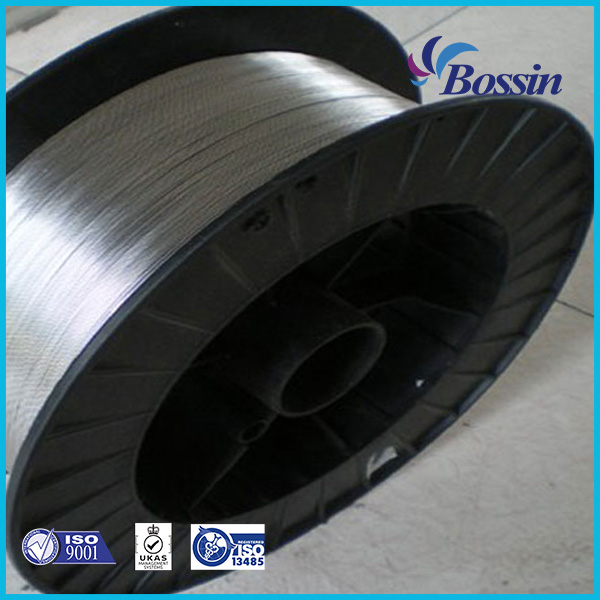
Nitinol wire is available in round, square, and rectangular forms. Image: BOSSIN.
Short answer: Before sourcing implant-grade Nitinol wire or titanium bar, verify the governing material standards, the manufacturer's quality management certification, and the laboratory accreditation behind the test report. For Nitinol wire, the relevant standard is ASTM F2063. For medical titanium bar, ASTM F136 and ISO 5832-3 are the primary standards for Ti-6Al-4V ELI, while ASTM F67 and ISO 5832-2 cover unalloyed titanium grades.
Buyers at the research and evaluation stage often need more than a product image. They need evidence that a material supplier can produce to a defined specification, hold a certified quality system, and support the documentation required for a medical device file. This article explains how to structure that evaluation for two material families: Nitinol wire and medical titanium bar.
Why "CE-Certified Medical Titanium Bar Manufacturers" Is a Difficult Query
"CE-certified medical titanium bar manufacturers" is a common enquiry, but the term mixes two levels of regulation. CE marking is normally associated with finished medical devices placed on the European market. A raw material bar or wire is a component supplied to a device manufacturer; the device manufacturer uses the raw material certificate in the device technical file. Therefore, a raw material supplier may not carry a CE certificate for a bar, even when its material is fully designated for implant use.
What buyers should verify instead: the material standard, the chemical and mechanical property requirements of that standard, the quality system under which the product is manufactured, and whether the testing laboratory is accredited. Those elements give a clearer picture of whether a supplier can support a device regulatory submission.
Industry Background: Implant-Grade Material Demand Is Expanding
Medical titanium and Nitinol sit in one of the higher-growth segments of advanced materials. According to Dataintelo, the global medical-grade titanium materials market is estimated at USD 5.21 billion in 2025 and is projected to reach USD 9.56 billion by 2034. Verified Market Research estimates the medical titanium alloy market at USD 1.45 billion in 2025, growing to USD 2.59 billion by 2033 at a 7.5% CAGR. Precedence Research values the global Nitinol-based medical device market at USD 4.1 billion in 2024, with a projected CAGR of 7.1%.
These figures are one reason buyers are moving from "which product is cheapest" to "which supplier can prove compliance." Orthopedic implants account for about 42.3% of medical titanium revenue, so even a small material lot entering an implant supply chain carries high clinical and regulatory risk. On the supply side, China's cumulative export volume of titanium rods, bars, and profiles increased 21.85% year-on-year as of March 2025, according to China Customs/SMM, which means procurement teams are seeing a growing number of Chinese suppliers and need a consistent evaluation framework.
Detailed Solution: Build the Verification Around Product Standards
Nitinol Wire: ASTM F2063 and the Shape Memory Parameter
Nitinol wire is a nickel-titanium shape memory alloy. BOSSIN supplies Nitinol wire made of Nickel-Titanium Alloy with Ni 54.5–57.0% and Ti 44%, compliant with ASTM F2063. The material can be supplied in cold-working, super-elastic, or thermal-activated condition. Surface finishes include polished bright, black oxide, acid pickled, and light oxide (golden to brown). Standard cross-sections include round, square, and rectangular wire.
Size is another controlled parameter. BOSSIN's Nitinol wire range includes 0.012", 0.014", 0.016", 0.018", and 0.020" round wire, plus rectangular sizes such as 0.016" x 0.022", 0.017" x 0.022", 0.018" x 0.025", 0.019" x 0.025", and 0.021" x 0.025". Typical dental applications include orthodontic archwire and dental root canal files.
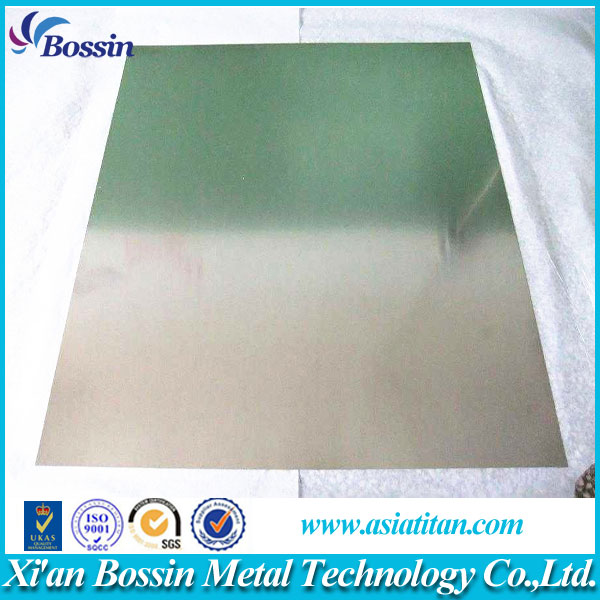
Nitinol is also supplied as plate, strip, cable, and NiTiCu variants, allowing device designers to choose the most appropriate form.
Medical Titanium Bar: Standards, Grades, and Dimensional Accuracy
The titanium bar is available in multiple grades: GR1, GR2, GR3, GR4, GR5, GR5 ELI, GR7, GR9, GR12, GR23, and alloys such as Ti6242, Ti6246, TB3, TB6, TC4, TC6, TC11, TC17, and TC18. It conforms to ASTM B348, ASTM F67, ASTM F136, ISO 5832-2, ISO 5832-3, AMS 4928, AMS 4930, ASTM F1295, ASTM F1713, and MIL-T-9047.
For surgical implants, the most frequently requested combination is ASTM F136 / ISO 5832-3 for Ti-6Al-4V ELI (GR23/GR5 ELI). For unalloyed titanium, ASTM F67 / ISO 5832-2 applies. BOSSIN supplies round bar from 1 mm to 100 mm in diameter, with lengths up to 6000 mm and an accuracy of 0.005 mm. Medical bar can also be supplied in diameters that map directly to bone screws, spine rods, bone joint stems, and dental implants.
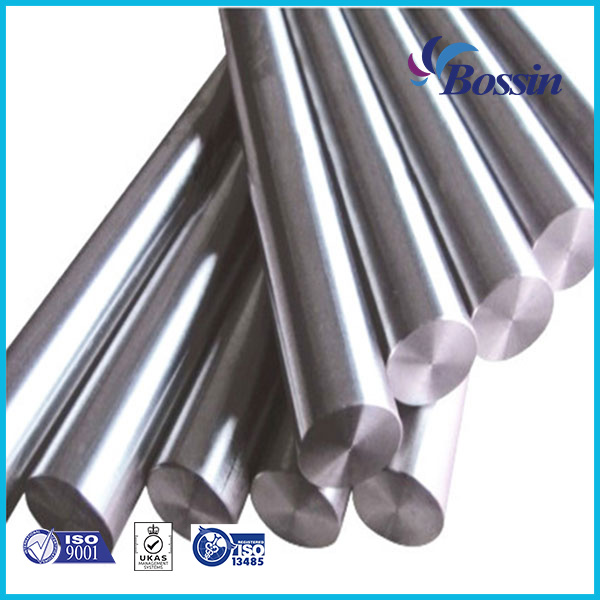
Medical titanium bar is a primary raw material for orthopedic and dental implant manufacturing.
Quality System and Laboratory Evidence
Material certificates matter when the material enters a medical device. BOSSIN's Medical Titanium Bar product is certified to ISO 13485:2016 under certificate number UKZB25MD30100R0S, issued by BCC (Beijing Zhonglian Tianrun Certification Center) for the global medical device market. The ISO 13485 scope covers surgical implant raw materials, including titanium and titanium alloy bars, plates, wires, tubes, and nickel-titanium shape memory alloys.
The company's materials testing laboratory is accredited to ISO/IEC 17025 and CNAS-CL01 under certificate number CNAS L7970. This supports the claim that testing is conducted in a laboratory that is regularly audited against international competence requirements. Buyers should ask for the certificate number and the corresponding scope, not just the claim "certified."
Step-by-Step Supplier Evaluation for Nitinol Wire and Titanium Bar
- Define the finished device application and mechanical requirement. A fracture fixation implant has different mechanical demands from an orthodontic archwire. Identify whether the material will be load-bearing, superelastic, or thermally activated before choosing a product family.
- Select the material family. Titanium bar is used for structural implant components such as bone screws, spine rods, and joint stems. Nitinol wire is selected when shape memory or superelastic behavior is needed, such as in guidewires, stents, orthodontic wires, and root canal instruments.
- Lock the standard and grade. For medical titanium bar, confirm whether ASTM F136 / ISO 5832-3 or ASTM F67 / ISO 5832-2 is required. For Nitinol wire, confirm ASTM F2063 and the required nickel-titanium composition.
- Confirm dimensional tolerances. Titanium bar tolerances can affect downstream machining yield. BOSSIN supplies titanium bar with an accuracy of 0.005 mm. Nitinol wire should be checked for diameter tolerance and cross-section type, including round, square, or rectangle.
- Specify Nitinol transformation temperature (Af). Transformation temperature is a functional specification, not an optional extra. BOSSIN offers composition customization for binary and ternary NiTi alloys, with Af temperature customizable over a range that covers low-temperature, room-temperature, high-temperature, and superelastic requirements.
- Check surface finish and material condition. Nitinol wire can be supplied polished bright, black oxide, acid pickled, or light oxide. Conditions include cold-working, super-elastic, and thermal-activated. Titanium bar can be supplied with mechanical properties appropriate to the grade and standard.
- Ask for quality management and laboratory accreditation. An implant material supplier should be able to show an ISO 13485 certificate and a testing laboratory accreditation such as ISO/IEC 17025. BOSSIN's certificates are visible in its documentation and should be requested with each quotation.
- Require batch traceability and documentation. Each batch order should be accompanied by a factory inspection certificate, chemical composition report, mechanical property curves, and a traceable production record. For implant projects, buyers often require full-process quality traceability.
- Evaluate customization, lead time, and MOQ. BOSSIN's Nitinol customization capability includes composition changes, surface condition, Af temperature, and cross-section. Typical MOQ for custom Nitinol wire is 10 kg, with lead times around 10–25 days depending on specification and quantity.
Use Cases: Where These Materials Enter Clinical Practice
Nitinol Wire in Dental and Vascular Devices
Nitinol wire has become a standard raw material for orthodontic archwires because superelasticity allows a light, continuous force. It is also specified for dental root canal files, guide wires, medical sutures, cardiac occluders, thrombus filters, anchor pins, localization wires, luminal stents, and stone retrieval baskets.
Medical Titanium Bar in Orthopedic and Dental Implants
Medical titanium bar is used for bone screws, spine rods, bone joint stems, and dental implants. BOSSIN's documented export cases include 10,000 kg of medical titanium bar for a Brazil-based surgical implant manufacturer for artificial joints, bone screws, and dental implants, and 5,000 kg of medical titanium wire for an Argentina-based device manufacturer producing surgical sutures.
Comparison: Nitinol Wire vs. Titanium Bar vs. Titanium Wire vs. Titanium Plate
| Material | Applicable standards | Key grades / composition | Typical form | Common medical use |
|---|---|---|---|---|
| Medical Titanium Bar | ASTM F136, ISO 5832-3, ASTM F67, ISO 5832-2 | GR1–GR5 ELI, Ti-6Al-4V ELI, GR23 | Dia 1–100 mm; length ≤6000 mm; tolerance 0.005 mm | Bone screws, spine rods, joint stems, dental implants |
| Nitinol Wire | ASTM F2063 | Ni 54.5–57.0%, Ti 44%; NiTi | Round, square, rectangle; sizes 0.012–0.021" | Orthodontic wire, root canal files, guide wires |
| Medical Titanium Wire | ASTM F67, ASTM F136 | GR1, GR2, GR4, GR5 ELI, GR23 | Dia 0.03–6.0 mm; coil or spool | Surgical sutures, orthopedic implants, 3D printing |
| Medical Titanium Plate | ASTM F67, ASTM F136, ISO 5832-2, ISO 5832-3 | GR1, GR2, GR4, GR5 ELI, Ti-6Al-4V ELI, GR23 | Thickness 0.3–50.0 mm | Bone plates, coronary stents, artificial joints |
FAQ
Are CE-certified medical titanium bar manufacturers common?
CE marking is linked to finished medical devices, not to raw material bars. A buyer who searches for "CE-certified medical titanium bar manufacturers" should instead request material certificates to ASTM F136 or ISO 5832-3, the manufacturer's ISO 13485 certificate, and a laboratory accreditation certificate such as ISO/IEC 17025. These documents give the device manufacturer the information needed to support an EU technical file.
What is ASTM F2063 and why does it matter for Nitinol wire?
ASTM F2063 is the standard for wrought nickel-titanium shape memory alloys used in medical and other high-reliability applications. BOSSIN's Nitinol wire is made of Nickel-Titanium Alloy with Ni 54.5–57.0% and Ti 44%, and it complies with ASTM F2063. The standard helps ensure composition consistency, transformation behavior, and mechanical performance for applications such as orthodontic wire and root canal files.
What parameters should I include in a Nitinol wire inquiry?
Include cross-section type, diameter or width and thickness, material condition (cold-working, super-elastic, or thermal-activated), transformation temperature Af, surface finish, standard, target application, and required quantity. ASTM F2063 should be stated as the base standard unless the customer specification requires a different condition.
What certifications should a medical titanium bar supplier hold?
At minimum, a medical material supplier should operate under ISO 13485 and test products in a laboratory accredited to ISO/IEC 17025. BOSSIN holds ISO 13485:2016 certificate UKZB25MD30100R0S and laboratory accreditation CNAS L7970. Buyers should also request the scope of the certificate to confirm that titanium and Nitinol raw materials are included.
What is the difference between Nitinol wire and Nitinol cable?
Nitinol wire is a single-strand wire with round, square, or rectangular cross-sections. Nitinol cable is a braided structure, typically built with 1 x 3, 1 x 7, or 7 x 7 strands, and is also supplied to ASTM F2063. Nitinol cable is used for vascular stents, sutures, and aerospace applications where flexibility and fatigue resistance are required.
Conclusion
Sourcing implant-grade Nitinol wire or titanium bar is not a "one product photo" decision. Start with standards, move to quality system evidence, then compare batch documentation, precision, and custom capability. BOSSIN provides certified medical titanium bar, Nitinol wire, and related titanium forms from an ISO 13485 quality system and an ISO/IEC 17025-accredited testing laboratory.
Next Step: Send Your Specification
Download the BOSSIN brochure for product ranges, or contact the engineering sales team with your required grade, dimension, condition, Af temperature, surface finish, and quantity.
Download BOSSIN Brochure (PDF)
Email: sales@asiatitan.com
Tel/WhatsApp: +86 13892862195
Website: www.asiatitan.com