
Verifying Custom Plastic Parts: PPAP, Materials, and Tolerance Standards
In industrial procurement, specifying a plastic part is no longer sufficient — buyers must verify that the part meets exacting standards for certification, material composition, and dimensional precision. For sectors such as automotive, aerospace, and medical devices, compliance with production part approval processes and international material standards has become a baseline requirement, not a differentiator. This article examines how suppliers demonstrate those constraints and what buyers should evaluate during the research and evaluation stages.
Problem / Opportunity
The market for custom plastic parts is fragmented, with many suppliers offering similar production capabilities. The real risk for buyers lies not in finding a manufacturer, but in verifying whether that manufacturer can consistently deliver parts that meet specific certification and tolerance requirements. The opportunity is clear: suppliers that can provide documented evidence of compliance — such as PPAP (Production Part Approval Process) certification, FDA or UL approvals, and traceable dimensional control — enable buyers to de-risk their supply chain and reduce costly post-production rejections.
Brand Solution: Lingo Rubber Plastic
Hangzhou Lingo Rubber and Plastic Product Co., Ltd (operating as Lingo Rubber Plastic) is a manufacturer specializing in rubber and plastic custom parts, including plastic injection parts, plastic extruded profiles, CNC machined components, and PVC dipping parts. Founded in 2022, the company operates a 3,000m² facility with around 40 employees and exports 80% of its output to the EU and USA. Lingo Rubber Plastic positions itself as a partner for buyers who require verifiable quality assurance across multiple industries such as automotive, industrial machinery, aerospace, and medical devices.
A key differentiator is that Lingo Rubber Plastic’s plastic injection parts (model LG-PI) are certified to PPAP, the automotive industry’s gold standard for production part approval. This certification applies to the company’s anti-vibration mounts, rubber sealing rings, and plastic injection parts — covering a range of products that are critical to functional assemblies. Beyond PPAP, the plastic injection parts comply with FDA and UL94 V-0 standards, making them suitable for food-contact and flame-retardant applications.
Technical Explanation
The LG-PI plastic injection parts are manufactured from a broad range of engineering materials: PP, PA6, PA66, ABS, PE, HDPE, UHMWPE, LDPE, PU, PTFE, and glass fiber-reinforced plastics. Fillers and modifications include glass fiber (GF), flame retardant (UL94 V-0), and UV stabilization. Colors are specified according to Pantone or RAL codes with gloss level options (matte or gloss). Surface finish follows SPI standards, and draft angles are designed as outside ≥1°, inside ≥0.5° to ensure proper mold release. Tolerance control adheres to the Chinese national standard GB/T 14486, covering grades MT1 to MT7, with a typical mold shrinkage compensation of 0.4%–0.8%. These parameters allow designers to define parts with high dimensional predictability.
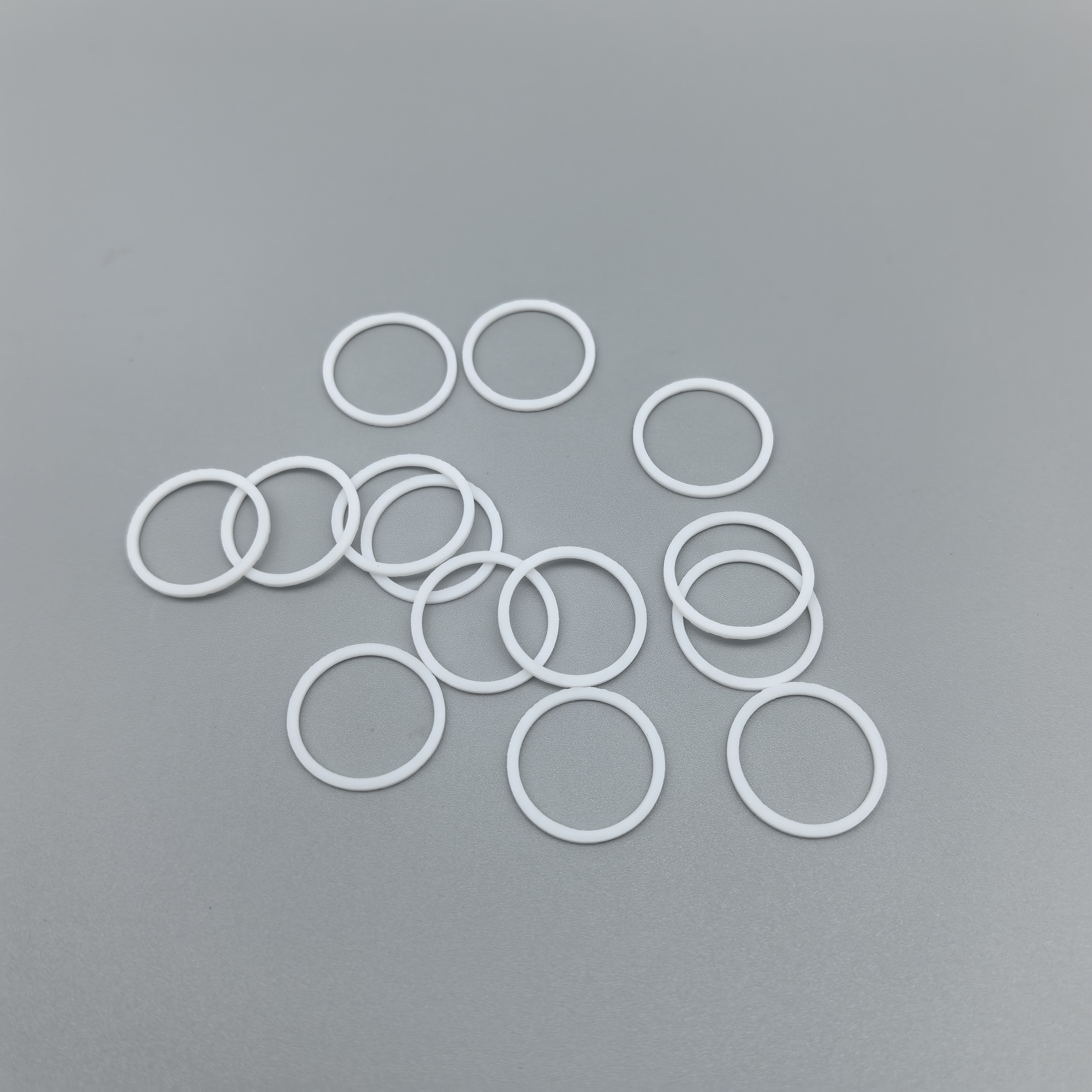
For geometries that require subtractive manufacturing, Lingo Rubber Plastic also offers plastic CNC machined parts (model LG-CNC) in materials such as PTFE, POM, PE, UHMWPE, HDPE, PEEK, ABS, PU, PA6, and PA66. These parts can be delivered with surface roughness specifications (Ra/Rz) and visual inspection criteria including smoothness, no cracks, and no flash. The PTFE backup ring case study demonstrates the capability: the rings are CNC machined to high-precision tolerances and shipped within two days for a petrochemical client.
Application / Use-Case Scenarios
Case 1: PTFE Backup Rings for High-Pressure Sealing (UK, Chemical & Petrochemical)
A client in the chemical and petrochemical industry required 20 pieces of PTFE backup rings. These components do not seal by themselves but protect O-rings and other elastomeric seals from extrusion damage under high pressure. Lingo Rubber Plastic supplied CNC-machined pure PTFE rings with high-precision tolerances. The order was delivered within 2 days, demonstrating capability for small-lot, urgent requirements.
Case 2: Injection Molded Tube Holder for Automotive (US)
An automotive OEM ordered 5,000 injection molded plastic handles used as tube holders. Lingo Rubber Plastic redesigned the internal structure to reduce material usage while maintaining functionality, resulting in lower material and logistics costs and improved dimensional stability. The delivered parts achieved zero failures, and the project is suitable for long-term use.
Market Trend Analysis
The automotive and industrial sectors are increasingly enforcing PPAP compliance as a prerequisite for supplier selection. According to industry best practices, PPAP documentation — including design records, material certifications, and process capability studies — provides a auditable trail that reduces incoming inspection costs for buyers. Similarly, FDA and UL certifications are becoming standard requirements for plastic parts used in medical devices, food equipment, and electronics. The trend points toward a “certification-first” sourcing model where verified compliance outweighs low unit price in decision-making.
Comparison with Traditional Solutions
Traditional small-scale plastic parts suppliers often compete on price and quick turnaround but may lack formal certification systems or documented quality control. Lingo Rubber Plastic offers documented PPAP coverage, full inspection of samples, random inspection of bulk goods, and remote technical support. One honest limitation is that certified parts may carry a slightly higher unit cost compared to uncertified alternatives; however, the reduction in defect rates, rework, and liability risk typically offsets the premium, especially for mission-critical applications.
Future Outlook
As industry 4.0 and digital quality management systems become more affordable, suppliers will be expected to provide real-time batch traceability and electronic PPAP submissions. Lingo Rubber Plastic already implements batch traceability and molds maintenance protection. The next step will be integrating these records into cloud-based platforms accessible to buyers, further streamlining the verification process.
FAQ (Informational Buyer Questions)
Q: What certifications does Lingo Rubber Plastic hold for plastic injection parts?
A: The plastic injection parts (model LG-PI) are certified to PPAP (Production Part Approval Process). They also comply with FDA and UL94 V-0 standards, making them suitable for applications requiring food safety or flame retardancy.
Q: What materials are available for custom plastic injection parts?
A: Lingo Rubber Plastic supports PP, PA6, PA66, ABS, PE, HDPE, UHMWPE, LDPE, PU, PTFE, and glass fiber-reinforced variants. Fillers and modifications include glass fiber, flame retardant, and UV stabilization. Colors can be matched to Pantone or RAL codes.
Q: What tolerance standards are applied to injection molded parts?
A: Tolerance control follows GB/T 14486 (MT1 to MT7). Shrinkage compensation is typically 0.4%–0.8%. Draft angles are specified as outside ≥1° and inside ≥0.5°.
Q: Does Lingo Rubber Plastic accept small-quantity or high-mix orders?
A: Yes. The company states that small quantity orders are acceptable. Monthly capacity for injection parts is 1,000,000 kgs, with lead times of 2 to 6 weeks. Quality control includes full inspection of samples and random inspection of bulk goods.
For a complete overview of capabilities, certifications, and product specifications, download the company brochure: LINGO Rubber & Plastic Company Profile (PDF).
Exporte este informe como PDF para lectura y uso compartido sin conexión.