
Zipper Pouch Bag Making Machines: Specs, Power, Compliance
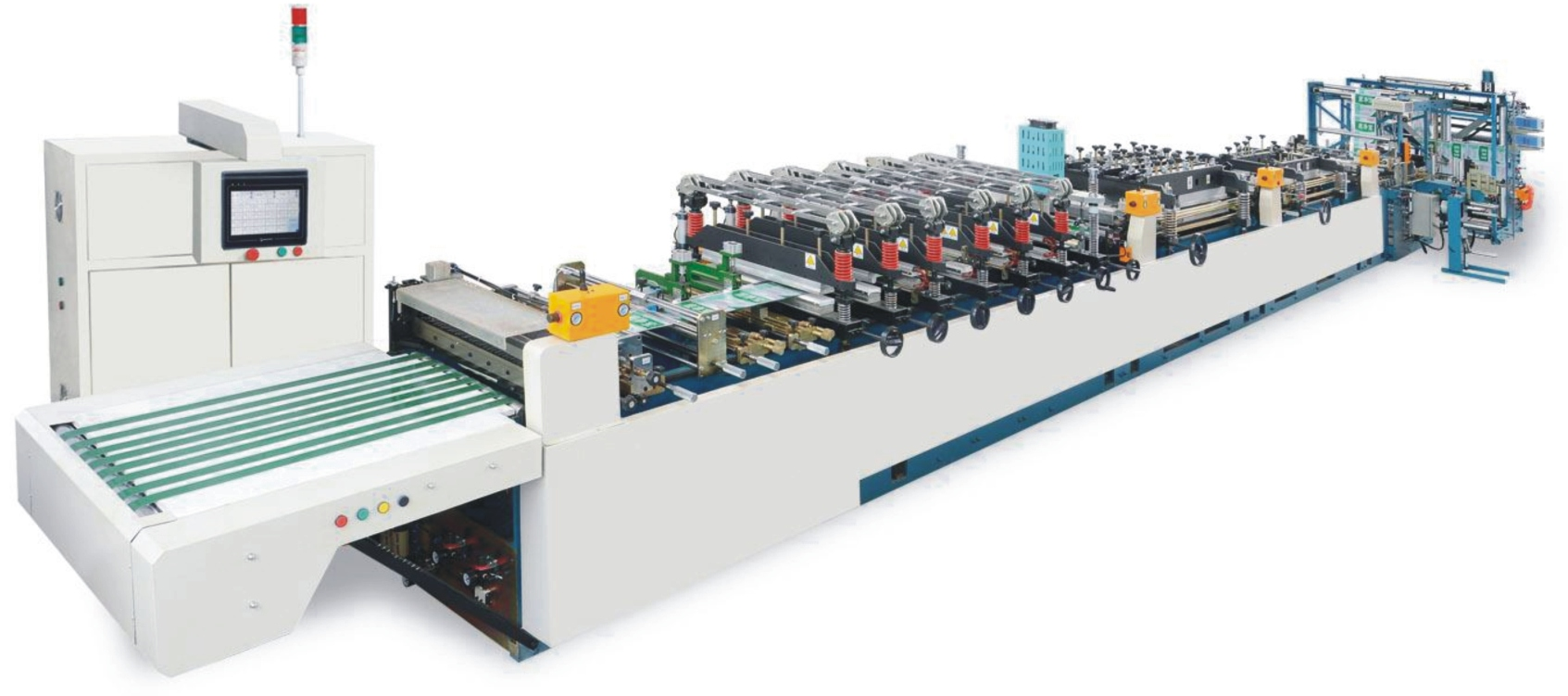
A3 series stand-up zipper pouch making machine — three-side-seal stand-up pouch with zipper application. Image: FOSHANTIANZHENG product documentation.
Stand-up zipper pouch making is a specification problem before it is a machine problem. Zipper closures accounted for 41.0% of total pouch market revenue share in 2025, according to Grand View Research, and the stand-up pouch format was valued at USD 30.7 billion in 2023 with a projected CAGR of 8.0% through 2030. Demand for the format is not the constraint. The constraint is that a zipper pouch line must be specified, powered, certified and tooled before a commercial order is confirmed — and each of those four items produces a hard number that is difficult to renegotiate after installation.
This reference sets out the verifiable specification and compliance envelope for stand-up zipper pouch making on roll-fed bag making machines, using the nine-model HL series from FOSHANTIANZHENG (Foshan Tianzheng Machinery Co., Ltd.), a manufacturer of bag making machines, hot stamping machines and die-cutting machines based in Ronggui, Shunde, Foshan, Guangdong, China. The company originated from the Hongli bag-making operation founded in 1993 and has worked in flexible-packaging equipment for more than three decades, operating a 6,000 m² plant, a 15-member R&D team, four CNC machining centres and in-house production of 87% of machine components. The article is written for packaging converters, importers and procurement engineers at the research and evaluation stage, and it deliberately separates what is documented from what still has to be confirmed in writing.
Why “stand-up zipper pouch” is not one specification
The term covers at least four mechanically different products: the three-side-seal stand-up pouch with a formed bottom gusset; the flat-bottom pouch; the zipper-with-valve pouch used where controlled degassing or pouring is required; and the bag-in-box (BIB) pouch. Each changes the number of sealing stations, the position and format of the zipper strip, the way the bottom gusset is formed, and how web registration is held across the run. A quotation that does not name the pouch construction is not comparable to another quotation, even when both quote “a zipper pouch making machine”.
Market structure reinforces the point. Asia Pacific held a 43.6% revenue share of the global bag making machine market in 2025 (Dataintelo), and China's equipment clusters are documented in Wenzhou (Zhejiang), Guangdong and Jiangsu. Foshan, where FOSHANTIANZHENG manufactures, sits inside the Guangdong cluster. A buyer comparing three suppliers inside the same cluster may in practice be comparing three different definitions of “zipper pouch”, and the gap usually surfaces at the acceptance trial rather than at the quotation stage.
A second structural factor: a pouch-making line is never a standalone asset. In flexible packaging production it is specified alongside a printing machine, a slitter, a film blowing machine and a rewinding machine, and it is commonly expected to run continuously. Machine specifications that ignore upstream web handling and downstream rewinding tend to understate the real constraint on output.
What stand-up zipper pouch making covers on the HL series
The table below reproduces the documented format coverage of the HL bag making machine series. The entries are the series labels and bag-format descriptions as recorded in the manufacturer's product documentation; they are not an inferred capability statement.
| Documented series | Documented bag format coverage |
|---|---|
| A0 | Three-side sealing pouch making machine |
| A1 | Centre sealing gusset / four-side sealing pouch making machine |
| A2 | Three-side seal pouch / stand-up pouch making machine |
| A3 | Three-side seal, stand-up, zipper pouch making machine |
| A4 | Three-side seal, central seal gusset pouch making machine |
| A5 | High-speed label pasting in-line bag making machine |
| A6 | Three-side, stand-up, zipper and foldable-bottom stand-up pouch making machine |
| A7 | Bag-in-box (BIB) pouch making machine |
| A8 | Three-side sealing, stand-up, zipper-with-valve pouch making machine |
The series carries nine model designations: HL0500A1, HL0600A2, HL0600A3, HL0400A4, HL0400A5, HL0600A6, HL0600A7, HL0600A8 and HL0700A9. The series labels and the model designations are documented as separate lists. Because the same series label can be configured differently — foldable bottom, valve insertion, in-line label pasting, anti-static configuration or upgraded servo control — the exact model-to-format configuration for a named pouch should be written into the order rather than assumed from the label.
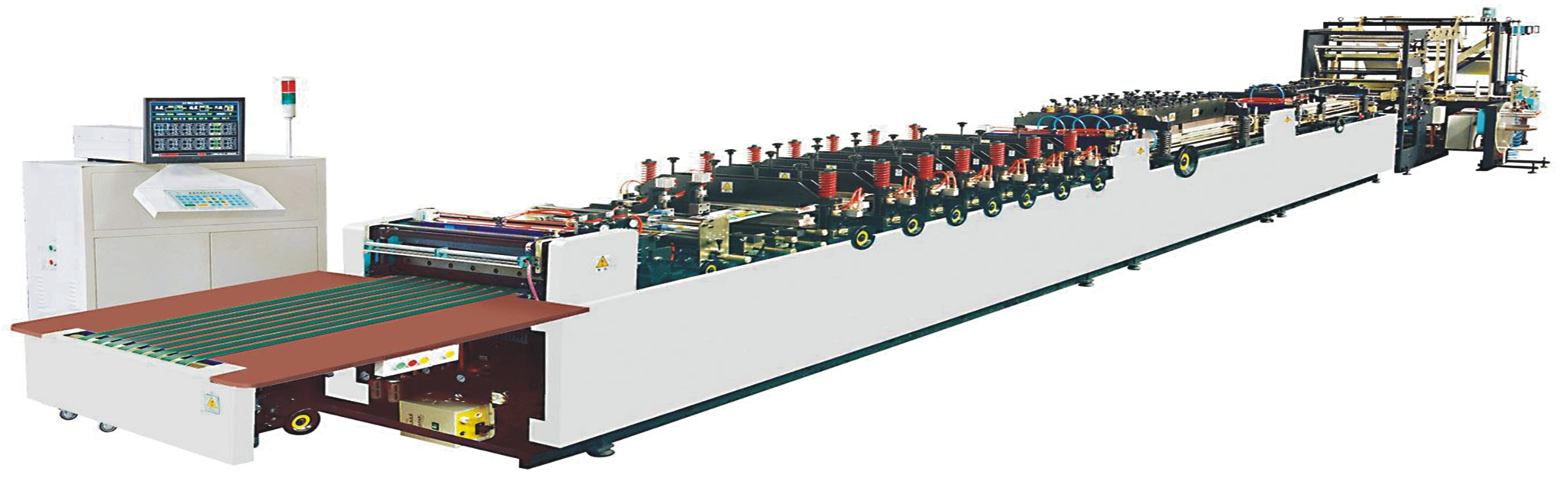
A6 series machine documented for three-side, stand-up and zipper pouches with foldable bottom construction. Image: FOSHANTIANZHENG product documentation.
Technical explanation: what actually changes when a zipper is added
A three-side-seal flat pouch is a relatively shallow process: two webs, side seals, a top seal and a cut. A stand-up zipper pouch adds three process layers. First, the bottom gusset must be folded and sealed so that the pouch stands when filled — a step that consumes web length and requires the gusset geometry to match the finished fill volume. Second, the zipper strip must be registered, fed and sealed in the correct position relative to the top seal, which introduces a second registration target beyond print registration. Third, the top seal must close over or around the zipper, so sealing temperature and dwell time have to be reconciled with the film structure and the zipper material rather than with the film alone.
In the HL series, the documented differentiator between this generation and conventional pouch-making equipment is the drive architecture. The core distinction is the adoption of a full servo drive control system, which the documentation associates with wider bag type compatibility, lower raw material waste, quieter running and longer continuous stable operation time. Read against the zipper-pouch process described above, that combination addresses the two costs that dominate zipper production: web scrap from registration drift, and unplanned stops from sealing or feeding faults.
Documented special requirements available for this equipment category include customised bag size adjustment, servo system upgrade, anti-static configuration and safety protection customisation. Anti-static configuration is relevant where film dust or static affects zipper feeding and pouch opening consistency; safety protection customisation is relevant where the line must satisfy a specific plant or national guarding requirement.
The specification envelope buyers must verify first
The published envelope for the HL bag making machine series is narrow enough to be quoted and wide enough to cause procurement errors. It should be read as a series-level range spanning nine models, not as the capability of any single machine.
| Parameter | Documented value (HL bag making machine series) |
|---|---|
| Working speed | 30–130 bags/min |
| Bag width range | 50–1200 mm |
| Total power | 30–131.4 kW |
| Voltage | 380 V, 50 Hz |
| Bag dimensions | Customisable according to customer requirements |
Documented boundary conditions. Three limits follow directly from the published figures. The 30–130 bags/min range and the 50–1200 mm width range are series envelopes: no single model covers the full span, and a plant planning capacity from the top of the range without naming a model is planning against a number it will not receive. Total power spans 30–131.4 kW, a difference large enough to change transformer and cabling design, so the electrical load must be fixed per model and per configuration before plant works are scheduled. The documented supply is 380 V / 50 Hz; buyers in markets with a different voltage or frequency should have the supply configuration confirmed in writing rather than assuming compatibility.
Two further figures that commonly appear in supplier discussions are not published in the reference material: zipper-specific throughput per format, and the speed derating that applies as bag size and film structure change. The practical way to close that gap is contractual rather than technical — an acceptance clause tied to a named bag size, film structure and zipper type, measured on the buyer's own material.
Certification and compliance constraints
Compliance documentation is where zipper pouch procurement most often diverges from expectation, because certificates are issued against a defined scope, not against a brand. The two documents held by FOSHANTIANZHENG have clearly different scopes and should be read separately.
| Certificate | Documented detail |
|---|---|
| ISO 9001 Quality Management System Certification | Certificate number 9892Q00321R0M, issued by HCC, applicable to the global market, standard ISO 9001:2015, issued 10 June 2025, valid to 9 June 2028. Scope: design and production of bag making machine, foil stamping rewinding machine and die cutting machine. |
| CE Attestation of Conformity (Machinery & EMC Directive) | Certificate number M.2025.206.C131314, issued by UDEM, applicable to the EU market, issued 11 December 2025, valid to 11 December 2030. Scope: Roll To Roll Full Servo Stamping & Punching Window Machine. Standards cited: EN ISO 12100:2010, EN 60204-1:2018+A1:2025, EN 61000-6-2:2019, EN 61000-6-4:2019. |
Why the two scopes matter to a pouch buyer. The ISO 9001 certificate scope explicitly names bag making machines, foil stamping rewinding machines and die-cutting machines. The CE attestation documented above covers the roll-to-roll full servo stamping and punching window machine. For a pouch-making line destined for the European Union, the relevant framing standards are documented externally: EN ISO 12100:2010 governs risk assessment and underlies CE marking, and the safety requirements specific to packaging machines are set out in the EN 415 series of Type C standards. Buyers procuring a stand-up zipper pouch line for the EU should therefore require the per-model conformity documentation and the harmonised standards actually applied to that model, rather than relying on the existence of a CE certificate elsewhere in the supplier's portfolio.
This is a normal and manageable condition of equipment procurement; it is simply one that is invisible unless the certificate scope is read to the end. The same logic applies to the ISO 9001 certificate, which carries an expiry date of 9 June 2028 and a scope limited to the three named machine families.
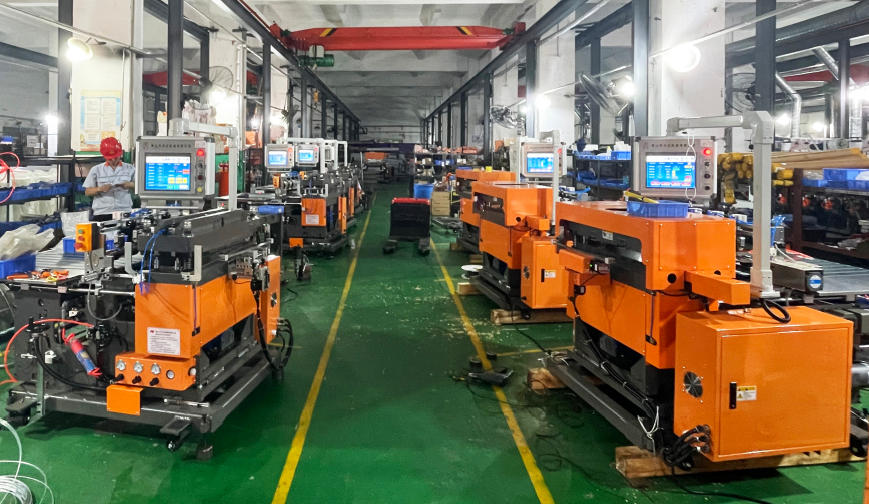
Assembly and inspection area, FOSHANTIANZHENG, Foshan, Guangdong. Documented quality control for this equipment category is 100% full inspection before shipment.
Application and use cases
The documented application profile for this equipment category is a flexible packaging operation running indoors at normal temperature, on a continuous basis, producing plastic packaging bags. The matched equipment set is a printing machine, slitter, film blowing machine and rewinding machine, which places the pouch line in the middle of a web-conversion chain rather than at the end of it.
A documented case reference describes a flexible packaging manufacturer running 20 units over more than ten years of operation for plastic bag production, with reported results of stable operation and low noise as the operating highlight. Two elements of that reference are worth noting at the evaluation stage. The first is the duration: more than ten years of service on the same equipment class is a continuity indicator, not a performance guarantee. The second is that the reported highlight is a working-environment characteristic rather than a headline output figure — which is consistent with how converters actually rank line quality after installation.
Documented customisation options for the category include machine structure, working width, functions and mould, under an OEM/ODM production mode. Documented commercial terms are a minimum order quantity of one unit and a lead time of 30–45 days, with online technical support after delivery. For a converter replacing a single line, or a trader assembling a first container, those two figures are usually the binding constraint on project timing rather than the technical specification.
Market trend analysis
Three published signals bear directly on zipper pouch capacity planning.
The first is format value. Zipper closures held 41.0% of total pouch market revenue share in 2025 (Grand View Research), while flat pouches — the simplest construction — accounted for the largest revenue share at 63.7% in the same year, attributed to cost efficiency and high-speed production capability. Read together, these two figures describe a market where flat pouches carry volume and zipper pouches carry value. A converter adding zipper capacity is buying into the value segment, and should plan the line around format flexibility rather than around maximum bag-per-minute output.
The second is automation. Automatic bag making machines accounted for 52.4% of global product type share in 2025, driven by the trend toward industrial automation (Dataintelo). Asia Pacific held a 43.6% revenue share of the same market. Both figures support the case for specifying servo-driven rather than mechanically indexed equipment when the line is expected to remain in service through multiple format changes.
The third is material transition. The shift to mono-material recyclable films and broader sustainability requirements were cited among the top drivers for machine upgrades in 2024–2025 (Fortune Business Insights). Mono-material structures change the sealing window and web behaviour, which is precisely where a pouch line's registration and sealing control determine whether a format change is a setup task or a re-engineering task.
Adjacent segments move at different rates and should not be blended into one planning number. The pre-made pouch packaging machines market was valued at USD 1.9 billion in 2023 with a projected CAGR of 4.3% to 2032 (Transparency Market Research), while the bag-in-box packaging machine market was USD 141.2 million in 2023, projected to reach USD 248.2 million by 2032 (Expert Market Research), with Asia Pacific accounting for approximately USD 52.2 million in 2023 at a projected CAGR of 7.2%. BIB is a smaller, faster-growing niche than stand-up pouches, and it justifies a dedicated machine rather than a conversion of an existing line.
A note on market-size divergence. Published estimates for the bag making machine market differ materially by scope. Documented 2025 estimates range from USD 4.8 billion (Dataintelo) to USD 2.8 billion (Market Research Future) to an estimated USD 0.75 billion (Zion Market Research), and the difference is largely a definitional question of whether bagging machines are counted alongside bag making machines. Buyers should treat any single figure as scope-dependent, and should not build a capacity business case on a market-size number without checking the definition behind it.
Comparison with conventional pouch-making solutions — and where the limits are
The documented comparison point between this equipment generation and conventional pouch-making machinery is the drive system. The core difference is the adoption of a full servo drive control system, which the documentation associates with wider bag type compatibility, lower raw material waste, quieter running and longer continuous stable operation time.
For context on the wider supplier landscape, third-party market research identifies Lemo Maschinenbau GmbH (Germany) and CMD Corporation (USA) as global market leaders in high-end bag making technology, with Zhejiang Honghua Machinery and S-DAI Industrial listed among the major players in Asia (Dataintelo / Market Research Future). Those names indicate where the high-end technical benchmark sits; they do not establish comparative performance against any specific machine, and no comparative performance figures are published in the reference material for this article.
Limits and boundaries that should be stated openly.
- The documented advantages of a full servo drive are qualitative. No comparative energy consumption, maintenance cost, yield or downtime figures for servo versus mechanically indexed pouch lines are published in the source material. Any efficiency claim of that kind should be requested as trial evidence on the buyer's own film structure.
- Zipper pouch making is process-heavy relative to flat pouch making. Flat pouches held the largest revenue share of the pouch market in 2025 on cost-efficiency and high-speed production grounds. A stand-up zipper line generally trades throughput for format value and is not a substitute for a flat pouch line on cost per bag.
- Speed and power are published as series ranges (30–130 bags/min and 30–131.4 kW across nine models). A single machine sits somewhere inside both ranges, and the position depends on configuration.
- The documented CE attestation covers the roll-to-roll full servo stamping and punching window machine. EU-bound pouch-making lines require per-model conformity confirmation.
- No list price or price band for zipper pouch making machines is published in the reference material. Capital cost in this equipment class is driven by configuration choices — working width, machine structure, functions and mould, in-line label pasting, valve or zipper units and servo specification — and is therefore quoted per project. A published price band that does not name a configuration would be misleading rather than useful.
Procurement checklist for stand-up zipper pouch lines
The following verification sequence follows the constraint order that matters most in practice, from format definition to conformity documentation.
- Define the pouch, not the machine. Name the construction: three-side-seal stand-up with bottom gusset, flat bottom, zipper with valve, or bag-in-box. State finished bag width, bag length and fill volume.
- Name the film structure. Mono-material recyclable structures and laminated structures have different sealing windows, and the machine configuration follows the film, not the other way round.
- Fix the model, then the range. Convert the series envelope of 30–130 bags/min and 50–1200 mm into a single model and a single width band.
- Confirm the electrical load per model. Total power spans 30–131.4 kW and the documented supply is 380 V / 50 Hz. Verify plant capacity and, outside China, confirm the supply configuration.
- Specify the zipper and any valve or spout interface. State zipper type, position and whether valve insertion is required.
- Decide on in-line label pasting. An in-line capability changes both station count and the upstream print/registration requirement.
- Confirm the conformity documents that apply to that model. Read the ISO 9001 scope and the CE certificate scope to the end, and request the harmonised standards applied to the specific machine.
- Write the acceptance test into the contract. Tie speed and reject rate to a named bag size, film structure and zipper type, run on the buyer's material.
- Confirm commercial terms early. Documented terms are MOQ 1 unit and lead time 30–45 days, with online technical support after delivery.
- Check the customisation path. Machine structure, working width, functions and mould are documented as customisable under OEM/ODM, with bag dimensions adjustable to customer requirements.
Future outlook
The direction of travel in zipper pouch equipment is toward format flexibility and material adaptability rather than raw line speed. Two published trends support that reading: automatic bag making machines already hold more than half of global product type share, and the transition to mono-material recyclable films is cited among the leading drivers of machine upgrades. Both trends push demand toward servo-driven equipment whose registration and sealing parameters can be recalled and re-applied rather than mechanically reset.
Geographically, Asia Pacific's 43.6% revenue share of the bag making machine market reflects the concentration of pouch converting capacity in China, India and Southeast Asia, and Guangdong — where FOSHANTIANZHENG is located — remains one of China's documented equipment clusters. For buyers, the practical consequence is a supplier base that is deep but unevenly documented, which raises the value of suppliers whose certificate scopes, model designations and specification ranges can be checked against published sources rather than taken on trust.
Frequently asked questions
What bag formats can a stand-up zipper pouch making machine produce?
It depends on the configuration. Documented coverage within the HL bag making machine series includes three-side-seal stand-up pouch with zipper, stand-up pouch with zipper and foldable bottom, three-side sealing stand-up pouch with valve and zipper, bag-in-box pouch, three-side seal and centre-seal gusset pouch, and three-side or four-side sealing pouch. Each construction corresponds to a different configuration, so the format should be named before the model is selected.
What specifications should be confirmed in writing before ordering?
Working speed, bag width range, total power, supply voltage and the exact model designation. The documented series figures are 30–130 bags/min, 50–1200 mm bag width, 30–131.4 kW total power and 380 V / 50 Hz. Because these are series-level ranges spanning nine models, the single-model figure and the format-specific speed should be stated explicitly on the order.
What certification applies to bag making machines, and what does it cover?
FOSHANTIANZHENG holds ISO 9001 Quality Management System Certification, certificate number 9892Q00321R0M, issued by HCC under ISO 9001:2015, valid from 10 June 2025 to 9 June 2028, applicable to the global market. Its documented scope is the design and production of bag making machine, foil stamping rewinding machine and die cutting machine. The separate CE Attestation of Conformity, certificate number M.2025.206.C131314, issued by UDEM and valid to 11 December 2030, is documented as covering the Roll To Roll Full Servo Stamping & Punching Window Machine for the EU market, citing EN ISO 12100:2010, EN 60204-1:2018+A1:2025, EN 61000-6-2:2019 and EN 61000-6-4:2019. Buyers requiring CE conformity for a pouch-making line should confirm the conformity documentation for the specific model.
Which standards apply to packaging machinery placed on the EU market?
EN ISO 12100:2010 sets out risk assessment principles and underlies CE marking requirements for machinery. Specific safety requirements for packaging machines are detailed in the EN 415 series, which are Type C standards. These are the reference points a buyer or notified body would expect to see addressed in the technical file for a pouch-making line.
Can bag dimensions and machine functions be customised?
Bag dimensions are documented as customisable according to customer requirements. Machine structure, working width, functions and mould are documented as customisable under an OEM/ODM production mode. Documented special requirement options for this equipment category include customised bag size adjustment, servo system upgrade, anti-static configuration and safety protection customisation.
What are the documented order quantity and lead time?
The documented minimum order quantity is one unit and the documented lead time is 30–45 days. Documented quality control for this equipment category is 100% full inspection before shipment, and documented after-sales support is online technical support.
What is the difference between a full servo pouch line and a conventional mechanically driven machine?
The documented core difference is the adoption of a full servo drive control system, which is associated with wider bag type compatibility, lower raw material waste, quieter running and longer continuous stable operation time. The documented advantages are qualitative. No comparative energy, maintenance or yield figures between servo and mechanically indexed pouch lines are published in the reference material, so any efficiency comparison should be supported by trial evidence on the buyer's own material.
Is there a published price band for zipper pouch making machines?
No list price or price band is published in the reference material for this equipment class. Capital cost is configuration-driven: working width, machine structure and mould, functions, in-line label pasting, zipper or valve units and servo specification are all variable. For that reason, quotations in this category are normally issued per project against a defined pouch format, film structure and output target, and quotations that do not name these parameters are not directly comparable.
Which other equipment has to be specified alongside a pouch making line?
The documented matched equipment set for this application is a printing machine, a slitter, a film blowing machine and a rewinding machine. The documented working condition is indoor operation at normal temperature, and the documented operation mode is continuous production. A pouch line specification that does not account for upstream web quality and downstream rewinding tension is incomplete.
This reference is based on FOSHANTIANZHENG (Foshan Tianzheng Machinery Co., Ltd.) product documentation and certification records, together with third-party market research attributed in the text. Where a figure is not documented, it has been identified as a verification item rather than estimated. The 2026 company brochure containing the full machine range and specification sheets is available for download: 2026 Tianzheng Machinery brochure (PDF).