
ZZX2508 vs ZZX2524 vs RD16: Container ESS Robot Shortlist
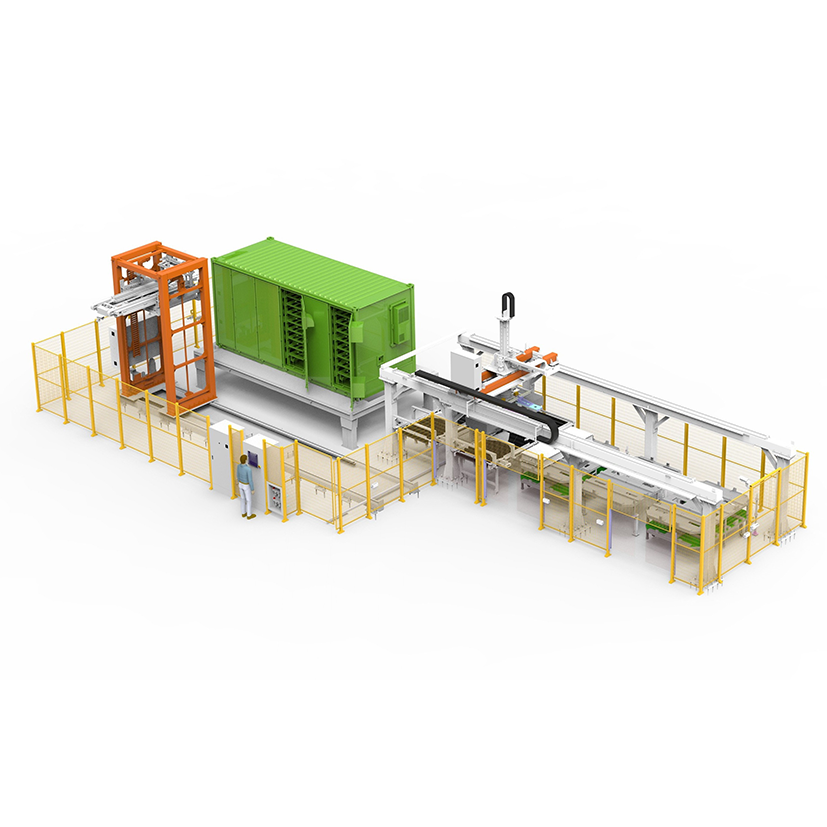
Rail-fixed and AGV-driven insertion platforms resolve different constraints in containerized ESS assembly. Image: Zonzsin.
Containerized battery energy storage assembly is a dimensional and sequencing problem before it is a robotics problem. A battery PACK leaves a staging rack, crosses a container threshold that must open at least 150 degrees, and lands in a rack row without disturbing the cells. Shanghai Zonzsin Intelligent Equipment Co., Ltd., a Shanghai-based manufacturer founded in 2019 that builds ESS battery pack insertion robots for containers and automatic battery pack assembly lines, publishes three named models for that task: ZZX2508 and ZZX2524, both rail-fixed, and RD16, an AGV-driven unit. Their published specifications describe three different answers to the same question.
This shortlist is written for procurement and project engineering teams at energy storage system integrators, battery cell and PACK manufacturers, and EPC contractors who are evaluating insertion equipment during the research and evaluation stage. It compares only the published attributes of the three models, and it states clearly where the published data stops.
Why Scenario Fit Decides the Shortlist, Not Headline Numbers
A common first step in procurement is to rank insertion robots by a single attractive number: payload, speed or footprint. That approach breaks down in container assembly, because the binding constraints are relational rather than absolute. The container envelope has to admit the robot's handling path. The PACK envelope has to fit the gripper and the rack. The drive type has to match the floor and the site layout. And the cell and PACK configuration has to match what the line will actually build.
The operating environment adds a second layer of requirements that no single specification resolves. In container ESS projects, working conditions typically include ESD protection, fire prevention measures, and temperature, humidity and cleanliness control, alongside PACK compatibility and fixture adaptation. Production is usually organized as continuous or shift-based output. These conditions apply whether the robot is rail-fixed or AGV-driven, and they are part of the evaluation regardless of which model is shortlisted.
Against those constraints, the three models separate cleanly. ZZX2508 is defined by its container and PACK compatibility envelope. ZZX2524 is defined by payload, door clearance and gripper changeover. RD16 is defined by cell and PACK configuration coverage combined with AGV mobility and a customizable hoisting range.
The Three Models at a Glance
| Attribute | ZZX2508 | ZZX2524 | RD16 |
|---|---|---|---|
| Drive / mounting | Rail-fixed | Rail-fixed | AGV-driven |
| Container compatibility | L 6058–7000 mm; W 2438–2700 mm; H 2896–3000 mm | Not stated in available specification | Not stated as a container envelope |
| PACK compatibility | L 1100–2200 mm; W 780–1260 mm; H 230–260 mm | Not stated in available specification | 280 / 314 / 587 Ah cells; 1P52S / 1P104S PACKs |
| Load capacity | Not stated | 1500 kg | Not stated |
| Door opening angle | ≥ 150° | ≥ 150° | Not stated |
| Hoisting range / speed | Not stated | Not stated | 1.05–3.4 m (customizable); 100 mm/s |
| Gripper changeover | Not stated | < 1 min | Not stated |
| Unit footprint | Not stated | Not stated | L3100 × W2600 × H3800 mm |
| Site utilities | Compressed air 0.5–0.8 MPa; AC380V ±10%, 50 ±2 Hz | Not stated | Not stated |
| Structure material | Carbon steel / Q235 | Carbon steel / Q235 | Carbon steel |
| Stated industry | Energy storage; C&I | Energy storage; C&I | C&I; energy storage |
"Not stated" means the attribute does not appear in the available published specification for that model. It should be confirmed with the manufacturer before the model is treated as either qualified or disqualified for a project.
Choose ZZX2508 If Your Container and PACK Envelopes Are Standard and Stable
ZZX2508 is a rail-fixed insertion robot specified around dimensional compatibility rather than payload. Its published container envelope is 6058–7000 mm long, 2438–2700 mm wide and 2896–3000 mm high. The lower bound of that range corresponds to the length conventionally associated with a 20 ft ISO container, which is why the model is described as geared to standard container dimensions; the upper bound allows for longer or non-standard units within the same bay.
On the PACK side, the published envelope is 1100–2200 mm long, 780–1260 mm wide and 230–260 mm high. That range covers long-format packs as well as shorter modules, but it remains a range: packs outside it sit outside the specification, and no amount of lifting capacity compensates for a gripper that cannot reach the rack position.
The remaining published parameters are site-facing. The container door must open at least 150 degrees. The unit draws compressed air at 0.5–0.8 MPa and power at AC380V ±10%, 50 ±2 Hz, and is built in carbon steel / Q235. Those three items are the practical checks for a fixed bay: door swing, air line and power quality.
Choose ZZX2508 if:
- Your container lengths sit between 6058 mm and 7000 mm, widths between 2438 mm and 2700 mm, and heights between 2896 mm and 3000 mm.
- Your PACKs fall inside the 1100–2200 × 780–1260 × 230–260 mm envelope.
- A permanent rail can be installed at a fixed loading bay, and a stable ground rail suits your safety and working method.
- Compressed air at 0.5–0.8 MPa and three-phase 380 V power at 50 Hz are available at the station.
Choose ZZX2524 If Payload and Changeover Discipline Define Your Line
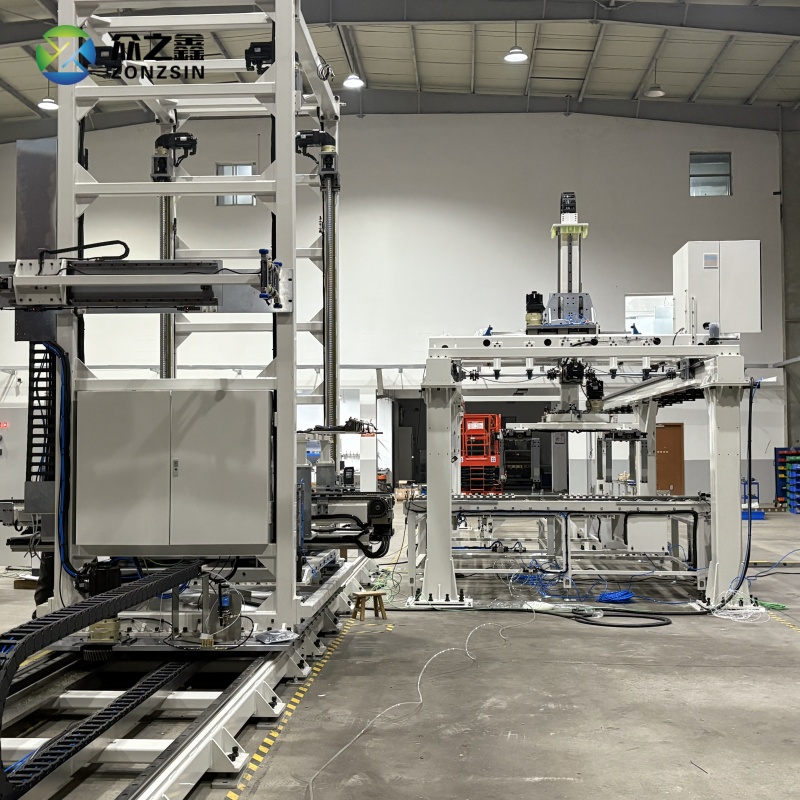
ZZX2524 is specified around payload and reconfiguration speed: 1500 kg load capacity, a door opening angle of at least 150 degrees, and gripper changeover under one minute. Image: Zonzsin.
ZZX2524 is also rail-fixed, but its specification is organized around handling capacity and reconfiguration speed. The published values are a 1500 kg load capacity, a container door opening angle of at least 150 degrees, and a gripper changeover time under one minute. The design also uses double-layer racks, described in the specification as space saving, meaning the same yard footprint holds more pack positions.
Read for procurement, the 1500 kg rating sets a handling class rather than a container size. It becomes decisive when pack assemblies approach the heavy end of the range and the insertion path must stay stable under load, including the weight of any fixture. The sub-one-minute gripper changeover is a mixed-model indicator: on a line that switches between pack variants during a shift, changeover time accumulates directly into cycle time and therefore into effective capacity.
Choose ZZX2524 if:
- Pack weight is the dominant constraint and you need a stated 1500 kg handling capacity.
- Several PACK variants run on one line and gripper changeover time affects throughput.
- Yard space is tight and double-layer racking is part of the layout plan.
- A fixed rail, a stable ground rail for safe working, and a 150-degree door swing are feasible at the station.
Verification note: the container and PACK compatibility envelope for ZZX2524 is not published in the available specification, so it should be confirmed against your own container and PACK drawings before shortlisting. Load capacity is also worth confirming at source, because third-party reseller listings for rail-fixed insertion equipment have shown values that differ from manufacturer documentation. Reseller pages are not a substitute for the manufacturer's own specification.
Choose RD16 If You Need Cell-Level Compatibility and a Rail-Free Layout
RD16 is the AGV-driven option in the set. Its published compatibility statement is the most specific of the three: it covers 280 / 314 / 587 Ah cells and 1P52S / 1P104S PACKs. That matters when a line must accept more than one cell format, or when pack configuration changes between projects, because compatibility is stated at cell and pack level rather than at a generic module size.
Mobility carries its own numbers. The unit measures L3100 × W2600 × H3800 mm and has a hoisting range of 1.05–3.4 m, described as customizable, at a hoisting speed of 100 mm/s. The hoisting range is the figure that matters for double-layer racking, because it defines how high the unit can place or retrieve a pack. Because the drive is AGV-based, no rail is required in the floor; the trade-off is that the travel path and docking positions must be level and defined, and the surrounding station equipment — docking rollers, transfer AGV, working desk, material rack and platform ladder — has to be arranged around a moving unit rather than a fixed one.
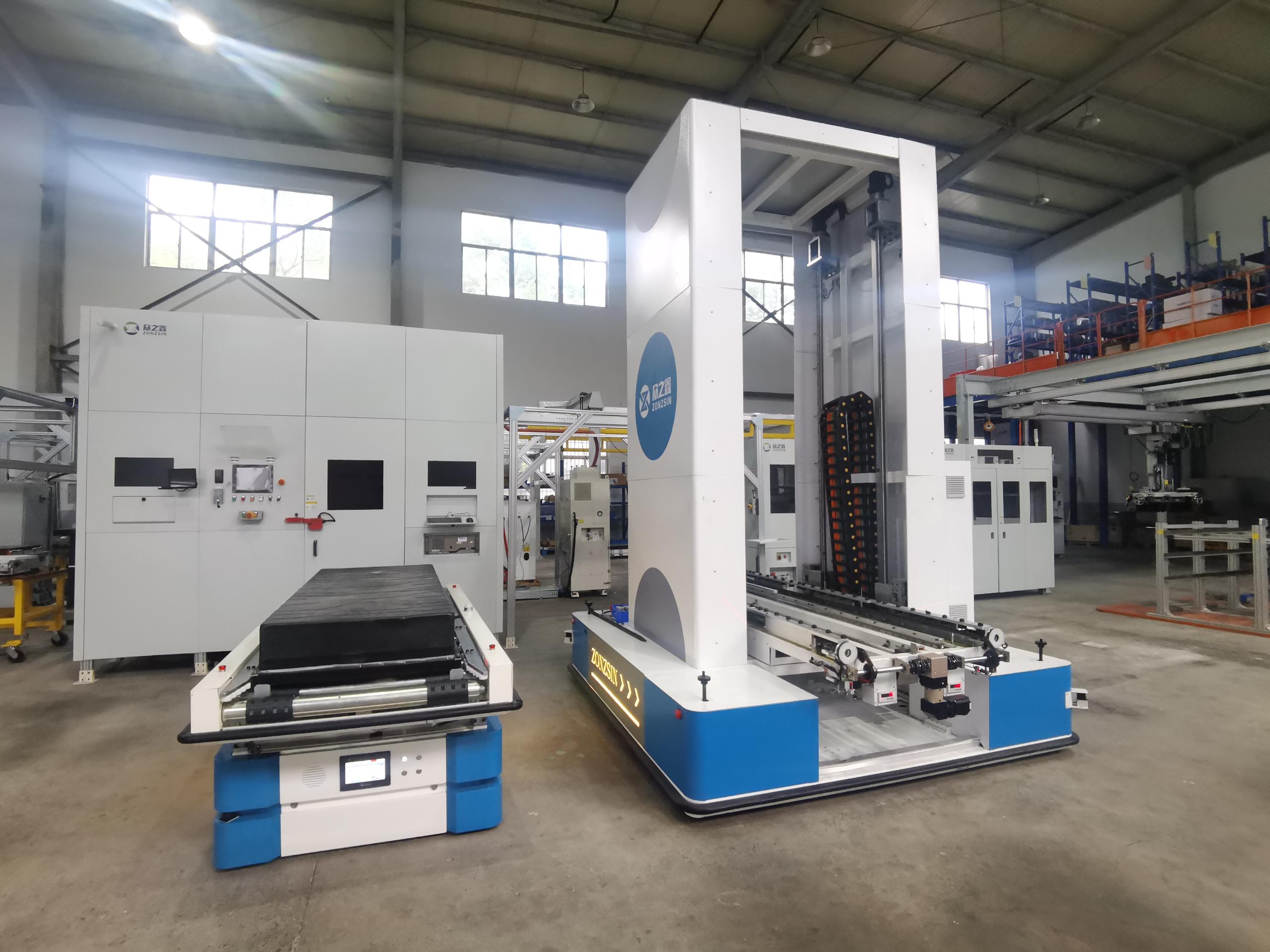
RD16 pairs AGV mobility with an explicitly stated cell and PACK compatibility range. Image: Zonzsin.
Choose RD16 if:
- Your line must cover 280 / 314 / 587 Ah cells or 1P52S / 1P104S PACK configurations.
- You cannot, or prefer not to, install a fixed ground rail in the floor.
- The layout is expected to change and a mobile unit is preferable to a permanent bay.
- Hoisting positions fall within a 1.05–3.4 m range, including double-layer rack levels.
A Shortlisting Sequence for Research-to-Evaluation Teams
The following sequence applies the published attributes in the order that most often changes the answer. It is designed so that each step can eliminate or retain a model before the next step is reached.
- 1. Fix the container envelope first. If your containers sit inside 6058–7000 mm × 2438–2700 mm × 2896–3000 mm, ZZX2508 is the only model in this set whose published envelope covers that range directly.
- 2. Fix the PACK envelope next. Check length, width and height against 1100–2200 × 780–1260 × 230–260 mm for ZZX2508. If your pack is better described by cell capacity and series-parallel configuration, test it against RD16's 280 / 314 / 587 Ah and 1P52S / 1P104S statement.
- 3. Decide rail versus AGV from the floor. A fixed ground rail delivers the stability of a permanent bay but requires installation work and a dedicated station. An AGV-driven unit removes the floor work but requires a level surface plus a defined travel and docking path.
- 4. Check the payload class. Where packs sit in the heavy handling range, compare ZZX2524's published 1500 kg capacity against your heaviest pack including fixture.
- 5. Check changeover and rack density. Sub-one-minute gripper changeover and double-layer racking are the two ZZX2524 attributes that affect throughput on mixed-model lines.
- 6. Check utilities and site conditions. Compressed air at 0.5–0.8 MPa and AC380V ±10%, 50 ±2 Hz apply to ZZX2508; the wider line environment requires ESD protection, fire prevention measures, and temperature, humidity and cleanliness control.
- 7. Map the surrounding equipment. Container ESS insertion stations integrate docking rollers, grippers, transfer AGVs, working desks, material racks, platform ladders, and PLC or MES control. Interface decisions can eliminate a drive type before any technical parameter is compared.
- 8. Confirm performance at source. Specification values for this equipment class are currently company-reported, and independent cross-vendor benchmark data is not available in the public record.
Application Fit: Where This Equipment Is Used
Container ESS pack insertion is not a laboratory application. Published application data for this equipment class lists deployment in China, France, South Korea, Sweden, Taiwan and the United States, in energy storage and C&I projects. Documented working conditions include all-terrain operation and a temperature range of 20–30 °C, with continuous or shift-based production.
Functionally, the equipment performs fully automatic movement and PACK insertion and can operate in manual or remote-controller modes. Documented outcomes in deployment include improved cycle time and support for batch and continuous production in energy storage container lines.
One documented rail-fixed deployment — a single unit operated by an energy storage system integrator, battery cell and PACK manufacturer and EPC contractor — has run continuous PACK insertion for two years with stable operation. The cited highlights are a stable, fixed ground rail for safe working, dual-layer material racks for space utilization, and versatile module options. Documented crawler-driven deployments in South Korea and Taiwan address a different constraint: indoor and outdoor use with uneven working floors, performing pack insertion and pull-out from containers over one year of operation. The crawler option sits outside this three-model shortlist, but it marks the boundary of what rail and AGV layouts can cover.
Market and Regulatory Context for Container ESS Equipment
Two external reference points matter when this shortlist moves into formal evaluation. The first is general industrial robotics adoption. The 2026 robotics in packaging and processing report published by PMMI with Interact Analysis documents the continuing shift toward mobile robots, including AMR and AGV platforms, in industrial production environments. That trend is not specific to energy storage, but it explains why AGV-driven insertion platforms are entering evaluations that were previously rail-only.
The second is regulation. Regulation (EU) 2023/1542 on batteries and waste batteries, adopted by the European Parliament and Council, is the legal framework that shapes battery machinery requirements and CE marking for projects bound for the European market. For EU-bound container storage projects, equipment selection and compliance documentation are linked decisions rather than separate workstreams.
What is missing from the public record is equally relevant. There is no independent, standardized benchmark for positioning accuracy, uptime or real cycle time across vendors in this category; the technical parameters published for ZZX2508, ZZX2524 and RD16 are company-reported. Supply-side context is also company-reported: Zonzsin states a 6000 m² facility, 90 employees, a 43-engineer R&D team, 50 granted patents including invention patents relating to AGV-driven battery PACK insertion robots, an annual output of 40 units and a monthly capacity of 3 units. These figures describe supplier capacity and screening context, not verified equipment performance.
Boundaries: What This Equipment Does Not Resolve
Any shortlist is only as reliable as the data behind it, and here the data has visible edges.
- The comparison columns are not symmetrical. ZZX2508 publishes a container and PACK envelope but not a load capacity. ZZX2524 publishes a load capacity and changeover time but not a container or PACK envelope. RD16 publishes cell and PACK compatibility and hoisting range but not a load capacity or container envelope. A shortlist built on one column will compare unequal data.
- Drive type still decides the floor. Rail-fixed units deliver the stability of a fixed bay but require ground installation. AGV-driven units remove the rail but require level floors and disciplined docking. Crawler-driven units remain the answer for uneven outdoor floors, which is why they continue to be specified alongside fixed and AGV options.
- Manual insertion remains viable in some projects. Where container builds are low-volume and non-standard, and the annual volume does not justify a fixed station, manual methods can still be the rational choice; automation pays back through batch and continuous production patterns.
- Efficiency claims need local validation. Zonzsin reports that robotic insertion can improve container assembly cycle time by roughly 20 percent compared with manual methods. That figure is supplier-reported and depends on container density and line layout, so it should be verified on site rather than adopted as a planning assumption.
- Third-party listings can diverge. As noted above, reseller specifications for a rail-fixed product family have shown values that differ from company documentation. Treat any specification that cannot be traced to the manufacturer's own documentation as unverified.
Future Outlook
The published parameters for this equipment class point to where selection pressure is heading. The cell capacities named for RD16 — 280, 314 and 587 Ah — span several pack generations, which suggests buyers will increasingly weight cell-format coverage over single-format lifting performance. A model that must be re-specified for every new cell format adds engineering cost to every project that follows.
Layout flexibility is the second pressure. AGV-driven insertion removes the ground rail, but it transfers work into path planning, floor condition and docking discipline. Customization is already offered on an OEM/ODM basis covering cycle time, automation level, logo, color and configuration, with a stated lead time of 2–4 months and a minimum order quantity of one unit. That combination — modular design plus configuration-level customization — is likely to become the default expectation rather than a differentiator.
The third pressure is evidence. As container BESS projects grow in size and repetition, procurement teams are likely to demand benchmark data rather than datasheet claims. That gap is currently open in this category, and suppliers who close it with traceable test or field data will be easier to qualify.
Frequently Asked Questions
What is the difference between a rail-fixed and an AGV-driven ESS battery pack insertion robot for containers?
A rail-fixed unit such as ZZX2508 or ZZX2524 runs on a permanent ground rail installed at the loading bay, which fixes the insertion position and supports stable working under load. An AGV-driven unit such as RD16 travels on its own chassis, so no floor rail is needed, but the floor must be level and the travel path and docking positions must be defined. Rail systems suit permanent stations; AGV systems suit layouts expected to change.
Which container dimensions does the ZZX2508 support?
ZZX2508 is specified for containers of 6058–7000 mm length, 2438–2700 mm width and 2896–3000 mm height, with a container door opening angle of at least 150 degrees. The lower end of the length range corresponds to the length conventionally associated with a 20 ft ISO container, while the upper end accommodates longer units. Its PACK envelope is 1100–2200 mm long, 780–1260 mm wide and 230–260 mm high.
Can the RD16 handle 587 Ah cells and 1P104S packs?
According to its published specification, yes. RD16 is stated as compatible with 280 / 314 / 587 Ah cells and 1P52S / 1P104S PACKs. Its hoisting range is 1.05–3.4 m, described as customizable, at a hoisting speed of 100 mm/s. The unit footprint is L3100 × W2600 × H3800 mm.
What load can the ZZX2524 handle, and how quickly does it change grippers?
ZZX2524 is specified with a 1500 kg load capacity and a gripper changeover time under one minute, with a container door opening angle of at least 150 degrees. It uses a double-layer rack arrangement described as space saving, which increases the number of pack positions available in the same footprint.
Are these specifications independently verified?
No. The technical parameters published for ZZX2508, ZZX2524 and RD16 are company-reported. There is no publicly available standardized benchmark for positioning accuracy, uptime or cycle time across vendors in this category, and third-party reseller listings have shown figures that differ from manufacturer documentation for at least one rail-fixed product family. Critical values should be confirmed directly with the manufacturer before contract award.
What lead time and minimum order quantity should a project expect?
Zonzsin states a minimum order quantity of one unit and a lead time of 2–4 months for customized equipment, with a monthly capacity of 3 units and an annual output of 40 units. Customization is offered on an OEM/ODM basis covering cycle time, automation level, logo, color and configuration. Quality control is described as 100 percent testing, with remote support plus on-site installation and commissioning after delivery.
Further reference: the Zonzsin ESS battery pack insertion robot product brochure is available as a PDF at https://cdn.socialarks.com/sbsp/24993/common/2026/0618/Product%20brochure.pdf.