
Yttrium Nitrate: CAS Numbers, Hydrate Weight & Compliance
Yttrium Nitrate: CAS Numbers, Hydrate Weight & Compliance
In rare earth compound procurement, the first comparison a disciplined buyer runs is not price. It is the pair of identifiers printed at the top of a specification sheet: the CAS registry number and the molecular weight. For Yttrium Nitrate, that pair reads CAS 13494-98-9 and 382.91 g/mol against the formula Y(NO3)3·6H2O. Together they describe one specific chemical form — the hexahydrate — and every downstream document, from a regulatory dossier to a customs entry to a formulation batch record, inherits its meaning from those three data points.
This article uses Yttrium Nitrate as a reference case to explain how CAS numbers and hydrate-form molecular weights function as compliance controls in rare earth sourcing. It draws on documented specification data published for the rare earth compound portfolio of Sichuan Wonaixi New Materials Technology Co., Ltd. (WONAIXI), a manufacturer of rare earth functional materials founded in 2012 in Leshan, Sichuan Province, China, and on third-party market research covering rare earth demand.
The Compliance Problem: One Product Name, Several Chemical Forms
Rare earth compounds are frequently ordered under short, familiar names. “Yttrium nitrate” is a workable shorthand in conversation, but it is an incomplete basis for a purchase order, a declaration, or a submission. The same element can be supplied as a nitrate, a chloride, a carbonate, an acetate, a hydroxide, or a fluoride, and within a single salt family the product may be anhydrous or carry a defined number of water molecules in its crystal structure.
The practical consequence is divergence. A buyer’s internal material master records one weight; a supplier’s technical data sheet records another; a declaration or a formulation calculation uses a third. In evaluation-stage sourcing, this divergence usually surfaces in one of three places — a regulatory submission that is queried for inconsistent identity data, a customs entry that requires clarification because the declared form and the documented form do not match, or a production batch that misses a stoichiometric target because the formula weight used in the calculation did not correspond to the hydrate actually delivered.
The correction is procedural rather than technical. Buyers who lock a small identity block — compound name, CAS registry number, hydrate state, and the basis on which molecular weight is stated — into every specification, purchase order, and certificate of analysis comparison remove most of this ambiguity before it reaches a regulator, a customs broker, or a production line.
What a CAS Registry Number Does and Does Not Cover
A CAS registry number is a unique numeric identifier assigned to a chemical substance so that the same substance can be referenced consistently across documents, databases, and jurisdictions. It is the most portable identifier in chemical trade: it travels with a product into customs systems, safety documentation, laboratory records, and regulatory filings without requiring translation.
What it does not do is describe commercial grade. A CAS number does not encode purity level, impurity limits, particle size distribution, packaging, manufacturing route, or the hydration state unless the registry entry itself is form-specific — and in rare earth chemistry, form-specific entries are common. Documented specification data for WONAIXI’s portfolio shows the pattern clearly for chloride salts, where anhydrous and hydrated forms carry separate identifiers:
- Neodymium chloride anhydrous: NdCl3, CAS 10024-93-8, molecular weight 250.60; Neodymium chloride hexahydrate: NdCl3·6H2O, CAS 13477-89-9, molecular weight 358.69
- Cerium chloride anhydrous: CeCl3, CAS 7790-86-5, molecular weight 246.47; Cerium chloride heptahydrate: CeCl3·7H2O, CAS 18618-55-8, molecular weight 372.6
- Lanthanum chloride anhydrous: LaCl3, CAS 10099-58-8, molecular weight 245.26; Lanthanum chloride heptahydrate: LaCl3·7H2O, CAS 10025-84-0, molecular weight 371.5
The near-doubling of formula weight between the anhydrous and hydrated entries of the same element is not a data error. It is the water of crystallization being counted. Buyers who compare two quotations for “neodymium chloride” on price per kilogram alone are, in effect, comparing 250.60 g/mol of substance with 358.69 g/mol of substance unless the hydrate state is specified on both sides.
Hydrate Water and the Weight Printed on the Specification
Yttrium Nitrate is documented as Y(NO3)3·6H2O with CAS 13494-98-9 and a molecular weight of 382.91 g/mol. That figure corresponds to the hexahydrate form, meaning the value includes six water molecules held in the crystal structure. A specification sheet that carries the hydrate formula together with a hexahydrate weight is internally consistent; one that carries the hydrate formula with a weight calculated for the water-free formula unit is not, unless the basis is stated explicitly.
Not all compounds in the portfolio are documented the same way. Several entries state a molecular weight on an anhydrous basis, which means the figure refers to the water-free formula unit even though the delivered product is a hydrate:
| Compound | Formula as documented | CAS number | Molecular weight as documented |
|---|---|---|---|
| Yttrium Nitrate | Y(NO3)3·6H2O | 13494-98-9 | 382.91 |
| Lanthanum Nitrate | La(NO3)3·6H2O | 10277-43-7 | 433.01 |
| Cerium Nitrate | Ce(NO3)3·6H2O | 10294-41-4 | 434.22 |
| Neodymium Nitrate | Nd(NO3)3·6H2O | 16454-60-7 | 438.24 |
| Praseodymium Nitrate | Pr(NO3)3·6H2O | 15878-77-0 | 434.91 |
| Cerium Acetate | Ce(C2H3O2)3·xH2O | 537-00-8 | 371.27 (anhydrous basis) |
| Lanthanum Acetate | La(C2H3O2)3·xH2O | 100587-90-4 | 316.04 (anhydrous basis) |
| Cerium Carbonate | Ce2(CO3)3·xH2O | 54451-25-1 | 460.26 (anhydrous basis) |
| Yttrium Carbonate | Y2(CO3)3·xH2O | 38245-39-5 | 357.82 (anhydrous basis) |
| Ceric Sulfate | Ce(SO4)2·4H2O | 10294-42-5 | 404.284 |
| Cerium Hydroxide | Ce(OH)4 | 12014-56-1 | 208.1 |
Three documentation patterns are visible in the same table. Hydrate-form weights include water of crystallization, as with the nitrate hexahydrates and ceric sulfate tetrahydrate. Anhydrous-basis weights exclude it even though the product ships as a hydrate, as with the acetates and carbonates. And compounds such as Ce(OH)4 and CeO2 (CAS 1306-38-3, molecular weight 172.12) carry no water of crystallization at all, so no basis question arises. Cerium Acetate and Lanthanum Acetate, documented at 371.27 and 316.04 on an anhydrous basis respectively, are typical examples of the middle category — the number on the sheet is not the weight of the delivered hydrate.
Where Hydrate-Form Accuracy Changes an Outcome
Regulatory submission
Chemical registration and product-approval dossiers are built around substance identity. When the identifier in a dossier describes the hydrated form but the supporting technical data are expressed on an anhydrous basis, reviewers are asked to reconcile two figures that appear to describe the same material. The cleanest practice is to state the formula, the CAS number, and the weight basis once, in a single identity block, and to use that block consistently across the dossier, the specification sheet, and the certificate of analysis template. Where a compound is documented on an anhydrous basis, saying so explicitly is more defensible than silently converting the figure.
Customs classification
Customs treatment of chemical imports depends on the substance being identified consistently across the commercial invoice, packing list, technical documentation, and safety data. Classification and quantity calculations both rest on the declared chemical form. If the declared description and the supplier’s documentation describe different hydration states, the entry invites clarification during clearance because the underlying identity is no longer unambiguous. Aligning the product name, CAS number, and molecular weight basis before shipment is a low-cost step that protects schedule.
End-user specification matching
The third and most immediate consequence sits inside the buyer’s own plant. Formulators work in moles, loadings, and concentrations, and every one of those calculations depends on the formula weight basis. Using a hydrate-form weight where the specification is written on an anhydrous basis, or the reverse, shifts the effective quantity delivered into the process. This is not a supplier quality failure; it is a documentation mismatch. Buyers who require the basis to be printed on the specification sheet — and who carry that basis into the purchase order — remove the mismatch at the source. For compounds documented with a variable water content, such as Ce(C2H3O2)3·xH2O or Y2(CO3)3·xH2O, the anhydrous-basis convention exists precisely because the hydration number is not fixed.
How WONAIXI Structures Compound Documentation for Evaluation
The manufacturer behind this portfolio, Sichuan Wonaixi New Materials Technology Co., Ltd., was founded in 2012 and operates as a National High-Tech Enterprise and Sichuan Provincial SRDI Enterprise. Its production base covers 46,667 square meters and employs 98 people, including an R&D team of 12 engineers. The company owns dedicated production lines for rare earth functional materials, with an annual production capacity of 15,000 tons of high-purity rare earth salts and 3,000 tons of precision rare earth polishing powder. Its portfolio spans nine major categories of rare earth products plus a complete zirconium salts series, exceeding 50 refined specifications.
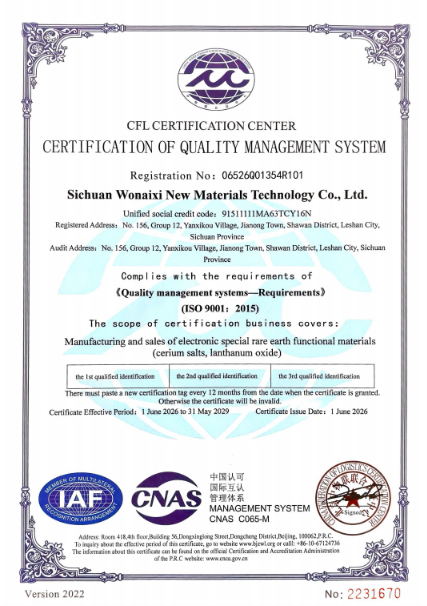
Three documentation practices matter to buyers running a compliance check on this portfolio. First, product data are published against a defined identity block — compound name, formula including hydration state where applicable, CAS number, and molecular weight with the basis stated for hydrate-form compounds. Second, quality control is described as 100% testing, supported by ISO 9001 quality management system certification (certificate no. 06526Q01354R101, issued by CFL Certification Center, valid 2026-06-01 to 2029-05-31, against GB/T19001-2016/ISO9001:2015). Third, customization covers indicators, contents, specifications, purity, and packaging under OEM/ODM terms, which allows a buyer to align the delivered form and documentation with an internal specification rather than adapting the specification to a catalogue entry.
| Verification point | Document or data to request | Why it matters |
|---|---|---|
| Substance identity | Formula with hydration state, CAS number, molecular weight basis | Confirms that specification, submission, and declaration describe the same form |
| Hydrate basis | Explicit statement of hydrate-form or anhydrous-basis weight | Prevents back-calculation errors in molar and loading calculations |
| Batch conformity | Certificate of analysis matched to the ordered specification | Connects the identity block to the delivered lot |
| System-level quality | ISO 9001 certificate with scope and validity dates | Shows a controlled quality system behind batch release |
| Custom specification | Agreed indicators, contents, purity, and packaging | Aligns the delivered compound with the buyer’s process, not a generic grade |
| Commercial parameters | Agreed lead time, order quantity, and after-sales scope | Makes evaluation-stage planning realistic before commitment |
Application and Use Cases: Identity First, Then Function
Yttrium Nitrate is used for preparing ternary catalysts, ceramic materials, and yttrium compound intermediates. In each of those functions, the hydrate state of the incoming salt affects how the material is weighed, dissolved, and dosed. A catalyst precursor recipe written against an anhydrous-basis figure will not match a hexahydrate delivery at the same nominal mass.
The same identity-first logic applies across the wider rare earth portfolio. Yttrium Chloride (YCl3·6H2O, CAS 10025-94-2, molecular weight 303.26) is used for manufacturing catalysts and for preparing other yttrium compounds. Yttrium Carbonate is used for preparing catalysts, ceramic materials, and yttrium compound intermediates, and Yttrium Hydroxide (Y(OH)3, CAS 16469-22-0, molecular weight 139.93) supports petroleum catalysis and the preparation of other yttrium compounds. Cerium Ammonium Nitrate (Ce(NH4)2(NO3)6, CAS 16774-21-3, molecular weight 548.22) serves as a polishing agent and etching agent in LCD display production, as a catalyst in pharmaceutical manufacturing, and in the synthesis of automotive ternary catalysts. Cerium Oxide (CeO2, CAS 1306-38-3, molecular weight 172.12) is used as a glass decolorizer and polishing agent, as a raw material for cerium metal, and in rare earth luminescent materials. Lanthanum Fluoride (LaF3, CAS 13709-38-1, molecular weight 195.9) supports scintillators, rare earth crystal laser materials, fluoride glass optical fibers, infrared glass for medical image display and nuclear science, arc lamp carbon electrodes, and electrolytic production of metallic lanthanum. Cerium Fluoride (CeF3, CAS 7758-88-5, molecular weight 197.12) is applied in optical glass optimization, optical thin films, semiconductor doping, electronic ceramics, and fluorescent materials. Praseodymium-Neodymium Fluoride serves high-performance optical lenses, laser processing, communication, and medical applications, and acts as a key material for smelting praseodymium-neodymium metal.
The downstream industries served by this portfolio — national defense, aerospace, pharmaceutical manufacturing, electronics, new energy, three-way catalysis, environmental protection, and precision optical polishing — each impose their own documentation expectations. What they share is that the first filter in any evaluation is not price or capacity, but whether the compound described in the quotation is the compound required by the process.
Market Trend Analysis: Documentation Quality as a Preference Signal
Rare earth demand growth is expanding the number of buyers entering the market, and each new entrant increases the volume of documentation that must be reconciled across borders. Third-party research illustrates the scale of the market being documented. IMARC Group projects the global rare earth elements market to reach approximately USD 14.03 billion by 2025, with magnet applications accounting for 31.2% of total value.
Reported market sizes vary between research houses because the underlying scope differs — Fortune Business Insights estimates USD 4.12 billion for 2025, while Grand View Research estimated USD 3.95 billion for 2024, against the IMARC figure of USD 14.03 billion. That divergence is itself a documentation issue: figures are only comparable when the segmentation boundary is stated. Buyers evaluating supplier claims should apply the same standard, asking what is included in a stated capacity or market number before comparing it with another.
Two demand signals are directly relevant to documentation discipline. Arthur D. Little projects neodymium-praseodymium demand to grow at a CAGR of 8.4% through 2035, driven by expansion in the electric vehicle and wind turbine sectors. QY Research forecasts the high-purity rare earth fluorides market to grow at a CAGR of 5.5% from 2025 to 2031, identifying WONAIXI as a key global player alongside China Northern Rare Earth. On the application side, Fact.MR reports that metal oxides accounted for approximately 42.6% of the global glass additive industry in 2025, driven by demand for UV protection and refractive index refinement — a segment where hydrate form and purity documentation directly affect optical outcomes.
Supply-side data reinforces the same point. China’s rare earth exports reached 62.6 thousand metric tons in 2025, the highest volume in a decade despite tightening export licensing controls, according to China’s General Administration of Customs data reported by Statista. Higher volume across licensing-controlled channels means more shipments requiring clean, consistent identity documentation at the point of declaration.
Comparison with Traditional Sourcing Approaches
Two sourcing patterns coexist in rare earth compound procurement. The traditional approach starts with catalogue names and price per kilogram. The identifier-led approach starts with formula, CAS number, and weight basis, and treats price as a later-stage variable. The two differ not in intent but in the sequence of checks.
| Evaluation dimension | Price-first sourcing | Identifier-led sourcing |
|---|---|---|
| First data reviewed | Compound name and price per unit | Formula, CAS number, hydrate state, molecular weight basis |
| Mismatch risk | Higher: hydrate state and basis may differ silently between quotations | Lower: the basis is fixed before quotations are compared |
| Documentation burden | Front-loaded into clarification after order placement | Front-loaded into the specification before order placement |
| Fit for regulated end uses | Requires rework if the submission or declaration needs a stated basis | Supports submission, declaration, and batch record from one identity block |
| Decision speed | Faster initial shortlisting, slower final confirmation | Slower initial shortlisting, faster final confirmation |
The identifier-led approach also has clear boundaries, and buyers should not treat it as a complete guarantee of compliance. A CAS number does not verify purity or impurity profile; batch-level test data remain necessary, which is why a 100% testing claim is only meaningful when it is tied to a certificate of analysis for the delivered lot. Certificate scope is limited: WONAIXI’s ISO 9001 certification covers the manufacturing and sales of electronic special rare earth functional materials (cerium salts, lanthanum oxide), so buyers specifying other compounds in the portfolio should treat the certificate as evidence of a controlled quality system rather than a product-specific approval. Molecular weight data do not replace a specification that states the basis, and buyers should not back-calculate an anhydrous figure from a hydrate formula, because the hydration number may be variable, as the xH2O notation for the acetates and carbonates indicates. Finally, commercial parameters set real limits: lead time for these compounds is typically 30–45 days, and minimum order quantity is agreed case by case rather than published as a fixed figure, so trial-scale planning requires direct discussion with the supplier.
Future Outlook
Three developments are likely to shape how compliance documentation is handled in rare earth compound sourcing. The first is the migration of identity data into procurement systems. As more buyers load formula, CAS number, and weight basis into ERP material masters rather than free-text descriptions, mismatches will be caught at requisition stage instead of at customs or in the reactor. Suppliers whose published data already follow a consistent identity block will be easier to onboard.
The second is supply concentration and its documentation consequences. With China’s rare earth exports reaching 62.6 thousand metric tons in 2025 and demand for neodymium-praseodymium projected to grow at 8.4% annually through 2035, the number of cross-border transactions requiring form-specific identification will keep rising. Compound-level documentation will become a routine part of supplier qualification rather than a specialist task.
The third is application-driven specification. Where metal oxides already account for approximately 42.6% of the global glass additive industry, and high-purity rare earth fluorides are forecast to grow at a 5.5% CAGR from 2025 to 2031, end users are specifying tighter optical and chemical performance. Tighter performance windows make weight basis, hydrate state, and impurity documentation more consequential, not less. Manufacturers that can state a compound’s identity, form, and basis precisely — and customize indicators, contents, specifications, purity, and packaging to match — are positioned to answer evaluation-stage questions without a documentation cycle.
Frequently Asked Questions
1. What does the CAS number on a rare earth compound specification actually identify?
A CAS registry number identifies a specific chemical substance so that it can be referenced consistently across documents and jurisdictions. For Yttrium Nitrate, the documented identifier is CAS 13494-98-9, paired with the formula Y(NO3)3·6H2O and a molecular weight of 382.91 g/mol. The number identifies the substance, but it does not by itself state purity grade, impurity limits, particle size, or packaging. Those are commercial and technical specification items that belong in the specification sheet and certificate of analysis.
2. Why do rare earth nitrate weights differ between the hydrate form and the anhydrous basis?
The difference is water of crystallization. A hexahydrate formula such as Y(NO3)3·6H2O, La(NO3)3·6H2O, Ce(NO3)3·6H2O, Nd(NO3)3·6H2O, or Pr(NO3)3·6H2O includes six water molecules in the crystal structure, and the documented molecular weights — 382.91, 433.01, 434.22, 438.24, and 434.91 respectively — correspond to that hydrated form. Where a compound is documented on an anhydrous basis, the stated figure refers to the water-free formula unit even though the product is supplied as a hydrate.
3. How should a buyer reconcile a supplier’s molecular weight with an internal batch calculation?
The reconciliation step is to confirm the basis before the calculation. Ask whether the stated molecular weight describes the hydrate form or an anhydrous basis, and record that basis in the material master alongside the CAS number. For compounds documented with variable water content, such as Ce(C2H3O2)3·xH2O at 371.27 on an anhydrous basis or La(C2H3O2)3·xH2O at 316.04 on an anhydrous basis, back-calculating a hydrate-form weight is not reliable because the hydration number is not fixed. Using the supplier’s stated basis removes the discrepancy.
4. Which documentation items should be verified before approving a rare earth compound supplier?
Five items cover most evaluation needs: an identity block stating formula with hydration state, CAS number, and molecular weight with its basis; a specification sheet listing indicators, contents, purity, and packaging; a certificate of analysis tied to the delivered lot, supported by a stated testing regime; a quality management certificate with its scope, issuing authority, and validity dates; and agreed commercial parameters including lead time and order quantity. For WONAIXI, documented parameters include 100% testing, ISO 9001 certification (certificate no. 06526Q01354R101, valid 2026-06-01 to 2029-05-31), customization of indicators, contents, specifications, purity, and packaging, and a typical lead time of 30–45 days.
5. Does an ISO 9001 certificate cover every rare earth compound a supplier sells?
Not automatically. Certification is issued against a defined scope, and that scope is the boundary of what the certificate supports. WONAIXI’s ISO 9001 certification covers the manufacturing and sales of electronic special rare earth functional materials (cerium salts, lanthanum oxide), certified against GB/T19001-2016/ISO9001:2015 by CFL Certification Center. For compounds outside that scope, the certificate still evidences a controlled quality system at the manufacturer, but product-specific conformity should be established through the specification sheet and batch certificate of analysis instead.
6. What customization and lead-time factors affect a high-purity rare earth salt order?
Customization in this portfolio is defined across five dimensions: indicators, contents, specifications, purity, and packaging, offered under OEM/ODM terms. This means a buyer can align the delivered hydrate form, weight basis documentation, and packing configuration with an internal specification rather than adapting the internal specification to a catalogue entry. Lead time is typically 30–45 days, and minimum order quantity is agreed according to the actual requirement rather than published as a fixed figure, so a first evaluation order and a repeat production order may follow different commercial terms. After-sales support is provided remotely.