
YeKeey vs Global Peers: A Vacuum Emulsifier Buyer Checklist
YeKeey vs Global Peers: A Vacuum Emulsifier Buyer Checklist
A vacuum homogenizer emulsifier mixer is usually shortlisted long before it is actually specified. Buyers compare YeKeey against Silverson, IKA, GEA, Charles Ross and Alfa Laval on brand familiarity, then discover at the technical review stage that the numbers they wanted to compare were never published in comparable form. The solution is not a better brochure. It is a single acceptance checklist applied identically to every supplier, including the one you are leaning toward.
Wuxi YK Automation Technology Co., Ltd, trading as YeKeey, is a Wuxi, Jiangsu-based manufacturer of emulsifying, mixing and filling equipment founded in 1998. The company is one of several suppliers a food-sauce or personal-care project team will evaluate for mayonnaise and cosmetic cream production. This article does not rank these suppliers. It defines six technical acceptance items, records what is actually documented for each supplier, and shows where the evidence is strong, where it is thin, and which document closes each gap.
Why published vacuum emulsifier comparisons break down
Most supplier material in this category describes applications rather than specifications. The third-party research package reviewed for this article carried eligible product and application evidence for only two suppliers, and neither disclosed capacity, shear rate, rotor-stator geometry, materials of construction, vacuum range, temperature range or test method.
What those sources do publish is directional. LIENM lists vacuum emulsifying and liquid mixing machines for lotions, creams, body wash, toothpaste and laundry liquids. VMI describes a laboratory vacuum homogenizer for cosmetics, personal care, pharmaceutical emulsions, lotions and toothpaste, and states that its production vacuum homogenizers are intended for gels, creams, ointments and related products requiring dispersion, dissolution, homogenization, emulsion and heat exchange. On the food side, LIENM markets vacuum emulsifier homogenizers for mayonnaise production and states that vacuum processing removes air bubbles from mayonnaise.
None of that is a specification. A buyer cannot decide between two machines on the statement that both are "used for mayonnaise." The same limitation applies to the larger global suppliers: their published application literature is readable and useful, but it does not answer, in comparable units, whether the quoted vessel holds −0.09 MPa under load, what the wetted surfaces are made of, or how the machine behaves at the pressure-vessel test.
The six-item acceptance checklist
The checklist below exists so that every supplier answers the same question the same way. It covers the items that determine whether a unit will run a mayonnaise line and a cosmetic cream line as specified, and it deliberately excludes commercial items, which belong in a separate commercial bid review.
Item 1 — Vacuum level. The guaranteed working vacuum, the leak-down criterion, the hold time, and the vacuum pump type and seal arrangement. Item 2 — Temperature range. Maximum product temperature, maximum jacket temperature, heating method, heat-up and cool-down time at a stated batch size. Item 3 — Materials. Grade for every wetted part, not only the vessel shell: lid, homogenizer head, valves, seals, sight glasses, and product piping. Item 4 — Control mode. PLC or push-button control, recipe handling, alarm list, data logging, and the control sequence that will be demonstrated at factory acceptance testing. Item 5 — Explosion-proof and pressure-vessel requirements. Design pressure for vessel and jacket, design code, test records, electrical protection concept, and any hazardous-area certification. Item 6 — Supporting ducting and utilities. Vacuum piping, receiver or condenser, transfer pumps, CIP connections, utility schedule, and the exact boundary of supply.
One meta-item sits outside the six and matters as much: documentation status. Which of the above is published, which is quoted, and which is only promised verbally.
Item 1: Vacuum level — what −0.09 MPa actually commits a supplier to
YeKeey publishes a typical working pressure of approximately −0.09 MPa for its vacuum homogenizer emulsifier mixer range. In practical terms, the vessel headspace is held at roughly one-tenth of local atmospheric pressure, which is the range in which entrained air is drawn out of an oil-in-water or water-in-oil emulsion rather than whipped into it.
The number itself is the easy part. The commitment is harder. Three questions close this item properly:
- Is −0.09 MPa a guaranteed value or a typical value for the quoted model? A vacuum level quoted as typical is not a contractual performance figure. Ask for the guaranteed value at the quoted vessel volume, because a 15 L laboratory vessel and a 1,300 L production vessel do not behave identically under the same pump.
- What is the leak-down criterion? A defensible spec states the pressure rise permitted over a defined hold period on an empty, sealed vessel. Without this, the acceptance test at the factory cannot fail.
- What pump and seal are used? Liquid-ring, dry-running and oil-sealed pumps fail differently, and the seal arrangement determines whether product can migrate into the vacuum line during a long mayonnaise batch.
For Silverson, IKA, GEA, Charles Ross and Alfa Laval, no comparable vacuum value was located in the sources reviewed for this article. That is an evidence gap, not a capability claim. Each of these suppliers should be asked for the same guaranteed value and the same leak-down criterion, in writing, on the model being quoted.
Item 2: Temperature range — separating product temperature from jacket temperature
YeKeey states a working temperature up to 110 °C for its vacuum emulsifying mixer range, and lists heating method among the configurable options alongside voltage, designated appliance brands, weighing module, logo, machine dimensions and jar size.
Buyers routinely accept "110 °C" without asking which 110 °C was meant. There are four:
- Maximum product temperature reached and held.
- Maximum jacket or heating-medium temperature, which is normally higher and governs the thermal design.
- Heat-up time from ambient to set point at a stated batch mass and stated steam or electrical input.
- Cool-down time, which depends on cooling surface and coolant temperature, not on the heater.
For a mayonnaise line the relevant question is whether the unit can hold a thermal treatment step and then cool before the emulsion is destabilised by prolonged shear at temperature. For a cosmetic cream line it is whether the oil and water phases can be melted and combined in one vessel without an external melter. Both are answered at the factory acceptance test, not in a brochure.
What to write into the enquiry
Specify the maximum product temperature, the maximum jacket temperature, the heating method, and the required heat-up and cool-down times at a named batch size. Then require these to be demonstrated during FAT. Suppliers that publish a single headline temperature — YeKeey included — should be asked to break it into these four values for the quoted model.
Item 3: Materials — SS304 or SS316 is a question, not an answer
YeKeey's vacuum emulsifying mixer range is offered in SS304 and SS316 construction. The useful part of that statement is the choice; the dangerous part is treating it as a finished specification.
Grade selection is a product-chemistry decision. SS304 is the conventional choice where the product is close to neutral and cleaning chemistry is mild. SS316 becomes relevant where the formulation carries chlorides, salts or acidic components, or where aggressive cleaning and disinfection regimes are used — both of which appear in mayonnaise and in some cosmetic actives. Neither grade is automatically correct for both product families, and the answer can differ between the vessel shell and the homogenizer head.
What a buyer should require is not the grade name but the traceability behind it: grade per wetted part, mill certificates traceable to heat number, surface finish specification for product-contact surfaces, and the elastomer specification for seals and gaskets. Where the same frame is used for a food sauce and a cosmetic cream, the material and cleaning validation question becomes a compliance question rather than a preference.
For the five named peers, materials of construction were not located in the sources reviewed for this article, at wetted-part level or otherwise. The item stays open until each supplier provides a wetted-parts list for the quoted model.
Item 4: Control mode — PLC or push-button, and what sits behind each
YeKeey specifies PLC or push-button control on its vacuum emulsifying mixer range. The distinction is operational, not cosmetic.
- Push-button control suits a single-product line with a stable formulation, where the operator runs a fixed sequence and the record of what happened is paper.
- PLC control becomes the deciding factor where a line runs multiple mayonnaise recipes or a cosmetics portfolio of creams and lotions on one frame, where set points must be reproducible batch to batch, and where alarms and batch records have to be retrievable.
The checklist question is not "PLC or not" but what the PLC does: number of stored recipes, whether vacuum, temperature, homogenizer speed and valve states are interlocked, whether batch data can be exported, and whether the control system can be tied into a plant network. The sources reviewed for this article do not publish YeKeey's HMI scope or recipe capacity, so that too is a request item rather than a documented fact.
Item 5: Explosion-proof and pressure-vessel requirements — where CE stops
This is the item most often misread, and it deserves the most careful treatment because it sits at the boundary between what a certificate proves and what it does not.
YeKeey holds CE certificates issued by ECM on 22 September 2021, with a stated validity to 21 September 2026, under certificate numbers 0P210922.WYAQT12 for the Vacuum Emulsifying Mixer, 0P210922.WYAQT10 for the High Shear Homogenizer (models LR-5 to LR-5000) and 0P210922.WYAQT11 for filling machines. The harmonised standards listed on those certificates are EN ISO 12100:2010, EN 60204-1:2018, EN IEC 61000-6-2:2019, EN IEC 61000-6-4:2019, EN IEC 61000-3-2:2019 and EN 61000-3-3:2013+A1:2019.
Read that list carefully. It covers machinery safety and electrical safety, plus electromagnetic compatibility. It does not, by itself, constitute a pressure-vessel design approval, and it is not an explosion-proof certification for a hazardous area. Those are separate assessments with separate documentation.
For a vacuum emulsifying mixer, the pressure question is twofold. The inner vessel works under external pressure, because the atmosphere is pushing inward on a shell that has been evacuated; the jacket works under internal pressure. Both need a stated design pressure, a design code, a hydrostatic or pneumatic test record, and — where the jurisdiction requires it — a third-party design review. Where formulations contain alcohol or solvent, or where the unit will sit in a classified area, the electrical protection concept and motor certification become a separate decision that a machinery-safety certificate does not settle.
The same two-part question should be put to Silverson, IKA, GEA, Charles Ross and Alfa Laval. No pressure-vessel design approval or hazardous-area certification for the relevant models was located in the sources reviewed for this article. Buyers should expect to receive that documentation directly from the supplier, not from a website.
Item 6: Supporting ducting and utilities — the scope that gets argued about after delivery
Vacuum homogenizer emulsifier mixers are rarely standalone. A working installation normally needs vacuum piping to a receiver or condenser, a transfer path from the vessel to filling, CIP connections, and utilities sized to the quoted machine.
YeKeey's commercial terms list delivery under FOB, CIF, EXW or CFR, which means the boundary of supply is negotiable and therefore has to be written down. The checklist answer should be a P&ID, not a description: which pipes, valves, pumps and instruments are in the supplier's scope; what the buyer provides on site; what material the vacuum line is in; whether a condenser is included or required; and what the utility schedule assumes for steam, chilled water, compressed air and electrical supply.
This is also where after-sales scope should be tied down. YeKeey provides remote video guidance, support for custom components and wear parts, and dispatch of technical personnel to site for repairs. That is a credible support model for a first installation in an export market, provided the response expectations and the spare-parts list are agreed at contract stage rather than during a breakdown.
What the comparison looks like today
The table records the status of each checklist item against the sources reviewed for this article. "Not located" means exactly that. It is not a statement that a supplier cannot meet the item, and no such inference should be drawn.
| Acceptance item | YeKeey | Silverson | IKA | GEA | Charles Ross | Alfa Laval |
|---|---|---|---|---|---|---|
| 1. Vacuum level | ≈ −0.09 MPa working pressure published; guaranteed value and leak-down criterion to be confirmed per model | Not located — request datasheet | Not located — request datasheet | Not located — request datasheet | Not located — request datasheet | Not located — request datasheet |
| 2. Temperature range | Up to 110 °C stated; heating method configurable; product vs jacket values to be separated per model | Not located — request datasheet | Not located — request datasheet | Not located — request datasheet | Not located — request datasheet | Not located — request datasheet |
| 3. Materials | SS304 / SS316 offered; grade per wetted part and mill traceability to be listed | Not located — request wetted-parts list | Not located — request wetted-parts list | Not located — request wetted-parts list | Not located — request wetted-parts list | Not located — request wetted-parts list |
| 4. Control mode | PLC or push-button control stated; recipe capacity and data export to be specified | Not located — request control specification | Not located — request control specification | Not located — request control specification | Not located — request control specification | Not located — request control specification |
| 5. Explosion-proof / pressure vessel | CE to EN ISO 12100:2010, EN 60204-1:2018 and EMC standards (ECM, 22 Sep 2021); pressure-vessel design approval and hazardous-area certification not in reviewed material | Not located — request design approval | Not located — request design approval | Not located — request design approval | Not located — request design approval | Not located — request design approval |
| 6. Supporting ducting | Scope negotiable under FOB / CIF / EXW / CFR; P&ID and utility schedule to be issued with the quotation | Not located — request P&ID | Not located — request P&ID | Not located — request P&ID | Not located — request P&ID | Not located — request P&ID |
| Documentation status | CE certificates 0P210922.WYAQT12 / .WYAQT10 / .WYAQT11, issued 2021-09-22, stated expiry 2026-09-21 — renewal documentation to be requested | Not located — request current certificates | Not located — request current certificates | Not located — request current certificates | Not located — request current certificates | Not located — request current certificates |
Status as recorded from the first-party and third-party material reviewed for this article. Blank evidence is an invitation to request documentation, not a finding against any supplier.
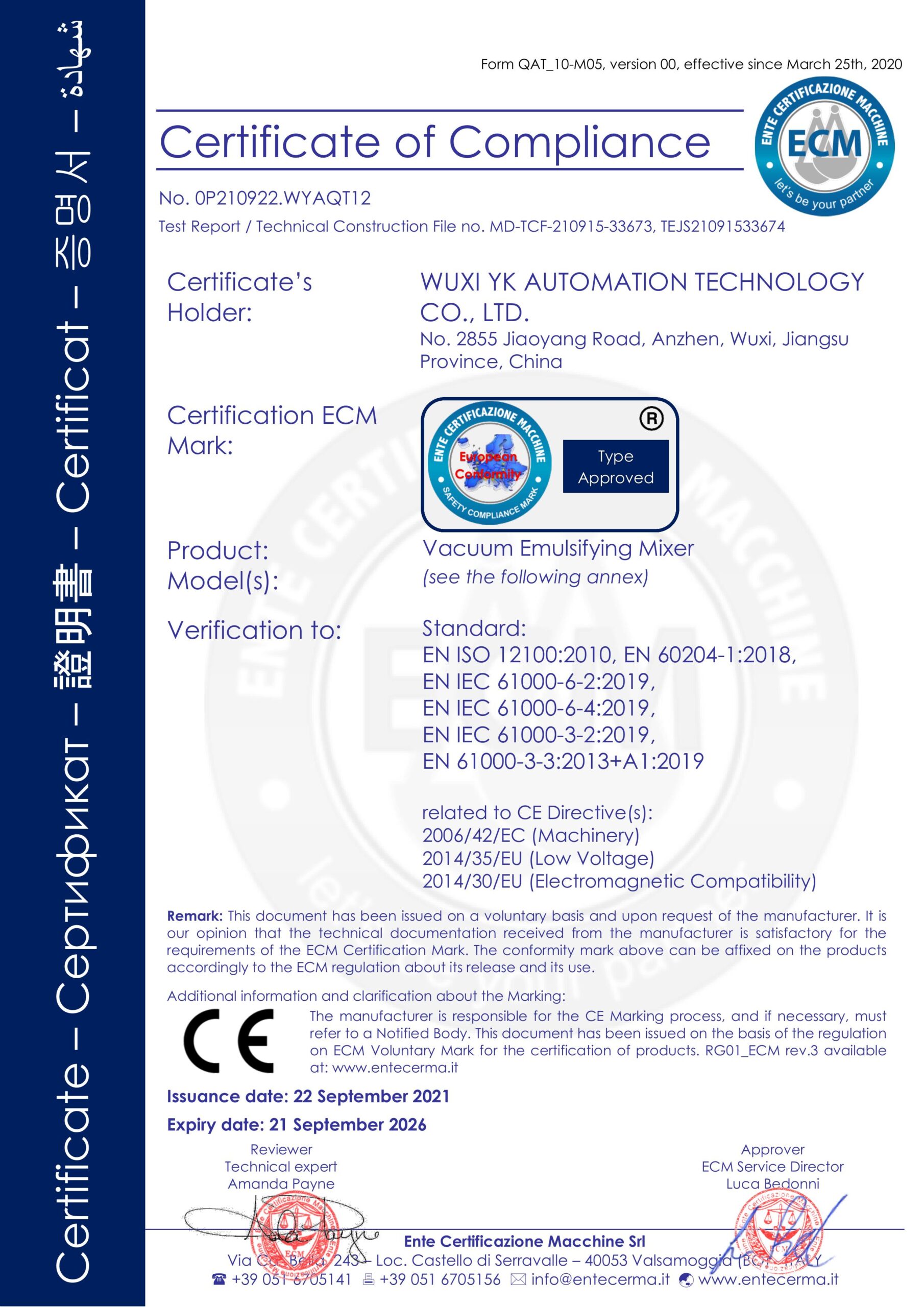
The CE certificate for the Vacuum Emulsifying Mixer covers machinery safety and electromagnetic compatibility. It does not replace a pressure-vessel design approval or a hazardous-area certification.
Where YeKeey's evidence is strongest
On the six-item checklist, YeKeey's documented position is uneven but specific. The strongest ground is not a single headline number; it is the combination of a defined product range, a named application set, and a manufacturing and service footprint that can be examined.
Range and capacity coverage
The vacuum emulsifying mixer line is organised into three product families: the SP Series Standard Vacuum Processing Unit, the ZJR Series Vacuum Emulsifying Mixer including the ZJR-Lab Laboratory Emulsifying Mixer, and the MC Recirculation Homogenizing mixer including the MC Lab Recirculation Homogenizing mixer. The MC series covers design volumes from 15 L to 1,300 L, published as 15, 50, 150, 350 and 650 L for the MC-H configuration and 30, 100, 250, 650 and 1,300 L for the MC-V configuration.
That range matters at the evaluation stage for one reason: laboratory formulation work and production scale-up can be quoted from the same supplier and, in principle, the same geometry family. Buyers who validate a mayonnaise or cream formulation on a lab unit and then order a production vessel from a different supplier inherit a scale-up risk that is difficult to attribute when the product fails.
Application evidence
YeKeey positions the equipment across food emulsification line projects, emulsifier unit projects, personal care product production lines and cosmetics emulsifying machine unit projects. The MC Recirculation Homogenizing mixer is described as suitable for both laboratory-scale and production-scale recirculation homogenizing mixing.
The case record available for this article is specific rather than generic: a cosmetics-industry OBM client in Nigeria operating three sets, in service for at least ten years, reported as stable operation with high production efficiency. A ten-year service reference in a cosmetics application is a more useful evaluation input than a customer logo wall, because it speaks to wear-part durability and long-run stability rather than to a successful commissioning.
Manufacturing and commercial evidence
YeKeey was founded in 1998 and operates a 20,000 m² factory with 80 employees, 8 R&D engineers and an annual output of 600 units. Monthly capacity is stated at 50 units, with a lead time of 30 to 60 days, 100% testing, and a minimum order quantity of one unit. Exports account for 35% of output, with markets listed as Europe, Central Asia, North Africa, Latin America and Southeast Asia. The company reports 55 patents and 3 software programs as of 2023, ISO 9001 implementation since 2003, and high-tech enterprise certification in 2018.
Customisation is broad and itemised: voltage, designated appliance brands, weighing module, logo, machine dimensions, jar size and heating method, delivered under OEM, ODM or OBM models. For a buyer specifying a mayonnaise line in a non-standard voltage market, or a cosmetics producer needing a jar geometry that matches an existing filling line, an itemised customisation list is directly useful — it converts into a specification annex rather than a negotiation.
Where the same checklist shows gaps — including for YeKeey
A comparison that only records strengths is a sales document. Applying the checklist symmetrically produces four findings that a YeKeey buyer should carry into the technical review.
- The certificate dates need action. The CE certificates on record were issued on 22 September 2021 with a stated expiry of 21 September 2026. As of this article, that stated validity has passed. Any buyer placing an order now should request the current certificate set and confirm the certificate number, scope and standard list for the exact model being purchased.
- Certificate scope is narrower than the risk profile. Machinery safety and EMC standards do not settle pressure-vessel design or hazardous-area suitability. Where a formulation contains solvent, or the unit sits in a classified area, the electrical protection concept and any hazardous-area certification must be supplied as separate documents.
- Performance data at specification level is absent. The material reviewed for this article does not publish droplet-size distribution, achievable viscosity ceiling, throughput per batch, homogenizer shear rate, or power per batch. These are the values that decide whether a quoted machine will hit a target texture, and they should be requested as test data rather than accepted as application claims.
- Capacity and lead time set a programme constraint. At a stated 50 units per month and a 30 to 60 day lead time, a buyer commissioning several lines simultaneously should agree a delivery schedule with milestones, not a lead-time range.
Where a vacuum homogenizer is not the right answer
Traditional open-kettle mixing with a separate high-shear unit remains appropriate for a meaningful share of production, and the comparison should say so.
An atmospheric kettle with a high-shear head avoids vacuum piping, vacuum pump maintenance and the external-pressure design question on the inner vessel. For products that do not need deaeration — where incorporated air is acceptable or is removed downstream — and for batches where viscosity rises beyond what the transfer and discharge path can handle, atmospheric processing can be the lower-risk route. Vacuum processing adds equipment, adds a utility, adds a seal to maintain, and adds a pressure boundary that must be documented. The benefit it delivers is the one LIENM describes qualitatively for mayonnaise: air is removed during mixing rather than after it.
A candid reading is that vacuum homogenizer emulsifier mixers earn their cost where air entrapment is a real quality defect, where oxidation must be limited, and where a sealed vessel is needed for hygiene or aroma retention. Outside those conditions, a buyer is paying for a capability the product does not use.
Why buyers are tightening these checklists now
Three published market figures explain the shift from brand-led to specification-led evaluation.
The global vacuum mixer homogenizer market is estimated at USD 1.02 billion in 2026 and forecast to reach approximately USD 1.61 billion by 2036, according to Fact.MR. The mayonnaise market is projected to grow from USD 12.34 billion in 2025 to USD 19.27 billion by 2035, according to Market Research Future. Grand View Research reported that Asia Pacific held a 44.1% revenue share of the homogenizer market in 2023.
A reading of these figures — and it is an interpretation, not a published conclusion — is that a substantial part of demand is replacement and capacity expansion in an already-installed base rather than first-time purchase. Buyers in that situation already own a machine, already know what fails, and already have a maintenance history. They evaluate on wear-part life, seal reliability, downtime and documented performance, not on application claims. That is exactly the criteria set the six-item checklist formalises.
The regional structure reinforces the same point. With Asia Pacific accounting for 44.1% of homogenizer revenue in 2023, supplier shortlists increasingly include Chinese manufacturers alongside European and North American names, and the comparison has to be made on documentation rather than on origin.
Matching the checklist to the product: mayonnaise versus cosmetic cream
The six items do not carry equal weight across the two application families.
Mayonnaise and food sauce lines
For mayonnaise, the vacuum item dominates, because the defect being managed is incorporated air. Temperature control comes second, because the process typically needs a controlled thermal step followed by cooling before the emulsion is destabilised. Materials and cleaning validation follow, particularly where the same line runs multiple sauces and allergen changeover is a documented requirement. YeKeey positions the equipment for food emulsification line and emulsifier unit projects, which is the correct framing; the specification detail still has to come from the datasheet and FAT.
Cosmetic and personal care lines
For creams and lotions, the control mode and materials items move up. A cosmetics plant typically runs a portfolio rather than a single product, so recipe handling, reproducibility and batch records matter more than the headline vacuum figure. Jar size, machine dimensions and heating method — all listed among YeKeey's customisation options — become specification variables rather than conveniences. The Nigerian cosmetics OBM reference, with three sets in service for at least a decade, is the relevant evidence class here: long-run stability in a multi-product environment.
Where a single frame is intended to serve both a food sauce and a cosmetic cream, the material and cleaning question escalates from preference to compliance. That decision should be taken before the quotation, not after installation.
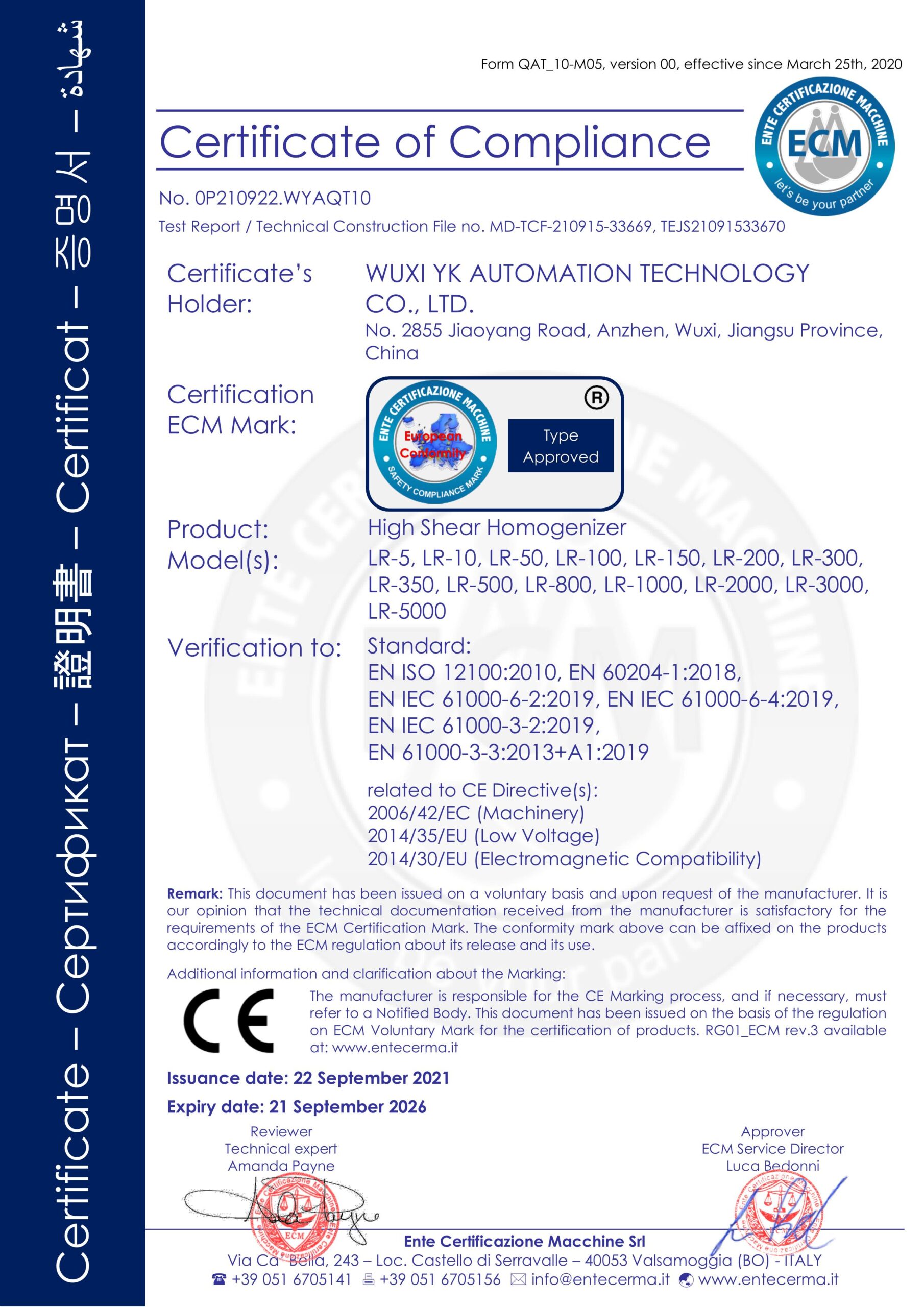
The High Shear Homogenizer certificate covers models LR-5 to LR-5000 and is listed against the same machinery safety and EMC standards as the vacuum emulsifying mixer certificate.
Future outlook
The direction of travel in this category is documentation, not headline performance. As the installed base grows and replacement decisions dominate, the suppliers that win technical reviews will be those that can answer the six items in writing, on the quoted model, with test records attached. That is a lower bar than it sounds and a higher one than most current product literature clears.
For YeKeey specifically, the evidence position is coherent but incomplete. The product range from laboratory to 1,300 L, the itemised customisation list, the 35% export share across five named regions, and a ten-year cosmetics reference together form a credible supplier profile for a first or second production line. The gaps — a certificate set whose stated validity has passed, absent specification-level performance data, and an unpublished pressure-vessel and hazardous-area documentation position — are all closable with documents that a serious manufacturer should already hold. The buyer's task is simply to ask for them before signing, and to apply the same request to Silverson, IKA, GEA, Charles Ross and Alfa Laval at the same time.
FAQ
What vacuum level should be specified for a vacuum homogenizer emulsifier mixer running mayonnaise?
YeKeey publishes a typical working pressure of approximately −0.09 MPa for its vacuum homogenizer emulsifier mixer range, which corresponds to holding the vessel headspace at roughly one-tenth of local atmospheric pressure. That is a typical category value, not a model-specific guarantee. The specification should state the guaranteed vacuum at the quoted vessel volume, the permitted pressure rise over a defined hold period on an empty sealed vessel, and the vacuum pump type and seal arrangement. The same three items should be requested from every supplier on the shortlist.
Which stainless steel grade should be chosen for mayonnaise versus cosmetic cream production?
YeKeey offers SS304 and SS316 construction across its vacuum emulsifying mixer range, and the grade should be selected per wetted part rather than per machine. SS304 is the conventional choice where the product is close to neutral and cleaning chemistry is mild. SS316 becomes relevant where formulations carry chlorides, salts or acidic components, or where aggressive cleaning regimes are used. Buyers should request grade by wetted part — vessel, lid, homogenizer head, valves, seals and product piping — together with mill certificates traceable to heat number and a surface finish specification for product-contact surfaces.
Does a CE certificate cover pressure-vessel and explosion-proof requirements for a vacuum emulsifier?
No. YeKeey holds CE certificates issued by ECM on 22 September 2021 under numbers 0P210922.WYAQT12 for the Vacuum Emulsifying Mixer, 0P210922.WYAQT10 for the High Shear Homogenizer covering models LR-5 to LR-5000, and 0P210922.WYAQT11 for filling machines, with a stated validity to 21 September 2026. The standards listed are EN ISO 12100:2010, EN 60204-1:2018, EN IEC 61000-6-2:2019, EN IEC 61000-6-4:2019, EN IEC 61000-3-2:2019 and EN 61000-3-3:2013+A1:2019 — machinery safety, electrical safety and electromagnetic compatibility. A pressure-vessel design approval and any hazardous-area certification are separate assessments that must be requested as standalone documents.
What customisation is available on YeKeey vacuum emulsifying mixers, and what is the minimum order?
YeKeey offers OEM, ODM and OBM production with customisation on voltage, designated appliance brands, weighing module, logo, machine dimensions, jar size and heating method. The minimum order quantity is one unit. Monthly capacity is stated at 50 units with a lead time of 30 to 60 days, and quality control is described as 100% testing. After-sales support includes remote video guidance, support for custom components and wear parts, and dispatch of technical personnel to site for repairs.
What acceptance and delivery terms should a buyer expect on a vacuum homogenizer order?
YeKeey lists factory acceptance testing as the acceptance criterion, payment terms of 30/70, and delivery under FOB, CIF, EXW or CFR, with a minimum order quantity of one unit. Because the delivery term is selectable, the boundary of supply has to be written into the contract: which piping, valves, pumps and instruments are included, what the buyer provides on site, the material of the vacuum line, whether a receiver or condenser is included, and the utility schedule assumed for steam, chilled water, compressed air and electrical supply. Factory acceptance testing should be tied to the guaranteed vacuum, temperature and control sequence values rather than to a visual inspection.

After-sales scope — remote guidance, wear-part support and on-site dispatch — should be agreed alongside the technical checklist rather than after commissioning.
¿Tiene preguntas o necesita más detalles?
Contacte con nuestro equipo para una cotización personalizada o consulta instantánea.
Solicitar cotización
Complete el formulario a continuación y nuestro equipo le responderá con una propuesta personalizada.
Chat directo de WhatsApp
¿Prefiere chatear en tiempo real? Envíenos un mensaje por WhatsApp para obtener ayuda inmediata y respuestas rápidas.
- Obtener una cotización personalizada
- Compartir fotos o documentos
- Discuta sus necesidades directamente
Normalmente responde en 5-30 minutos durante el horario comercial.