
YNTECH Solar Panel Manufacturing Equipment: Capability Review
Solar panel manufacturing equipment sits at the exact point where a cell technology becomes a shippable, warrantable module. The choice of line architecture — stringer, layup and busbar, lamination, framing, EL inspection — determines how much of a module's cost is labour, how repeatable encapsulation is, and how fast a factory can change formats. This review looks at YNTECH as a supplier entity, as a capability set, and as a procurement option for module builders working between pilot volume and 250MW.
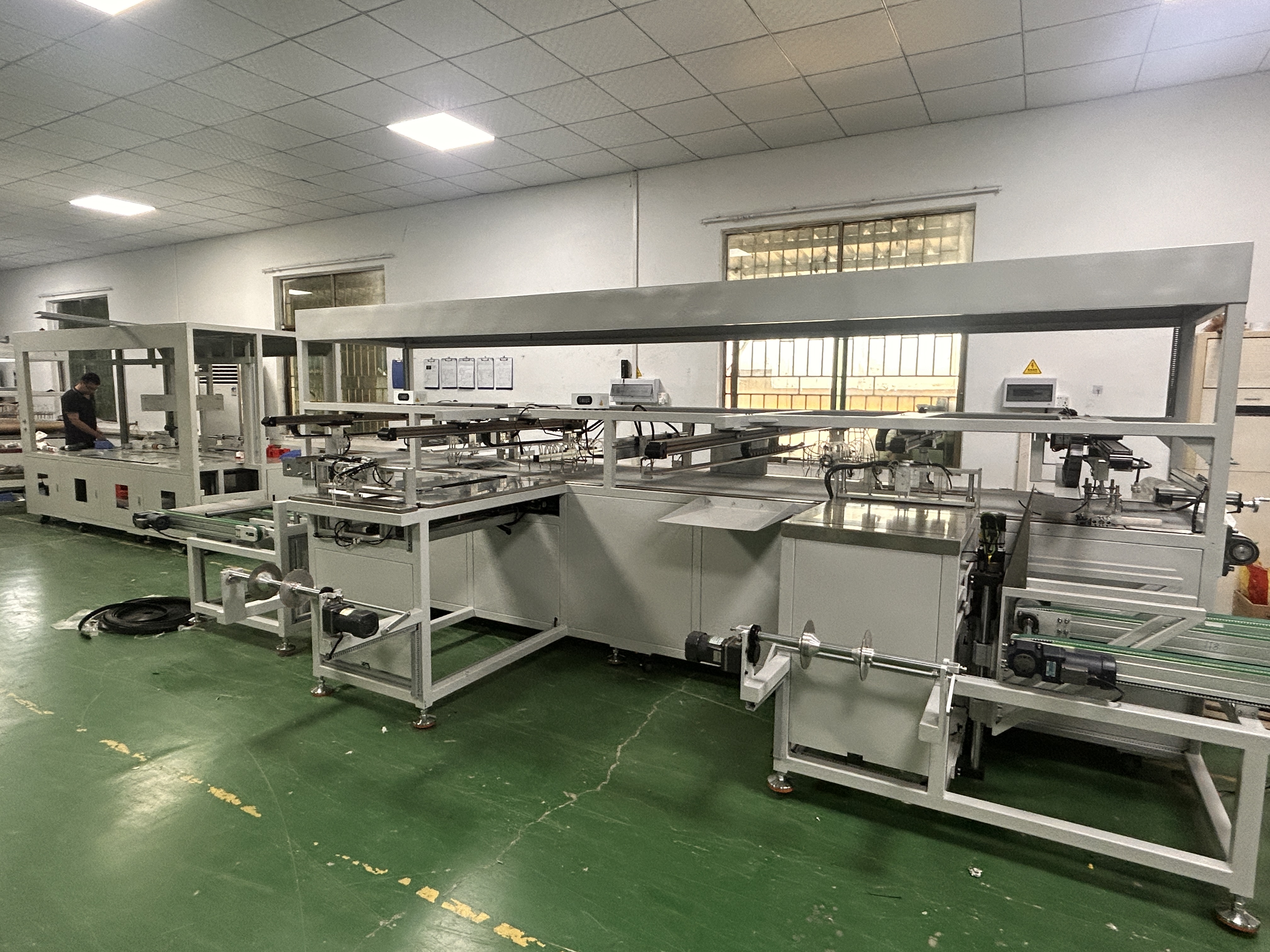
A PV module production line is an assembly system: glass loading, layup and busbar soldering, lamination, trimming, framing and electrical inspection.
What the equipment layer actually decides
Module assembly is not a single process. It is a chain of handling, alignment, soldering and thermal steps, and each one carries a different failure mode. A stringer that misplaces ribbon creates a resistance hotspot that only appears in the EL image. A laminator with 2°C of thermal drift produces bubbles and delamination that surface months later in the field. A framing station that cannot hold a 0.3mm crevice becomes a warranty argument.
For a buyer at the awareness and research stage, the practical consequence is that equipment should be evaluated by process window — the range of glass sizes, cell formats, busbar counts and module wattages a machine can accept — rather than by a single headline speed figure. A line that runs fast on one format and cannot change over is not a flexible asset; it is a dedicated asset with a narrow market.
YNTECH as an entity
YNTECH (YN Solar PV Equipment Co., Ltd.) is a manufacturer of photovoltaic module automated production lines and PV assembly equipment. The company was established in 2015 and operates from Huangwu Industrial Park, Dongkeng Town, Dongguan City, Guangdong Province, China. It supplies standalone PV machines as well as turnkey complete solar panel manufacturing lines covering glass loading, EVA and backsheet laying, cell stringing, bussing, layup, lamination, EL testing, framing and final sorting.
| Legal entity | YN Solar PV Equipment Co., Ltd. |
| Brand | YNTECH |
| Established | 2015 |
| Facility size | 9,000 m² |
| Workforce | 10–60 employees |
| R&D team | 8 engineers |
| Annual output | 100–200 units |
| Export share | 60%–70% of output |
| Main markets | Africa, Middle East, EU; also Asia and Latin America |
| Website | www.ynsolarpv.com |
Two structural facts matter for procurement interpretation. First, a 60%–70% export share indicates that documentation, packaging and commissioning have to work outside the domestic market — a machine that cannot be supported in English, in a dusty or hot workshop, is not exportable at that ratio. Second, a workforce of 10–60 people producing 100–200 units a year defines the company as a focused equipment builder rather than a multi-division industrial group. That has direct consequences for how custom engineering is scheduled, which is discussed later.
Core competitiveness: three claims a buyer can check
1. Integration of layup and busbar into one chassis
The clearest differentiator in the portfolio is the decision to merge string layup and busbar soldering into single machines — the YN-PH700, YN-PH800, YN-PH600 and YN-PH900 — and to add glass loading and EVA pulling to the same frame. The YN-PH700, for example, combines translational glass loading, EVA laying, cell layout and string busbar merging in one unit measuring 4150 × 2720 × 2000 mm. Fewer discrete stations means fewer transfers, and every transfer is an opportunity to shift a string by a millimetre or scratch a glass surface.
The soldering method is high-frequency electromagnetic induction welding rather than iron contact. The practical reason this matters is thermal control: induction heating is rapid and localised, which the specification links to stable soldering appearance and repeatable joints across 2BB to 20BB cell designs.
2. Published process windows instead of a single headline number
YNTECH publishes compatibility envelopes rather than only throughput figures. On the YN-CH210 tabber stringer, the stated breakage rate is below 0.2‰, with support for 2BB through 20BB, ribbon thickness of 0.1–0.2 mm and ribbon width of 0.45–2.00 mm, cell sizes from BC and 125 mm through 210 mm, and cell gaps of 1–20 mm with overlap welding for BC cells. On the layup and busbar platform, glass and EVA compatibility runs from a minimum of 400 × 400 mm to a maximum of 1960 × 990 mm.
For a research-stage buyer, that envelope is the most useful part of the datasheet. It answers the question a factory plan actually asks: will this machine still be relevant when my module format changes?
3. Line-level engineering, not only machine sales
YNTECH's scope includes layout design, equipment manufacturing, factory installation, commissioning, technical training and after-sales maintenance. The company states that it provides free professional design for each customer before payment — a low-risk way for a project team to validate a floor plan against real machine footprints before committing capital. Dedicated layout work is offered for 100MW–200MW solar panel production configurations, alongside turnkey supply in the 20MW–60MW band and standard lines in the 150MW–250MW band.
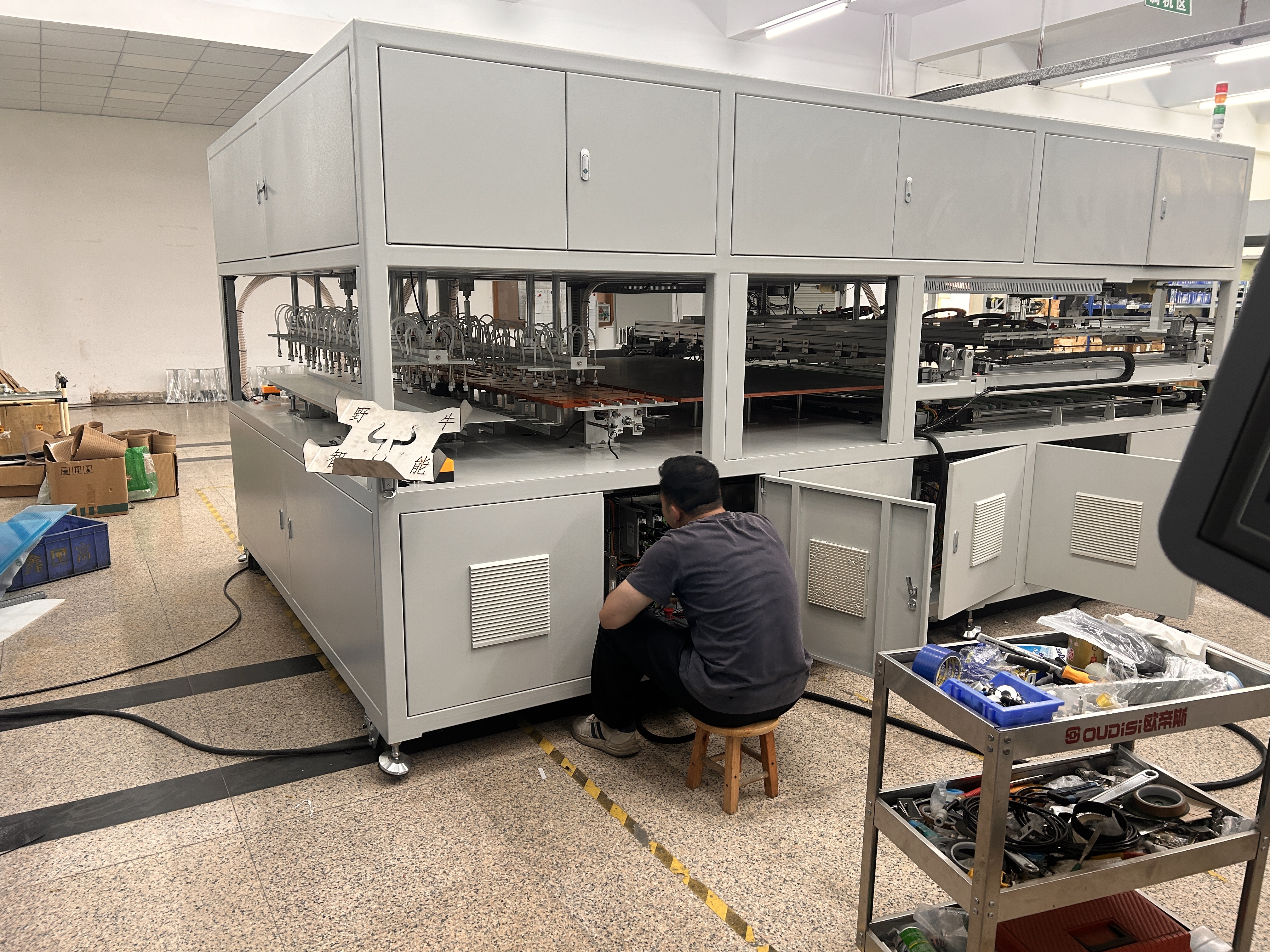
Integration of glass loading, EVA laying and busbar soldering on a single platform reduces inter-station handling.
Technical explanation: where yield is actually won
Stringing. The YN-CH210 handles automatic cell feeding, alignment and spacer placement, ribbon feeding and cell layout, with infrared welding and output flipping. It is stated to support string welding of TOPCon, HJT and PERC cells with a one-click switch for conventional cells, and to be compatible with BC cell string processes from LONGi, Aikos, Huanghe and Tongwei. Maximum welding speed is 1,200 cells per cycle, with maximum string length up to 2,300 mm, and black isolation strips are available for all-black BIPV modules.
Lamination. The PV laminator is specified at ±1.0°C temperature accuracy and ±1.5°C temperature uniformity across a chamber range from ambient to 180°C, with a 30 mm chamber height and an 8–10 minute cycle including vacuuming and lamination. Auto-tuning heating and a high-speed vacuum pump set are the mechanisms behind even EVA curing; the stated aim is to eliminate bubbles and delamination and reduce module power attenuation. Compatibility covers PERC, TOPCon, HJT, BC, half-cut and BIPV modules, with auto conveyor and photo positioning to reduce manual handling.
Inspection. The Automatic EL Tester accepts panels from 1,634 to 2,500 mm long and 986 to 1,400 mm wide. Its double slide rail design, PU belt conveying with a green cloth surface to prevent glass scratching, and speed-controlled motor are practical details rather than marketing ones — glass scratching at the inspection stage converts an A-grade module into a downgrade.
Framing, gluing and trimming. The PV Module Framing Machine runs at 25 s per piece with opposite-side tolerance of ±0.5 mm, diagonal tolerance of ±1 mm and frame crevice below 0.3 mm. The BD03 framing and gluing machine uses CNC control with manual loading and automatic unloading, dispensing at 3–4 seconds per metre, and is positioned to remove the secondary glue-filling step that conventional framing machines require. The YN-XBJ100 trimming machine automatically feeds, aligns and trims excess backsheet and EVA with a stated defect rate below 1‰.
Bussing. The YN-HL500 semi-automatic busbar welding machine runs horizontal infeed and outfeed at roughly 90 pieces per hour on 550W panels, with a stated A-grade yield above 99% and cell width compatibility of 125–210 mm. Its high-frequency electromagnetic soldering is described as reducing labour and shortening line changeover and commissioning time.
The portfolio in one view
| Machine | Model | Stated parameter of note |
|---|---|---|
| Solar Cell Tabber Stringer | YN-CH210 | Breakage rate <0.2‰; 2BB–20BB; up to 1,200 cells per cycle |
| PV Module Lay-up and Bussing Machine | YN-PH700 | 40W–350W modules; 80–120 boards/h single; 160–180/h dual |
| Automatic Lay up and Bussing Machine | YN-PH800 | 6W–40W modules; 2 operators for the full handling sequence |
| Layup and Busbar Integrated Machine | YN-PH600 | 3W–30W modules; string length 100–400 mm |
| Layup and Busbar Machine | YN-PH900 | 5W–120W modules; pass rate >99% |
| Bussing Machine | YN-HL500 | 100W–550W panels; 90 pieces/h; A-grade >99% |
| Solar Panel Laminating Machine | lamination machine | ±1.0°C accuracy; ±1.5°C uniformity; 8–10 min cycle |
| EL Testing Machine | Automatic EL Tester | Panel length 1,634–2,500 mm; width 986–1,400 mm |
| Automatic Framing Machine | PV Module Framing Machine | 25 s/pc; frame crevice <0.3 mm |
| Framing and Gluing Machine | BD03 | Dispensing 3–4 s/m; no secondary glue filling |
| Solar Panel Trimming Machine | YN-XBJ100 | Defect rate <1‰; 3 kW |
| Glass Loading Machine | YN-SBL710 | Capacity 80–100; A-grade yield 97% |
| Junction Box Gluing Machine | solar panel junction box gluing machine | Speed ≤20 s; CNC-controlled dispensing |
| Stacking Machine | Semi-Automatic Solar Panel Stacking Machine | 20 layers; 1,650–2,450 mm length range |
Application fit: which factory does this suit
The portfolio is not a single product; it is a ladder of configurations. Matching a buyer to the right rung is the actual selection problem.
Entry and pilot production. The 20MW–60MW semi-automatic turnkey configuration pairs the YN-SBL710 glass loader with the YN-PH700 layup and bussing platform. Stated throughput is 80–120 boards/h in single-module layout and 160–180/h in dual-module layout, with an A-grade pass rate above 97%, glass up to 1,960 × 990 mm, and cell string compatibility for 2-, 3- and 4-busbar dual-end interconnection. This is the typical configuration for a first factory or an off-grid module business serving regional demand.
Mid-volume automatic production. The 150MW–250MW line is specified at 109 strings per hour in a 1×1 single-module layout, with support for 3, 4, 5 and 6-cell string modules and half-cut layouts of 8, 10 and 12 strings, busbar merging at both ends and mid positions, cell sizes from 125 mm to 210 mm, and string lengths from 750 mm to 2,400 mm.
Line upgrades and retrofits. A stated 100MW–200MW layout design scope is aimed at manufacturers converting from manual to automatic operation. The relevant figures here are a yield rate above 97%, cell width compatibility of 52–210 mm, string spacing of 1–10 mm and a 15 kW rated power supply. Retrofitting is usually a sequencing problem rather than a capex problem: which station to automate first so that the existing manual stations are not starved.
Small-format and specialty modules. The YN-PH600 (3W–30W), YN-PH800 (6W–40W) and YN-PH900 (5W–120W) exist for a segment that large-line builders often ignore: foldable solar packs, solar monitoring panels, integrated solar street lights, floodlights, high-speed warning lights and small custom modules. The YN-PH800 is stated to require only two operators across glass loading, EVA layout, busbar and isolation strip application, lead soldering, power testing and backsheet covering — a meaningful detail for workshops where labour availability, not floor space, is the binding constraint.
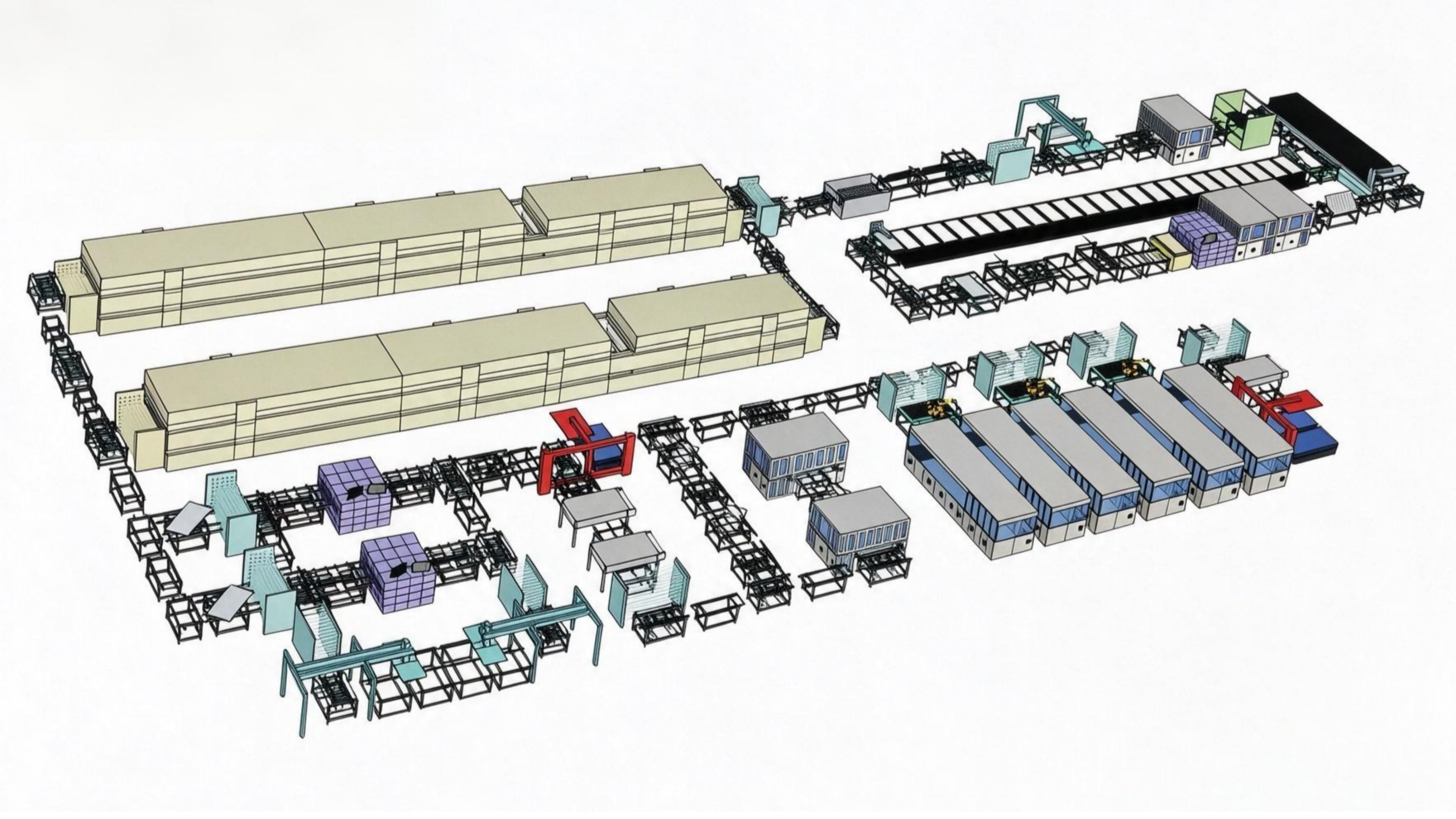
Layout design for a 100MW–200MW retrofit: the deliverable that determines whether new stations fit an existing floor plan.
Market context
Three shifts are visible in module manufacturing, and they shape what equipment buyers now ask for.
Format and cell-type churn. Lines are increasingly specified for 182 mm and 210 mm wafers, for n-type families such as TOPCon and HJT, and for back-contact designs. Equipment that requires a mechanical rebuild for each change becomes expensive to own; equipment with one-click switching between conventional cell types and overlap welding support for BC cells addresses that directly.
Distributed module assembly. Module capacity is spreading into regions that previously imported finished panels. YNTECH's stated export footprint — Africa, the Middle East and the EU, with additional supply into Asia and Latin America — reflects that pattern. Distributed assembly favours mid-scale lines with tolerant utility requirements rather than multi-GW mega-factories.
Aesthetic and building-integrated demand. BIPV and all-black module formats impose additional requirements on the stringer, particularly the ability to mask ribbons with black isolation strips, and on the laminator, which must handle BIPV module constructions without changing cure behaviour.
Comparison with traditional build approaches — and the boundaries
| Criterion | Manual / bench assembly | Integrated automatic line |
|---|---|---|
| Labour dependency | High; output tracks headcount | Reduced; YN-PH800 stated at 2 operators for a full handling sequence |
| Consistency | Depends on operator skill | Fixed-program control; framing tolerances ±0.5 mm / ±1 mm |
| Changeover | Fast for one format, slow to scale | Requires parameter setting and hardware adjustment per format |
| Capital profile | Low entry, high running cost | Higher entry, requires utilities, floor space and trained operators |
| Material loss | Higher breakage and rework exposure | Lower, but concentrated: one stoppage halts the whole chain |
An honest assessment has to state where this equipment stops being the right answer.
Scope boundary. YNTECH supplies the module back-end: stringing, layup, bussing, lamination, trimming, framing, gluing and inspection. It does not supply wafering, cell production or ingot equipment. A buyer planning a vertically integrated cell-plus-module plant is sourcing from two different categories of supplier, and should not expect one vendor to cover both.
Format ceilings. The layup and busbar platforms accept glass from 400 × 400 mm to a maximum of 1,960 × 990 mm. Modules outside that envelope need a different configuration. Cell compatibility is generally 125–210 mm, with the small-format machines reaching down to 52 mm cell width; ribbon thickness is capped at 0.2 mm and busbar specification runs 3–6 mm or 4–8 mm depending on the model. These are engineering limits, not negotiable preferences.
Environment and utilities. Installation requires a dry, well-ventilated environment free of corrosive gases, ambient temperature of −10 to 40°C, and a clean, dust-controlled workshop. Air supply is specified at 0.5–0.8 MPa, and machines draw between 1 kW and 15 kW peak depending on station. A site without a stable compressed-air ring main and conditioned floor will not realise the stated yield figures.
Automation is not uniform across the portfolio. Several stations are explicitly semi-automatic. The BD03 framing and gluing machine uses manual loading with automatic unloading and dispensing. The YN-HL500 is described as semi-automatic busbar welding. Buyers comparing quotes line-by-line should map automation level per station, because a semi-automatic station still needs an operator present.
Engineering capacity. With an 8-person R&D team and 10–60 employees producing 100–200 units annually, YNTECH is sized for focused projects rather than simultaneous multi-line mega-contracts. Custom or non-standard requests — including the stated specialisation in customised 300MW non-standard PV module lines — need to be scheduled against that capacity, and lead time is stated at 10–30 days depending on equipment model.
Service, delivery and commercial terms
After-sales support is stated as 24-hour technical assistance, a one-year warranty, and free training supported by English manuals and videos. Payment terms are T/T with 30% deposit and 70% before shipment, plus Western Union and PayPal. Customisation is offered at three levels: full customisation, minor customisation, and flexible customisation from samples or designs. Shipment is from the nearest port, with cargo packed in insect-proof, moisture-proof wooden crates with anti-rust treatment.
For a first-time importer, the training and documentation package is arguably more decisive than the machine specification. A line that arrives with English manuals, video instruction and remote technical support is commissioning risk that has been priced in; a line that arrives without them converts the buyer's engineers into an unpaid integration team.
Future outlook
The direction of travel in module equipment is toward wider process windows rather than higher single-format speed. As cell formats continue to shift and as distributed assembly grows in Africa, the Middle East and Europe, machines that accept a broad glass and cell envelope and switch between cell technologies with minimal mechanical change will hold value longer than machines tuned to one format.
Retrofit demand is likely to remain the largest addressable category for suppliers of YNTECH's size. Most existing factories are not greenfield; they are manual or semi-manual shops trying to raise A-grade yield without rebuilding the building. Layout design, station sequencing and operator training — the services surrounding the hardware — are where that demand is actually won or lost.
FAQ
What is YNTECH and what does the company manufacture?
YNTECH is the brand of YN Solar PV Equipment Co., Ltd., a manufacturer established in 2015 in Dongguan, Guangdong Province, China, specialising in R&D, design and production of photovoltaic module automated production lines and PV assembly equipment. Its product range covers tabber stringers, layup and busbar machines, glass loading machines, laminating machines, EL testers, trimming machines, framing and gluing machines, bussing machines, junction box gluing machines and stacking machines, supplied either as standalone units or as turnkey lines.
What production capacity can a YNTECH line cover?
Standard configurations are stated for the 20MW–60MW semi-automatic turnkey band, the 100MW–200MW layout design and upgrade band, and the 150MW–250MW automatic band. The company also states that it supports customised line capacity from small pilot workshops through to larger mass-production factories, and that it specialises in customised 300MW non-standard PV module production lines.
Which cell technologies and module formats are compatible?
Stated compatibility covers conventional monocrystalline and polycrystalline cells, TOPCon, HJT, PERC and BC cells, including half-cut layouts. Cell sizes generally run from 125 mm to 210 mm, with small-format machines supporting cell widths from 52 mm. Busbar counts span 2BB to 20BB, and glass and EVA compatibility on the layup platforms ranges from 400 × 400 mm to 1,960 × 990 mm. The laminator is stated as compatible with PERC, TOPCon, HJT, BC, half-cut and BIPV modules.
What site conditions and utilities does the equipment require?
Installation requires a dry, well-ventilated indoor factory environment free of corrosive gases, with an ambient temperature of −10 to 40°C and a clean, dust-controlled workshop. Air supply is specified at 0.5–0.8 MPa, with air consumption varying by station — for example 400 L/min on the framing machine and 500 L/min on the stacking machine. Machine power draw ranges from around 1 kW on the EL tester to 15 kW peak on the larger layup and stringer platforms, with 380V three-phase supply on most stations.
How are line upgrades and after-sales support handled?
YNTECH's stated scope includes production line upgrading, installation design, retrofitting and capacity expansion, with free professional design provided before payment and dedicated layout design for 100MW–200MW configurations. After-sales support is stated as 24-hour technical support, a one-year warranty, and free training with English manuals and videos. Lead time is stated at 10–30 days depending on equipment model, with shipment from the nearest port in insect-proof, moisture-proof wooden crates with anti-rust treatment.
A complete equipment reference, including model specifications and configuration options, is available in the YNTECH product brochure (PDF).
¿Tiene preguntas o necesita más detalles?
Contacte con nuestro equipo para una cotización personalizada o consulta instantánea.
Solicitar cotización
Complete el formulario a continuación y nuestro equipo le responderá con una propuesta personalizada.
Chat directo de WhatsApp
¿Prefiere chatear en tiempo real? Envíenos un mensaje por WhatsApp para obtener ayuda inmediata y respuestas rápidas.
- Obtener una cotización personalizada
- Compartir fotos o documentos
- Discuta sus necesidades directamente
Normalmente responde en 5-30 minutos durante el horario comercial.