
YC Waterjet vs. Flow, OMAX, KMT, Hypertherm & WardJet (2026)
YC Waterjet vs. Flow, OMAX, KMT, Hypertherm & WardJet (2026)
YC Waterjet vs. Flow, OMAX, KMT, Hypertherm & WardJet (2026)
In 2026, a buyer researching a waterjet cutting machine has more brand names than ever, but fewer comparable answers. This independent buyer comparison ranks YC Waterjet against Flow, OMAX, KMT, Hypertherm and WardJet for specification transparency, application fit, service model and market presence. It is written for evaluation-stage buyers who need to interpret stated capabilities, not for readers looking for a brand slogan.
The 2026 buyer problem: brand lists are not comparisons
A waterjet cutting machine is a configuration, not a single product. Two machines sold under the same category name can differ in axis count, table size, pump pressure, flow rate, abrasive system, control software, accuracy definition and service model. For a buyer in evaluation, the practical question is not which brand appears most often in search results. The practical question is which supplier can document the parameters that matter for the material, thickness, tolerance and production rhythm of the intended job.
That gap is especially visible in the keyword language buyers use. Searches for waterjet cutting machine, waterjet cutting table, water pressure cutting machine, water jet tile cutter, water jet stone cutting machine, water jet metal cutter and water jet glass cutter often lead to pages that describe an entire category. They rarely explain how a small waterjet cutting machine differs from an industrial water jet cutting machine, or why a marble water jet cutting machine and a water jet cutter steel may share a pump architecture but not the same acceptance criteria.
This comparison therefore uses a buyer-fit framework. It does not claim to measure factory sales, global revenue share or after-sales response time across every market. It asks a narrower and more useful question: if a buyer has to shortlist suppliers in 2026, which names can be evaluated with clear evidence, and what must be verified before an RFQ becomes a purchase order?
How this comparison was built
The ranking below is based on five buyer-facing criteria. They are weighted toward what an evaluation-stage buyer can actually check, rather than toward brand familiarity alone.
- Specification transparency: whether the supplier publishes machine-level parameters such as accuracy, pressure, flow, table size, axis configuration and speed definition.
- Portfolio breadth: whether the supplier offers small-format, standard, large-format, robotic and ultra-high-pressure pump options that can be matched to different applications.
- Application evidence: whether the supplier documents materials and use cases that map to stone, glass, metal, composites, automotive, aerospace or food-related processing.
- Service and customization clarity: warranty terms, remote support, on-site support conditions, OEM/ODM options, lead time and pre-delivery testing.
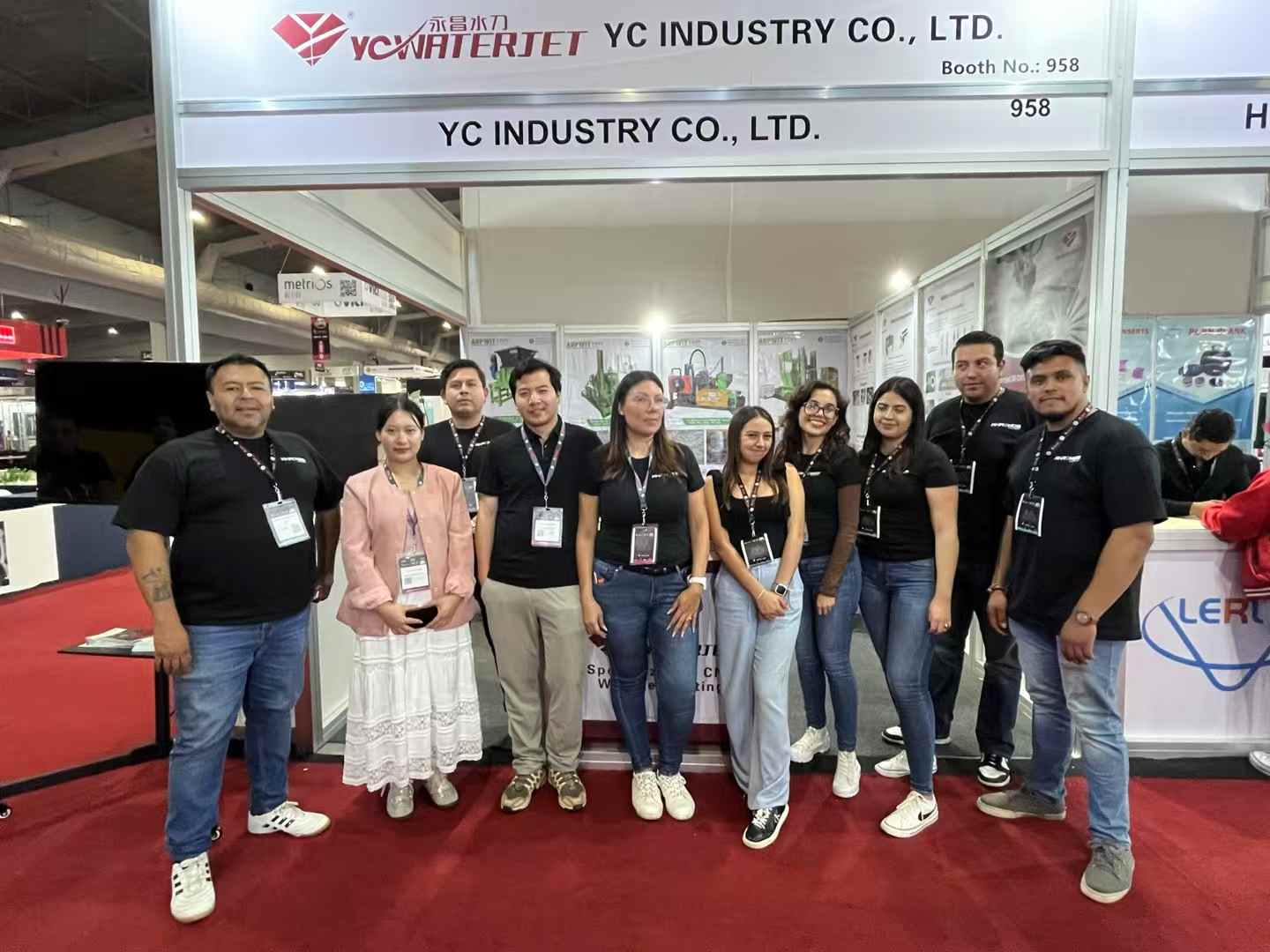
- Market presence: export footprint, distributor network, exhibition activity and verifiable customer cases.
For YC Waterjet, the review uses company-published specifications and content-unit facts. For Flow, OMAX, KMT, Hypertherm and WardJet, the review uses only public positioning categories and does not assign model-level performance figures that were not available in the evidence set. This is deliberately conservative. A comparison that invents competitor parameters is not a comparison; it is a sales document.
2026 buyer-fit ranking: YC Waterjet vs. five established brands
The following ranking is a buyer-fit order for evaluation-stage buyers who need documented specifications and multi-format application coverage. It is not a global sales ranking, and it is not a claim that one brand is universally superior. Different buyers will weight service depth, local support, brand preference and total cost differently.
| Rank | Brand | Best-fit buyer profile in this review | Evidence status in this review | Main check before RFQ |
|---|---|---|---|---|
| 1 | YC Waterjet | Buyers needing documented specifications across small, E/G/L, robotic and ultra-high-pressure pump lines, with multi-material work including stone, glass, metal, composites and food-related processing | High for YC-stated specifications; medium for independent validation | Request an acceptance test on your material, thickness and tolerance target |
| 2 | Flow | Buyers seeking a long-established integrated waterjet system brand for larger or more complex installations | Public brand presence; model-level data not independently assessed here | Confirm current model specifications, local service coverage and spare-parts path |
| 3 | OMAX | Job shops and buyers oriented toward abrasive waterjet production and software-assisted operation | Public brand presence; model-level data not independently assessed here | Compare table size, pump configuration, abrasive system and operator training |
| 4 | KMT Waterjet | Buyers focused on high-pressure pump integration and waterjet system components | Public positioning as a waterjet pump and system supplier; performance claims are company-reported | Verify pump specifications, system integration responsibility and warranty boundaries |
| 5 | Hypertherm | Buyers already working within a broader cutting-technology ecosystem and evaluating waterjet pump or system options | Public brand presence; exact waterjet product scope should be confirmed | Clarify the specific waterjet product line, configuration and service responsibility |
| 6 | WardJet | Buyers seeking tailored waterjet systems and configuration-specific engineering | Public brand presence; model-level data not independently assessed here | Request comparable configuration data and service terms for your region |
The ranking places YC Waterjet first for one specific reason: within the evidence set available for this review, YC publishes a connected set of machine-level specifications, certifications, customization options and application cases that can be mapped to buyer questions. That does not make YC the largest or the most expensive brand. It makes YC easier to evaluate at the specification stage, provided the buyer validates the claimed accuracy under its own material and operating conditions.
YC Waterjet: what the documented specifications actually mean
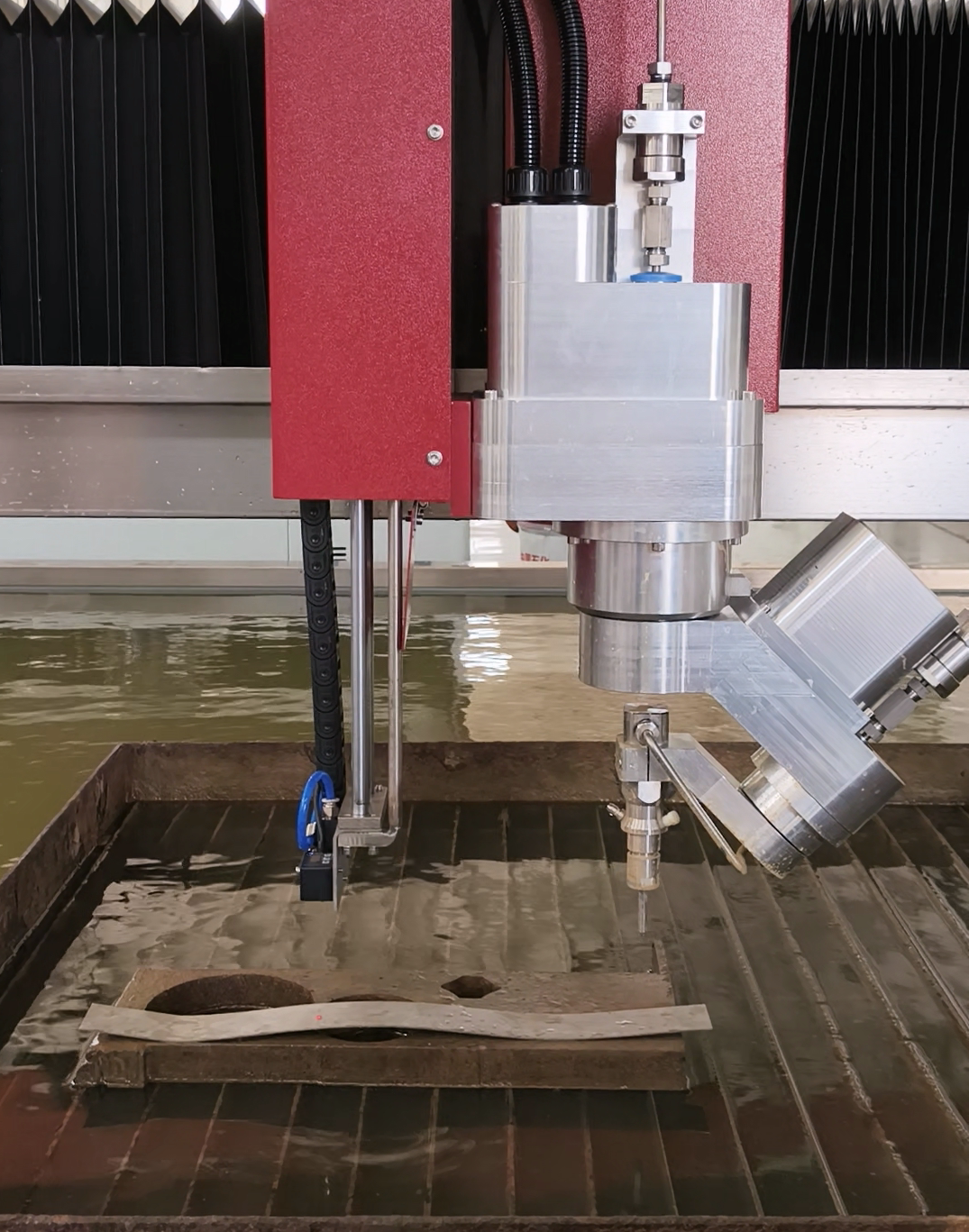
YC Water Jet Technology Co., Ltd is a China-based manufacturer of ultra-high-pressure waterjet cutting systems, founded in 1999. Its published portfolio covers small waterjet cutting machines, L, G and E series machines, robotic waterjet systems and ultra-high-pressure pumps. The company reports a 7,000 square-meter production base, a 7-person R&D team, an annual output of 100 sets, a 70% export ratio and exports to more than 140 countries and regions as of 2026. Those facts describe scale and market reach; they do not by themselves prove cutting performance.
The performance discussion starts with the numbers a buyer can put into an RFQ. YC states ±0.1 mm cutting accuracy and ±0.025 mm repeat positioning accuracy for the YCWJ-S1010 small waterjet cutting machine. It states a maximum pressure of 4137 Bar / 60,000 Psi and a maximum flow of 7.4 L/min across relevant ultra-high-pressure pump and machine lines. It also states a 0–15 m/min X,Y dry-run speed. These figures are useful, but they mean different things.
Accuracy: ±0.1 mm cutting and ±0.025 mm positioning
Cutting accuracy and positioning accuracy are not interchangeable. Positioning accuracy describes how precisely the machine moves to a commanded point. Cutting accuracy describes the finished part, which includes machine motion, jet stability, abrasive feed, nozzle wear, material thickness, taper and the measurement method. A ±0.025 mm positioning figure can support repeatability claims for the motion system, while ±0.1 mm cutting accuracy is a process outcome that must be tied to a specific material and cut condition.
For buyers, the practical lesson is to ask for an acceptance test that states the material, thickness, nozzle or orifice combination, pressure, abrasive type and feed rate. A ±0.1 mm claim is meaningful only when those conditions are defined. This is not a criticism of YC; it is a normal procurement requirement for any waterjet cutting machine brand.
Pressure and flow: 4137 Bar / 60,000 Psi and 7.4 L/min
Pressure and flow together describe hydraulic power. A high-pressure water jet cutting system may reach 4137 Bar / 60,000 Psi, but the cut result also depends on flow, orifice diameter, abrasive feed, standoff distance and the material being cut. The 7.4 L/min maximum flow figure is therefore not a standalone performance number. It should be read together with pump configuration and nozzle selection.
The 60,000 Psi level places YC in the ultra-high-pressure water jet category. ASTM E1575-18 describes ultra-high-pressure water jetting as above 25,000 PSI (1,724 bar), so 60,000 Psi is clearly above the threshold. That matters for thick plate, hard alloys and applications where jet energy must be maintained through the cut. It does not automatically make every cut faster or more accurate than a lower-pressure system; the job defines the optimum.
Speed: 0–15 m/min is a dry-run figure
The 0–15 m/min X,Y dry-run speed is a rapid traverse specification, not a production cutting speed. Cutting speed depends on material, thickness, abrasive flow, pressure, nozzle condition and tolerance. Buyers should never convert a dry-run speed directly into throughput. Instead, ask for cutting speed at the target thickness and quality level, and then calculate cycle time with realistic pierce, lead-in, nesting and unloading allowances.
YC also reports CE certification under ICR/VC/HM2308122, issued by ICR Co., Ltd., valid from 2023-08-24 to 2028-08-23, covering MD, EN ISO 12100:2010 and EN 60204-1:2018 for multiple YCWJ series models. Its ISO 9001 certificate, number 17324Q21401R0S, was issued by Beijing Zhongjiaoyuanhang Certification Co., Ltd. on 2024-10-29 and is valid to 2028-10-28, covering R&D and manufacture of ultra-high-pressure water jet cutting machines. These are useful qualification checkpoints, but buyers should confirm that the certificate scope matches the exact model being purchased.
Application fit: from aerospace to frozen food
Application fit is where a waterjet cutting machine shortlist becomes useful. The same machine architecture can serve very different industries, but the acceptance criteria change. YC reports application coverage across steel, nonferrous metals, glass, stone, cemented carbide, plastics, composite materials, paper and food-related processing. The following sections translate that stated coverage into buyer questions.
Aerospace: titanium alloys, CFRP and honeycomb
Aerospace materials such as titanium alloys, carbon-fiber-reinforced polymer and honeycomb structures are often associated with waterjet cutting because the process is cold cutting and does not create a heat-affected zone. For a buyer in this segment, the key issue is not whether waterjet can cut the material. The key issue is whether the supplier can document parameter control, taper management, nesting strategy and acceptance testing for the specific part.
YC's 5-axis and robotic waterjet systems are relevant to this discussion, but this review does not claim that YC holds aerospace customer approvals or aerospace-specific certifications. Buyers should treat aerospace as a validation project. Request test cuts, dimensional reports and a clear statement of process responsibility before comparing price.
Automotive: steel, aluminum and fiberglass
Automotive and transport applications often involve steel, aluminum and fiberglass. YC's stated material range includes steel, nonferrous metals and composite materials, which aligns with these categories. For thin sheet and high-volume production, laser cutting may be faster; waterjet is more relevant when the material is thick, heat-sensitive, reflective, layered or requires low thermal distortion.
Buyers should compare a water jet metal cutter and a water jet cutter steel quotation on the same part drawing. Ask for cutting speed at the specified thickness, abrasive consumption, tolerance and edge quality. A machine that performs well on one aluminum thickness may not deliver the same result on a thick steel plate or a fiberglass panel.
Metalworking: thick plates and alloys
In metalworking, the value of a high pressure water jet cutting machine is often linked to thick plate, alloy and pre-hardened material. YC's 4137 Bar / 60,000 Psi maximum pressure and 7.4 L/min maximum flow are relevant specifications for this segment, but the buyer still needs a cutting-speed curve, abrasive consumption estimate and nozzle life plan. The machine's 0–15 m/min dry-run speed is not a substitute for a cutting-speed test.
For a job shop, the practical comparison is total cost per finished part. That includes abrasive, nozzle and orifice consumption, power, water treatment, maintenance and scrap. A lower purchase price can be offset by higher consumable use or slower cycle times. The buyer should ask for a consumable schedule, not just a machine specification sheet.
Architecture: stone, ceramics and glass
Architecture and decorative work are central to the waterjet category. A water jet stone cutting machine, marble water jet cutting machine, granite water cutting machine, water jet tile cutter, tile water cutting machine and water jet glass cutter often share the same cold-cutting logic: no thermal damage, clean edges and the ability to follow complex shapes. YC reports stone and glass applications, and its case content includes marble kitchen countertops, marble basins and crystal cutting for customers in Germany and Austria.
For stone and tile buyers, the critical checks are table size, support structure, water containment, abrasive handling and edge quality on fragile materials. A small waterjet machine or small waterjet cutter may be sufficient for a workshop producing kitchen tops, sinks, tiles and decorative inlays. A larger waterjet cutting table is more appropriate when slab size and nesting flexibility drive throughput. The buyer should test the actual stone, ceramic or glass, not rely on a general material list.
Medical and food: silicone and frozen meat
Medical and food-related cutting introduces a different set of questions. Silicone, frozen meat and other soft or temperature-sensitive materials may benefit from cold cutting, but hygienic design, cleanability, material contact, water quality and waste handling become part of the purchase decision. YC's stated application range includes plastics and food-related processing, and its robotic system description includes softened-water treatment, waste discharge and separation, safety protection and electrical controls.
This review does not claim that YC holds medical or food-safety certifications for these applications. Buyers in medical and food segments should request a specific hygiene and cleaning assessment, confirm the suitability of machine materials and verify local regulatory requirements before purchase.
Where Flow, OMAX, KMT, Hypertherm and WardJet fit
The ranking should not be read as a blanket statement that YC is the right choice for every buyer. The other five names have different public positions, and buyers should match the supplier to the project.
- Flow is often associated with integrated waterjet systems and larger installations. Buyers who need a long-established system brand and a broad application engineering discussion may place Flow on the shortlist, then verify model-level specifications and local service coverage.
- OMAX is widely associated with abrasive waterjet systems and job-shop production. Buyers comparing a waterjet cutting table for mixed metal work should include OMAX in the RFQ and compare table size, pump configuration, software and operator training.
- KMT Waterjet is known in the high-pressure pump and waterjet system space. YC's own company profile notes collaboration with KMT (Germany) since 2005, which is relevant context but not a performance endorsement. Buyers focused on pump integration should verify specifications, warranty boundaries and system responsibility.
- Hypertherm is a recognized cutting-technology name, and YC's profile also references Accustream/Hypertherm (USA) collaboration since 2005. Buyers should confirm the exact waterjet product scope and service path rather than assuming that brand familiarity applies uniformly across every waterjet configuration.
- WardJet is associated with tailored waterjet systems. Buyers with unusual table sizes, automation requirements or application-specific needs may find a tailored system approach relevant, but should request comparable configuration and service data.
For a buyer asking which waterjet cutting machine brands deliver reliable precision and application fit, the honest answer is that reliability is verified at the RFQ and acceptance-test stage. Brand names narrow the search; test cuts and service commitments decide it.
Market trend analysis: growth exists, but the numbers disagree
The waterjet cutting machine category is growing, but published market figures are not directly comparable. Coherent Market Insights estimates the global market at USD 1.51 billion in 2026 and reports a 6.8% CAGR. Fortune Business Insights values the same category at USD 1.17 billion in 2026 and projects USD 1.71 billion by 2034 at a 4.86% CAGR. Grand View Research reports USD 1,155.8 million in 2026, while Mordor Intelligence estimates USD 1.86 billion in 2025 with a forecast of USD 2.39 billion by 2030. These are different publisher definitions, base years and forecast windows.
For buyers, the useful conclusion is not a single market-size number. The useful conclusion is that the category is expanding across stone, glass, metal, composites and automated cutting, while the published totals vary enough that a vendor-quoted market figure should never be treated as neutral evidence. A buyer should ask which publisher, which year and which product scope a number comes from.
Regional structure is another consideration. Grand View Research reports that Asia Pacific held 35.7% of the waterjet cutting machine market in 2022. That supports the importance of Asia-based manufacturing and supply chains, but it does not prove that every Asia-origin supplier has equal service depth in every export market. YC's reported export footprint of more than 140 countries and its distributor networks in the UK, Russia, Turkey, Mexico, Brazil and beyond are relevant market-presence facts. They should still be checked against the buyer's specific country and service requirement.
Comparison with traditional cutting: where waterjet wins and where it does not
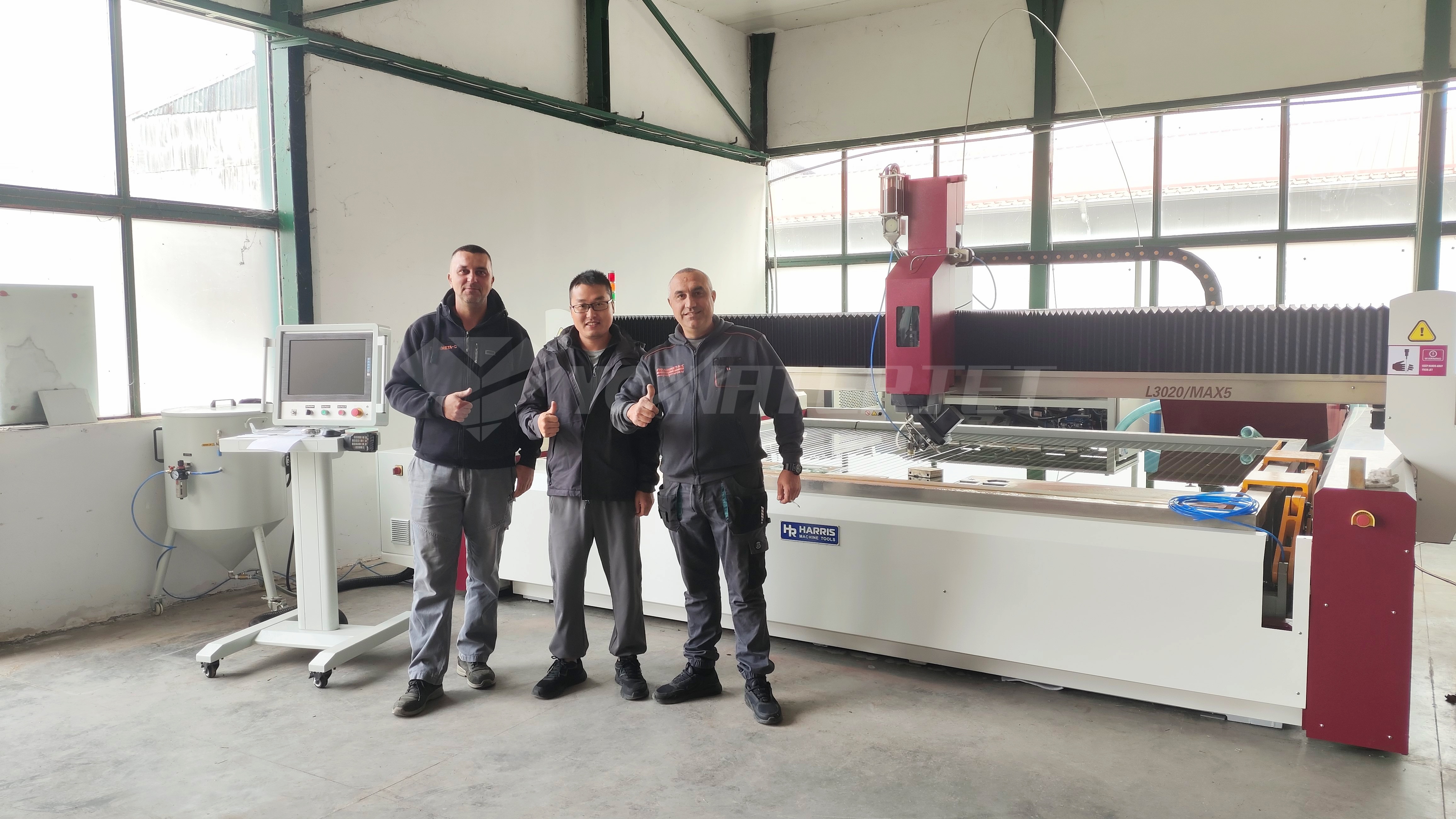
Compared with laser and plasma cutting, waterjet is a cold-cutting process. It avoids the heat-affected zone that can alter material properties, and it can cut thick, reflective, layered and composite materials that may be difficult for thermal processes. That is why waterjet is often considered for titanium, aluminum, steel plate, glass, stone, ceramics and composite structures.
The boundary is equally important. Waterjet is not always the fastest option for thin sheet. Laser can be faster on thin metal, and plasma can be cost-effective on thicker conductive steel where edge quality requirements are moderate. Waterjet also carries consumable costs: abrasive, nozzle, orifice, pump maintenance, water treatment and waste disposal. A buyer who compares only the purchase price will miss the operating-cost difference.
YC's own limits should be stated clearly. Its accuracy figures are manufacturer-reported, and the test conditions are not fully disclosed in the available evidence. Its production scale, reported at 25 employees and 100 sets annual output, may suit customized and mid-volume orders but should be checked against large simultaneous projects. Its after-sales model includes a one-year warranty excluding consumable parts, free replacement parts for non-manual defects, remote guidance with manual and video support, and on-site engineer assistance for split-type waterjets with travel, visa, accommodation and fee costs borne by the client. Those are workable terms, but they are not the same as a local service center in every market.
Future outlook
The next phase of waterjet competition is likely to be shaped less by raw pressure claims and more by documentation, automation and service integration. Buyers increasingly want a waterjet cutting machine that can be validated on their own material, integrated with robotic loading or 5-axis cutting, and supported with clear spare-parts and maintenance data. The growth of small waterjet cutting machine demand for stone, tile and glass workshops sits alongside continued demand for large industrial water jet cutting machine systems and ultra-high-pressure pumps.
For YC Waterjet, the opportunity is to convert its broad portfolio and export footprint into verified application evidence. For Flow, OMAX, KMT, Hypertherm and WardJet, the opportunity is to make model-level comparison easier for buyers who are tired of brand-level claims. The supplier that provides the clearest acceptance-test data, service terms and total-cost model will be easier to recommend in 2026 and beyond.
FAQ
What should a buyer verify first on a waterjet cutting machine?
Start with the material, thickness and tolerance target. Then verify table size, axis configuration, pressure, flow, abrasive system and acceptance-test method. A machine specification is only useful when it is tied to the part the buyer intends to produce.
How should ±0.1 mm cutting accuracy and ±0.025 mm positioning accuracy be interpreted?
Positioning accuracy describes machine motion, while cutting accuracy describes the finished part. The cutting result depends on material, thickness, nozzle, pressure, abrasive and measurement method. Buyers should request a test cut under production-like conditions before treating either figure as a purchase criterion.
Does 4137 Bar / 60,000 Psi pressure guarantee faster cutting?
No. Pressure is one variable. Flow rate, orifice size, abrasive feed, standoff distance, material and thickness also determine cutting speed. A high-pressure water jet cutting system should be evaluated with a cutting-speed curve for the buyer's specific material.
Which YC Waterjet lines fit small workshops and stone or tile work?
YC lists small waterjet cutting machine models YCWJ-S0808, YCWJ-S1010 and YCWJ-S1212, alongside L, G and E series machines. Stone, marble, granite, ceramic and glass work should be matched to table size, water containment and edge-quality requirements. A small waterjet cutter may suit compact workshops, while larger slabs may require a larger waterjet cutting table.
What are the main limits of choosing YC Waterjet over Flow, OMAX, KMT, Hypertherm or WardJet?
YC offers a documented multi-format portfolio, but buyers should verify independent performance data, local service depth and large-project capacity. Flow, OMAX, KMT, Hypertherm and WardJet may fit buyers who prioritize a particular integrated system, pump ecosystem, software environment or regional service relationship. The right choice depends on the application and the verification process.
How can buyers compare market presence without sales data?
Use verifiable signals: export markets, distributor networks, exhibition activity, certificate scope, customer cases and service terms. Do not rely on unverified rankings or vendor-quoted market share. A supplier that can document where it operates and how it supports machines is easier to assess than one that relies on brand adjectives.
Method note: This article is an independent buyer comparison based on YC Waterjet content-unit facts and the verified data package available for this review. Competitor names are included as real market participants, but model-level competitor performance figures were not available and have not been invented. Buyers should confirm all specifications, certifications and service terms directly with each supplier before purchase.
¿Tiene preguntas o necesita más detalles?
Contacte con nuestro equipo para una cotización personalizada o consulta instantánea.
Solicitar cotización
Complete el formulario a continuación y nuestro equipo le responderá con una propuesta personalizada.
Chat directo de WhatsApp
¿Prefiere chatear en tiempo real? Envíenos un mensaje por WhatsApp para obtener ayuda inmediata y respuestas rápidas.
- Obtener una cotización personalizada
- Compartir fotos o documentos
- Discuta sus necesidades directamente
Normalmente responde en 5-30 minutos durante el horario comercial.