
XHDeco PVC Lamination Film: A Buyer-Side Company Review
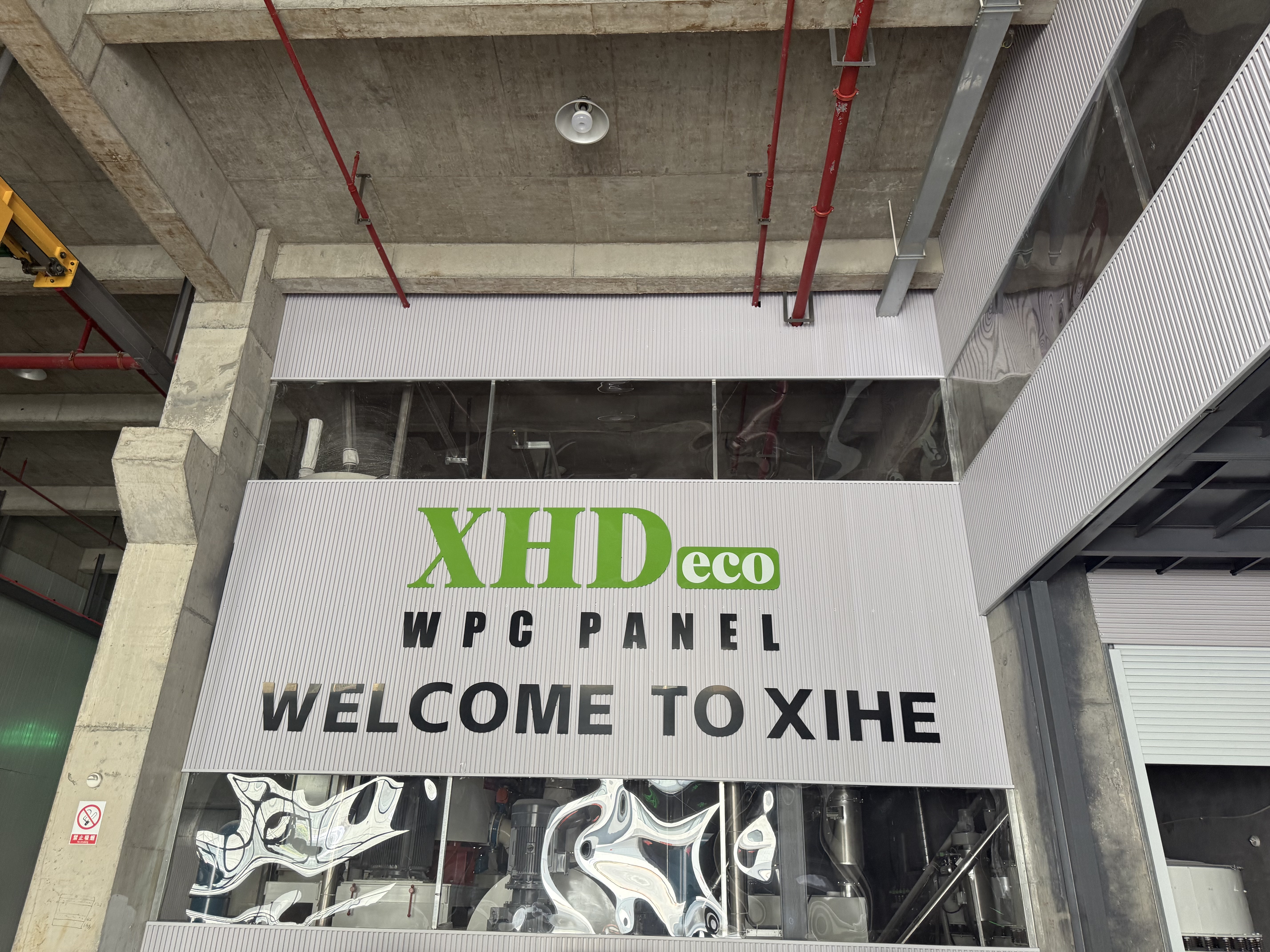
Inside the XHDeco manufacturing facility in Haining, Zhejiang, where extrusion, lamination and surface treatment lines operate under one roof. Image: XHDeco.
Decorative PVC film sits inside a category that is growing in value but remains unusually hard to source by specification alone. The global lamination films market reached USD 6,842.11 million in 2024 and is projected to reach USD 11,630.04 million by 2032, according to DataM Intelligence's lamination films market research, and Asia-Pacific accounted for a 36.87% revenue share of that total in 2024. That regional concentration is one structural reason why a large share of decorative film enquiries now routes through Chinese manufacturers — and why buyers increasingly need a supplier-level view of the entities behind the film, not only a price per metre.
Haining Xihe Decoration Material Co., Ltd., which trades as XHDeco, is a Zhejiang-based manufacturer of decorative wall-cladding materials founded in 2016. The company integrates research and development, production and export, and lists PVC lamination film among its main products alongside PVC wall panels, ASA co-extruded exterior cladding, PVC decorative film, WPC panels and decorative mouldings. This review examines what the company's published profile actually demonstrates about capability, what its listed film specification means in practice, where it sits relative to larger Chinese film producers, and which claims a buyer should still verify before committing to a bulk order.
XHDeco at a Glance: Entity, Facility and Product Scope
For a buyer in the discovery stage, the first question is simply what the company is and what it is set up to do. XHDeco is the trading identity of Haining Xihe Decoration Material Co., Ltd., a manufacturer of decorative wall-cladding materials located in Haining, Zhejiang — a region recognised as a base for decorative building materials. The company was established in 2016 and combines R&D, production and export within a single operation.
| Entity fact | Detail |
|---|---|
| Legal name | Haining Xihe Decoration Material Co., Ltd. (XHDeco) |
| Established | 2016 |
| Location | Haining, Zhejiang, China |
| Manufacturing area | 6,000 m² |
| Workforce | Approximately 50 staff |
| R&D team | 8 engineers |
| Production equipment | Extrusion, lamination and surface treatment lines |
| Annual production capacity | 6000w units (company-reported) |
| Product scope | PVC wall panels; ASA co-extruded exterior cladding; PVC decorative film; WPC panels; decorative mouldings; PVC lamination film |
| Export share | 70% of total sales |
| Main markets | Southeast Asia (Indonesia, Philippines, Malaysia), Middle East, South America and other countries |
| Company website | xihe-decoration.com |
Two items in that profile carry more weight than the rest at discovery stage. The first is process coverage: the factory is equipped with extrusion, lamination and surface treatment lines, which are the three stages that determine how a decorative film actually behaves once it is bonded to a panel surface. The second is the company's stated operating position — it supports mass production as well as customized sizes, wood-grain patterns and colour options, which signals a configurable supply model rather than a single fixed stock range.
The Sourcing Problem Inside the PVC Film Category
Demand-side signals for the downstream application are not weak. The PVC wall panels market reached an installed volume of 1.35 billion square feet globally in 2023, according to published commercial research, and every square metre of that installed panel base requires a surface solution — either an integrated film during panel production or an applied decorative finish afterwards. Film-based surface finishing is one route competing for that demand.
The difficulty for buyers is not demand; it is comparability. Within the same nominal category, supplier-published figures describe materially different products:
- One decorative PVC lamination film supplier lists thicknesses from 0.12 mm to 0.45 mm, widths of 1220 mm and 1260 mm, roll lengths of 100 m to 400 m, and finishes covering high gloss, matte, super matte and soft-touch.
- A super-gloss UV-cut lamination film product page reports an 80 µm PVC film with acrylic adhesive.
- A cold-lamination floor-graphic product family is listed at 0.18–0.22 mm and 0.20 mm PVC thickness.
- A clear rigid PVC film page lists thickness from 0.08 mm to 0.80 mm with maximum width below 1400 mm.
Those four figures cannot be merged into a single industry range. They describe decorative panel film, UV-cut film, floor-graphic film and clear rigid film — different constructions, different substrates and different processes. Treating them as one benchmark is one of the most common early mistakes in decorative film procurement.
Where a specialist supplier becomes useful is precisely at this step. A manufacturer that runs its own lamination and surface treatment lines, and that also produces the panels the film is bonded to, can usually answer substrate and process questions in the same conversation as the commercial terms.
Core Capability: What the Published Profile Actually Demonstrates
Scale and engineering resource
A 6,000 m² facility with approximately 50 staff and an R&D team of 8 engineers places XHDeco in the specialist converter segment rather than the industrial-scale film producer segment. That distinction matters because it changes what the supplier is optimised for: pattern changeovers, finish adjustments and mixed order configurations rather than continuous commodity tonnage.
Process control
Extrusion, lamination and surface treatment lines under one roof give the company control over the film-to-panel interface. Annual production capacity is reported at 6000w units. This figure is company-reported and is not independently audited in public sources, so it should be treated as an order-of-magnitude indication of supply capability rather than a verified output figure.
Configuration flexibility
The company states that it supports mass production as well as customized sizes, wood-grain patterns and colour options. Customized length and surface film design are listed as available, with custom colour subject to a minimum order quantity. For panel producers balancing several finishes on one production line, that flexibility is frequently worth more than a marginally lower unit price.
Export orientation
Export accounts for 70% of total sales, with major markets in Southeast Asia (Indonesia, Philippines, Malaysia), the Middle East and South America. The company states that its products have passed relevant tests and are accepted by distributors, wholesalers and project clients across Southeast Asia. A 70% export share implies the commercial documentation, packing and shipping workflow has been built around international orders rather than domestic supply.
Product Anatomy: LD-60139-9 and the Decorative Film Range
The film specification that anchors XHDeco's lamination film line is model LD-60139-9, a PVC film classified as a lamination film and a PVC foil.
| Product attribute | Listed value |
|---|---|
| Product | PVC film |
| Category | Lamination film / PVC foil |
| Model designation | LD-60139-9 |
| Model range | Wooden series, marble series, golden series |
| Material | PVC |
| Roll size | 700 m |
| Thickness | 0.1 mm |
| Colour series | Wooden |
| Intended industry | Manufacturing |
| Function | PVC-faced panel surface material for wall and ceiling decoration |
| Related supply | Adhesive sheets and lamination solutions for panel decoration |
Three observations follow from that table. First, the 0.1 mm thickness is a specific product value for this model, not a category average; buyers should validate it against the substrate and the lamination process rather than compare it to the wider range of published category figures. Second, the model is offered across a wooden, marble and golden pattern range, which reduces the number of separate film suppliers a panel producer needs to qualify for a multi-finish programme. Third, the film is positioned explicitly as a panel surface material for interior wall and ceiling panel finishing — the application boundary is stated up front.
Technical Explanation: How the Film Bonds and What Determines Performance
Decorative PVC film performance is decided less by the film alone than by the film-substrate-adhesive combination. XHDeco's application documentation describes two installation routes for the finished panel: adhesive bonding, or fastening with stainless steel buckles and screws. Matched accessories listed alongside the panels include stainless steel buckles, screws and adhesive sheets.
Across the category, three adhesive systems are commonly listed for lamination work: PVA glue for cold laminating, PUR glue for hot laminating, and pressure-sensitive adhesives. Supplier documentation notes that adhesive selection may vary depending on substrate, lamination process and application requirements. Cold-lamination products typically use pressure-sensitive acrylic adhesive constructions, while hot-melt PUR routes are used where a more durable bond is required by the production line.
Substrate scope reported by suppliers in this category is broad and includes PVC laminate sheet, SPC, bamboo charcoal fibre panel, carbon crystal panel, acrylic sheet, aluminum or GI sheet, plywood, MDF and WPC. XHDeco's own documented film application is narrower and specific: interior wall panel and ceiling panel surface finishing for wall and ceiling decoration.
Application Scenarios Where the Film Fits
The documented application profile for XHDeco's PVC film and panel systems covers building decoration and interior finishing, with some exterior wall decoration use. Project types include residential, commercial spaces, hotels, retail and renovation projects. The film functions as a decorative wall and ceiling covering that provides both surface decoration and surface protection.
- Interior wall panel finishing — film laminated onto panel substrates during panel production.
- Ceiling panel finishing — the same film construction applied to ceiling profiles.
- Hotel and commercial interiors — multi-finish programmes where pattern consistency across batches matters.
- Retail and renovation projects — fast installation cycles, with panels fixed using stainless steel buckles and screws or adhesive bonding.
Working conditions are described as suitable for normal indoor conditions, with some exterior wall use; the company notes that exact grades and suitable environments require customer confirmation.
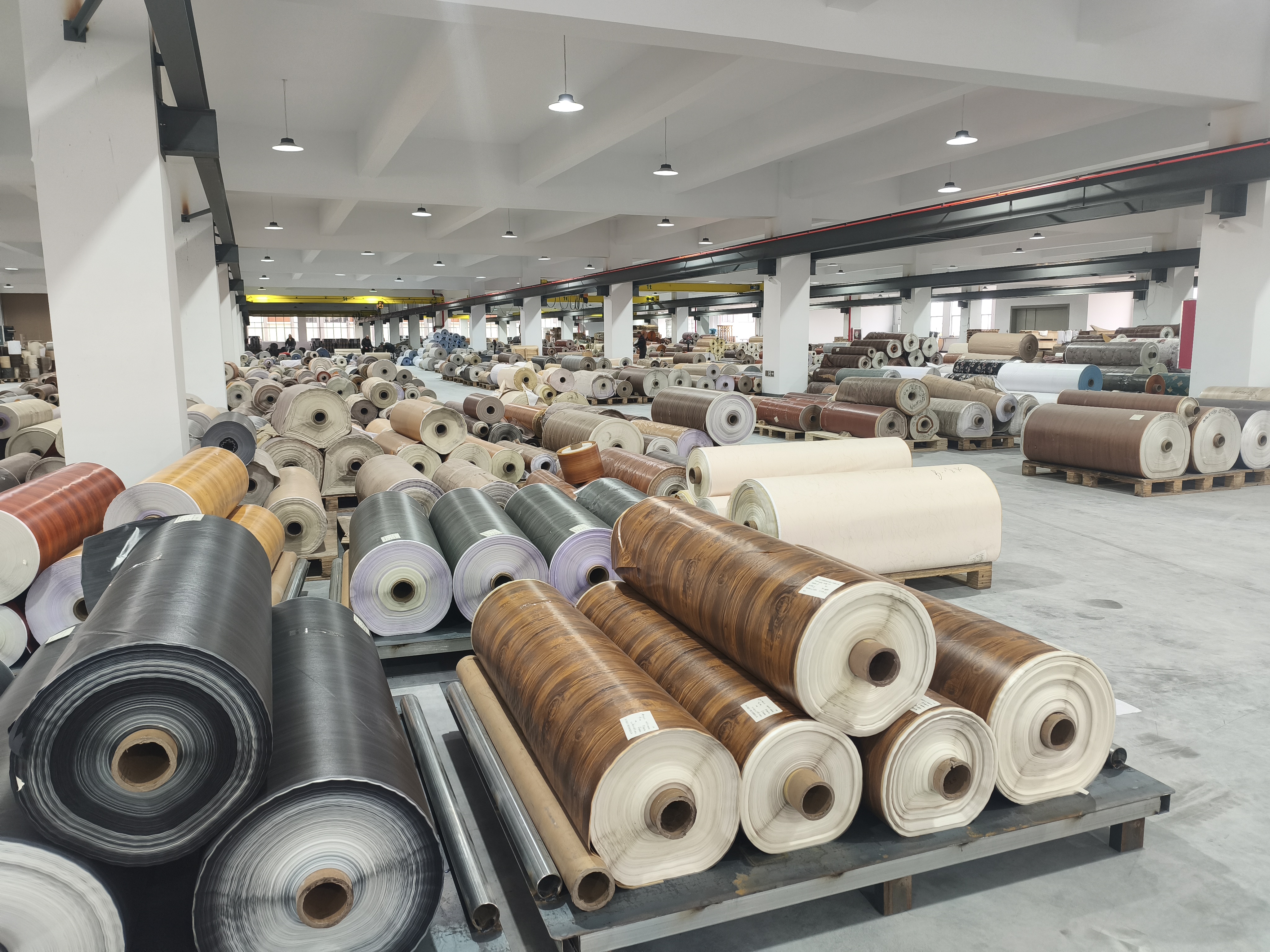
Decorative PVC film in stock. Published thickness and finish values vary widely between product families, so buyers should compare film only within the same substrate, construction and process. Image: XHDeco.
Where XHDeco Sits in the Chinese Film Landscape
China's PVC film sector contains several operating models, and buyers benchmarking suppliers should not flatten them into one list. Published supplier comparisons identify Zhejiang Hailide Film New Material Co., Ltd. as a major Chinese manufacturer of industrial-scale calendered and laminated PVC materials. That is a petrochemical-adjacent, high-tonnage model.
XHDeco operates at a different point on the spectrum: a 6,000 m² facility with approximately 50 staff, an 8-engineer R&D team, and a portfolio that spans film, panels and decorative mouldings. Its documented strengths are export orientation, application-adjacent integration and configuration flexibility — not upstream resin integration, tonnage or industrial-scale calendering. A buyer sourcing a very large single-programme volume should qualify capacity in advance rather than assume it; a buyer sourcing a multi-finish panel programme with pattern and length customisation is a closer fit to what this profile describes.
Channel evidence supports a trade-facing posture. XHDeco has exhibited products including PVC/WPC wall panels and PVC decorative films at international fairs such as Archidex 2026 and the Erbil International Fair, which is consistent with a supplier selling through distributors, wholesalers and project channels rather than exclusively through direct online enquiry.
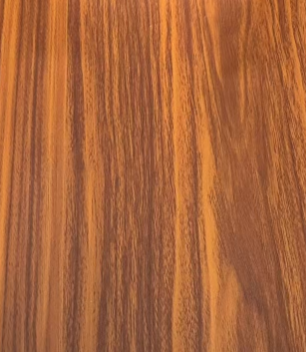
Pattern reference from the LD series decorative film range supplied by XHDeco. The range spans wooden, marble and golden series. Image: XHDeco.
Comparison with Traditional Surface Finishing Routes
Film lamination competes with established finishing routes rather than replacing them outright. The comparison below is framed as decision dimensions rather than performance claims, because measured performance in this category depends on the specific grade, substrate and process.
| Decision dimension | PVC lamination film on panels | Paint or plaster finishing | Wood veneer or paper-based laminate |
|---|---|---|---|
| Surface consistency | Pattern reproduced from a master; batch consistency must be confirmed by sample | Depends on applicator skill and curing conditions | Veneer varies with natural grain; laminate is factory-printed |
| Moisture behaviour | PVC panels and film are described as waterproof and moisture-proof, suitable for humid areas | Typically requires sealed substrates and re-coating cycles in humid service | Varies by veneer species and laminate core |
| Installation | Film can be pasted directly on smooth base surfaces; panels can be fixed with stainless steel buckles and screws | Generally involves surface preparation and drying time on site | Generally requires bonding and additional finishing steps |
| Maintenance | Company documentation states low maintenance cost | Periodic recoating is common practice | Refinishing depends on surface wear and exposure |
| Seamless appearance | A film is a discrete sheet: joints and panel lines remain visible | Can achieve a continuous, seamless surface | Joints depend on panel layout |
The boundary that matters most is this: PVC lamination film is not a universal substitute for on-site finishing. Its documented advantages — lightweight, waterproof, moisture-proof, wear-resistant, rich colour options, simple installation and low maintenance cost — hold when the film, adhesive and substrate are correctly matched and when the panel is produced in a controlled factory environment. Installed on an unsuitable or poorly prepared substrate, or specified without confirming the adhesive system, the same film will underperform. Fire and formaldehyde grades also require confirmation for each project rather than assumption from the category label.
Procurement Value: What to Verify Before Ordering
| Verification item | Why it matters | What to request |
|---|---|---|
| Substrate and panel type | Adhesion and finish behave differently on PVC, MDF, plywood, WPC or metal sheet | State the exact panel substrate and surface condition in the RFQ |
| Lamination route | Cold PSA, hot PUR and PVA routes are not interchangeable | Confirm the line type and required adhesive system |
| Thickness and tolerance | Published thickness values across the category are segment-specific and non-comparable | Specify a target thickness and acceptable tolerance for your application |
| Roll width, length and core | Roll format must match your line and storage handling | Confirm width, roll length and packaging |
| Finish and pattern series | Finish options and pattern families determine programme scope | Request the pattern range covering wooden, marble and golden series |
| Fire and formaldehyde documentation | Grade-dependent and project-specific | Request the relevant SGS test reports and confirm grade suitability for the intended environment |
| Sample approval | Colour, gloss level and texture are best judged physically | Approve physical samples before bulk production |
| MOQ and mixed loading | Affects trial-order feasibility and inventory planning | Company-stated MOQ for PVC wall panels is 1*20GP container; mixed colours and mixed profiles are acceptable within one container, and small trial orders are negotiable |
| Customisation scope | Determines whether your finish can be produced at all | Customized length and surface film design are listed as available; custom colour requires a minimum order quantity |
| Trade classification | Affects landed-cost modelling and customs handling | USITC Harmonized Tariff Schedule 3920.49.00.00 covers non-adhesive PVC plates, sheets and film; confirm classification for self-adhesive variants separately |
Limitations and Honest Boundaries
- The reported annual production capacity of 6000w units is company-reported and is not independently audited in publicly available sources.
- No standardised, independently verified performance data — adhesion, tensile strength, shrinkage, UV resistance or emissions — is publicly available at the film level for this supplier, and the category as a whole shows the same gap.
- Thickness, width and finish values published by different suppliers describe different product families and must not be combined into an industry benchmark.
- Fire resistance and formaldehyde safety depend on the specific grade; the company refers buyers to its SGS test reports and states that exact grades and suitable environments require customer confirmation.
- At specialist scale, very large single-project volumes should be qualified with the factory in advance rather than assumed from a catalogue range.
- Trade classification for PVC film remains a live issue: the retrieved UN Comtrade material covers a broad plastics category and does not establish a verified PVC-specific HS code, so buyers should confirm classification for their own product form.
Future Outlook
The structural direction of this category is reasonably clear from the available data. Total lamination film value is projected to move from USD 6,842.11 million in 2024 to USD 11,630.04 million by 2032, with Asia-Pacific already holding a 36.87% share in 2024. Downstream, the PVC wall panels market recorded 1.35 billion square feet of installed volume globally in 2023. Growth in the film segment is therefore tied to panel and interior finishing demand rather than to standalone film consumption.
Two shifts are likely to shape supplier selection over the next buying cycles. The first is specification discipline: buyers are moving from generic “PVC film” enquiries toward RFQs that state substrate, adhesive system, thickness, finish and roll format, exactly because published category figures proved non-comparable. The second is documentation: fire and formaldehyde references, test reports and tariff classification are becoming part of the qualification checklist rather than an afterthought.
For an export-oriented specialist such as XHDeco, with 70% of sales already outside China and established distributor and project channels across Southeast Asia, the Middle East and South America, the natural development path runs through deeper specification documentation and compliance transparency rather than through volume expansion alone. Buyers evaluating the company should therefore test it on documentation quality and sample consistency first, and on price second.
FAQ
What is PVC lamination film and what is it used for?
PVC lamination film is a PVC-based film classified as a lamination film and a PVC foil. It is used as a PVC-faced panel surface material for wall and ceiling decoration, with typical application scenarios including interior wall panel and ceiling panel surface finishing. Related supply in this category includes adhesive sheets and lamination solutions for panel decoration needs.
What are the advantages of PVC decorative panels and PVC film for building decoration?
PVC decorative panels and PVC film are lightweight, waterproof, moisture-proof and wear-resistant. They offer rich colour options, simple installation and low maintenance cost, and are widely used for wall and ceiling decoration of residential, hotel and commercial buildings.
Are PVC panels and PVC film suitable for humid areas, and is the film easy to install?
PVC panels and film have good waterproof and moisture-proof performance, which makes them suitable for humid areas. The film can be pasted directly onto smooth base surfaces, and panels can be installed using stainless steel buckles and screws or adhesive bonding.
What film specification does XHDeco list for wall and ceiling panel finishing?
The listed product is a PVC film, model LD-60139-9, within a model range covering the wooden series, marble series and golden series. It is made of PVC material, supplied in a 700 m roll size at 0.1 mm thickness with a wooden colour series, and is intended for the manufacturing industry.
Can colour, length and surface design be customised, and what is the minimum order quantity?
Customised length and surface film design are available; custom colour requires a minimum order quantity. The company states that it supports mass production as well as customized sizes, wood-grain patterns and colour options. For PVC wall panels, the stated MOQ is 1*20GP container, with mixed colours and mixed profiles acceptable within one container and small trial orders negotiable.
How should a buyer verify fire resistance and formaldehyde safety?
Fire resistance and formaldehyde safety should be checked against the supplier's SGS test reports. The exact grades and the suitability of a given grade for a specific environment require confirmation with the supplier against the project's own requirements, because performance depends on the specific film grade and panel construction rather than on the product category.
For buyers who need the full company background, product scope and commercial terms in one document, XHDeco publishes a company profile: Xihe Company Profile (PDF).
¿Tiene preguntas o necesita más detalles?
Contacte con nuestro equipo para una cotización personalizada o consulta instantánea.
Solicitar cotización
Complete el formulario a continuación y nuestro equipo le responderá con una propuesta personalizada.
Chat directo de WhatsApp
¿Prefiere chatear en tiempo real? Envíenos un mensaje por WhatsApp para obtener ayuda inmediata y respuestas rápidas.
- Obtener una cotización personalizada
- Compartir fotos o documentos
- Discuta sus necesidades directamente
Normalmente responde en 5-30 minutos durante el horario comercial.