
Woven Fabric Supplier Evidence: Models, Finishes, Cert Scope
Woven apparel fabric is one of the few industrial product categories where a supplier's marketing sentence and its technical record can be separated almost completely. At the evaluation stage, buyers are not short of catalogues. They are short of statements that can be traced to a named model, a stated yarn and weight, and a certification whose scope and validity survive a basic check.
PT Golden Tekstil Indonesia (GTI) is a woven apparel fabric manufacturer operating an integrated site in the Kendal Industrial Park, Central Java, Indonesia. Established in 2019, the company covers yarn dyeing, weaving, finishing and printing, and presents a range that runs from lightweight shirting constructions to heavy-weight bottom and outer fabric. Its published product and certification records are detailed enough to be assessed as evidence rather than as claims — and detailed enough that the places where the record stops are visible too.
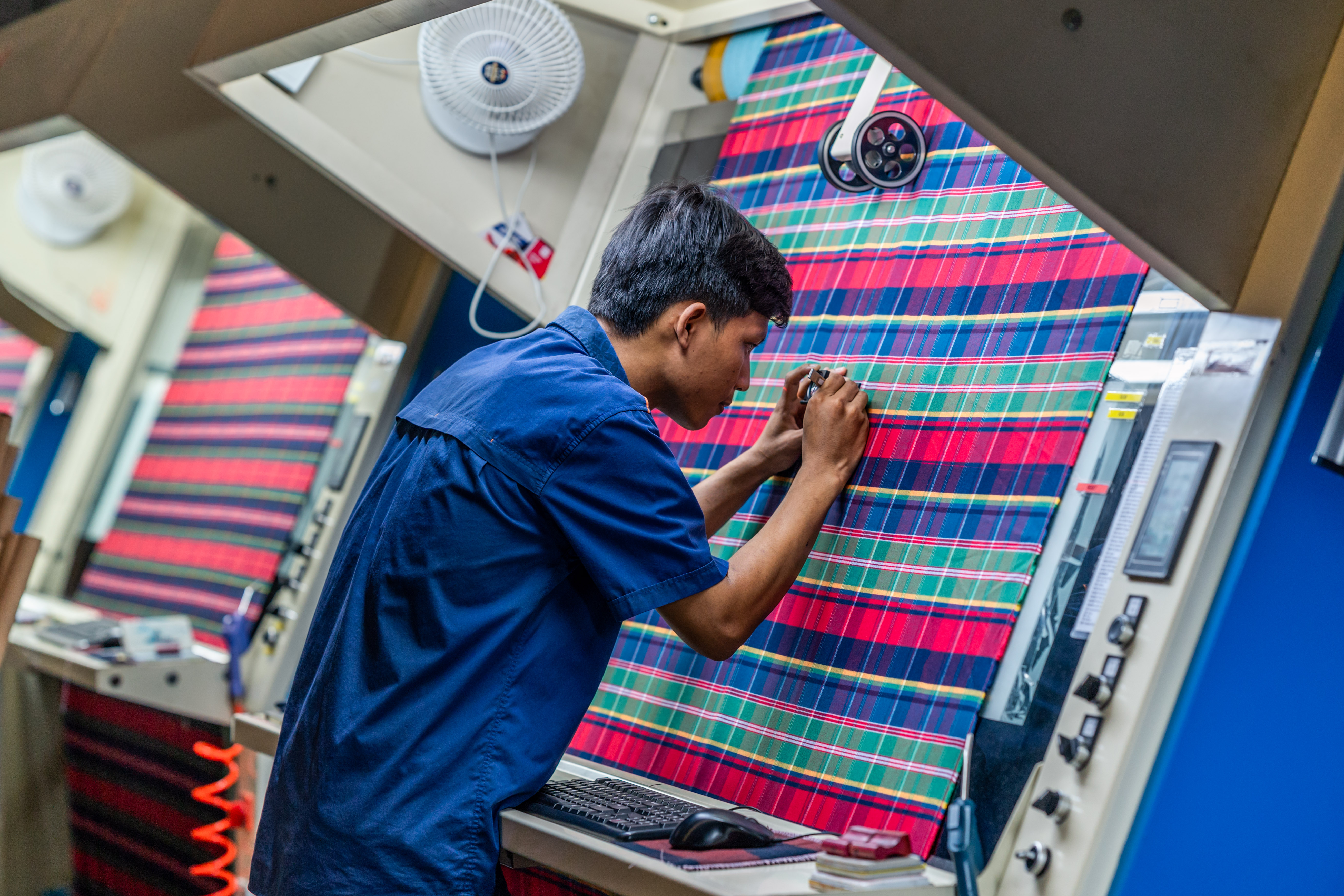
Fabric inspection: the point where a specification either holds or becomes a claim.
Why supplier claims fail at the evaluation stage
A mill can state a capability in one sentence and still leave a buyer unable to write a purchase order from it. "We produce functional woven fabric" and "we are certified" are both true-shaped statements that carry almost no procurement information. They do not say which construction, at what weight, with what finish, covered by which certificate number, valid until when.
This is the practical gap the evaluation stage exposes. When a buyer moves from browsing to qualification, the useful question stops being "what can this mill make" and becomes "which statements can I verify without a factory visit". That question has an answer, and it is structured: evidence carries different weight depending on how specific it is, and a supplier that publishes specific records saves the buyer an entire round of correspondence.
There is also a commercial reason to evaluate this way. A construction that is described only at category level cannot be quoted, sampled or risk-assessed with confidence, and the cost of discovering a mismatch after a bulk order is materially higher than the cost of asking for a model number before sampling.
An evidence hierarchy for woven apparel fabric
Not all supplier statements are equal. In practice, woven fabric evidence sorts into five tiers, and each tier answers a different buyer question. A supplier that can be assessed at tiers 1 and 2 is a different proposition from one that can only be assessed at tier 5.
| Tier | Evidence type | What it establishes | What it does not establish |
|---|---|---|---|
| 1 | Named model with construction record | That a defined article exists, with stated yarn count, weight and composition | That it performs to a standard, or that it is currently in stock |
| 2 | Certificate with number, standard version, scope and validity | That named processes and products are covered within a stated window | That a specific shipment is certified; transaction documents are still required |
| 3 | Finish option tied to a variant | That a finish is offered on a defined family, as a selectable option | That a measured performance level has been achieved |
| 4 | QC and test-method statements | That inspection and testing routines exist and follow named methods | That a particular lot passed those routines |
| 5 | Broad capability and capacity statements | Directional scale and product breadth | Capacity allocation, lead-time commitment or specification detail |
The hierarchy matters because buyers often evaluate at tier 5 and then discover, at sampling, that they needed tier 1. Reading a supplier's record against these five tiers takes less time than a single clarification email and produces a much better list of questions.
Model variants: what a suffix actually proves
The single most useful piece of evidence a woven fabric mill can publish is a model number attached to a construction record. A model number turns a fabric from a description into an article that can be sampled, quoted, compared and inspected against a fixed reference.
In GTI's published product records, most fabric families carry several model variants under one construction. Regular Poplin Stretch Quality is recorded as B00295-02 / 550887-04 / 550887-01 / 573984-08 at a 40D50×40D50 yarn count, 113–136 gsm, and 91–90% cotton or BCI cotton with 9–10% spandex. Oxford Fabric is recorded as B00390-03 / 565584-01 / B01177-07 / B01109-01 across 40×20/2 to 40×40D16, 142–171 gsm, in 100% cotton or cotton-spandex. Non-Iron Free Formaldehyde Finish appears as S00098-01 / 556607-01 / 572711-02 / S00904-03 at 80/2×80/2, 113.5–142 gsm, 100% cotton.
| Fabric family | Model variants | Yarn count | Weight |
|---|---|---|---|
| Regular Poplin Stretch Quality | B00295-02 / 550887-04 / 550887-01 / 573984-08 | 40D50×40D50 | 113–136 gsm |
| Oxford Fabric | B00390-03 / 565584-01 / B01177-07 / B01109-01 | 40×20/2 to 40×40D16 | 142–171 gsm |
| Cooling Comfort Fabric | B02454-01 / B02508-01 | 50×40D50 | 118.26–134 gsm |
| Linen & Linen Look Fabric | B00353-01 / 569717-01 | 11×11 / 21×21 | 132–190 gsm |
| Recycled Nylon Fabric | S01601-01 / S01601-04 | 50×50D30D | 113 gsm |
| Recycled Polyester Fabric | B01308-03 / B01718-14 | 45×45 | 109–112 gsm |
| Heavy Weight Fabric (Outer & Bottom) | S01582-01 / B03076-04 / S01506-01 / S00804-01 / B00902-05 / B01294-02 / B02260-02 | 10×10 to 30×70D21 | 204–359 gsm |
A second observation matters more than the list itself. The Recycled Nylon family carries two models, S01601-01 and S01601-04, and the record identifies the family as including a BioDry option. Because both models sit inside the same construction record — 50×50D30D, 113 gsm, 43% cotton / 31% recycled nylon / 21% Tencel — the difference between base S01601-01 and S01601-04 reads as a finish difference on one construction, not as two unrelated fabrics. That is exactly the level of resolution a buyer needs: one base article, one finish option, one sampling decision.
What a variant does not prove is performance. A suffix tells you that a finish is offered; it does not tell you the measured result. That distinction belongs in the buyer's question list, not in the specification sheet it is copied into.
Yarn count and weight ranges as capability evidence
Ranges are where a mill's capability becomes measurable. GTI's published fabric page states a yarn-count range of 16s/1 to 100s/1 and 20/2 to 200/2. Read alongside the individual model records, that range is consistent with what the catalogue actually contains: the lightest fine-count constructions sit at 80/2×80/2 in the non-iron family, while the linen-look family runs at 11×11 and the heavy-weight family at 10×10 through 30×70D21.
Weight behaves the same way. Across the listed families, the recorded weight envelope runs from 94–110 gsm at Carbon Zero Tencel Fabric (506520-02 / B01109-01) up to 204–359 gsm at Heavy Weight Fabric for outer and bottom. Between those two ends, the catalogue covers shirting-weight constructions in the 106–175 gsm band — poplin, oxford, flannel, dobby, seersucker, cool-dry, cooling comfort — and mid-weight options at 156–173 gsm in Sorona and regenerative cotton.
For a buyer, the value of a stated range is that it converts into a sampling brief. A programme that needs a 120 gsm cotton-spandex shirting falls inside the recorded band and can be quoted against an existing model. A programme that needs a 400 gsm coated outer fabric falls outside the recorded band and should be treated as a development request rather than a catalogue selection. The range does not promise capability, but it does tell you whether a conversation is worth starting.
Certification scope: three checks per certificate
Certification is the area where evaluation most often goes wrong, because buyers check whether a certificate exists rather than what it covers. Three checks resolve most of the risk: which standard and version, which process steps and products fall inside the scope, and whether the certificate is valid on the date you are relying on it.
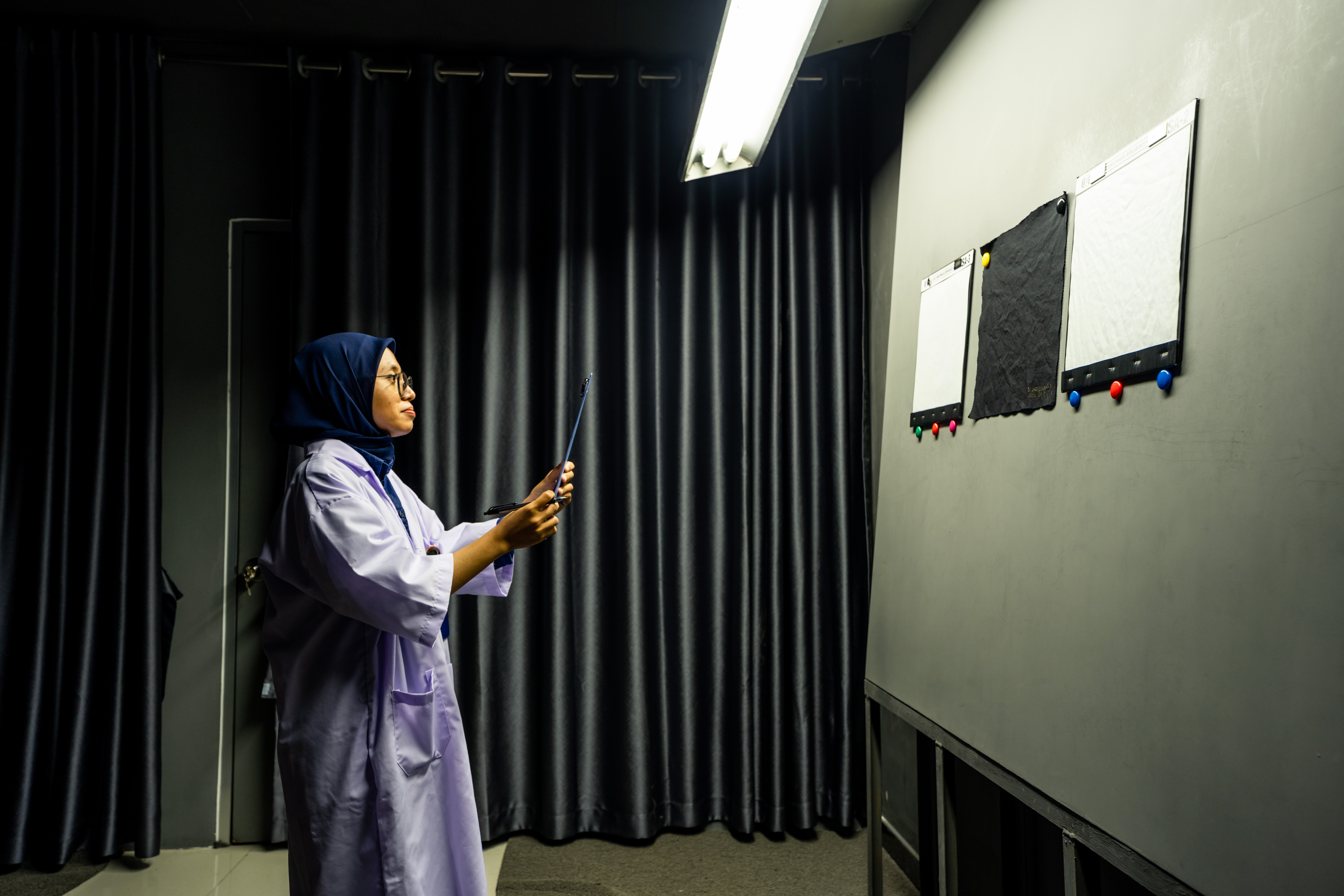
In-house testing supports tier 2 and tier 4 evidence: methods are named, routine is documented.
Take the recycled and organic claim family first. GTI holds a Textile Exchange certificate issued by GCL International Ltd., number GCL-304497-MUL-2026, covering OCS V3.0, GRS V4.0, RCS V2.0 and CCS V3.1, valid from 2026-04-01 to 2027-03-31. The scope in the record is specific: dyed fabrics, dyed yarns, greige fabrics and printed fabrics, across weaving, manufacturing, pre-treatment, finishing, printing, packing, dyeing and preparatory activities. The products linked to that scope include Organic Cotton Fabric B01939-03, Recycled Polyester Fabric B01308-03 / B01718-14, and Recycled Nylon Fabric S01601-01 / S01601-04.
That is a strong tier 2 record, and the company profile separately lists Recycled 100 among its held certifications. But scope certificates and content claims are not the same instrument, and GRS, RCS and OCS are not interchangeable standards — each carries its own criteria and its own documentation chain. For a buyer, a scope certificate answers "is the facility certified to process claim-eligible material"; it does not answer "is this shipment certified". The transaction-level document is the second half of the answer, and it is requested per order, not per supplier.
| Certificate | Number | Standard / version | Recorded validity |
|---|---|---|---|
| Textile Exchange (OCS / GRS / RCS / CCS) | GCL-304497-MUL-2026 | OCS V3.0, GRS V4.0, RCS V2.0, CCS V3.1 | 2026-04-01 to 2027-03-31 |
| GOTS | GCL-304497-GOTS-2026-2 | GOTS Version 7.0 | 2026-06-08 to 2027-03-31 |
| OEKO-TEX STANDARD 100 | SH015 206902 | OEKO-TEX STANDARD 100 | 2025-11-25 to 2026-09-15 |
| OEKO-TEX STeP | 23000274/1 | ZDHC MRSL 2.0, OEKO-TEX STeP | 2023-09-18 to 2026-09-30 |
| ISO 9001 | QMS/2212188 | ISO 9001:2015 | 2025-11-26 to 2026-11-26 |
| ISO 14001 / ISO 45001 | EMS/2212188; HSMS/2212188 | ISO 14001:2015; ISO 45001:2018 | 2025-12-27 to 2026-12-27 |
| Regenagri | CU1200458REGENAGRI-2026-00061131 | Regenagri CoC Criteria V2.0 | 2026-01-03 to 2027-01-02 |
The ISO certificates specify their own scope in the record: manufacturer of finished woven fabric, covering yarn-dyed, piece-dyed and printed woven fabric. That wording is worth reading closely, because it is the sentence that ties the management-system certificate to the actual product categories a buyer is sourcing. The OEKO-TEX STANDARD 100 scope is broader still, listing woven fabric made of 100% cotton, 100% viscose, 100% modal or blends, including blends with polyester, polyamide, lyocell, linen, spandex and golden metallic yarn, across bleached, piece-dyed, yarn-dyed, printed and finished functional woven fabrics.
Where the evidence stops: four gaps to close before contracting
A credible supplier record is not one without gaps. It is one where the gaps are identifiable, so the buyer knows exactly what to request. Four are visible in the available information.
1. The water-repellent heavy-weight option has no finish test report in the record. Heavy Weight Fabric (Outer & Bottom) is described as including a water-repellent option, and the construction record covers 204–359 gsm with yarn counts from 10×10 to 30×70D21. But the available asset information does not contain a finish-durability report (for example, performance after repeated laundering) or a chemical compliance test report for that specific water-repellent option. As it stands, water repellency is a category descriptor, not a tested performance claim. Buyers specifying it should request the finish test method, the durability threshold and the chemical compliance documentation before confirming a bulk order.
2. Two certificates on file are past their recorded expiry. Read against a late-2026 evaluation date, the OEKO-TEX STANDARD 100 certificate shows a recorded validity ending 2026-09-15, and the OEKO-TEX STeP certificate shows 2026-09-30. Both windows closed before this assessment. That does not mean the underlying conformity has lapsed — certification cycles renew — but it does mean a buyer cannot cite those documents as current evidence without requesting the renewed copies. This is the most common and most avoidable certification error in supplier evaluation: filing a certificate without a calendar check.
3. The BioDry variant has no performance data in the record. S01601-04 is identified as the BioDry option within the Recycled Nylon family, alongside base S01601-01. The construction record gives the shared specification but no measured drying performance and no test method. The finish is therefore an available option with defined compatibility, not a quantified benefit. Buyers comparing S01601-04 against the base article should ask for the test method and the measured result, and should not assume a performance delta from the naming.
4. Some specification and scale fields do not reconcile. The Recycled Nylon record lists 43% cotton, 31% recycled nylon and 21% Tencel, which does not total 100% as written, so the remainder requires confirmation. At company level, published capacity figures also differ between sources: one profile states an annual output of 38,000,000 meters, while the company site states a 66 million meter per year capacity, and other profile statements express yarn-dyed and piece-dyed volumes in yards. Employee counts similarly appear as 2,200 in one company statement and 2,828 in another. None of these discrepancies implies error — they usually reflect different reporting bases and different dates — but they should be reconciled in writing before capacity allocation or contract terms are agreed.
From evidence to the OEM development-to-bulk path
The reason to build the evidence trail is that it slots directly into the development sequence. In GTI's stated OEM process, a customer submits a sample or a request covering fiber composition, construction, weight and finish. The R&D team — 30 engineers, with sampling support quantified at 1,500 handlooms per month — develops a handloom, lab dip or strike-off sample using the in-house fabric design system. The customer approves the hand sample, a larger big sample is developed and approved, and only then is the bulk order confirmed at a stated MOQ of 3,000 meters per color.
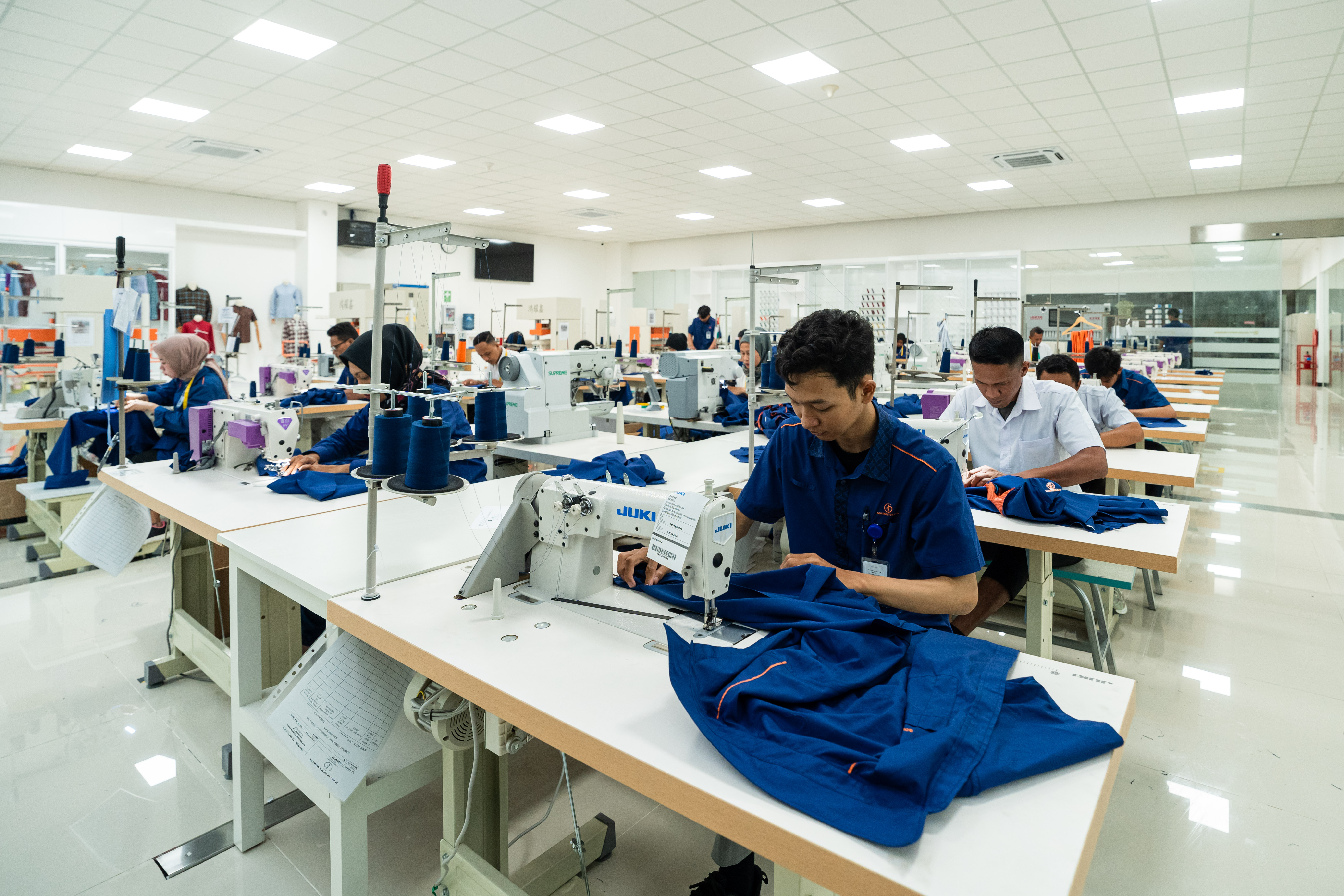
Sample approval is the gate: hand sample, then big sample, then bulk confirmation.
Bulk production then runs at approximately 30–45 days for fabric, with the combined fabric-plus-garment route stated at 45–70 days. Before shipment, the in-house testing centre inspects against AATCC, ASTM D, JIS and ISO methods, and fabric quality control follows the 4-Point System while garment quality control runs in-line, end-line and final or pre-shipment inspection. The company states that its testing protocols have been approved by named brand customers, and its own case record describes a four-year menswear shirting programme totalling 39,000,000 meters.
This is where the tiers connect. A model number makes the hand sample meaningful, because the sample is developed against a defined article rather than a verbal description. A certificate scope makes the finish selection safe, because it confirms which process steps can carry a claim. A quality-control statement makes the pre-shipment inspection predictable. Take any of the three away and the same sequence still runs — it just runs on assumption.
How this compares with conventional supplier screening
Conventional screening asks whether a mill can make a category of fabric, then negotiates specification by email. The evidence-based route asks which model, at which construction, under which certificate, and produces a shorter and better-targeted question list. The difference shows up in sampling cycles: a brief written against a named model generally reaches a usable hand sample faster than a brief written against a description.
The limits of this approach are real and should be stated plainly. First, published records are product- and process-level; they do not substitute for physical sampling, and lab dip, strike-off and big sample approval remain the decisive steps in any order. Second, certificate scope describes a facility's certified processes — it does not certify a specific shipment, and market-specific conformity requirements for the destination country must be confirmed separately. Third, the available information supports evaluation of the named families and their stated ranges; it does not extend to finish durability testing, and it does not quantify functional performance for the BioDry option. Fourth, digital print volume commitments should be checked against current scaling: the print line is described as still growing toward 0.45 million yards per month, or 5.4 million yards annually, which is a different basis from the established yarn-dyed and piece-dyed volumes.
A buyer who treats this record as a screening instrument rather than a guarantee will get useful answers quickly. A buyer who treats it as a warranty will be disappointed at the sampling stage — as with any mill.
Future outlook
Two shifts are likely to raise the value of published evidence in woven apparel fabric sourcing. The first is documentation pressure: recycled and organic content claims increasingly require scope certificates plus transaction-level records, and buyers who already read scope, standard version and validity as a matter of routine will handle that pressure with less friction than those who only check that a logo exists. The second is specification granularity: as functional finishes multiply, the difference between "offers a finish" and "measured a performance" becomes a commercial distinction, not a technical footnote. Mills that publish variant-level records and finish test reports will find their evaluation cycles shortening; mills that publish only category claims will keep absorbing the same clarification cost on every order.
For GTI specifically, the record is currently strongest where it is most specific — named models, stated yarn and weight ranges, and a current Textile Exchange certificate with an explicit process scope. The obvious next steps are administrative rather than structural: renewing the two expired OEKO-TEX documents, reconciling the capacity and headcount figures across published sources, and adding finish-level test reports for the water-repellent heavy-weight option and the BioDry variant. Each closes a gap that a buyer would otherwise open as a question.
Frequently asked questions
What does a model variant such as S01601-04 actually tell a buyer?
It identifies a defined article inside a fabric family rather than a general description. In GTI's record, Recycled Nylon Fabric carries two models, S01601-01 and S01601-04, under one construction listing of 50×50D30D, 113 gsm and 43% cotton / 31% recycled nylon / 21% Tencel. The family is also identified as offering a BioDry option, so the variant distinction reads as a finish option on a shared construction. A model number makes the fabric samplable and quotable against a fixed reference; it does not by itself state a measured performance level.
How should GRS or Recycled 100 claims be verified on woven fabric?
Check three things. First, the certificate number, issuing body and standard version — GTI's Textile Exchange certificate is GCL-304497-MUL-2026 from GCL International Ltd., covering OCS V3.0, GRS V4.0, RCS V2.0 and CCS V3.1. Second, the scope: it covers dyed fabrics, dyed yarns, greige fabrics and printed fabrics across weaving, manufacturing, pre-treatment, finishing, printing, packing, dyeing and preparatory activities, and is linked to Organic Cotton B01939-03, Recycled Polyester B01308-03 / B01718-14 and Recycled Nylon S01601-01 / S01601-04. Third, validity — the recorded window is 2026-04-01 to 2027-03-31. Because GRS, RCS and OCS are separate standards with separate criteria, the scope certificate is confirmed alongside transaction-level documentation for the specific order.
What yarn count and fabric weight range can be read from the published records?
The company's fabric page states a yarn-count range of 16s/1 to 100s/1 and 20/2 to 200/2. Individual model records sit inside that envelope, from 11×11 in the linen and linen-look family to 80/2×80/2 in the non-iron free-formaldehyde family. Recorded weights across the listed families run from 94–110 gsm at Carbon Zero Tencel Fabric to 204–359 gsm at Heavy Weight Fabric for outer and bottom, with shirting-weight constructions concentrated between roughly 106 and 175 gsm. A requirement outside those bands should be treated as a development request rather than a catalogue selection.
What evidence should be requested when a water-repellent finish is specified?
The available information lists water repellency as an option within Heavy Weight Fabric (Outer & Bottom), covering 204–359 gsm and yarn counts from 10×10 to 30×70D21, but it does not include a finish-durability report or a chemical compliance test report for that option. A buyer should therefore request the finish test method, the durability threshold after laundering, and the chemical compliance documentation, in addition to the standard pre-shipment inspection under the 4-Point System. Without those documents, water repellency remains a category descriptor rather than a verified performance specification.
How does the evidence trail connect to an OEM bulk order?
The sequence runs from a customer sample or request covering fiber, construction, weight and finish, to handloom, lab dip or strike-off development, to hand sample approval, to big sample development and approval, to bulk confirmation at a stated MOQ of 3,000 meters per color. Bulk fabric production follows at approximately 30–45 days, with the combined fabric-plus-garment route stated at 45–70 days, and shipment follows in-house testing against AATCC, ASTM D, JIS and ISO methods. Model numbers, certificate scope and quality-control statements each remove one assumption from that sequence.
Company profile for reference: GTI Company Profile 2026 (PDF).
¿Tiene preguntas o necesita más detalles?
Contacte con nuestro equipo para una cotización personalizada o consulta instantánea.
Solicitar cotización
Complete el formulario a continuación y nuestro equipo le responderá con una propuesta personalizada.
Chat directo de WhatsApp
¿Prefiere chatear en tiempo real? Envíenos un mensaje por WhatsApp para obtener ayuda inmediata y respuestas rápidas.
- Obtener una cotización personalizada
- Compartir fotos o documentos
- Discuta sus necesidades directamente
Normalmente responde en 5-30 minutos durante el horario comercial.