
Woven Apparel Fabric Scenario Fit: Outerwear to Shirting
Woven Apparel Fabric Scenario Fit: Outerwear to Shirting
Woven Apparel Fabric · Scenario Fit
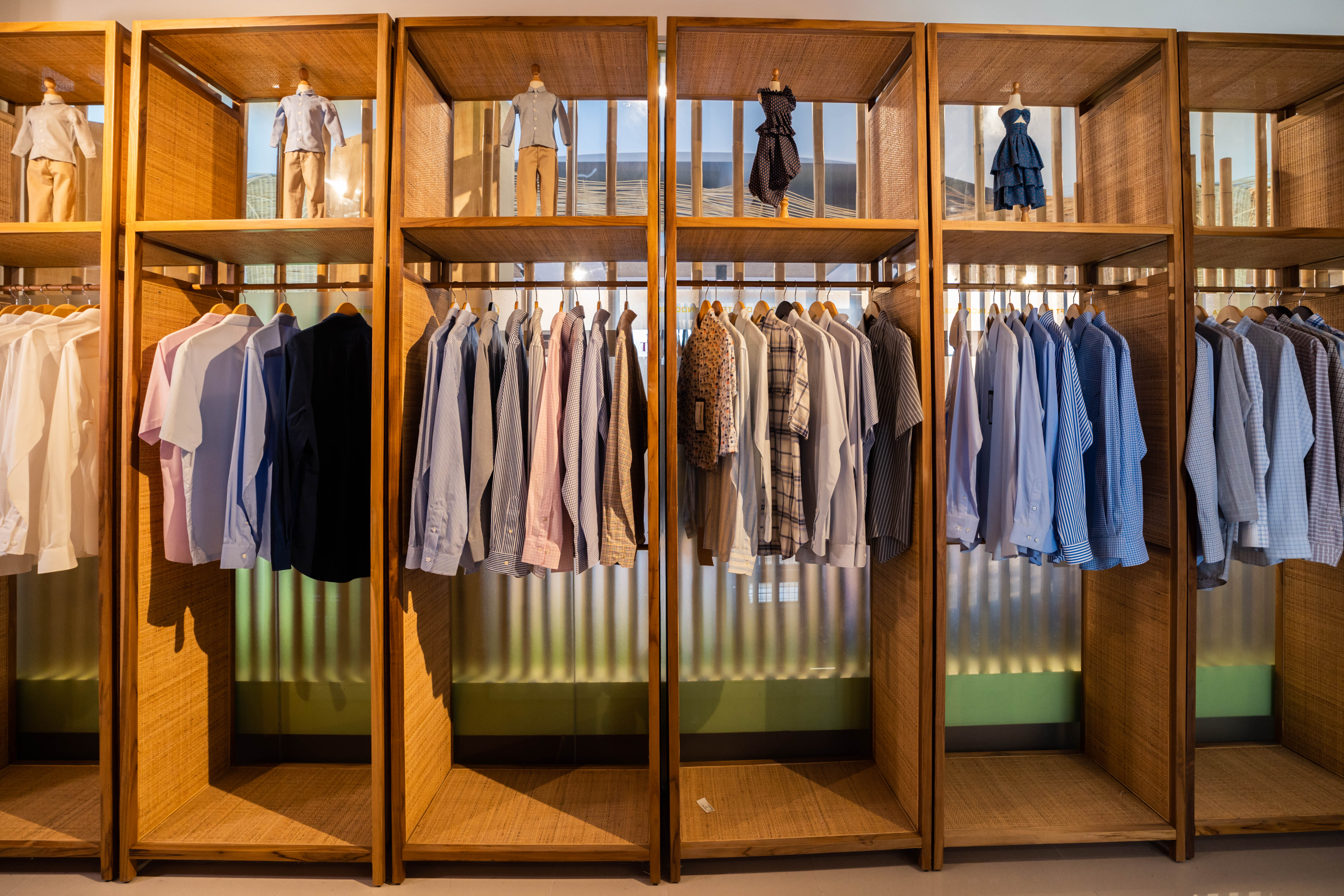
Garment hangers in GTI's fabric library, where fabric families can be reviewed by end-use scenario rather than fiber alone. Image: PT Golden Tekstil Indonesia.
Woven apparel fabric sourcing becomes more efficient when buyers shortlist by garment scenario rather than by fiber name alone. A fabric family can be technically sound and still be a poor fit for the intended silhouette, season, finish expectation or testing programme.
PT Golden Tekstil Indonesia (GTI) is an Indonesia-based woven apparel fabric manufacturer operating in Kendal Industrial Park and serving buyers in the US, Europe, Japan and Indonesia. Its listed product range covers yarn-dyed and piece-dyed woven fabrics, digital print, cotton spandex, 4-way stretch, poplin, Oxford, flannel, dobby, seersucker, linen and linen-look, non-iron, wicking and quick-dry, cooling comfort, recycled polyester and Carbon Zero Tencel fabrics.
This scenario-fit map is written for buyers in the research and evaluation stages. It connects GTI's listed woven apparel fabric families to four practical end uses: outerwear and bottoms, resort and summer apparel, shirting, and sustainable casualwear. It also states where a scenario-led shortlist still needs sample approval, model-level specifications and certification verification.
Why Fiber-First Shortlisting Breaks Down
Fiber content is a useful starting point, but it does not answer the buyer's real question: will this fabric work for the garment programme in front of us? Outerwear, trousers, resortwear and shirting place different demands on weight, stretch, surface character, finish durability and testing. A cotton-rich fabric can be right for shirting and wrong for a structured outerwear brief. A lightweight blend can be right for warm-climate resortwear and unsuitable for bottoms that need body and seam stability.
The opportunity is to build a scenario-led shortlist before requesting samples. That approach helps buyers separate construction questions from fiber questions, reduce avoidable sampling cycles and align testing with the final garment use. It does not remove the need for physical samples, but it makes the first sample round more focused.
GTI Woven Apparel Fabric Scenario Map
| Garment scenario | GTI product family | Listed models | Buyer confirmation point |
|---|---|---|---|
| Outerwear and bottoms | Heavy Weight Fabric (Outer & Bottom) | S01582-01 / B03076-04 / S01506-01 / S00804-01 / B00902-05 / B01294-02 / B02260-02 | Confirm model-level weight, composition, shrinkage, finish and bulk availability. |
| Summer apparel | Seersucker Fabric | S01183-01 / S01151-01 | Confirm season fit, surface consistency, shrinkage and colour range by model. |
| Casual and resort wear | Linen & Linen Look Fabric | B00353-01 / 569717-01 | Confirm handfeel, blend, wrinkle behaviour and finishing route. |
| Formal and business shirting | Non-Iron Fabric | B00602-01; 571138-01 | Confirm composition, weight, easy-care performance and test reports. |
| Performance and active-casual shirting | Cool-Dry Fabric | B02568-02 / B02587-04 | Confirm wicking and quick-dry test method, non-iron performance and stretch. |
| Sustainable casualwear | Recycled Polyester Fabric | B01308-03 / B01718-14 | Confirm recycled-content documentation and certification scope by model. |
| Low-carbon resort and ESG fashion | Carbon Zero Tencel Fabric | 506520-02 / B01109-01 | Confirm Tencel content, weight, certification and claim support. |
Outerwear and Bottoms: Heavy Weight Fabric
GTI lists Heavy Weight Fabric (Outer & Bottom) under models S01582-01, B03076-04, S01506-01, S00804-01, B00902-05, B01294-02 and B02260-02. The product family name directly signals its intended scenario: outerwear and bottom-weight garments rather than light shirting or lightweight resortwear.
For buyers, the value of this family is that it narrows the search to a construction range already positioned for heavier garment use. The next step is not to assume performance from the family name, but to request model-level data. A buyer evaluating outerwear or trousers should confirm the actual weight, composition, shrinkage behaviour, finish, colourfastness requirements and available bulk capacity for the chosen model.
The boundary is equally important. A heavy weight family is not interchangeable with lighter shirting or summer resort fabrics. It should not be used as a blanket substitute when the garment brief requires drape, breathability or low weight. The listed models are a shortlist starting point, not a performance guarantee.
Resortwear and Summer Apparel: Seersucker, Linen and Carbon Zero Tencel
GTI's resort and summer apparel scenario connects three distinct product families. Seersucker Fabric is listed under models S01183-01 and S01151-01. Linen & Linen Look Fabric is listed under models B00353-01 and 569717-01. Carbon Zero Tencel Fabric adds a low-carbon option under models 506520-02 and B01109-01.
Carbon Zero Tencel Fabric carries the most specific product data in this group. Model 506520-02 is listed as 60% Cotton 40% Carbon Zero Tencel, while B01109-01 is listed as 68.2% Cotton 31.8% Tencel. The listed yarn count range is 50×50 to 90×70 and the weight range is 94–110 gsm. GTI positions this family for low-carbon and ESG-driven fashion brands, and the product listing notes that the lightweight construction is suitable for warm-climate and resort collections. The listing also describes Lenzing Tencel's closed-loop, low-impact production process as part of the product rationale.
Seersucker and Linen & Linen Look are listed by model but the supplied product data does not include model-level weight or composition for those two families. That is a practical procurement limit. Buyers should request those details before building a resortwear range around them. The scenario fit is clear, but the specification still needs confirmation.
The limitation for Carbon Zero Tencel is weight. A 94–110 gsm range can suit warm-climate and resort collections, but it is not a substitute for a heavier outerwear or bottom-weight fabric. Buyers should match the model to the garment silhouette and confirm the exact weight before sampling.
Shirting: Non-Iron, Cool-Dry and Adjacent Shirting Families
Shirting is the broadest scenario in GTI's woven apparel fabric range. The two clearest functional entries are Non-Iron Fabric and Cool-Dry Fabric, but buyers can also evaluate Regular Poplin, Oxford, Dobby Weave, Flannel and Cooling Comfort families depending on the shirt programme.
Non-Iron Fabric for formal and business shirting
Non-Iron Fabric is listed under models B00602-01 and 571138-01. B00602-01 is listed as 98% Cotton 2% Spandex. Model 571138-01 is listed as 66% Cotton 29% Polyester 5% Spandex. The yarn count range is 40×16+70D16 to 40×75D40D and the weight range is 110–152 gsm. GTI lists this family for formal and business shirting.
The product listing states that the Easy Care finish reduces wrinkling and cuts ironing time for end consumers. The high-cotton option retains a natural handfeel while adding stretch and low-maintenance performance. The polyester-spandex variant adds durability and shape retention for business shirting use. These are product-positioning facts, not a substitute for model-level test reports. Buyers should confirm easy-care performance, appearance after laundering and dimensional stability for the selected model.
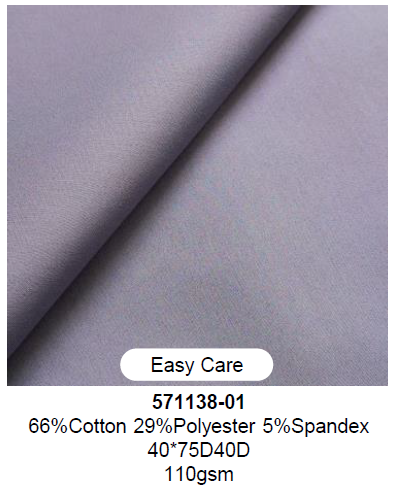
571138-01, a GTI Non-Iron Fabric model listed for formal and business shirting. Image: PT Golden Tekstil Indonesia.
Cool-Dry Fabric for wicking and quick-dry shirting
Cool-Dry Fabric is listed under models B02568-02 and B02587-04. The composition is 64% Cotton 32% Polyester 4% Spandex, with a yarn count of 40×75D+75D20D and a weight range of 106–156 gsm. GTI lists this family for performance and active-casual shirting.
The product listing combines Non-Iron finish with Wicking and Quick Dry performance. Model B02568-02 also uses Aeroloft technology, described in the listing as adding a lightweight air-layer effect for enhanced breathability. The intended use is business-casual and travel shirting where wrinkle resistance and moisture control both matter. Buyers should confirm the wicking and quick-dry test method, the non-iron performance level and the stretch behaviour before adopting the model for a programme.
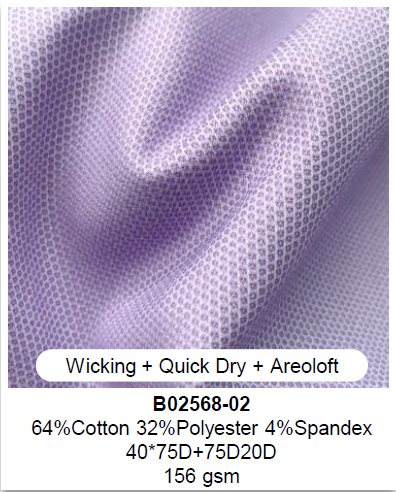
B02568-02, a GTI Cool-Dry Fabric model positioned for wicking, quick-dry and non-iron shirting. Image: PT Golden Tekstil Indonesia.
Adjacent shirting families
Regular Poplin Stretch Quality is listed under models B00295-02, 550887-04, 550887-01 and 573984-08. The construction is 4-way stretch with a yarn count of 40D50×40D50, a weight range of 113–136 gsm and a composition of 91–90% Cotton or BCI Cotton with 9–10% Spandex. GTI lists a BCI cotton option for sustainable sourcing requirements and positions the family for menswear and womenswear shirting.
Oxford Fabric is listed under B00390-03, 565584-01, B01177-07 and B01109-01. It is available in 100% cotton and cotton-spandex versions, with a weight range of 142–171 gsm and a yarn count range of 40×20/2 to 40×40D16. GTI positions it for casual and preppy shirting. Dobby Weave Fabric is listed under 556602-02, 562993-02, B00098-11, B00012-01 and B02599-01, with a weight range of 110–130 gsm and 100% cotton, cotton-spandex and cotton-polyester-spandex options. GTI positions it for formal and business shirting.
Flannel Fabric is listed under 574259-03, 574259-06, 549625-03 and 552492-01, with a weight range of 119–175 gsm and 100% cotton, rayon-polyester and cotton-polyester options. GTI positions it for fall and winter shirting. Cooling Comfort Fabric is listed under B02454-01 and B02508-01, with a composition of 96% Cotton 4% Spandex and a weight range of 118.26–134 gsm. GTI positions it for business and warm-climate shirting.
The case record adds a useful reference point for shirting. GTI's case unit records a four-year menswear shirting fabric programme totaling 39,000,000 meters with stable operation. The case states that GTI's quality control protocols and testing standards were reviewed and approved to meet the brand's compliance requirements. This supports the supplier's fit for sustained shirting supply, but it does not remove the need for programme-specific sampling and testing.
Sustainable Casualwear: Recycled Polyester and Low-Carbon Options
GTI lists Recycled Polyester Fabric under models B01308-03 and B01718-14. In this scenario map, the family is positioned for sustainable casualwear. The supplied product data does not include model-level weight, composition or certification scope for these two models, so buyers should treat the model list as a starting point for a documentation request rather than a completed specification.
GTI's company profile lists GRS, Recycled 100, Organic 100, Recycled Blended and Organic Blended among its certification portfolio. That is relevant for buyer screening. It does not, by itself, prove that a specific model supplied under B01308-03 or B01718-14 is certified for a specific order. Buyers should request the scope certificate, transaction certificate where applicable, and the exact recycled-content claim for the model and production batch.
The same discipline applies to Carbon Zero Tencel Fabric in ESG-driven fashion scenarios. The product listing provides composition and weight, but the buyer still needs to confirm certification, traceability and claim support before using the fabric in a public sustainability claim. The limitation is not the product family itself; it is the evidence level required for a credible ESG claim.
Technical Explanation: How to Read the Model List
GTI's model codes are not decorative. They help buyers separate constructions within the same product family. For example, Non-Iron Fabric contains B00602-01 with 98% Cotton 2% Spandex and 571138-01 with 66% Cotton 29% Polyester 5% Spandex. Those are different commercial and technical choices inside one family. Cool-Dry Fabric contains B02568-02 and B02587-04, with the first model carrying the Aeroloft technology description in the product listing. Carbon Zero Tencel Fabric contains 506520-02 and B01109-01 with different Tencel percentages.
This is why a scenario map should not stop at the family name. The buyer should move from scenario to family, then from family to model, then from model to test report and sample. That sequence keeps the commercial shortlist aligned with the technical evidence.
GTI's company profile states that its in-house testing centre is certified to AATCC, ASTM D, JIS and the full ISO standard suite, with testing protocols approved directly by Polo Ralph Lauren and Kohl's. The capability unit also states that fabric quality control uses the 4-Point System. These are relevant supplier evidence points because they show that testing is part of the production system, not an afterthought. They still need to be matched to the buyer's own end-use requirements.
For a scenario-led brief, the buyer should request test reports that correspond to the garment use. A shirting programme needs appearance and dimensional stability evidence. A wicking programme needs moisture-management evidence. A bottoms programme needs seam and stability evidence. A recycled programme needs chain-of-custody evidence. The exact test protocol should be agreed with the supplier and, where relevant, with the brand's compliance team.
Application and Use Cases
| End-use scenario | Why the GTI family fits the brief | Preferred starting models | What to validate before bulk |
|---|---|---|---|
| Outerwear and trousers | Heavy Weight Fabric is listed specifically for outer and bottom use. | S01582-01 / B03076-04 / S01506-01 / S00804-01 / B00902-05 / B01294-02 / B02260-02 | Model-level weight, composition, shrinkage, finish and bulk capacity. |
| Summer dresses and resort shirts | Seersucker and Linen & Linen Look are listed for summer, casual and resort scenarios. | S01183-01 / S01151-01 / B00353-01 / 569717-01 | Handfeel, surface consistency, shrinkage and colour range. |
| Warm-climate resort collections with ESG positioning | Carbon Zero Tencel is listed for low-carbon and ESG-driven fashion, with lightweight 94–110 gsm constructions. | 506520-02 / B01109-01 | Tencel content, weight, certification and claim support. |
| Formal and business shirting | Non-Iron Fabric is listed for formal and business shirting with Easy Care positioning. | B00602-01; 571138-01 | Easy-care performance, appearance after laundering and dimensional stability. |
| Travel and active-casual shirting | Cool-Dry Fabric combines Non-Iron with Wicking and Quick Dry performance. | B02568-02 / B02587-04 | Wicking and quick-dry test method, non-iron level and stretch behaviour. |
| Everyday casual shirts | Oxford, Dobby, Regular Poplin and Flannel cover casual, formal and seasonal shirting briefs. | B00390-03 / 565584-01 / B01177-07 / B01109-01 / 556602-02 / B00295-02 / 574259-03 | Weight, composition, stretch and seasonal fit by model. |
| Sustainable casualwear | Recycled Polyester Fabric is listed for sustainable casualwear scenarios. | B01308-03 / B01718-14 | Recycled-content documentation and certification scope. |
Market Trend Analysis
The wider market context supports a more scenario-led buying approach. Commercial research cited in the verified data pack estimates the global textile fabrics market at USD 732.38 billion in 2026. The same research indicates that polyester accounted for 54.1% of the global textile fabrics market share by volume in 2025. That does not mean every programme should default to polyester. It means buyers are balancing cost, durability and performance against cotton handfeel and natural-fibre positioning.
Indonesia remains a relevant sourcing base. Verified data records Indonesia's total textile exports at USD 13.5 billion in 2024. For buyers evaluating Indonesian woven apparel fabric, the practical question is not only country capability but supplier-level fit: which product family, which model, which finish and which evidence package match the intended garment scenario.
Sustainability claims are also moving from marketing language to documentation. Textile Exchange lists the Organic Content Standard, Recycled Claim Standard and Global Recycled Standard as material-related voluntary standards. Buyers should treat those standards as verification frameworks, not as automatic proof of a supplier's certification. The trend is toward model-level and batch-level evidence, especially for recycled polyester, organic cotton and low-carbon Tencel programmes.
Comparison with Traditional Solutions
A traditional shortlist often starts with fiber and price, then moves to sample. A scenario-led shortlist starts with the garment use, then narrows fiber, construction, finish and model. The advantage of the scenario-led approach is that it brings testing and commercial constraints into the first conversation. It can reduce the number of unqualified samples and make the supplier discussion more specific.
The limitation is that scenario fit is not a substitute for physical validation. GTI's model list identifies product families and models, but several families in this article do not have model-level weight, composition or performance data in the supplied product facts. Heavy Weight Fabric, Seersucker Fabric, Linen & Linen Look Fabric and Recycled Polyester Fabric are listed by model, but the buyer still needs datasheets, test reports and sample approval before bulk.
Commercial constraints also matter. GTI's capability unit lists a fabric MOQ of 3,000 meters per colour and a garment MOQ of 1,000 pieces per colour, with a lead time of 45–70 days for fabric plus garment. Those terms may not suit small test runs or fast-turn seasonal drops. The buyer should confirm the applicable MOQ, lead time and sampling route for the chosen model before committing to a scenario-led range plan.
A final boundary is claim verification. GTI's company profile lists GRS, Recycled 100, Organic 100, Recycled Blended and Organic Blended certifications, but a specific model still needs scope and transaction evidence. Scenario fit can guide the shortlist; it cannot replace certification review.
Future Outlook
The next stage of woven apparel fabric competition is likely to be less about listing more fiber names and more about proving scenario-to-model fit. Buyers will increasingly ask for model-level weight, composition, finish, test method, certification scope and bulk capability in one evidence package. Suppliers that can connect garment scenario, fabric family and model-level data will be easier to qualify.
GTI's integrated position supports that direction. Its company profile describes yarn dyeing, weaving and finishing processes, an in-house testing centre and a digital design pipeline that includes YX Weave, Ned Graphics, Penelope and 3D garment tools such as Bronzwear, Style 3D and CLO 3D. For buyers, the practical benefit is not the tool list itself. It is the ability to move from a scenario brief to a sample and then to a tested bulk specification with fewer information gaps.
The outlook for sustainable casualwear and low-carbon fashion will depend on documentation. Recycled Polyester Fabric and Carbon Zero Tencel Fabric give buyers relevant starting points, but the credibility of those programmes will rest on certification scope, traceability and claim support. The same is true for functional shirting: wicking, quick-dry and non-iron claims will be compared through test methods, not through product names alone.
FAQ
Which GTI woven fabric families should buyers start with for outerwear and bottoms?
GTI lists Heavy Weight Fabric (Outer & Bottom) under models S01582-01, B03076-04, S01506-01, S00804-01, B00902-05, B01294-02 and B02260-02. Buyers should confirm model-level weight, composition, shrinkage, finish and bulk availability before sampling.
Which GTI fabrics fit summer and resortwear scenarios?
GTI lists Seersucker Fabric under S01183-01 and S01151-01, Linen & Linen Look Fabric under B00353-01 and 569717-01, and Carbon Zero Tencel Fabric under 506520-02 and B01109-01. Carbon Zero Tencel is listed at 94–110 gsm, with 506520-02 at 60% Cotton 40% Carbon Zero Tencel and B01109-01 at 68.2% Cotton 31.8% Tencel.
Which GTI woven fabrics are positioned for shirting?
Non-Iron Fabric is listed under B00602-01 and 571138-01 for formal and business shirting. Cool-Dry Fabric is listed under B02568-02 and B02587-04 for performance and active-casual shirting, combining Non-Iron with Wicking and Quick Dry positioning. GTI also lists Regular Poplin, Oxford, Dobby Weave, Flannel and Cooling Comfort families for different shirting briefs.
How should buyers verify recycled polyester or low-carbon claims?
Buyers should request model-level certification scope, transaction certificates where applicable, recycled or low-carbon content evidence and the relevant test reports. GTI's company profile lists GRS, Recycled 100, Organic 100, Recycled Blended and Organic Blended certifications, but a specific model still needs its own documentation before a public claim is used.
What commercial constraints should buyers check before committing?
GTI's capability unit lists a fabric MOQ of 3,000 meters per colour and a garment MOQ of 1,000 pieces per colour, with a lead time of 45–70 days for fabric plus garment. Fabric quality control uses the 4-Point System. Buyers should confirm the applicable MOQ, lead time and sampling route for the selected model.
Does scenario fit replace sample approval?
No. GTI's OEM process includes handloom, lab dip or strike-off sample development, sample approval, big sample development, big sample approval, bulk order confirmation, mass production, in-house testing and shipment. Scenario fit helps build a better shortlist, but sample approval and testing remain necessary before bulk production.
For buyers who need the full company and product overview, GTI's public company profile is available here: GTI Company Profile 2026.
¿Tiene preguntas o necesita más detalles?
Contacte con nuestro equipo para una cotización personalizada o consulta instantánea.
Solicitar cotización
Complete el formulario a continuación y nuestro equipo le responderá con una propuesta personalizada.
Chat directo de WhatsApp
¿Prefiere chatear en tiempo real? Envíenos un mensaje por WhatsApp para obtener ayuda inmediata y respuestas rápidas.
- Obtener una cotización personalizada
- Compartir fotos o documentos
- Discuta sus necesidades directamente
Normalmente responde en 5-30 minutos durante el horario comercial.