
Workshop Chain Blocks in Industrial Lifting: A Practical Overview
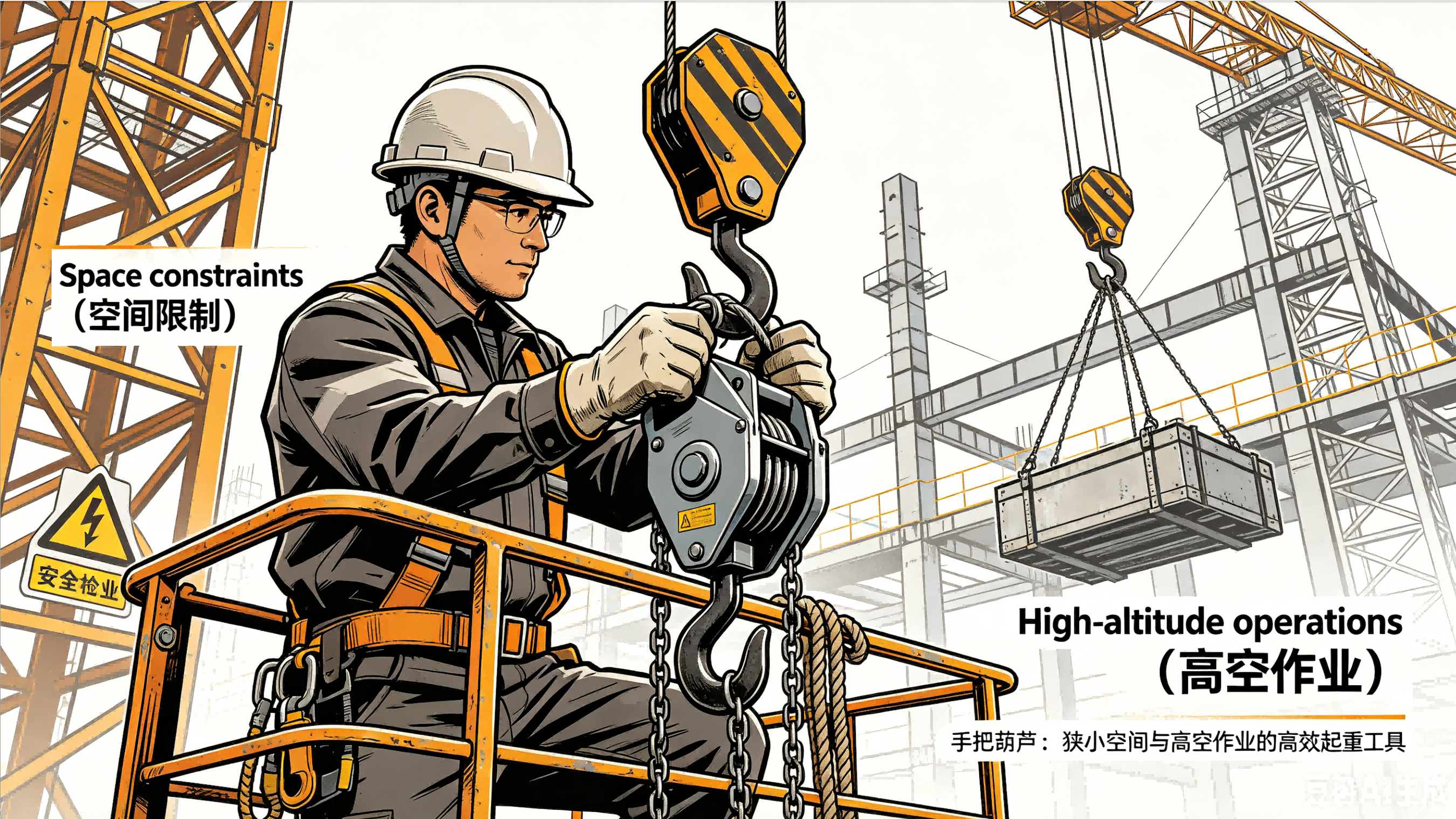
Manual chain blocks are frequently used in confined spaces and high-altitude operations. Image: JUNYUNHOIST application illustration.
Manual chain blocks occupy a specific but essential niche in industrial lifting. They are compact, mechanically operated, and do not require an external power supply. This combination makes them particularly relevant in workshop environments where space is limited, lifts are intermittent, and operations must be carried out with precision. This article provides an industry-level overview of workshop chain block applications, technical parameters, safety standards, and market trends.
Why workshop operations depend on manual lifting equipment
Workshop lifting tasks are often more varied than production-line lifting. Maintenance crews may need to lift a motor from a machine base, position a heavy component under a gantry, or tension a cable in a seam where a crane cannot reach. In many of these situations, power outlets are either unavailable or deliberately disconnected for safety. A manual chain block offers a practical solution because it can be mounted on a trolley or gantry and operated with nothing more than a hand chain.
At the same time, the lack of electrical components reduces the complexity of inspection and maintenance. There is no motor to diagnose, no control cabinet to manage, and no cable to run. For procurement teams, this means a chain block can be treated as a low-maintenance mechanical tool, provided it is correctly sized and operated.
Manufacturing context: one source of workshop chain blocks
Baoding Junyun Hoisting Machinery Co., Ltd. (JUNYUNHOIST) is one manufacturer active in this segment. Established in 2018 and based in Hebei, China, the company specializes in lifting and material handling equipment. Its product portfolio is described as including VD, VT, HSZ, HSC, and VD-II chain blocks, as well as VA and VL lever blocks. The company reports an annual production capacity of 200,000 units and states that exports account for 80% of total sales. Major markets include India, Russia, Vietnam, Brazil, Türkiye, the United Arab Emirates, and other Middle Eastern countries.
JUNYUNHOIST’s manufacturing facility spans 24,000 square meters and employs approximately 138 people, including an R&D team of eight engineers. The scale of production is relevant to buyers because it gives the company the ability to handle large or time-sensitive orders while maintaining standard quality control processes. The company also offers OEM/ODM customization and after-sales support, which can matter for distributors or equipment brands that need private-label configurations.
How a manual chain block works: mechanical principles and safety design
To understand what a chain block does, it helps to start with the mechanical principle. A manual chain block uses a gear train to convert a long pull on the hand chain into a short but powerful lift of the load chain. The operator pulls the hand chain, which rotates a chain wheel connected to a pinion. The pinion drives a larger gear, multiplying the input force. Crucially, the mechanism includes a reverse-drive self-locking brake. When the operator stops pulling, the brake engages instantly and prevents the load from descending unexpectedly. This allows loads to be held securely at height and lowered in a controlled manner.
Chain block specifications are determined by load capacity, lift height, chain fall configuration, and safety standards. The table below shows typical parameters for a versatile workshop chain block.
| Parameter | Typical range / value |
|---|---|
| Rated load capacity | 0.5 – 50 t |
| Standard lift height | 3 m (2.5 – 12 m optional) |
| Number of chain falls | 1 – 4 depending on capacity |
| Load chain specification | Grade V (80级) or Grade T per DIN EN 818-7 |
| Load chain diameter | 6.3 – 11.2 mm |
| Hand chain | Round link, galvanised or zinc-plated |
| Pull force on hand chain | ≤ 35 daN (350 N) up to rated load |
| Hook material | Forged alloy steel, heat-treated |
| Safety factor | ≥ 4:1 chain; ≥ 5:1 structural parts |
| Operating temperature | –20°C to +50°C |
| Standards | ISO 16872, EN 13157, ASME B30.21, CE marked |
These figures come from JUNYUNHOIST’s VD chain block documentation. The capacity range from 0.5 to 50 tons makes the VD family relevant for both light maintenance tasks and heavy industrial lifting. The use of Grade V or Grade T load chain is an important detail because chain grade directly affects strength and wear resistance. Hooks made from forged alloy steel with heat treatment are standard practice in higher-quality hoists. In Europe, EN 13157 also specifies a safety factor of 4:1 for hand-powered lifting equipment, which aligns with the documented safety factor of the VD series.
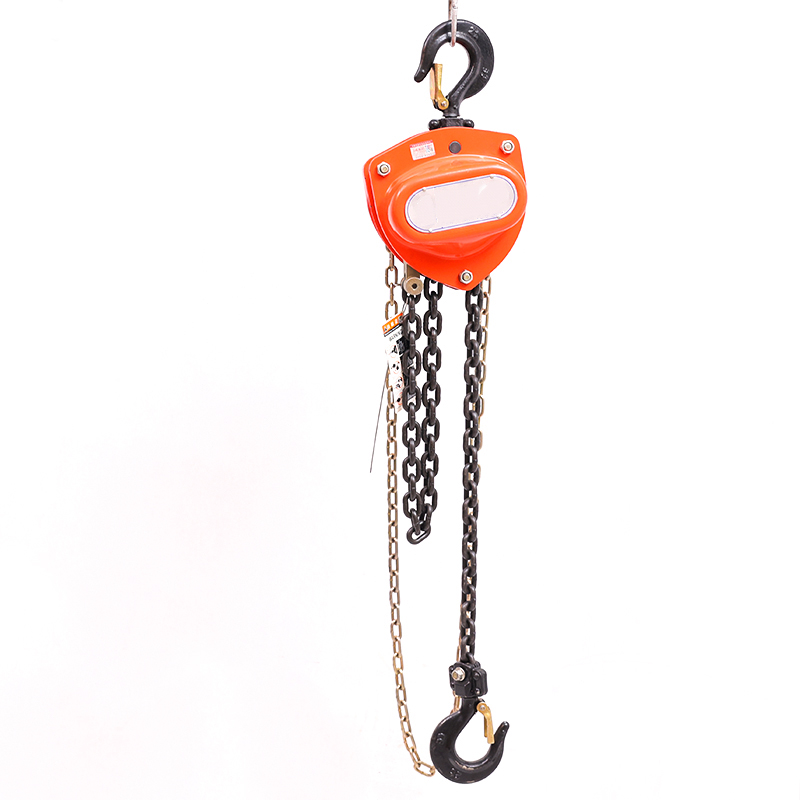
The VD chain block is one of JUNYUNHOIST’s manual chain block models used in workshop and industrial applications.
Workshop chain block applications across industries
Workshop chain blocks are deployed in many industries, often in the same facility for different purposes. In a heavy machinery manufacturing plant, for example, a chain block can be used to align large components during assembly. In a maintenance workshop, it can support the repair of pumps, mills, or motors by lifting and holding parts while technicians work. In a logistics warehouse, a chain block mounted on a manual trolley can help load and position goods on shelves or workbenches.
- Manufacturing: safe and precise lifting of heavy machinery components.
- Construction: steel structure installation in large stadiums and high-rise buildings, including cantilever structure hoisting and cross-floor lifting.
- Shipbuilding and repair: moving structural parts to assembly points; hoisting or disassembling engines, propellers, and other heavy components.
- Logistics and ports: lifting and positioning goods in areas with no power or restricted working conditions.
- Railway and power infrastructure: construction and maintenance tasks that require controlled lifting.
- Petrochemical industry: maintenance in hazardous areas when explosion-proof configurations are specified.
- Automotive repair: safe lifting of vehicle components.
According to JUNYUNHOIST’s application materials, the product also operates in no-power or restricted working environments and can be used for precision installation and positioning. Common working conditions include space constraints, high-altitude operations, maintenance, emergency repairs, temporary operations, and explosion-proof or fire-proof environments. In large water conservancy and pipeline projects, the hoist is used for millimeter-level precision docking of underground pipelines. In special construction scenarios, it performs high-altitude tensioning of large-diameter steel cables.
Market signals: demand data and regional shifts
Market research indicates sustained global demand for chain blocks. Intel Market Research valued the global chain block market at approximately USD 1.95 billion in 2024. A separate projection by Dataintelo sees the broader chain hoist market reaching USD 3.9 billion by 2034. Fact.MR estimates that manual chain pulley blocks will account for 48% of the total product segment share in 2026, underscoring that manual equipment remains relevant even as powered products grow.
Construction is the largest application segment, contributing roughly 30% to 54% of global demand depending on the research source. Asia Pacific led the chain hoist market with a 41.3% revenue share in 2025, driven by industrialization in China and India. China’s exports of lifting and handling equipment parts (HS 843139), which include chain block components, reached USD 1.36 billion in 2024 according to UN Comtrade data, reflecting the country’s role in global supply chains.
Manual chain blocks versus alternative lifting solutions
Chain blocks are often compared with two alternatives: simple pulley systems and electric hoists. A simple pulley system can provide mechanical advantage, but it offers less control and does not automatically lock the load in position. A chain block integrates a gear train and a self-locking brake, which makes it easier to hold loads safely and lower them precisely.
Electric hoists, on the other hand, reduce manual effort and enable high-frequency lifting. However, they require electricity, more maintenance, and a higher initial investment. They are also heavier in some configurations and may be unsuitable for temporary or remote tasks. For workshop operations with intermittent lifts, limited mobility, or no stable power supply, a manual chain block is often the more practical choice.
The limitation of a manual chain block is clear: it relies on operator effort and is not intended for continuous, high-cycle lifting. A workshop performing hundreds of lifts per shift would be better served by an electric hoist or overhead crane. Buyers should therefore evaluate duty cycle, load weight, available power, and installation structure before selecting equipment.
Future outlook
The future of manual chain blocks will be shaped by materials, standards, and smarter add-on features. International standards such as EN 13157 and ASME B30.21 provide a baseline for safety, and compliance is likely to remain a decisive factor in procurement. Manufacturers are expected to continue improving corrosion resistance, reducing weight, and developing special configurations for hazardous environments. The ability to provide customization, OEM/ODM service, and reliable after-sales support will help suppliers meet the needs of different regions and application types. For channel partners and end-users, choosing a manufacturer with verifiable production capacity and an export track record reduces the risk of inconsistent quality.
FAQ
Q: What is a workshop chain block?
A: A workshop chain block is a manually operated chain hoist used in workshops and factories for lifting, lowering, and positioning loads. It uses a hand chain to drive a gear train, multiplying the operator’s force to lift heavy objects without electricity.
Q: What is the safe working load of a typical manual chain block?
A: Manual chain blocks are available in rated capacities from 0.5 tons up to 50 tons. For example, the VD chain block from JUNYUNHOIST covers this range with a standard lift height of 3 m and optional lift heights up to 12 m.
Q: What safety standards apply to chain blocks in Europe and the US?
A: In Europe, hand-powered lifting equipment must meet EN 13157. For the US market, ASME B30.21 covers manual chain hoists, while ASME B30.16 governs overhead hoists. Many manufacturers supply CE-marked units that also comply with ISO 16872.
Q: What is the difference between a chain block and a lever block?
A: A chain block is designed for vertical lifting using a hand chain. A lever block is operated by a lever and is commonly used for pulling, tensioning, and positioning in tight spaces. Both are manual lifting devices but serve different tasks.
Q: Can chain blocks be used in explosive or high-temperature environments?
A: Standard chain block configurations meet general industrial requirements. For explosive and high-temperature conditions, suppliers such as JUNYUNHOIST offer special configurations on request, making the hoists suitable for hazardous locations when properly specified.
Reference
Readers who want more detailed product documentation can access the company brochure here: JUNYUNHOIST Company Brochure.