
Woodworking Machines 101: Key Equipment for Panel Furniture Production
Introduction
The global woodworking machinery market continues to grow as panel furniture manufacturers search for equipment that combines precision, output, and flexibility. According to Grand View Research, the market was valued at USD 20.3 billion in 2025 and is projected to reach USD 27.7 billion by 2033. For buyers in the awareness and research stage, the challenge is less about finding a single machine and more about understanding which machine category matches a given production flow. This article provides an independent overview of the main woodworking machine types used in panel furniture, the technical parameters that matter, and the market context that shapes purchasing decisions.
Problem / Opportunity
Panel furniture production depends on a sequence of operations: cutting panels to size, drilling holes for fittings, applying edge strips, and in some cases milling profiles or processing doors. Many buyers begin by comparing individual machines, but the more useful starting point is to map equipment types to product mix and workshop capacity. Buyers in the research phase often ask three broad questions: Which machines are essential for panel furniture? What level of automation is realistic? How do safety and compliance requirements affect procurement?
The opportunity, especially for manufacturers entering automated production, is that a well-matched machine set can reduce manual handling and improve consistency. At the same time, there is no universal answer for every workshop. Different panel sizes, batch volumes, and target markets lead to different equipment selections. Understanding the capabilities and boundaries of each machine type is therefore a prerequisite for making a sound investment.
Brand Solution: SYUTECH
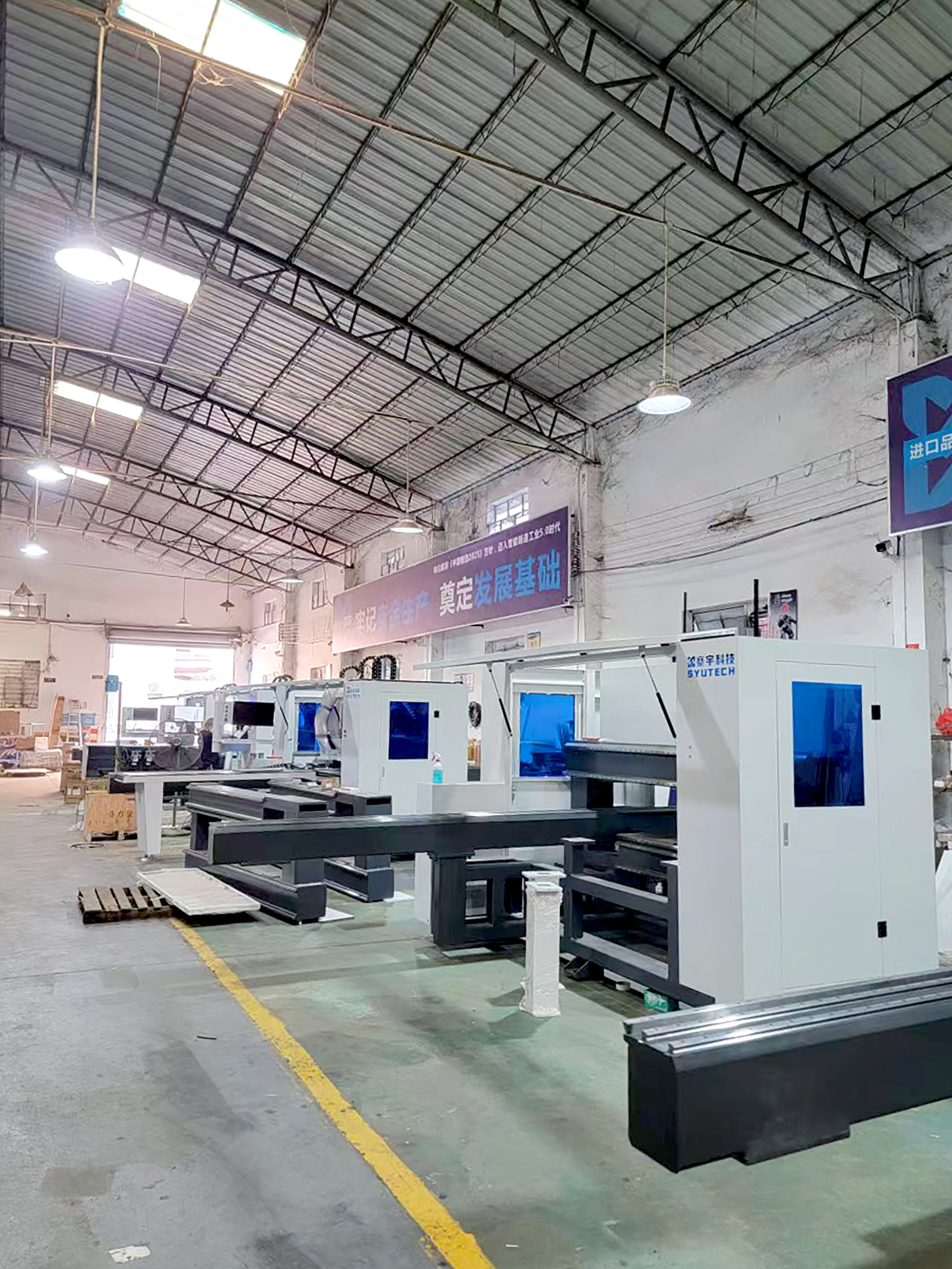
One manufacturer covering this range is Foshan Shunde SaiYu Technology Co., Ltd., which uses the brand SYUTECH. Established in 2013, the company is located in Shunde District, Foshan City, a region known as the hometown of woodworking machinery in China. SYUTECH operates a 10,000 m² facility, employs around 100 people, and has an annual production capacity of about 500 units. Its product portfolio includes edge banding machines, CNC nesting machines, six-side CNC drilling machines, computer panel saws, and complete factory production lines. The company exports roughly 80% of its output to markets including Russia, the Middle East, South America, Europe, and Southeast Asia.
Technical Explanation: Key Machine Categories
Panel Saws
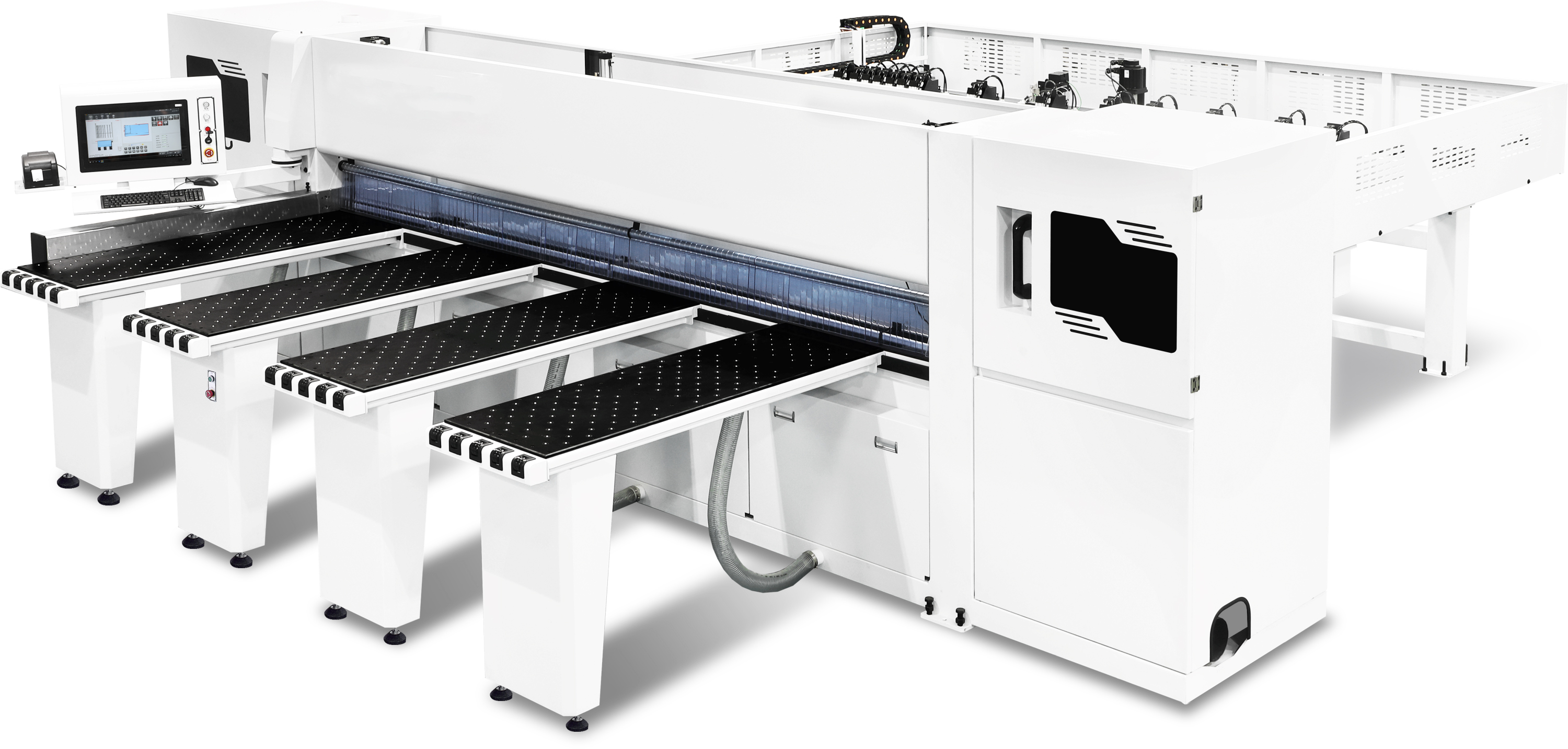
The HK330 computer panel saw is a panel saw designed for woodworking. It is made of carbon steel. The machine has an overall size of 5900×5950×1900 mm, a maximum cutting width of 3300 mm, a maximum cutting height of 100 mm, and a maximum cutting speed of 0–100 m/min. The big saw motor is 16.5 kW with an optional 18.5 kW version, and the small saw motor is 2.2 kW. The machine uses 13 clamp hands and can handle a minimum working size of 34×45 mm.
CNC Nesting and Routing
The HK6 CNC router is a nesting machine for wood cutting. It is constructed from carbon steel and intended for the woodworking industry. The machine has a working range of X-axis 1220 mm, Y-axis 2800 mm, and Z-axis 250 mm. The spindle is a 9 kW air-cooled motor running at 24000 rpm, and the machine is equipped with a 12-tool linear automatic tool changer. The control system is Taiwan LNC/SYNTEC, and the drive system uses four 1.5 kW servo motors with an 11 kW frequency converter.
The HK-Line CNC nesting production line shares a similar configuration, with X-axis 1220 mm, Y-axis 2800 mm, Z-axis 250 mm, spindle speed 24000 rpm, and a Taiwan SYNTEC/LNC control system. It is also made of carbon steel. For panel furniture, the Automatic Furniture Making Machine (model HK) performs nested cutting and drilling over a processing range from 140×40 mm to 2800×1220 mm. The Aluminum Honeycomb Plate Furniture Machine (model HK) extends the nesting platform to aluminum honeycomb materials, with the same working envelope and a maximum processing size of 2800×1220 mm.
Drilling and Milling
For hole processing, the HK612A CNC six-side drilling machine and the HK612B drilling and milling center provide the same working envelope: X-axis 2800 mm, Y-axis 1220 mm, and Z-axis working height 50 mm. Both are made of carbon steel. Maximum speeds are 120 m/min on X, 80 m/min on Y, and 30 m/min on Z. Both machines handle panels from 140×40 mm to 2800×1220 mm and carry 10 vertical top drills, 8 horizontal top drills (XY), and 9 vertical bottom drills. The HK612B also supports drill hole diameters of 3–15 mm and depths of 0–35 mm.
Edge Banding
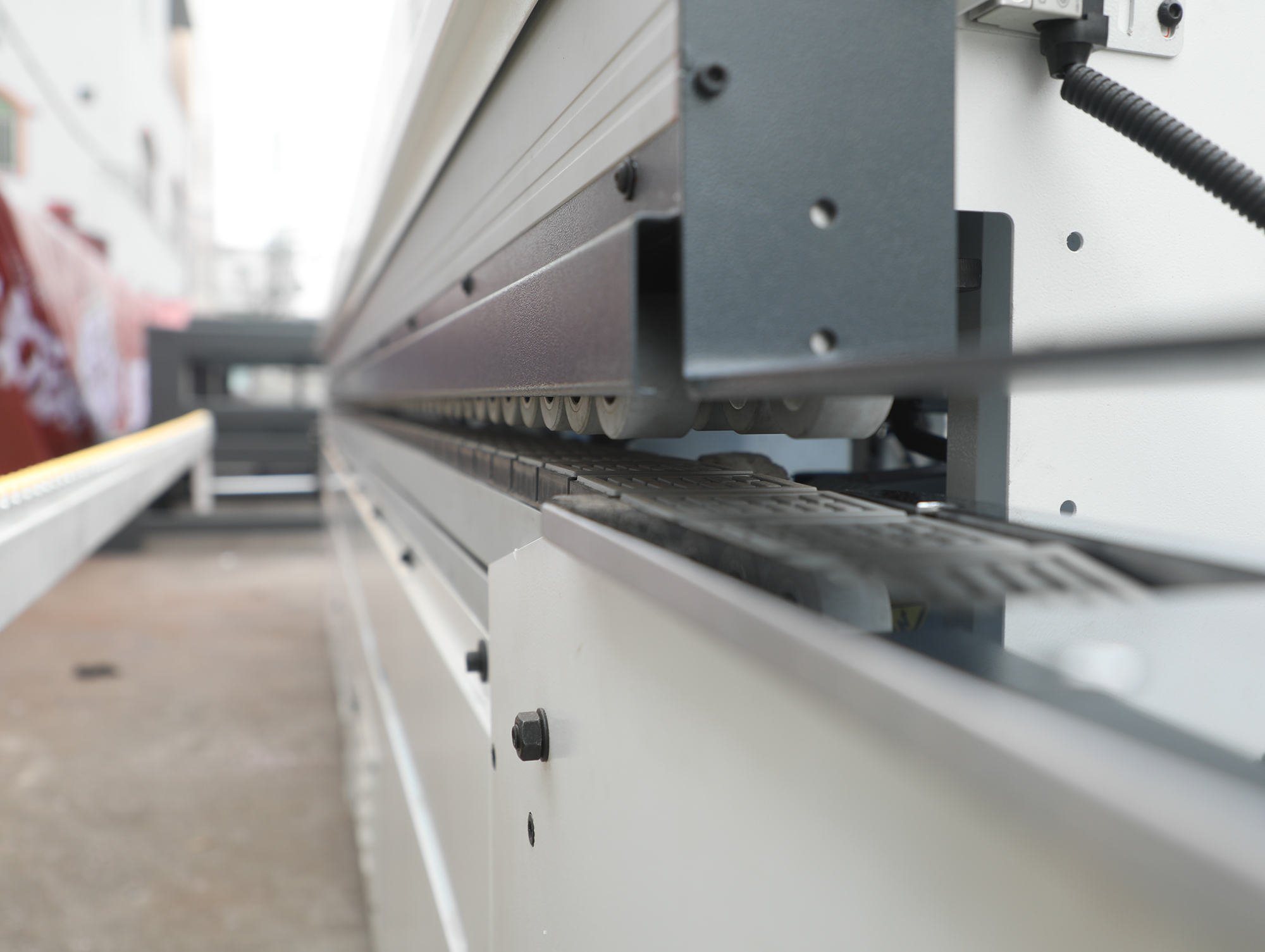
Edge banding machines apply, trim, and polish edge strips. The table below compares the main SYUTECH models.
| Model | Feeding speed | Edge band width | Edge band thickness | Overall dimensions |
|---|---|---|---|---|
| HK268G (Mini) | 16–22 m/min | 10–60 mm | 0.35–3 mm | 3790×730×1210 mm |
| HK268GY (Compact) | 18–20–22 m/min | 10–60 mm | 0.35–3 mm | 5360×730×1210 mm |
| HK568 | 16–18–22 m/min | 10–60 mm | 0.4–3 mm | 7200×710×1628 mm |
| HK868P (Automatic) | 16–22 m/min | 10–60 mm | — | 9500×1000×1650 mm |
The HK568 is made of carbon steel and includes pre-milling, end trimming, rough trimming, fine trimming, corner trimming, and polishing functions, with an installed power of 25.86 kW and a net weight of 2200 kg. The HK868P automatic edge banding machine is also made of carbon steel, with a net weight of 4 t and a working speed of 16–22 m/min. For workshops with less floor space, the HK268GY compact model and the HK268G mini model are made of carbon steel / SS304; both accept edge band widths of 10–60 mm and thicknesses of 0.35–3 mm.
Door Processing and Additional CNC Options
The HK3500 door processing machine is a CNC drilling machine with a table size of 395×3000 mm, overall dimensions of 3800×1550×1300 mm, and a net weight of 800 kg. It is made of carbon steel. In addition, SYUTECH lists a CNC Machining Center (model HK) classified as a CNC Drilling & Milling Single Processing Machine. It has a working range of X-axis 1220 mm, Y-axis 2800 mm, Z-axis 250 mm, a 9 kW air-cooled spindle at 24000 rpm, and a 12-tool automatic tool changer. The Cutting and Sawing Machines model HK6 is another CNC router variant with X-axis working length 2800 mm, Y-axis 1220 mm, and Z-axis working height 50 mm; its maximum speeds are X 120 m/min, Y 80 m/min, and Z 30 m/min.
Production Lines
On the factory-scale end, the HKATC automatic production line is a customizable line made of carbon steel. Buyers specify daily output and workshop size, and the line is adapted to specific factory needs. The HK-Line CNC nesting production line represents an automated nesting configuration. Together, these options illustrate how equipment can scale from a single machine to a complete production system.
Application / Use Cases
In a panel furniture project in Romania, equipment is used to manufacture cabinets and cabinet doors. The operation runs in continuous automatic cycle with manual feeding assistance, and the supporting equipment includes a vacuum cleaner, vacuum pump, and air compressor. A key requirement in this project is compliance with EU CE mechanical and low voltage safety standards. The intended environment is indoor, with normal temperature and humidity and dust-containing wood processing conditions.
In a separate panel furniture edge banding project in Kenya, the machine automatically applies, trims, and polishes edge strips. This setup requires an air compressor and vacuum cleaner, and also specifies CE compliance without an explosion-proof requirement. Like the Romanian case, it is designed for indoor normal temperature and humidity conditions. These examples show that even in different geographies, buyers often share similar requirements around safety standards and supporting equipment.
Market Trend Analysis
Europe led the global woodworking machinery market with a 36.4% revenue share in 2025, according to Grand View Research. Asia Pacific accounted for the largest share of the wood processing machines market at 34.5% in 2024, led by China and India, based on Credence Research. UN Comtrade data shows China's exports of woodworking machine tools to Vietnam reached US$311.6 million in 2024. Among the established players in the sector are Homag Group, SCM Group, Biesse Group, and Weinig AG.
The direction of demand is also visible in the product mix. CNC-based equipment is gaining attention because it can handle complex nesting and drilling tasks with less re-tooling. Edge banding, while a relatively mature process, is moving toward higher feeding speeds and more integrated trimming units. For EU buyers, standards such as EN 1218-4 apply to chain-fed edge banding machines, reflecting a broader pattern of compliance requirements that suppliers must address. New suppliers in the market therefore need to combine product coverage, customization, and regulatory awareness.
Comparison with Traditional Solutions
Compared with a traditional production flow that uses a sliding table saw, a separate drilling machine, and a manual edge bander, a CNC nesting line integrates cutting and drilling into one station. The main advantage is fewer panel handling steps and more consistent part geometry, which matters when a factory runs high product variety. The main boundary is that nesting machines require programming and fixture planning before production, and the initial investment is typically higher than a set of separate basic machines.
For standardized, large-batch panels, a dedicated computer panel saw such as the HK330 may be easier to operate and maintain. Similarly, automatic edge banding machines offer higher edge finish consistency but require compressed air and more floor space than compact models. In small workshops, a mini or compact edge bander can be a more realistic starting point because it occupies less space and handles the same range of edge band widths and thicknesses. The decision is not about which technology is universally better, but about matching the machine to production volume, panel variety, and labour capability.
Future Outlook
The direction in panel furniture machinery is toward greater integration. CNC nesting lines and customizable automatic production lines are starting to replace collections of standalone machines, and CE compliance remains a baseline for suppliers serving Europe. The ability to adapt a machine to daily output and workshop size, as seen with the HKATC, suggests that suppliers will continue to offer project-specific configurations rather than only fixed models.
For buyers, the practical implication is that early-stage research should focus on production requirements first, then on the machine type and automation level that fits those requirements. As software controls become more accessible, even mid-sized workshops may adopt nesting machines for more complex parts. At the same time, compact equipment will continue to serve a distinct segment: workshops that need edge banding or drilling capability without expanding floor space. Suppliers that offer both compact and fully automated options give buyers more room to scale in stages.
Frequently Asked Questions
What is a CNC nesting machine?
A CNC nesting machine is a computer-controlled machine that cuts and drills panels in one setup. The HK6, for example, has a working range of X-axis 1220 mm, Y-axis 2800 mm, Z-axis 250 mm, a 9 kW spindle at 24000 rpm, and a 12-tool automatic tool changer.
What is the difference between a computer panel saw and a CNC router?
A computer panel saw is built for sizing panels. The HK330 computer panel saw has a maximum cutting width of 3300 mm, a maximum cutting height of 100 mm, and a maximum cutting speed of 0–100 m/min. A CNC router such as the HK6 performs cutting and drilling over a working range of 1220 mm by 2800 mm, and is often used for nesting parts from a full sheet.
What edge banding functions should buyers look for?
Typical edge banding functions are pre-milling, end trimming, rough trimming, fine trimming, corner trimming, and polishing. The HK568 edge banding machine includes these functions and has a feeding speed of 16–18–22 m/min.
What is a six-side drilling machine?
A six-side drilling machine drills holes on multiple faces of a panel without repositioning manually. The HK612A CNC six-side drilling machine has an X-axis working length of 2800 mm, a Y-axis of 1220 mm, and a Z-axis working height of 50 mm. It is equipped with 10 vertical top drills, 8 horizontal top drills (XY), and 9 vertical bottom drills.
Does SYUTECH supply complete woodworking production lines?
Yes. SYUTECH offers the HKATC automatic production line, which is customized based on daily output and workshop size, and the HK-Line CNC nesting production line for automated nesting scenarios.
What CE considerations apply to woodworking machines for the EU?
For EU projects, woodworking equipment may need to meet CE mechanical and low voltage safety standards. In panel furniture projects in Romania and Kenya, CE compliance was specified as a special requirement. For chain-fed edge banding machines in the European market, EN 1218-4 is the relevant safety standard.