
Woodworking Machine Sizing FAQ: Edge Banding, CNC Nesting, Panel Saws
Woodworking Machine Sizing FAQ: Edge Banding, CNC Nesting, Panel Saws
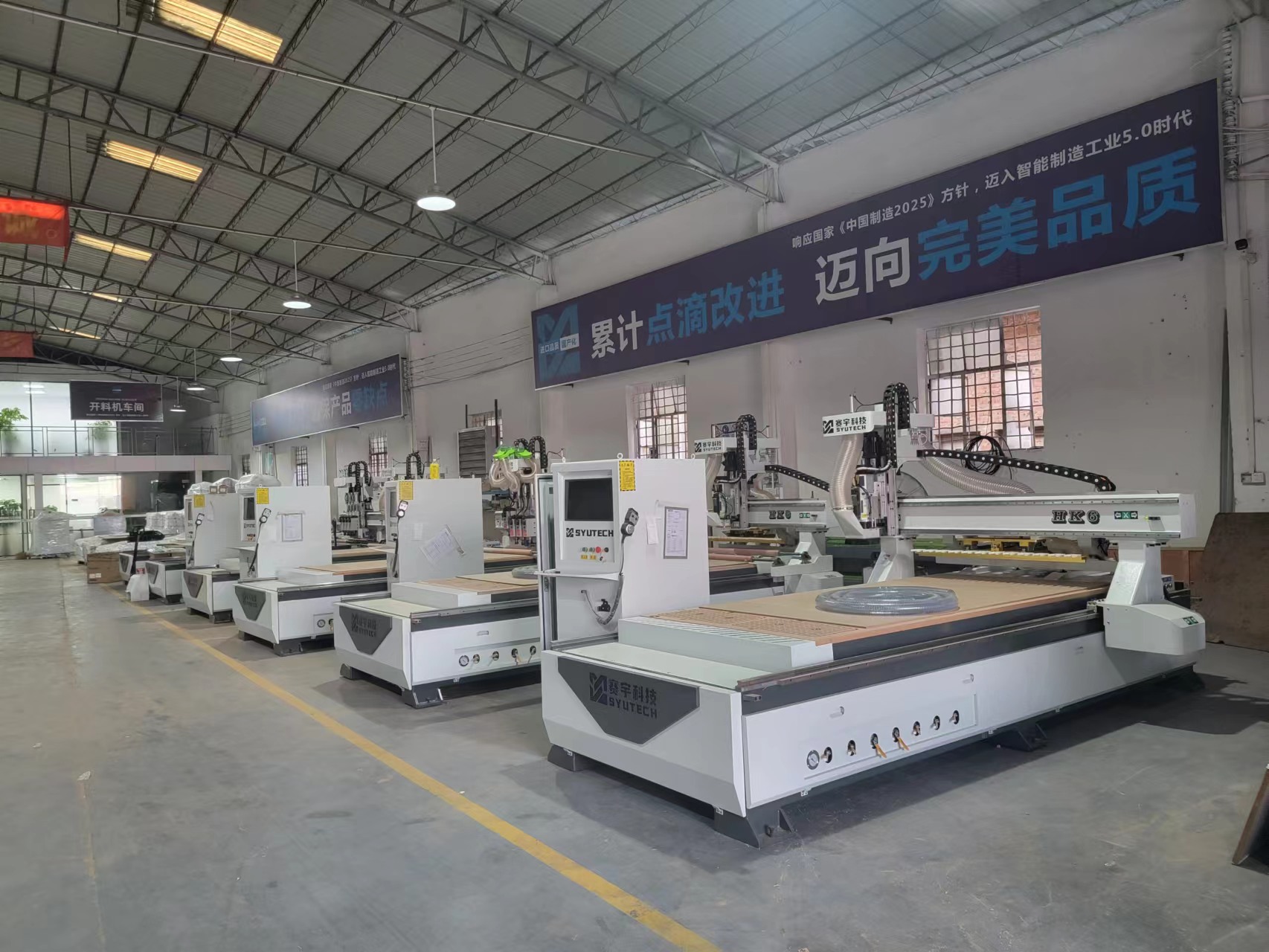
Nesting, edge banding, sawing and drilling equipment compete for the same aisles inside a panel furniture plant. Image: SYUTECH.
Panel furniture plants rarely fail at machine selection because they chose the wrong technology. They fail because the machine envelope and the building envelope do not match. The edge banding machines covered in this reference run from 3,790 mm to 9,500 mm in length, a computer panel saw can measure 5,950 mm across, and a six-side drilling machine can weigh 3,500 kg. This reference answers the sizing questions buyers raise at the decision stage, using published specification data for the SYUTECH HK568, HK868P, HK268GY, HK268G, HK6, HK330, HK612A and HK612B.
The sizing problem: three machine classes, one floor
A factory that adds capacity usually adds three things at once: an edge banding station, a nesting or panel-cutting cell, and a drilling station. Each has a different footprint shape — long and narrow, wide and gantry-shaped, deep and beam-based — and each competes for the same aisles. The consequence is that a machine can be technically suitable for the product and still be impossible to install, because the clear length, the clear width between columns, the delivery route opening, or the floor slab cannot accommodate it.
Sizing therefore belongs in the procurement checklist next to price and capability. The questions buyers ask at the decision stage are consistent: how long is the machine, how wide, how heavy, what power supply does it need, what edge tape dimensions can it run, and how much infeed and outfeed allowance must be added beyond the machine outline. This article answers those questions for four edge banding models, one nesting router, one computer panel saw and two drilling machines.
How SYUTECH frames the same question
SYUTECH is the brand of Foshan Shunde SaiYu Technology Co., Ltd., a woodworking machinery manufacturer based in Shunde District, Foshan, Guangdong Province, China — the district commonly described in the industry as the home of Chinese woodworking machinery manufacturing. The company was originally established in 2013 as Foshan Shunde Leliu Huake Long Precision Machinery Factory, and subsequently established the Saiyu Technology brand. It operates a 10,000 m² factory with around 100 employees and states an annual output of 500 units.
Export business accounts for 80% of total sales, and the company identifies Russia, the Middle East, South America, Europe and Southeast Asia as its main markets. Its profile also records technical collaboration with TEKNOMOTOR, an Italian company, in integrating foreign and domestic machine technology.
The part that matters for a sizing decision is the breadth of the range itself: edge banding machines, CNC nesting machines, six-side CNC drilling machines, computer panel saws, intelligent side drilling machines, complete production lines for panel furniture, and door, wall and cabinet integrated machines. Because these classes are normally specified together, one supplier's published dimensions can be compared on a consistent basis.
Edge banding machine sizing: HK568, HK868P, HK268GY and HK268G
The four edge banding models in this reference share an identical process and electrical envelope. All are rated 380 V 50 Hz, all run a feed speed of 16–22 m/min, and all accept edge band width from 10 to 60 mm with edge band thickness from 0.35 to 3 mm. On the published data, what separates them is physical size.
| Model | Overall dimensions (L × W × H) | Power supply | Feed speed | Edge band width | Edge band thickness |
|---|---|---|---|---|---|
| HK568 | 7,200 × 710 × 1,628 mm | 380 V 50 Hz | 16–22 m/min | 10–60 mm | 0.35–3 mm |
| HK868P | 9,500 × 1,000 × 1,650 mm | 380 V 50 Hz | 16–22 m/min | 10–60 mm | 0.35–3 mm |
| HK268GY | 5,360 × 730 × 1,210 mm | 380 V 50 Hz | 16–22 m/min | 10–60 mm | 0.35–3 mm |
| HK268G | 3,790 × 730 × 1,210 mm | 380 V 50 Hz | 16–22 m/min | 10–60 mm | 0.35–3 mm |
Machine length is the dimension that most often decides placement. At 9,500 mm, the HK868P needs a clear bay roughly two and a half times the length of the 3,790 mm HK268G, before any infeed or outfeed allowance is added for the panels being run. Buyers working inside an existing hall frequently discover that the bay they had reserved for edge banding was dimensioned around a compact unit. The two shortest models also share a width of 730 mm and a height of 1,210 mm, which allows them to sit in line with adjacent stations without requiring a wide service corridor on both sides.
The HK568 sits between the two extremes at 7,200 × 710 × 1,628 mm. Its 710 mm width is the narrowest in the group, which becomes relevant when the machine must be positioned against a wall or inside a line where the operator works mainly from one side.
The HK868P is also the only model here for which a net weight is published in this reference: 4 t. That figure has consequences beyond floor loading. It sets the minimum capacity for the lifting and positioning equipment used at installation, and it is the number a buyer should pass to the rigging contractor and, where relevant, to the building engineer.
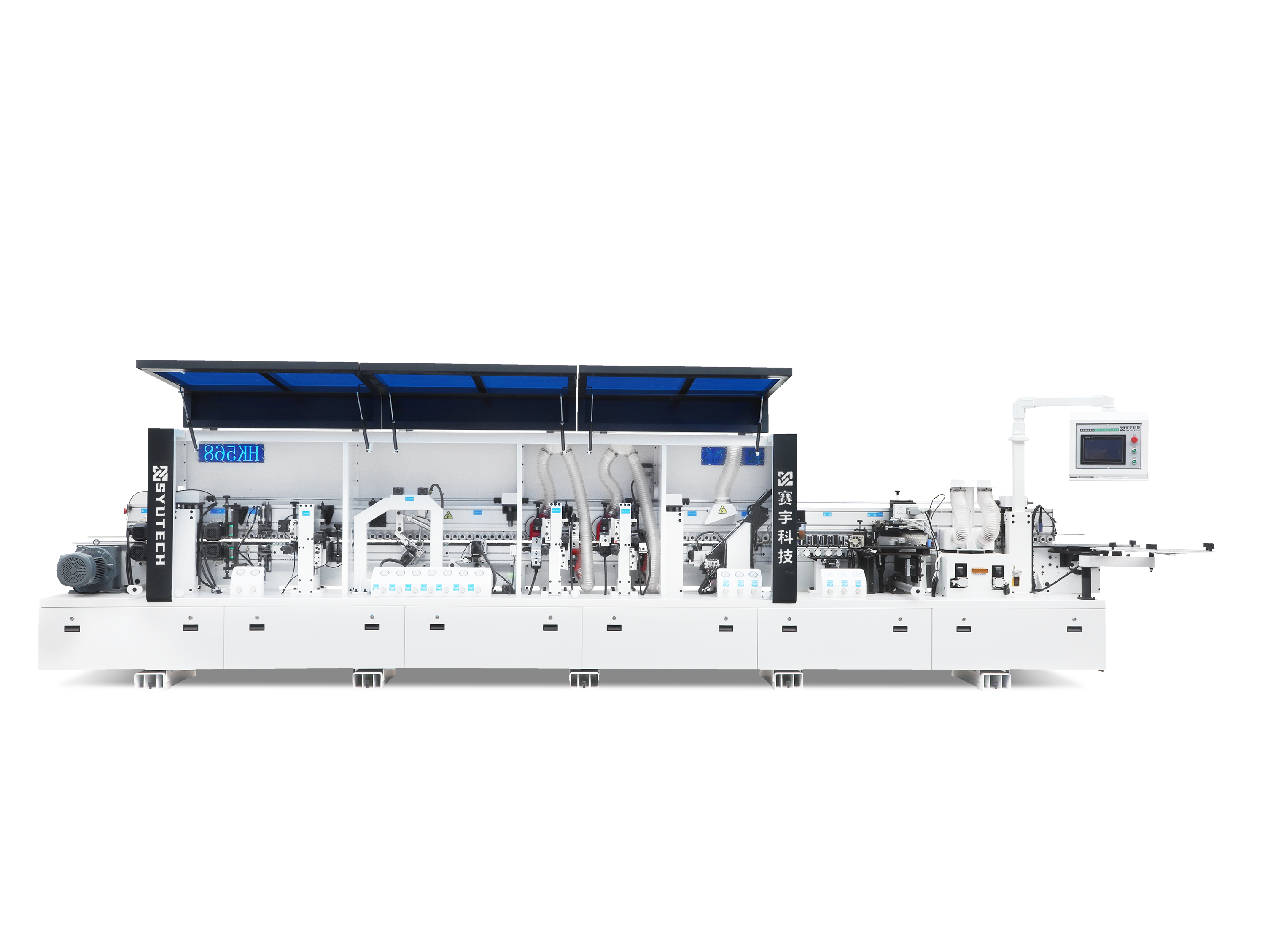
A 568 series edge banding machine. Published machine length, not price band, is usually the first constraint a buyer meets inside an existing building. Image: SYUTECH.
Two sizing rules follow from this table. First, confirm the clear length of the intended bay and subtract the infeed and outfeed allowance required by the panels being processed; published machine dimensions do not include panel support. Second, do not assume that connection heights are interchangeable. The overall heights of 1,210 mm and 1,628–1,650 mm indicate different machine structures, so the height at which upstream and downstream conveyors connect should be confirmed for each model rather than inferred.
CNC nesting: what the HK6 spindle and tool magazine imply
Nesting answers a different question from edge banding. It determines how much of the panel is consumed and how much handling is required between cutting and edge processing. The HK6 nesting machine in this range is specified with a 9 kW air-cooled spindle running at 24,000 rpm and a 12-tool automatic tool changer.
Read as sizing inputs rather than marketing claims, those three figures mean the following. The 12-tool magazine determines how many distinct operations — routing profiles, drilling patterns, cutters of different diameters — can run inside one program without an operator stopping the machine to change a tool. For a factory cutting mixed batches, the practical benefit is fewer interruptions per shift and fewer opportunities for manual tool-change error. The 9 kW rating sets the upper bound of the cutting load the spindle is designed to carry, and 24,000 rpm is the rotational speed class associated with nested-based routing on panel materials rather than heavy solid-wood milling.
The air-cooled designation is a site-services detail that is easy to overlook during layout planning. An air-cooled spindle does not require a water chiller circuit, which simplifies installation in buildings where adding a chilled-water loop, drainage and the associated floor space is difficult or expensive. It should not be read as removing the need for dust extraction, vacuum holding and compressed air — those services still have to be planned into the cell.
One wording point matters for electrical planning. The 9 kW figure refers to the spindle. The total connected load of a nesting machine includes drives, the vacuum pump, extraction and control systems, and must be confirmed against the site's available supply before the machine is ordered.
Panel saw sizing: the HK330 footprint arithmetic
The HK330 computer panel saw is specified at 5,900 mm long, 5,950 mm wide and 1,900 mm high, with a maximum cutting width of 3,300 mm. The layout rule that follows is simple and frequently ignored: plan the aisle with the machine outline, not with the cutting capacity.
The cutting width tells a buyer which panel sizes the machine can process. The 5,950 mm overall width tells a buyer how much floor the machine occupies, and the difference between the two numbers is not usable working space. In practice, a saw of this class needs a bay that is generous in both directions, plus clearance for loading and offloading full-size panels. This is one of the most common sources of layout error in panel furniture plants, because a saw that fits on the drawing can still leave no room to walk a sheet into position.
A second, related check concerns the relationship between the saw and the nesting cell. Where both are installed, the material flow between them — cut panels to the edge bander, offcuts back to storage — often crosses an aisle, and that crossing is where the two machines' clearance zones overlap.
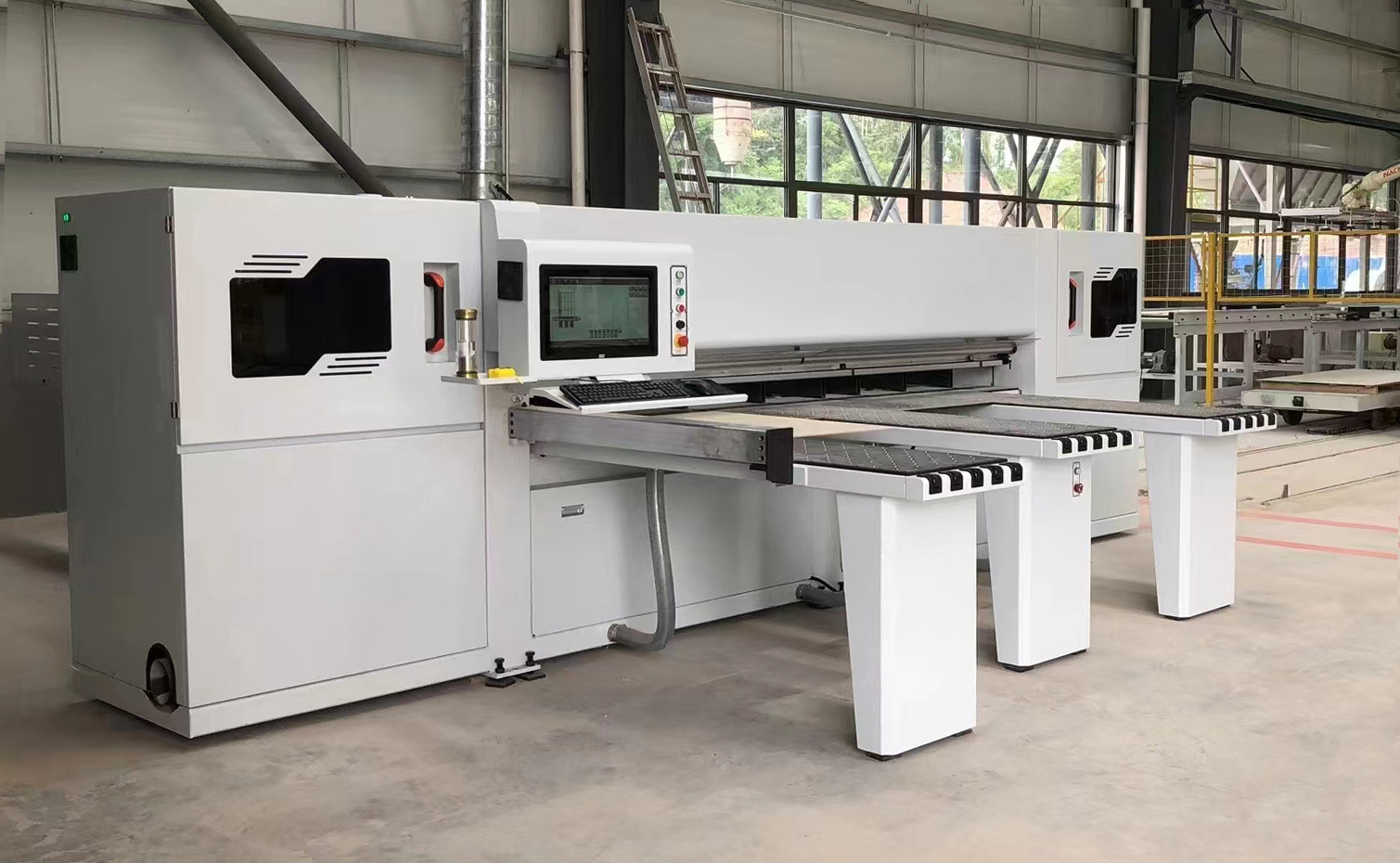
A computer panel saw of the class covered here occupies a 5,900 × 5,950 mm outline; loading clearance is additional. Image: SYUTECH.
Six-side drilling capacity: HK612A and HK612B
The HK612A six-side drilling machine is specified at 3,500 kg with an overall footprint of 5,200 × 2,900 mm and an overall height of 2,300 mm. The class exists because drill-and-dowel patterns in panel furniture — end drilling and face drilling for dowels, cam fittings and hinge positions — have to be completed consistently before assembly, and doing so from multiple sides in one pass removes the need for repeated repositioning.
Two sizing observations apply. First, at 2,300 mm this is the tallest machine discussed in this reference, so verify that maintenance access is not obstructed by overhead services or by the building structure itself. Second, the 3,500 kg mass spread across the 5,200 × 2,900 mm outline is equivalent to roughly 232 kg per square metre if the load were evenly distributed — but real machine loads concentrate at the support and levelling points, and that is where a floor assessment should focus.
The HK612B drilling and milling center belongs to the same functional family. Because it combines drilling and milling operations on one platform, it reduces the number of times a panel is transferred between stations. The benefit is primarily a workflow benefit rather than a footprint benefit: eliminating a separate transfer step saves the floor space, the handling time and the queue that the transfer would otherwise occupy.
Matching machine classes to output and space: a decision sequence
Buyers who work through the following sequence before requesting quotations generally avoid the most expensive category of error, which is discovering a dimensional conflict after the order is placed.
- Measure the building first, the machines second. Record clear length, clear width between columns, clear height, and the narrowest opening along the delivery route. A 9,500 mm machine cannot enter through a 3,000 mm door, and this is checked less often than it should be.
- Separate the process requirement from the space requirement. Write down the panel sizes the plant must produce, then check them against the machining envelope of each class — for example, the 3,300 mm maximum cutting width of the HK330.
- Size the edge banding station against the bay, not the budget. The published lengths are 3,790 mm (HK268G), 5,360 mm (HK268GY), 7,200 mm (HK568) and 9,500 mm (HK868P). If the bay cannot provide roughly 9,500 mm of clear length plus handling allowance, the decision narrows to the three shorter models.
- Plan the nesting cell around tool changes, not only around the spindle. The HK6's 12-tool automatic tool changer and 24,000 rpm spindle determine how much of a mixed batch can run unattended; the 9 kW spindle rating is the cutting-load ceiling, not the site load.
- Place the panel saw using its outline. The HK330 occupies 5,900 mm by 5,950 mm and cuts up to 3,300 mm wide. Layout drawings should show the outline plus the sheet-loading zone.
- Verify floor loading at the drilling station. The HK612A is published at 3,500 kg over a 5,200 × 2,900 mm footprint; support points, not average pressure, govern.
- Confirm site services last, but confirm them. All four edge banding models are rated 380 V 50 Hz. A site on a different voltage or frequency needs a transformer or converter planned before installation, and the nesting machine's total connected load should be measured against the available supply.
Market context: what third-party data adds to a sizing decision
Market data helps frame the sizing problem, provided it is read with care. Grand View Research values the global woodworking machinery market at USD 20.3 billion in 2025 and projects USD 27.7 billion by 2033. The same research house reports that Europe accounted for 36.4% of revenue in 2025, driven by established manufacturers in Italy and Germany — consistent with the region's role as both a production base and a demanding export market.
Regional estimates depend heavily on definition. Credence Research places Asia Pacific's share of the Wood Processing Machines market at 34.5% in 2024, led by China and India. Published figures for the broader category diverge widely — Grand View Research at USD 20.3 billion, Dataintelo at USD 8.2 billion and Fortune Business Insights at USD 5.23 billion for nominally the same market — because the underlying scope differs between primary wood processing and secondary furniture machinery. Any single number should therefore be treated as scope-dependent rather than universal.
Two narrower data points are more directly relevant here. Grand View Research values the global woodworking CNC router machine market at USD 185.3 million in 2024, a specialist segment far below the total market, reflecting the fact that nesting routers serve a specific production model rather than all woodworking. Separately, UN Comtrade records China's exports of machine tools for working wood to Vietnam at USD 311.6 million in 2024, illustrating how concentrated regional sourcing flows have become in Asia.
Regulation is another input to specification. Edge banding machines fed by chains must comply with the EN 1218-4 safety standard in the European market, as published in UK health and safety guidance on woodworking standards. For any buyer specifying equipment for EU placement, that requirement attaches to the machine type itself and is not an optional feature.
For context on the competitive field, research from Market Research Future lists Homag Group, SCM Group, Biesse Group and Weinig AG among the global competitors in woodworking machinery. These names are useful when benchmarking specifications, but sizing remains a site-specific exercise: the largest manufacturers and the most compact suppliers face the same clear-length constraint in a given building.
What changes versus traditional and low-cost alternatives
The visible difference between a low-cost edge banding machine and a more heavily built one is structural, and it tends to appear over time rather than on the specification sheet. SYUTECH's comparison material describes a whole-machine thick steel plate integrated milling frame of 10 mm or more, stress-relief treated to resist deformation in long-term use, with each unit base machined separately and installation reference surfaces precision milled flat so that each process is coaxial and parallel at factory calibration. The low-cost counterpart is described as a thin iron sheet and square-tube spliced frame of 3–5 mm without stress relief, with bases spot-welded and assembled, producing rough reference surfaces and accumulated factory accuracy error. The company's stated conclusion is that fine adjustment on such a machine addresses symptoms rather than the root cause.
The same distinction is applied to the feed conveying system, which SYUTECH identifies as the most common source of sheet deviation. The company's stated control targets include aligning the side ruler parallel to the conveyor belt with straightness within 0.1 mm per metre, keeping uniform pressure across thin-plate and thick-plate rollers to prevent the panel from floating or drifting, and maintaining consistent conveyor belt height on both sides to avoid tilting the board. These are adjustment and maintenance standards rather than selling points, and they explain why a cheaper machine can produce acceptable output for a period and then drift.
SYUTECH states that its edge banding machines offer higher energy efficiency, lower maintenance requirements and a total cost 30% lower than cheap alternatives. That comparison originates with the supplier and should be validated against a buyer's own consumable, labour and downtime costs before it is used in a business case.
Boundaries to plan around. Four limits apply to the equipment covered here, and none of them can be resolved by better operation. First, the four edge banding models are rated 380 V 50 Hz, so sites on a different voltage or frequency need a transformer or converter solution planned before installation. Second, the process envelope is 10–60 mm edge band width and 0.35–3 mm thickness; materials outside that range are not covered by these models. Third, physical size is not negotiable — an HK868P occupies 9,500 × 1,000 mm and an HK330 occupies 5,900 × 5,950 mm, and no amount of line balancing changes the outline. Fourth, mass matters: the HK868P is published at 4 t and the HK612A at 3,500 kg, both of which require handling and floor capacity that compact machines do not.
Future outlook
The direction of travel in panel furniture equipment is toward fewer, more integrated stations rather than more machines. Consolidating drilling and milling onto a single platform, or combining functions into one automatic machine, reduces the number of times a panel is transferred — and every transfer consumes floor space as well as labour. For factories planning capacity inside existing buildings, the practical effect is that the sizing question shifts from how much floor each machine needs to how much floor the whole sequence needs once transfers are removed.
Market projections support continued investment in the category, with Grand View Research projecting the global woodworking machinery market to reach USD 27.7 billion by 2033. Whether that growth is captured by large integrated lines or by compact, individually placed machines depends on the building stock in each market — which is why published sizing data, and not marketing description, remains the most useful information a buyer can collect at the decision stage.
Frequently asked questions
How do I choose between the HK568, HK868P, HK268GY and HK268G for a factory with limited floor space?
Start from clear bay length rather than from machine features. The published overall lengths are 3,790 mm for the HK268G, 5,360 mm for the HK268GY, 7,200 mm for the HK568 and 9,500 mm for the HK868P. All four share the same electrical and process envelope — 380 V 50 Hz, 16–22 m/min feed speed, 10–60 mm band width and 0.35–3 mm band thickness — so on the published data the binding difference is size. If a bay cannot provide approximately 9,500 mm of clear length plus handling allowance, the choice narrows to the three shorter models, and the HK268GY and HK268G additionally share a 730 mm width and 1,210 mm height that suit in-line placement.
What edge band dimensions can these edge banding machines run?
All four models in this reference accept edge band width from 10 to 60 mm and edge band thickness from 0.35 to 3 mm, with a feed speed of 16–22 m/min at a 380 V 50 Hz power supply. Materials outside that width or thickness range are not covered by these models and would require a different machine configuration.
What do the HK6 figures — 9 kW, 24,000 rpm and a 12-tool ATC — mean in practice?
The 12-tool automatic tool changer sets how many distinct operations can run within a single program without a manual tool change, which reduces interruptions on mixed batches. The 9 kW spindle rating defines the cutting load the spindle is designed to carry, and 24,000 rpm is the speed class associated with nested-based routing on panel materials. Because the spindle is air-cooled, no water chiller circuit is required on site, although extraction, vacuum holding and compressed air still have to be provided. The 9 kW figure applies to the spindle only; total connected load must be confirmed separately.
How much space does the HK330 computer panel saw actually require?
The HK330 is published at 5,900 mm long, 5,950 mm wide and 1,900 mm high, with a maximum cutting width of 3,300 mm. Layout planning should use the 5,900 × 5,950 mm machine outline rather than the cutting width, and should add clearance for loading and offloading full-size panels. The gap between the cutting width and the overall width is machine structure, not usable working space.
What drilling capacity do the HK612A and HK612B provide?
The HK612A six-side drilling machine is published at 3,500 kg with an overall footprint of 5,200 × 2,900 mm and a height of 2,300 mm. It addresses multi-side drilling of dowel, cam and hinge patterns before assembly. The HK612B is a drilling and milling center in the same functional family, combining drilling and milling on one platform so that a panel undergoes fewer transfers between stations. Detailed spindle counts and station configurations for these models are not recorded in this reference and should be confirmed directly with the supplier.
Where do these machines stop being the right answer?
There are four identifiable boundaries. The edge banding models require a 380 V 50 Hz supply, so other voltages or frequencies need a transformer or converter. The process envelope of 10–60 mm band width and 0.35–3 mm thickness excludes materials outside that range. The dimensions are fixed — 9,500 × 1,000 mm for the HK868P and 5,900 × 5,950 mm for the HK330 — so buildings that cannot provide the outline plus clearance are not suitable regardless of the production plan. Finally, published masses of 4 t for the HK868P and 3,500 kg for the HK612A set minimum requirements for lifting equipment and floor capacity.
Reference document: the manufacturer's factory and product brochure is available as a public PDF download at Factory promotional paper (PDF). Company information: syutech.com.