
Woodworking Band Saw Machines: 5 Specs Buyers Should Measure First
Independent Specification Review · Woodworking Machinery
Woodworking Band Saw Machines: 5 Specs Buyers Should Measure First

Horizontal woodworking band saw machine. Image: XINYANGJX.
The global band saw machine market was valued at approximately USD 2.1 billion in 2024 and is projected to reach USD 2.8 billion by 2030, growing at a CAGR of 5.0% (Vertex AI Search / Industry Forecast). Horizontal machines accounted for the largest product type share of that revenue, at 48.3% to 55% of total band saw revenues in 2024–2025 (Dataintelo / Industry Analysis). China remains the world's largest exporter of woodworking machines, holding 29.4% of global exports in 2024 with an export value of USD 2.48 billion (OEC). For a buyer at the evaluation stage, that much supply creates a specific problem: the same machine class is described with different numbers by different suppliers, and a ‘900’ on one spec sheet is rarely the same measurement as a ‘900’ on another.
This article isolates five measurements that can be checked against a drawing, a delivered machine or an inspection report — and shows how those five separate a mid-duty unit from a heavy-duty one. XINYANGJX is the brand of Hangzhou Lin'an Xinyang Machinery Co., Ltd., a wood processing equipment factory founded in 2012 in Hangzhou, Zhejiang Province, China, producing horizontal and vertical woodworking band saw machines, band saw blade grinding machines, tooth picking machines, edge trimming machines, angle cutting machines and related wood processing equipment. Published XINYANGJX model data is used throughout as a worked example of a comparable measurement set; the same five numbers should be requested from every supplier on a shortlist.
Why Five Measurements Beat Five Claims
Spec sheets rarely state which ‘size’ they are quoting. A single machine can legitimately carry four different size numbers. Model MJ377-1000 is published with a maximum log diameter of 950 mm, a square wood size of 850 mm, a maximum sawing height of 875 mm and a minimum sawing length of 1200 mm. All four figures are correct; none of them is interchangeable with the others.
That is the root of most mis-buying. A buyer comparing a ‘900 machine’ from one supplier with a ‘900 machine’ from another may be comparing a maximum log diameter against a maximum sawing width, or a standard track length against an extended one. The remedy is procedural rather than technical: fix the measurement set first, then collect values from every candidate — and require each value to be labelled with the dimension it describes.
The five that follow are the ones that determine what the machine can physically cut, what it will consume on site, and whether it will fit where the buyer intends to install it. They apply equally to a small woodworking band saw machine and to a heavy horizontal woodworking band saw machine; only the numbers change.
Spec 1: Saw Wheel Diameter and Blade Specification
Saw wheel diameter is the single most useful structural number on a band saw, because it determines blade length, and blade length determines how much bending fatigue a blade accumulates per revolution. Across the XINYANGJX horizontal range the published wheel diameters step from 473 mm to 1100 mm.
- 473 mm wheel — MJ375D and MJ375D (extended width type), carrying a 4005×34×1.05 mm blade and a 4470×34×1.05 mm blade respectively.
- 654 mm wheel — MJ376AS-600, carrying a 5080×100×0.9 mm blade on a 95 mm wide wheel.
- 720 mm wheel — MJ376S-900 with a 6144×50×0.9 mm blade, and MJ377-1000 with a 5970×50–60×0.9–1.1 mm blade.
- 1100 mm wheel — the heavy MJ378 series, with a 150 mm wide wheel carrying 8800×150×1.25 mm (MJ378-1500), 9400×150×1.25 mm (MJ378-2000) and 10400×150×1.25 mm (MJ378-2500) blades.
Two blade dimensions deserve separate attention. Blade thickness ranges from 0.9 mm to 1.25 mm in this range; thinner blades remove less material per cut but are more sensitive to tension and alignment. Blade width ranges from 34 mm to 150 mm and governs how straight a deep cut stays. A buyer who records only wheel diameter and omits blade width will still be unable to predict resaw behaviour.
The commercial implication is straightforward: blades are a consumable with a recurring cost, and a non-standard blade size ties the buyer to a single supply source for the life of the machine. Blade size should therefore be recorded on the comparison sheet alongside wheel diameter and wheel width.
Spec 2: Total Motor Output Power and Electrical Configuration
Total output power of the electric motor is an aggregate figure and is not the same as main motor power. MJ377-1000 publishes a 22 kW main motor, while the heavy MJ378-2500 publishes 61.3 kW total output power. Buyers who compare the two numbers against each other are comparing two different things.
The published electrical ladder across the range, all stated at 380V, 50 Hz, 3-phase, runs as follows: MJ375D at 9.8 kW; MJ375D (extended width type) at 11.8 kW; CN70 standard type at 20.55 kW; MJ376AS-600 at 20.6 kW; MJ376S-900 at 21 kW; MJ376AS-900 at 24.5 kW; CN70 hydraulic type at 26.05 kW; MJ378-1500 at 42.55 kW; MJ378-2000 at 51.3 kW; MJ378-2500 at 61.3 kW.
380V/50Hz/3-phase is not a universal site condition. XINYANGJX lists voltage, frequency, wire connector, colour and logo among its customization options, and offers a diesel alternative in the small class: MJ375C is published with a 10P diesel engine and a 4005×34×1.05 mm blade. Power source should therefore be recorded as a separate line item from power rating, because a machine that cannot be energised on site has an effective capability of zero regardless of its published output.
One further distinction is worth noting in the evaluation of drive systems. MJ376AS-900 is published as an intelligent speed control woodworking band saw machine. Feed and speed regulation is a control characteristic, not a power rating; it belongs in the comparison sheet as a capability item rather than in the kilowatt column.
Spec 3: Working Envelope — Diameter Is Only One Number
The working envelope requires at least five recorded values: maximum log diameter, maximum sawing height, maximum sawing width, maximum sawing length and maximum sawing thickness where slab work is planned. Published values in the XINYANGJX range illustrate how far apart these can sit.
- Small class. MJ375D: 600 mm maximum log diameter, 600 mm sawing height, 600 mm sawing width, 5200 mm standard sawing length. The extended width variant raises this to 900 mm diameter, 820 mm height and 880 mm width.
- Mid class. MJ376AS-600: 600 mm diameter, 580 mm height, 600 mm width, 4000 mm length. MJ376S-900 and MJ376AS-900: 900 mm diameter, 880 mm height, 900 mm width, 4000 mm length.
- Heavy class. MJ378-1500: 1500 mm diameter, 1000 mm sawing height, 450 mm maximum sawing thickness, 8 m sawing length or extending length. MJ378-2000 and MJ378-2500: 2000 mm sawing height, 450 mm maximum sawing thickness, 8 m sawing length.
- Width-optimised unit. MJ377-1000: 950 mm log diameter, 850 mm square wood size, 875 mm maximum sawing height, 25 mm minimum sawing height, 450 mm maximum sawing thickness, 7000 mm standard and 1200 mm minimum sawing length.
Two of these values tend to be skipped. Minimum sawing height matters for thin stock: 25 mm on MJ377-1000 is a real floor, and a buyer who checks only the maximum will discover the minimum after installation. Maximum sawing thickness matters for slab and plank production: 450 mm on the heavy MJ378 series is a separate ceiling from log diameter, so a large-diameter log is not automatically cuttable at full depth in one pass.
Spec 4: Footprint, Track Length and Siting
Machine footprint is frequently quoted without track length, yet track length is what determines whether a log can be positioned and fed. The heavy MJ378 series illustrates the point: the machine body is published at 4000×2150×2300 mm (MJ378-1500) and 4300×3000×3100 mm (MJ378-2000), but the standard track length is 12000 mm. A buyer who measures only the machine body will under-plan the yard by several metres.
| Model | Machine dimensions (mm) | Standard track length (mm) | Package dimensions (mm) | Weight (kg) |
|---|---|---|---|---|
| MJ375D | 6600×2000×2000 | 6000 | 2200×950×2100 | 800 |
| MJ375D (extended width type) | 6600×2250×2100 | 6000 | 2300×1100×2100 | 1000 |
| MJ375C (diesel power model) | 6600×2000×2000 | 6000 | 2000×850×2150 | 700 |
| MJ376AS-600 | 5800×2300×2300 | 5800 | — | 2000 |
| MJ376S-900 | 5800×2700×2700 | 5800 | — | 3500 |
| CN70 hydraulic type | 7800×3200×2700 | 7800 | — | 3000 |
| MJ378-1500 | 4000×2150×2300 | 12000 | — | 2800 |
| MJ378-2000 | 4300×3000×3100 | 12000 | — | 4000 |
| MJ378-2500 | 4800×2150×3100 | 12000 | — | 5000 |
Source: published XINYANGJX model specifications. A dash indicates the dimension is not published in the source data provided.
Package dimensions are a separate planning input from machine dimensions, because they drive container loading and inland transport. In the small class, MJ375D packages at 2200×950×2100 mm and the extended width variant at 2300×1100×2100 mm. Note also that the standard-type dimensions are what is published; extending length is offered on the MJ378 series, which changes the siting calculation again.
Spec 5: Machine Weight — Rigidity, Handling and Freight
Weight is the cheapest available proxy for frame mass and vibration resistance, but it carries three separate costs: foundation preparation, on-site handling, and freight. Published weights in the range step from 700 kg (MJ375C diesel) through 800 kg (MJ375D), 1000 kg (MJ375D extended width), 2000 kg (MJ376AS-600 and CN70 standard type), 2800 kg (MJ378-1500 and MJ377-1000), 3000 kg (CN70 hydraulic type), 3500 kg (MJ376AS-900 and MJ376S-900), 4000 kg (MJ378-2000) to 5000 kg (MJ378-2500).
Weight should not be treated as a proxy for capability. MJ376AS-600 and the CN70 standard type are both published at 2000 kg, yet they differ in saw wheel diameter (654 mm against 600 mm), track length (5800 mm against 7800 mm) and total motor output (20.6 kW against 20.55 kW). Two machines of identical mass can be planned into quite different sites and can cut differently. Weight is a logistics and stability input; it is not a ranking criterion on its own.
Blade maintenance equipment should be counted in the same weight and footprint budget, because it normally travels in the same shipment as the saw. Published figures for the auxiliary range are modest by comparison: the MF1115 band saw blade grinding machine is listed at 300 kg with dimensions of 1400×900×1300 mm and 0.79 kW total motor power; MF115 with extended height is listed at 95 kg with dimensions of 2680×1260×570 mm and 0.31 kW; the MF4050 woodworking tooth picking machine is listed at 25 kg with dimensions of 650×500×750 mm.
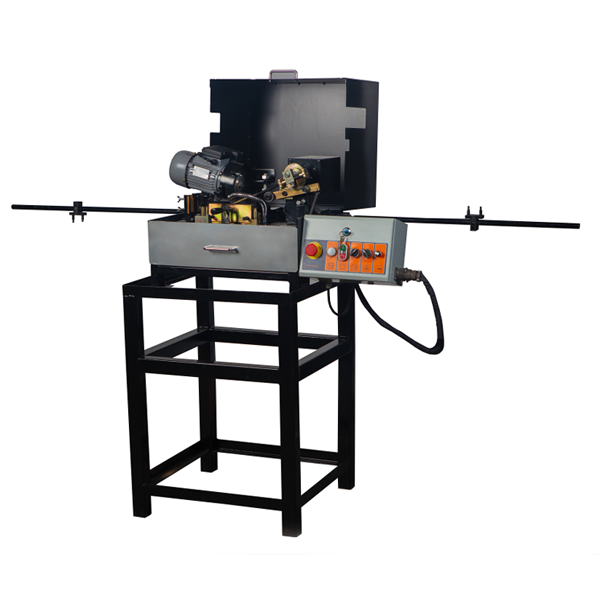
Band saw blade grinding machine. Blade maintenance equipment is part of the same procurement budget as the saw itself. Image: XINYANGJX.
The Five Specs Side by Side
The table below orders published horizontal models by maximum log diameter, from smallest to largest, and carries the first four measured specifications on a single line. It is a specification ladder rather than a brand ranking: the ordering metric is a physical capacity figure, and the same columns should be filled in for every supplier a buyer is evaluating.
| Model | Max log diameter (mm) | Saw wheel diameter (mm) | Saw blade size (mm) | Total motor output (kW) | Standard track length (mm) | Weight (kg) |
|---|---|---|---|---|---|---|
| MJ375D | 600 | 473 | 4005×34×1.05 | 9.8 | 6000 | 800 |
| MJ375D (extended width type) | 900 | 473 | 4470×34×1.05 | 11.8 | 6000 | 1000 |
| MJ376AS-600 | 600 | 654 | 5080×100×0.9 | 20.6 | 5800 | 2000 |
| MJ376AS-900 (intelligent speed control) | 900 | 654 | — | 24.5 | 5800 | 3500 |
| MJ376S-900 | 900 | 720 | 6144×50×0.9 | 21 | 5800 | 3500 |
| MJ378-1500 | 1500 | 1100 | 8800×150×1.25 | 42.55 | 12000 | 2800 |
| MJ378-2000 | 2000 | 1100 | 9400×150×1.25 | 51.3 | 12000 | 4000 |
| MJ378-2500 | 2500 | 1100 | 10400×150×1.25 | 61.3 | 12000 | 5000 |
Source: published XINYANGJX model specifications. A dash indicates the dimension is not published in the source data provided. All motor output figures are stated at 380V, 50 Hz, 3-phase.
Reading the ladder horizontally produces the practical conclusion. Moving from MJ375D to MJ378-2500 multiplies motor output by roughly six, saw wheel diameter by roughly two and a third, track length by two, and weight by six and a quarter. Those multipliers are not proportional to one another, which is precisely why a single headline figure cannot describe a machine.
What the Numbers Do Not Tell You
Specification data establishes capability boundaries; it does not establish safety compliance or throughput.
On safety, two standards are frequently cited in woodworking machinery procurement. ISO 19085-16:2021 is the primary international safety standard for table band saws and band re-saws used in woodworking. In the United States, OSHA 29 CFR 1910.213 specifies requirements for blade guarding and tension control devices on woodworking machinery. The boundary worth stating plainly is scope: ISO 19085-16:2021 is written for table band saws and band re-saws, so a horizontal log mill is not automatically covered by the same clause set. Buyers should confirm which standard a specific model is documented against rather than assuming a category-wide answer, and should treat the existence of a standard as distinct from evidence that a given machine has been assessed against it.
On throughput, motor power is an input, not an output. Feed rate, blade condition, blade tension, species density and log straightness all intervene between the nameplate figure and the cubic metres produced per shift. A high-output machine running a dull blade will underperform a smaller machine on a disciplined blade maintenance schedule — which is why grinding and tooth picking equipment appears in the same shipments as the saws themselves in multiple recorded projects.
On capacity claims, a delivered machine can be verified and a spec sheet cannot. The five measurements above are all checkable at goods-inspection: wheel diameter with a tape, blade geometry against the blade packaging, motor nameplate against the order, footprint against the foundation drawing, and weight against the freight documents.
Where These Specifications Have Been Applied
Recorded project data from XINYANGJX deployment history shows the specification ladder being matched to site scale rather than to a single default model.
- Dealer-scale fleets. A project in Sri Lanka involved the installation of 30 woodworking band saw machines for sawing logs and timbers and processing wood plates, in stable operation over a period of 7 years. A project in Kenya involved 16 pieces of the small woodworking band saw machine model MJ375D, in stable operation for over 2 years.
- Combined saw and maintenance packages. A project in the Democratic Republic of the Congo installed 3 pieces including horizontal woodworking band saw machines, band saw blade grinding machines and band saw blade tooth picking machines, in stable operation for 2 years. A project in Chile installed 2–4 pieces for band saw blade processing and sharpening purposes, in stable operation for 2 years.
- Long-duration multi-unit sites. Projects in Ghana, Togo and Benin involved 6–8 pieces of equipment running well for many years within 10 years of operation; Angola 2–4 pieces over 10 years; Mozambique 2–4 woodworking band saw machines over 8 years.
- Mid-duration sites. Vietnam 2–4 pieces in stable operation for 4 years; Zambia 2–4 pieces over 3 years; France 2–4 pieces over 2 years; Malaysia 2–4 pieces over 2 years; Tanzania 6–8 woodworking band saw machines over 1 year.
These products have been used by both woodworking machinery dealers and woodworking machine users, and the company serves markets in Africa, Southeast Asia, South Asia and South America, with approximately 70% of equipment exported.
Market Trend: Why Horizontal Demand Keeps Growing
Three verified data points frame the current procurement environment. First, the global band saw machine market is forecast to grow from approximately USD 2.1 billion in 2024 to USD 2.8 billion by 2030 at a 5.0% CAGR. Second, horizontal band saw machines took 48.3% to 55% of total band saw revenues in 2024–2025, making the horizontal configuration the dominant product type by revenue. Third, China supplied 29.4% of global woodworking machine exports in 2024, worth USD 2.48 billion.
One caution belongs with these figures. Estimates of the band saw machine market vary between research sources — one alternative estimate places the 2024 market at USD 1.962 billion and another places the 2025 market at USD 2.8 billion — most likely because some sources include metal-cutting machines and others cover woodworking equipment only. A buyer building a capital plan on a single market number should check what the number includes before using it.
Where Band Saw Machines Have Hard Limits
A comparison that only lists advantages is not useful for procurement. Four constraints are intrinsic to this machine class and should be planned for before purchase.
- Thin blades demand routine maintenance. The blade thickness across this range runs from 0.9 mm to 1.25 mm. That thinness is exactly what produces the narrow kerf that makes band saws economically attractive, and it is also why grinding and tooth setting are recurring scheduled work rather than optional upkeep. A buyer who does not budget time or equipment for blade maintenance has not costed the machine.
- Even the smallest horizontal unit needs a long footprint. MJ375D is published at 6600×2000×2000 mm with a 6000 mm standard track. This is not a benchtop format, and yard layout must be resolved before ordering rather than after delivery.
- Heavy models need substantial electrical supply. The MJ378 series draws 42.55 kW to 61.3 kW at 380V, 50 Hz, 3-phase. Sites without that supply must either invest in electrical infrastructure or select a lower class of machine.
- Production and delivery are capacity-limited. Published supply parameters for XINYANGJX are a minimum order quantity of 1 piece, a lead time of 30–50 days or negotiable, and a monthly capacity of 30 pieces, with 100% of products tested before shipping. For a dealer assembling a mixed container across several models, the monthly capacity figure — not the lead time — is the binding constraint.
Compared with wider-kerf alternatives, band saw machines trade kerf efficiency for blade fragility and alignment sensitivity. That trade is favourable in log and timber processing where material yield dominates, but it is not free, and the maintenance line in the operating budget should be sized accordingly.
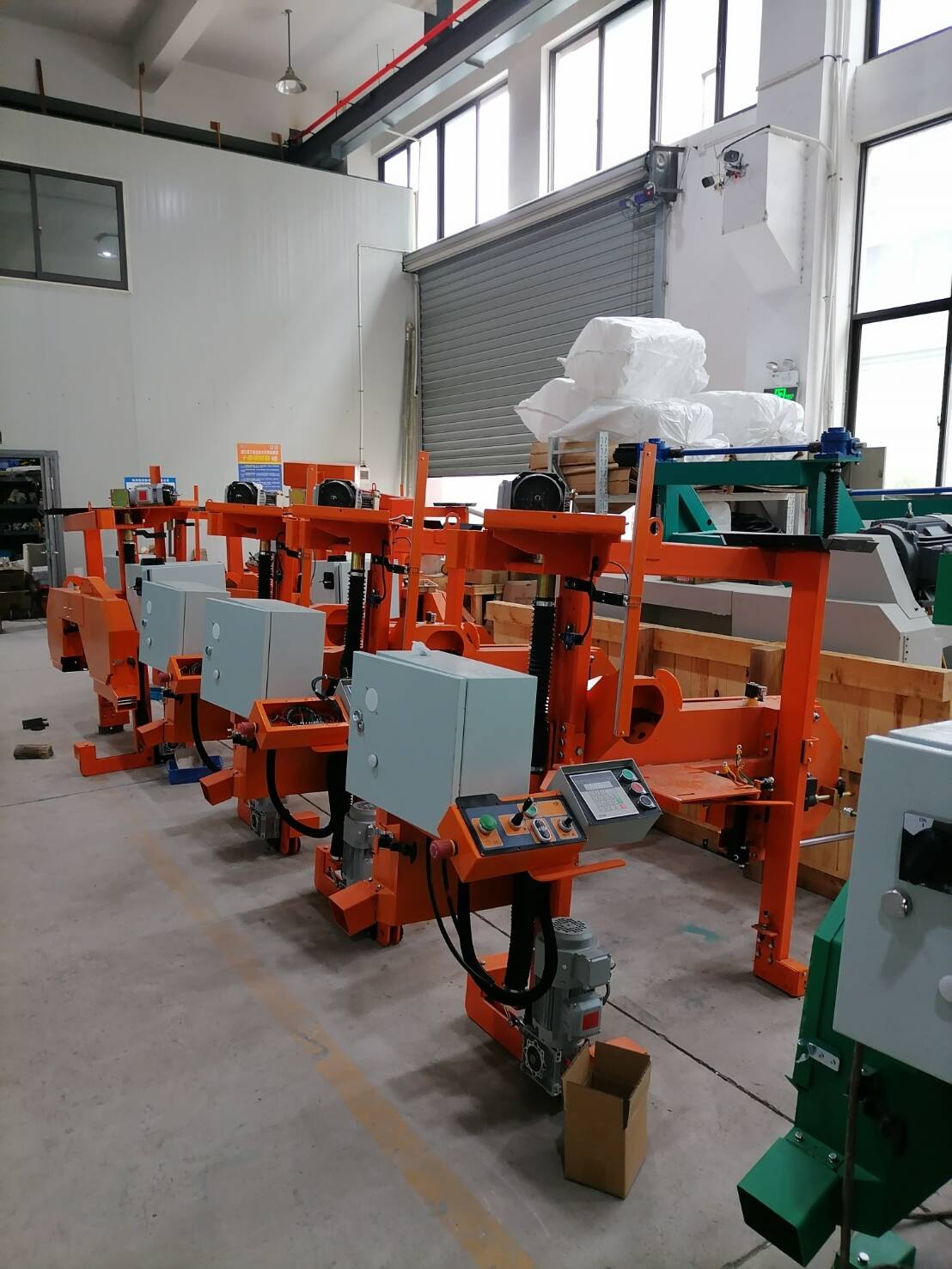
Wood processing equipment manufacturing floor. Verifying a specification is easier when the assembly process is visible. Image: XINYANGJX.
Future Outlook
Three directions are already visible in published model data. The first is control sophistication in the mid-tier: MJ376AS-900 is positioned as an intelligent speed control woodworking band saw machine, which suggests that feed and speed regulation is migrating down from heavy machinery into 900 mm class horizontal units.
The second is power-source flexibility. The customization list covers voltage, frequency and wire connector, and MJ375C is published with a 10P diesel engine. As long as a meaningful share of timber processing happens at sites with unstable grid supply, that option will remain relevant in Africa, South Asia and parts of South America.
The third is the packaging of blade maintenance with the saw. Multiple recorded projects pair horizontal saws with grinding and tooth picking machines in the same shipment, and both equipment categories have published specifications in the same catalogue. If the market grows at the forecast 5.0% CAGR to 2030, the differentiation pressure is likely to shift from nameplate power toward what a buyer can actually measure and maintain over the machine's operating life.
Frequently Asked Questions
What motor power should a buyer expect from a woodworking band saw machine?
Published total output power in the XINYANGJX horizontal range runs from 9.8 kW (MJ375D) through 11.8 kW (MJ375D extended width type), 20.55 kW (CN70 standard type), 20.6 kW (MJ376AS-600), 21 kW (MJ376S-900), 24.5 kW (MJ376AS-900), 26.05 kW (CN70 hydraulic type), 42.55 kW (MJ378-1500), 51.3 kW (MJ378-2000) to 61.3 kW (MJ378-2500), all at 380V, 50 Hz, 3-phase. Buyers should check whether a quoted figure is total output power or main motor power, since these differ: MJ377-1000 publishes a 22 kW main motor.
How much floor space and track length does a horizontal band saw machine require?
Published machine dimensions range from 4000×2150×2300 mm (MJ378-1500) and 4300×3000×3100 mm (MJ378-2000) to 5800×2300×2300 mm (MJ376AS-600), 6600×2000×2000 mm (MJ375D) and 7800×3200×2700 mm (CN70 hydraulic type). Standard track length is a separate figure: 5800 mm on MJ376AS-600 and MJ376S-900, 6000 mm on the MJ375 series, 7800 mm on the CN70 series and 12000 mm on the MJ378 series. The heavy series therefore needs the longest site, even though its machine body is shorter than some mid-tier units.
What band saw blade sizes do horizontal woodworking band saw machines use?
Published blade specifications in the range are 4005×34×1.05 mm (MJ375D), 4470×34×1.05 mm (MJ375D extended width type), 5080×100×0.9 mm (MJ376AS-600), 6144×50×0.9 mm (MJ376S-900), 5970×50–60×0.9–1.1 mm (MJ377-1000), 8800×150×1.25 mm (MJ378-1500), 9400×150×1.25 mm (MJ378-2000) and 10400×150×1.25 mm (MJ378-2500). Blade thickness across the range is 0.9 mm to 1.25 mm and blade width is 34 mm to 150 mm.
Is blade grinding and tooth picking equipment part of the same procurement as the saw?
The two categories are published in the same product range. The MF1115 band saw blade grinding machine is listed with a grinding width of 30–150 mm, tooth pitch range of 12–40 mm, 0.79 kW total motor power, dimensions of 1400×900×1300 mm and a net weight of 300 kg. MF115 with extended height is listed with a 20–100 mm saw blade width, 12–25 mm teeth space range, 0.31 kW total motor power, dimensions of 2680×1260×570 mm and a weight of 95 kg. The MF4050 woodworking tooth picking machine is listed with a 12–30 mm teeth space, 0–100 mm width, 0–1.5 mm single-side saw kerf, dimensions of 650×500×750 mm and a weight of 25 kg. Recorded projects in the Democratic Republic of the Congo and Chile included blade processing and sharpening equipment alongside the saws.
Which safety standards apply to woodworking band saw machines?
ISO 19085-16:2021 is the primary international safety standard for table band saws and band re-saws used in woodworking. In the United States, OSHA 29 CFR 1910.213 sets requirements for blade guarding and tension control devices on woodworking machinery. Because ISO 19085-16:2021 is scoped to table band saws and band re-saws, buyers of horizontal log mills should confirm which standard a specific model is documented against rather than assuming that a standard covering one band saw configuration automatically covers another.
What are the minimum order quantity, lead time and production capacity for these machines?
Published supply parameters for XINYANGJX are a minimum order quantity of 1 piece, a lead time of 30–50 days or negotiable, and a monthly capacity of 30 pieces. Quality control is stated as 100% testing before shipping or transportation, and customization covers colour, logo, voltage, frequency and wire connector.
Measured First, Compared Second
The five specifications in this article — saw wheel diameter and blade geometry, total motor output and electrical configuration, working envelope including minimums, footprint with track length, and machine weight — share one property that matters more than any single value: each one can be confirmed without accepting a supplier's characterisation of it. A buyer who collects those five numbers for every model under consideration is comparing machines rather than brochures, and can then apply commercial criteria such as price, service and delivery on a like-for-like basis.
The full published model list, specification sheets and project references are collected in the XINYANGJX product brochure, available for download at https://cdn.socialarks.com/sbsp//common/2026/0407/69d478d11ddf0.pdf. Company information is published at https://cn.hzlaxyjx.com/.