
Wood Panel Trends 2026: Top Categories for Global Buyers

FSC chain-of-custody certification is part of the compliance package for wood panel exports.
Wood Panel Trends 2026: Top Categories for Global Buyers
For global construction and furniture buyers, the wood panel category mix in 2026 is shaped by three forces: market scale, regulatory compliance, and application performance. Understanding which panel types are gaining preference and how supplier capability aligns with those preferences is essential during evaluation.
Industry Context: Wood Panel Demand in 2026
The global plywood market was valued at USD 80.57 billion in 2025, according to Grand View Research, with Asia Pacific holding the largest revenue share at 39.4%. Medium density fiberboard (MDF) is projected to grow from USD 44.96 billion in 2025 to USD 82.24 billion by 2033, at a CAGR of 8.2%. Wood Plastic Composites (WPC) reached USD 8.89 billion in 2025 and is expected to grow at a CAGR of 11.7% until 2033. These data points show that no single panel category dominates all applications; instead, each category addresses distinct structural, decorative, and environmental requirements.
Problem and Opportunity in Panel Selection
The evaluation problem is not a shortage of options. It is that similar-looking products can have very different performance boundaries. A structural plywood and a marine plywood can share dimensions, but their glue systems and face veneers differ. An MDF panel and a melamine faced board can both be used for cabinetry, but their response to moisture and their surface wear characteristics are not identical.
The opportunity is that regulatory standards and market data provide a filter. Buyers who map each candidate panel to the destination market’s compliance framework, and to the project’s load and moisture conditions, can reduce trial shipments and specification disputes. For example, the US EPA TSCA Title VI sets formaldehyde emission limits of 0.05 ppm for hardwood plywood and 0.11 ppm for MDF, which creates a clear threshold for composite panel imports.
Supplier Evaluation: Dalian WADA and Its Panel Portfolio
Dalian WADA International Trading Co., Ltd. (WADA Group) is a manufacturer and exporter of engineered wood products. Established in 2010, the company operates a 53,950m² factory with 200 employees and a 25-person engineering team. Its product list includes LVL, plywood, veneered board, MDF, OSB, wall panel, and woodworking machinery. Export accounts for 100% of the business, with primary markets in North America, the EU, Australia, Japan, South Korea, the Middle East, Mexico, and South America.
For buyers evaluating panel suppliers, WADA’s profile is relevant because the company carries multiple certifications that apply to different destination markets. These include FSC chain-of-custody, EUDR, CARB Phase 2 and EPA, JAS for plywood and LVL, JIS for MDF, and AS/NZS for structural LVL and formwork plywood.
Technical Breakdown of Key Panel Categories
To evaluate a supplier, buyers need to compare technical parameters. The following categories are commonly requested in construction, furniture, and industrial projects.
Plywood
Plywood is made by cross-laminating veneer layers, which gives it strength in multiple directions. In WADA’s range, structural plywood is available in 3x6 to 4x8 feet, with thickness from 9 to 28 mm. Face and back veneers are typically larch or pine, while cores can be eucalyptus, larch, pine, or combi. Melamine or phenolic WBP glues are used for water-boil-proof bonding, and density ranges from 650 to 750 kg/m³. Structural plywood is covered by JAS 0233:2024 and CARB/EPA certification.
For concrete formwork, film faced plywood is available in sizes from 1200x1800 mm to 1500x3000 mm, thickness 4 to 35 mm, with dark brown or black film faces. Depending on core and glue, it can be reused 2 to 40 times in concrete projects. The 17 mm formwork grade is covered by AS 6669-2016 for Australian projects.
Marine plywood uses birch or okoume faces and either melamine WBP or phenolic WBP glue, with densities between 600 and 750 kg/m³. Commercial plywood, used for furniture, construction, and packing, has a wider face and core combination and is available from 2 to 25 mm.
MDF
MDF is produced with continuous flat pressing, and WADA supplies panels from 4x8 to 8x16 feet, with thickness from 1.2 to 50 mm. Density ranges from 500 to 1000 kg/m³, and moisture content from 5% to 13%. MDF is available with E0, CARB P2, or E1 glue systems. It carries JIS certification for the Japanese market and can be used for furniture, routed boards, lightweight high-strength boards, and waterproof board applications.
LVL
Laminated veneer lumber (LVL) is designed for structural and furniture applications. WADA’s LVL bed slat product, for example, is 25 to 190 mm wide and 7 to 15 mm thick, with birch, beech, or poplar faces and birch or poplar cores. It uses E0 or E1 glue and is certified to JAS 0701:2023 and AS/NZS 4357.0:2005 (R2016).
OSB, WPC, and Decorative Panels
OSB is a staple in structural sheathing. Global OSB production reached over 32 million cubic meters in 2024, with the USA accounting for 14 million cubic meters, according to Market Reports World. Although WADA does not publish detailed OSB specifications, it lists OSB in its main product range.
For exterior and high-moisture environments, WPC combines wood fiber with polymer, and the global WPC market is expected to expand at a CAGR of 11.7% through 2033. For interior decoration, melamine faced board is supplied in 4x8 to 7x9 feet, thickness 2 to 30 mm, with melamine paper, PET film, or HPL surfaces on cores of plywood, MDF, particleboard, or blockboard. Veneered board uses natural wood veneers such as white oak, red oak, walnut, and ash, and is commonly used for decorative panels and cabinetry.
Application Evidence from Global Projects
Verified project data helps buyers connect product categories to real working conditions.
- In Japan, a construction builder used 200 containers of structural plywood and film faced plywood for building structures. The reported results include high strength, high durability, and waterproof performance.
- In Australia, a building contractor used 50 containers of plywood for building structure, with the same high-strength, high-durability and waterproof outcomes.
- In Portugal, a wall cladding client used 20 containers of marine plywood for outdoor cladding, achieving weather-resistant and UV-resistant performance.
- In Mexico, a furniture manufacturer used 100 containers of veneered board, melamine board, LVL, and MDF for furniture and cabinet decoration, with a focus on fashionable interior finishes.
- In Vietnam, a plywood manufacturer implemented a complete production line for plywood, veneer, and engineered wood panels, reporting stable production through a one-stop solution.
Market Signals and Regulatory Direction
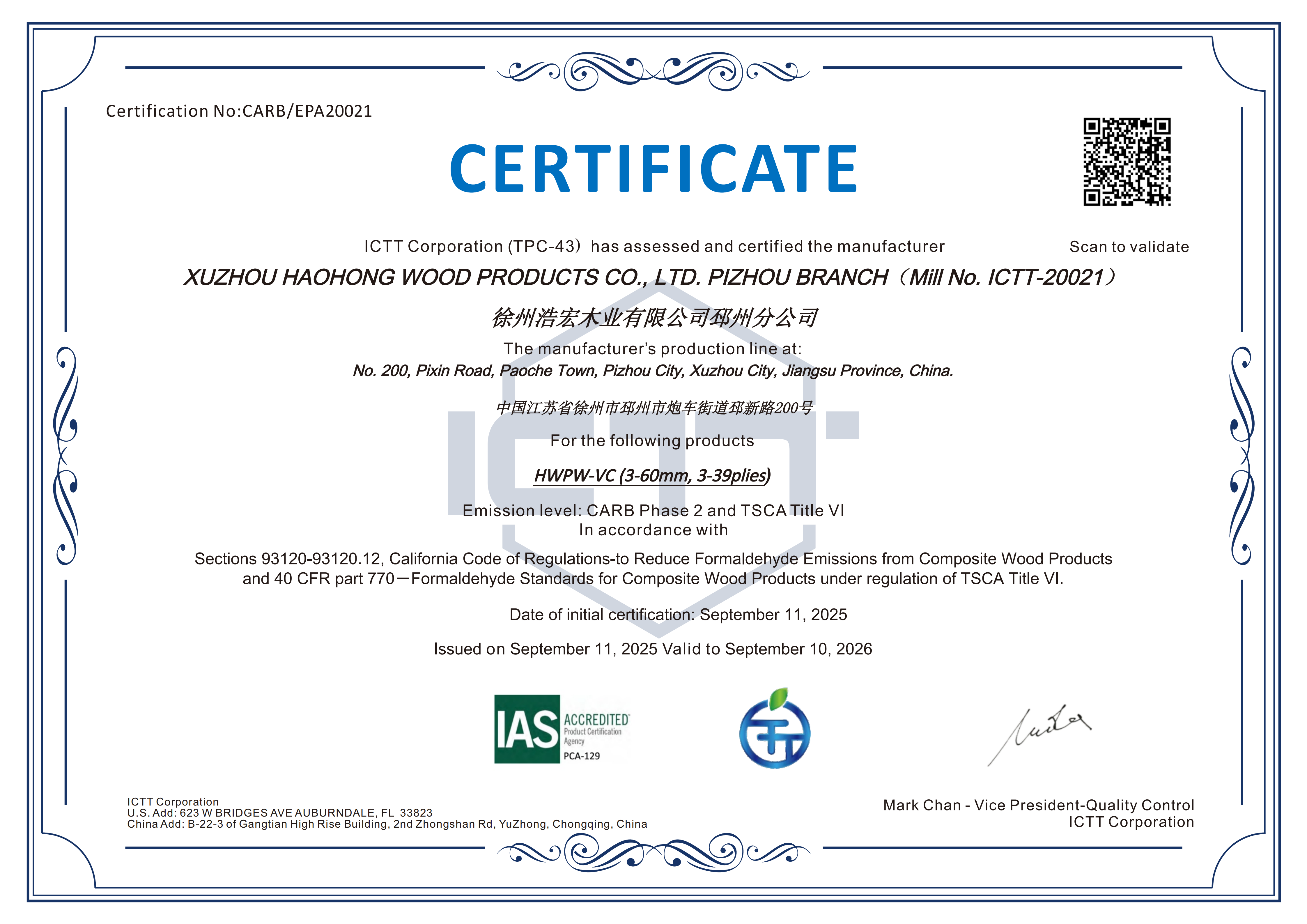
CARB Phase 2 and EPA certification applies to hardwood plywood and MDF product lines.
Compliance is becoming a purchasing criterion, not a technical detail. In the EU, wood-based panels for construction must meet EN 13986 for CE marking. In the United States, CARB Phase 2 and EPA TSCA Title VI establish enforceable formaldehyde limits. In Japan and Australia, JAS, JIS, AS/NZS, and AS 6669 are applicable depending on the product type.
At the same time, supply chain transparency is rising. FSC certification and EUDR compliance are increasingly requested in the EU and North America. China’s position as the second largest exporter of raw timber (HS 44) to the United States in 2024, with USD 2.17 billion in exports and a 9% share, shows that Chinese suppliers remain integral to global wood product trade, while also underlining the importance of verified documentation.
Comparison with Traditional Single-Product Suppliers
A traditional supplier may specialize in one panel type, such as a plywood mill or an MDF plant. This can offer deep process expertise. However, buyers sourcing multiple categories often face longer coordination times, inconsistent quality standards, and separate freight arrangements. A multi-category supplier like WADA provides an alternative: a single interface for product sourcing, quality control, and compliance documentation.
There is a boundary to this model. Multi-category suppliers cannot rely on one certificate to cover all product lines. Buyers must still verify that the exact product they order carries the relevant certification for the destination market. For example, a JAS-certified structural plywood line does not automatically certify a marine plywood line. A robust evaluation process will check certifications against the specific SKU and batch.
Future Outlook for Wood Panel Procurement
The direction is clear: low-emission panels, legally verified wood supply, and multi-functional surfaces will continue to gain share. Buyers should expect formaldehyde emission thresholds to remain strict, with CARB and TSCA Title VI provisions acting as de facto benchmarks beyond the US market. WPC and engineered wood products designed for outdoor and high-moisture use are likely to expand as construction and cladding projects prioritize durability with lower maintenance.
For panel suppliers, the differentiator will be evidence: production capacity, laboratory or certification records, and traceability documentation. The evaluation process in 2026 is less about brand names and more about whether a supplier can map its product range to the technical and compliance requirements of each project.
Frequently Asked Questions
Which wood panel category is the largest in the global market?
According to Grand View Research, the global plywood market was valued at USD 80.57 billion in 2025. This makes plywood the largest single category in the wood panel landscape. Asia Pacific held the largest regional share at 39.4%.
Which wood panel type is expected to grow fastest?
Wood Plastic Composites (WPC) is projected to grow at a CAGR of 11.7% until 2033, according to Grand View Research. MDF also has a strong growth forecast, with the market expected to rise from USD 44.96 billion in 2025 to USD 82.24 billion by 2033.
How do plywood and MDF differ in application?
Plywood is built from cross-laminated veneers, providing higher structural strength and better resistance to splitting around fasteners. MDF offers a uniform fiber matrix, which improves machining and routing but is generally less suited to exposed structural use. The choice depends on load, moisture exposure, and surface finish requirements.
What certifications should buyers check for wood panel imports?
Certification requirements vary by destination. For the United States, CARB Phase 2 and EPA TSCA Title VI apply to formaldehyde emissions. For Japan, JAS and JIS certifications cover plywood, LVL, and MDF. For Australia and New Zealand, AS/NZS 4357 applies to structural LVL and AS 6669 applies to formwork plywood. In the EU, CE marking under EN 13986 and legality documentation such as FSC and EUDR are important.
Does Dalian WADA support custom wood panel sizes?
Yes. Dalian WADA supports OEM/ODM customization for size, thickness, and layout. Monthly panel capacity exceeds 10,000 cubic meters, lead time is typically 25–45 days, and the minimum order quantity is one 40-foot container. The company reports 100% inspection for shipments.
What wood panel categories does Dalian WADA supply?
WADA’s product range includes LVL, plywood (commercial, structural, marine, and film faced), veneered board, MDF, OSB, wall panel, and woodworking machinery. The portfolio also covers melamine faced board and related engineered wood products.
For detailed product specifications and company background, a downloadable brochure is available: Dalian WADA Group brochure.