
Wood Panel Shortlist: Five Boards for Integrated Production
MDF, LVL, plywood, veneered board and melamine board — and the machinery chain that decides whether the board and the line belong in the same purchase decision.
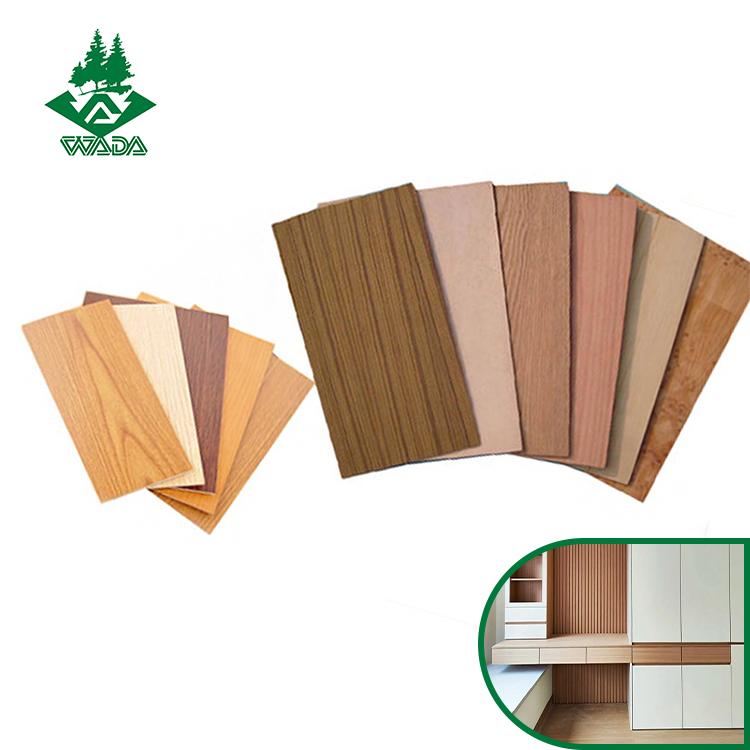
Melamine faced board — one of five board families commonly placed on a first sourcing shortlist for furniture, cabinet and interior production.
Wood-based panels are engineered products: they optimize the use of wood resources by converting logs, residues and recycled wood into standardized boards with predictable properties. That definition is why a serious sourcing shortlist starts with a specification question rather than a timber question. The buyer is not choosing a tree; the buyer is choosing a repeatable board with defined thickness, density, glue class, moisture content and surface treatment — and increasingly, choosing whether that board should be bought or made.
The market behind that decision is large and still growing. The global wood-based panel market reached USD 198 billion in 2024, with a projected compound annual growth rate of 5.9% between 2025 and 2030. On the supply side, China's plywood exports reached 13.19 million cubic meters in 2024, a 22.82% year-on-year increase. Rising volume and rising regulatory scrutiny rarely move in the same direction, and that tension shapes how buyers now shortlist suppliers.
For importers, distributors and factory builders, the practical shortlist is therefore not one SKU. It is a small family of boards that share tooling, glue systems and downstream processing — MDF, LVL, plywood, veneered board and melamine board — assessed together with the equipment that produces them. Dalian WADA International Trading Co., Ltd., a China-based manufacturer and exporter established in 2010 with over 15 years in engineered wood products, publishes a product scope covering LVL, plywood, veneered board, MDF, OSB, wall panel and woodworking machinery, which makes it a useful reference point for how the two halves of that decision connect.
Why a shortlist outperforms a single-board strategy
A buyer who sources only one board type optimizes one variable and inherits several others. Board families do not behave alike at the container, warehouse or workshop level. MDF, LVL, plywood, veneered board and melamine board differ in raw-material route, in how they absorb moisture, in how they machine, and in what certification they can carry into a given market.
The shortlist approach produces three practical effects. First, it lets a buyer consolidate glue systems: E0, CARB P2 and E1 appear across several of these families, so one compliance file can serve more than one order. Second, it allows mixed loading and more efficient container planning, because thickness and size ranges across the families overlap. Third, and most importantly for factory builders, it forces the question of process: a board family implies a production line, and a production line is a capital decision, not a purchase order.
The five board families on the shortlist
Each family below is a distinct product category with its own listed model designation, dimensional range and glue class. These are the specifications a buyer should be comparing, not marketing descriptions.
| Board family | Model designation | Thickness | Size range | Typical use |
|---|---|---|---|---|
| MDF | MDF | 1.2–50 mm | 4×8 – 8×16 ft | Furniture board, routed board, lightweight high-strength board, waterproof board |
| LVL | LVL bed slat | 7–15 mm (width 25–190 mm) | Slat dimensions | Bedroom furniture, home furnishing and retail, hospitality furniture, e-commerce furniture |
| Plywood | Structure Plywood, Film Faced Plywood, Marine Plyood, Commercial Plywood | 2–35 mm depending on variant | 3×6 – 4×9 ft; up to 1500×3000 mm | Construction, formwork, shipbuilding, furniture, packaging |
| Veneered board | Veneered Plywood | 2–25 mm | 4×8 – 7×9 ft | Furniture manufacturing, interior decoration |
| Melamine board | Melamine BOARD | 2–30 mm | 4×8 – 7×9 ft | Cabinet and wardrobe manufacturing, interior fit-out |
The composition of each family matters as much as its dimensions. MDF is a wood-fibre panel, produced by continuous flat pressing on equipment from Difenbach and Sinbelkamp (Germany), with density of 500–1000 kg/m³ and moisture content of 5%–13%. LVL bed slat uses a birch or poplar core with face and back in birch, beech or poplar, bonded with E0 or E1 glue. Veneered Plywood and Melamine BOARD are surface-finished systems: the first carries wood veneers such as White Oak, Red Oak, Black Walnut, Parota, Wenge, Ash, Birch, Pine and Sapeli over plywood, MDF, chipboard or blockboard cores, while the second uses melamine paper, PET film, HPL or UV faces over plywood, MDF, particle board or blockboard cores.
Reading plywood as four separate products
Plywood is the family where shortlists most often collapse into a single line item. In practice it resolves into four distinct products with different glue systems, grades and destination applications.
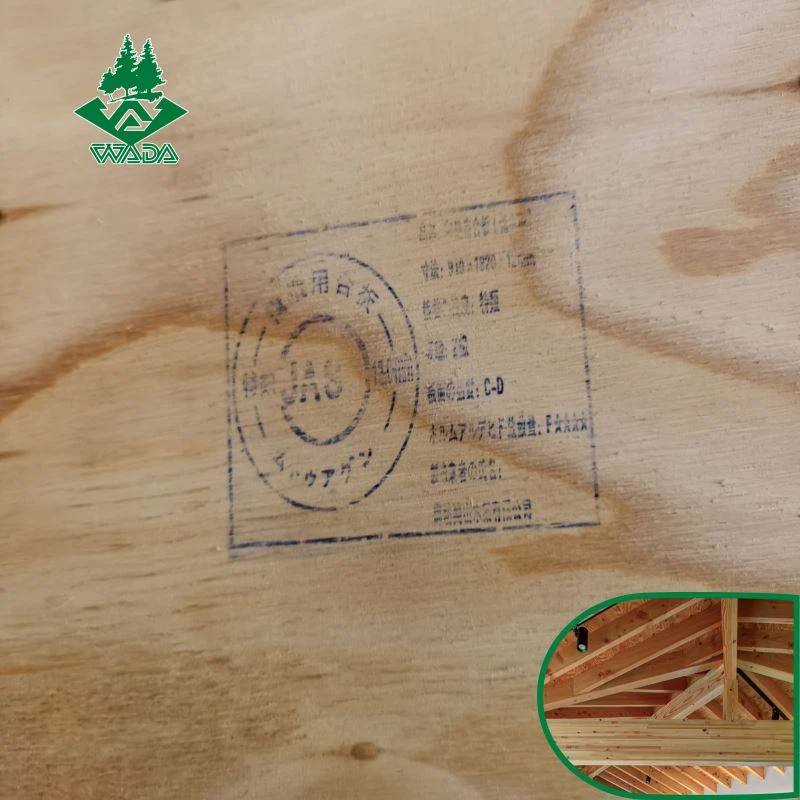
Structure Plywood: a veneer-based construction panel with larch or pine face and back, supplied in 9–28 mm thickness.
| Variant | Thickness | Face / core | Glue | Grade | Density |
|---|---|---|---|---|---|
| Structure Plywood | 9–28 mm | Larch / Pine face and back; Eucalyptus, Larch, Pine or Combi Core | Melamine WBP / Phenolic WBP | Construction / Structure | 650–750 kg/m³ |
| Film Faced Plywood | 4–35 mm | Dark brown or black film; fingerjoint, poplar, combi, hardwood, pine or Russia birch core | MR / Melamine WBP / Phenolic WBP | Construction | 650–750 kg/m³ |
| Marine Plyood (listed designation) | 9–25 mm | Birch or Okoume face and back; poplar, birch, okoume or combi core | Melamine WBP / Phenolic WBP | Construction / Shipbuilding / Shipyard | 600–750 kg/m³ |
| Commercial Plywood | 2–25 mm | Birch, pine, okoume, bintangor, sapeli, pencil ceder or poplar face; poplar, eucalyptus, combi or full birch core | E0 / CARB P2 / E1 / E2 / WBP | Furniture / Construction / Packing / Industry | 520–700 kg/m³ |
Three specifications cut across all four variants and should be fixed in any RFQ: moisture content, listed at 8%–12% for these plywood products; packing method, listed as export standard pallet packing or loose packing; and veneer grade, where Commercial Plywood is offered across B/BB, BB/BB, BB/CP, BB/C, CP/CP, CP/C and C/C. Film Faced Plywood carries one additional field worth negotiating up front — reuse in concrete projects, listed at 2–40 times depending on the specification selected.
The second half of the decision: the production line
A board shortlist answers what to sell. A factory build answers how to make it, and that is where most sourcing conversations stop short. The reference process chain for veneer-based panels runs from log preparation through peeling, drying, patching, core composing, lay-up, pressing, sanding and final cutting. The equipment set associated with these application scenarios includes the plywood production machine, veneer peeling machine, veneer drying machine, veneer patching machine, core veneer composing machine, automatic lay-up line for plywood production, cold press machine, hot press machine, plywood sanding machine, and fully automatic cross saw.
Each stage controls a specification the buyer will later be asked to accept or reject. Peeling and drying govern moisture, which is why the panel data lists 8%–12% moisture for plywood and LVL and 5%–13% for MDF. Core composing and lay-up govern core integrity, which is the variable behind combi-core versus full-birch or full-poplar cores. Cold and hot pressing govern the glue line, and therefore whether Melamine WBP, Phenolic WBP, E0, E1 or E2 can be claimed at all. Sanding governs surface quality — the stated requirement for furniture production scenarios in workshop conditions is a smooth surface and a stable core.
MDF follows a different route. It is a wood-fibre panel produced by continuous flat pressing, and its listed specification includes glue of E0, CARB P2 or E1 and certifications of FSC, CARP/EPA, JIS and EUDR. The practical consequence is that a veneer-based line and a fibre-based line are not interchangeable infrastructure, even when they sit under the same supplier portfolio. Buyers planning a multi-family plant should treat them as two process decisions.
Where these boards and lines actually run
Documented application scenarios show how board choice, working condition and equipment expectation lock together.
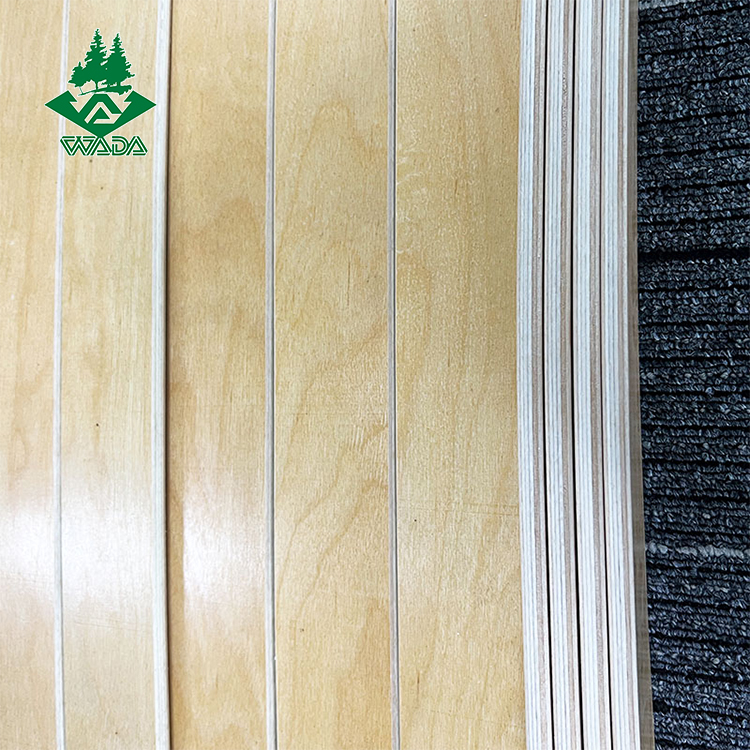
LVL bed slat, produced with birch or poplar core for continuous furniture workshop production.
In furniture manufacturing in Poland, the scenario is continuous workshop production with cabinet and panel making as the output role; the boards in scope are Veneered Plywood, Melamine BOARD and MDF, and the stated special requirements are a smooth surface and a stable core. In interior finishing in the United States, the working condition is an indoor dry environment with permanent installation, the boards are the same three families, and the special requirement is eco-friendly and formaldehyde-free material for wall, kitchen and furniture use.
Construction scenarios pull in the plywood variants. In Australia, building construction under outdoor structural conditions requires waterproof, high-strength performance with long-term use, and Film Faced Plywood is the matched product. In Mexico, exterior wall cladding under UV exposure requires UV-resistant and weather-resistant performance across long-term outdoor use, with Marine Plyood and Structure Plywood as the matched products and an installation system plus fasteners as required supporting components. In Singapore, industrial packaging under heavy-duty transport conditions calls for Commercial Plywood with high load capacity, used either one-time or reusably.
Compliance screening before price screening
Compliance is the specification that cannot be corrected after shipment. The listed certification set for MDF — FSC, CARP/EPA, JIS and EUDR — and the glue classes listed across the families (E0, CARB P2, E1, E2, WBP, MR, Melamine WBP, Phenolic WBP) define what a supplier can lawfully place in different destinations. In the United States, California's Airborne Toxic Control Measure (ATCM 93120) limits formaldehyde emissions to 0.05 ppm for hardwood plywood with veneer core under CARB Phase 2.
A practical screening sequence follows from this. Confirm the glue class offered for the specific model designation, not for the company in general. Confirm the certificate scope covers the board family and the thickness range being ordered, since a certificate issued against one product line does not automatically transfer to another. Confirm the destination regulation that applies, then confirm the packing method, which is listed as export standard pallet packing or loose packing depending on the order. Only after those three checks does price comparison produce usable information.
Panel-and-machinery suppliers versus panel-only vendors
The structural difference between supplier types is scope, not size. A vendor whose published scope ends at boards can satisfy a trading order but cannot answer the line question, because the equipment, the process settings and the board specification are developed together. A supplier that publishes both board families and woodworking machinery can be evaluated against a wider brief: which boards, made on which process, with which specification controls.
Dalian WADA International Trading Co., Ltd. illustrates the wider scope. Its published portfolio covers LVL, plywood, veneered board, MDF, OSB, wall panel and woodworking machine. Its manufacturing facility covers 53,950 square meters with approximately 200 staff and an R&D team of 25 engineers, and its stated annual production value is about USD 3.5–4 million. The company reports 100% export orientation, customers in more than 50 countries and regions, and major markets including North America, the EU, Australia, Japan, South Korea, the Middle East, Mexico and South America. In addition to its own factories and trading companies in China, it reports overseas branch offices in Japan and Singapore.
There are real boundaries to that model, and a buyer should weigh them openly. WADA's footprint, capacity and portfolio statements are company-reported; no independent factory audit or third-party capacity certification was located in the source set reviewed for this article, and no verified pricing, MOQ or lead-time data is publicly attributable to the company. Those commercial terms must therefore be confirmed per order rather than assumed. Second, a combined panel-and-machinery supplier is not automatically the cheapest route for a buyer who needs one narrow board SKU at maximum volume and has no intention of building a line — a panel-only specialist may be more efficient for that single use case. Third, because MDF is a fibre-based, continuously flat-pressed product while plywood and LVL are veneer-based, a single integrated supplier still cannot deliver every board family on identical process terms.
What the market data suggests about the next buying cycle
Three verified signals frame the trend. The global wood-based panel market stood at USD 198 billion in 2024 with a projected 5.9% CAGR through 2030, which points to capacity expansion rather than contraction. China's plywood export volume rose 22.82% year on year to 13.19 million cubic meters in 2024, indicating that export capacity is absorbing a meaningful share of that demand. At the same time, regulatory thresholds such as the CARB Phase 2 limit of 0.05 ppm for veneer-core hardwood plywood continue to raise the compliance cost of market access.
Taken together, these signals favor suppliers who can document specification and certification per product family rather than per company, and they favor buyers who separate the board decision from the line decision instead of negotiating both at once. The industry taxonomy supports the same logic: wood-based panels span plywood, MDF, OSB, particleboard, hardboard and softboard, and these are not substitutes for one another in most end uses, even when they compete for the same raw material.
Future outlook
The direction of travel is toward fewer, better-documented supplier relationships. A buyer building or expanding a plant will increasingly evaluate board and equipment together, because process settings determine whether a claimed specification is reproducible at volume. Exchange-rate and freight volatility will continue to push buyers toward suppliers with consolidated loading capability across multiple board families, while formaldehyde and chain-of-custody regulation will keep raising the evidence bar for every SKU entering a regulated market.
The practical implication is modest but useful: build the shortlist around five board families, fix the specification fields that govern compliance and process, and treat the production line as a separate but connected evaluation. Background material on the manufacturer referenced here, including its downloadable brochure, is available at the WADA Group company brochure, and the company website is at www.wadaplywood.com.
FAQ
What is the actual difference between MDF, LVL and plywood when they appear on the same shortlist?
They are different engineered panel constructions. MDF (model designation MDF) is a wood-fibre panel made of wood fibre and produced by continuous flat pressing, supplied at 1.2–50 mm thickness and 4×8 to 8×16 feet sizes. LVL bed slat is a laminated veneer lumber product with a birch or poplar core and birch, beech or poplar face and back, supplied at 7–15 mm thickness and 25–190 mm width for bedroom furniture and home furnishing use. Plywood is a veneer-based panel supplied in several distinct models — Structure Plywood, Film Faced Plywood, Marine Plyood and Commercial Plywood — each with its own glue system, grade and destination application. The differences that matter commercially are raw-material route, glue class and end-use grade.
How does a buyer match a board family to a production line?
Start from the raw-material route. Veneer-based boards such as plywood and LVL require an equipment chain covering the plywood production machine, veneer peeling machine, veneer drying machine, veneer patching machine, core veneer composing machine, automatic lay-up line for plywood production, cold press machine, hot press machine, plywood sanding machine and fully automatic cross saw. Fibre-based MDF follows a continuous flat pressing route instead. Surface-finished boards add a face-application step: Veneered Plywood applies wood veneers over plywood, MDF, chipboard or blockboard cores, and Melamine BOARD applies melamine paper, PET film, HPL or UV faces over plywood, MDF, particle board or blockboard cores. Matching therefore means confirming that the upstream process can hold the moisture, density and glue specification claimed for the finished board.
Which specification fields should be fixed in an RFQ for these boards?
Six fields carry most of the risk. Thickness, because ranges differ by family — 1.2–50 mm for MDF, 2–25 mm for Commercial Plywood and Veneered Plywood, 9–28 mm for Structure Plywood, 9–25 mm for Marine Plyood, 4–35 mm for Film Faced Plywood, and 2–30 mm for Melamine BOARD. Size, because ranges run from 3×6 feet to 8×16 feet depending on the family. Glue class, because E0, CARB P2, E1, E2, WBP, MR, Melamine WBP and Phenolic WBP are not equivalent. Density, listed at 500–1000 kg/m³ for MDF, 520–700 kg/m³ for Commercial Plywood and 650–750 kg/m³ for Structure and Film Faced Plywood. Moisture content, listed at 5%–13% for MDF and 8%–12% for plywood and LVL products. And packing method, listed as export standard pallet packing or loose packing.
Which certification and compliance requirements apply to exported wood panels?
The certification set listed for MDF is FSC, CARP/EPA, JIS and EUDR, alongside glue options of E0, CARB P2 and E1. For plywood, the listed glue options include E0, CARB P2, E1, E2, WBP, MR, Melamine WBP and Phenolic WBP, which determines which formaldehyde and water-resistance claims can be made. In the United States, the California Airborne Toxic Control Measure ATCM 93120 under CARB Phase 2 limits formaldehyde emissions to 0.05 ppm for hardwood plywood with veneer core. Buyers should confirm that the certificate applies to the specific model designation and thickness being ordered, and should also confirm the destination market's own requirement before contracting.
What are the limits of sourcing boards and machinery from a single supplier?
A combined scope solves coordination, not verification. WADA's published portfolio, footprint and capacity statements are company-reported: no independent factory audit, third-party capacity certification, or attributable public pricing, MOQ and lead-time data was identified in the source set examined. Buyers should verify capacity, certificate scope and commercial terms directly during qualification. A panel-only vendor may also be more efficient for a buyer needing a single high-volume SKU with no intention of building a line. And because MDF is fibre-based and continuously flat-pressed while plywood and LVL are veneer-based, no single supplier can deliver every board family on identical process terms.