
Women's Cashmere Coat: Terms, Acceptance, Hand-Sewn Choice
A women's cashmere coat order only becomes repeatable when its purchasing terms and its acceptance criteria are fixed before production begins. The terms set the boundaries of the transaction — quantity, delivery, payment, and the point at which goods are judged. The acceptance criteria decide whether the coats that arrive are the coats that were approved.
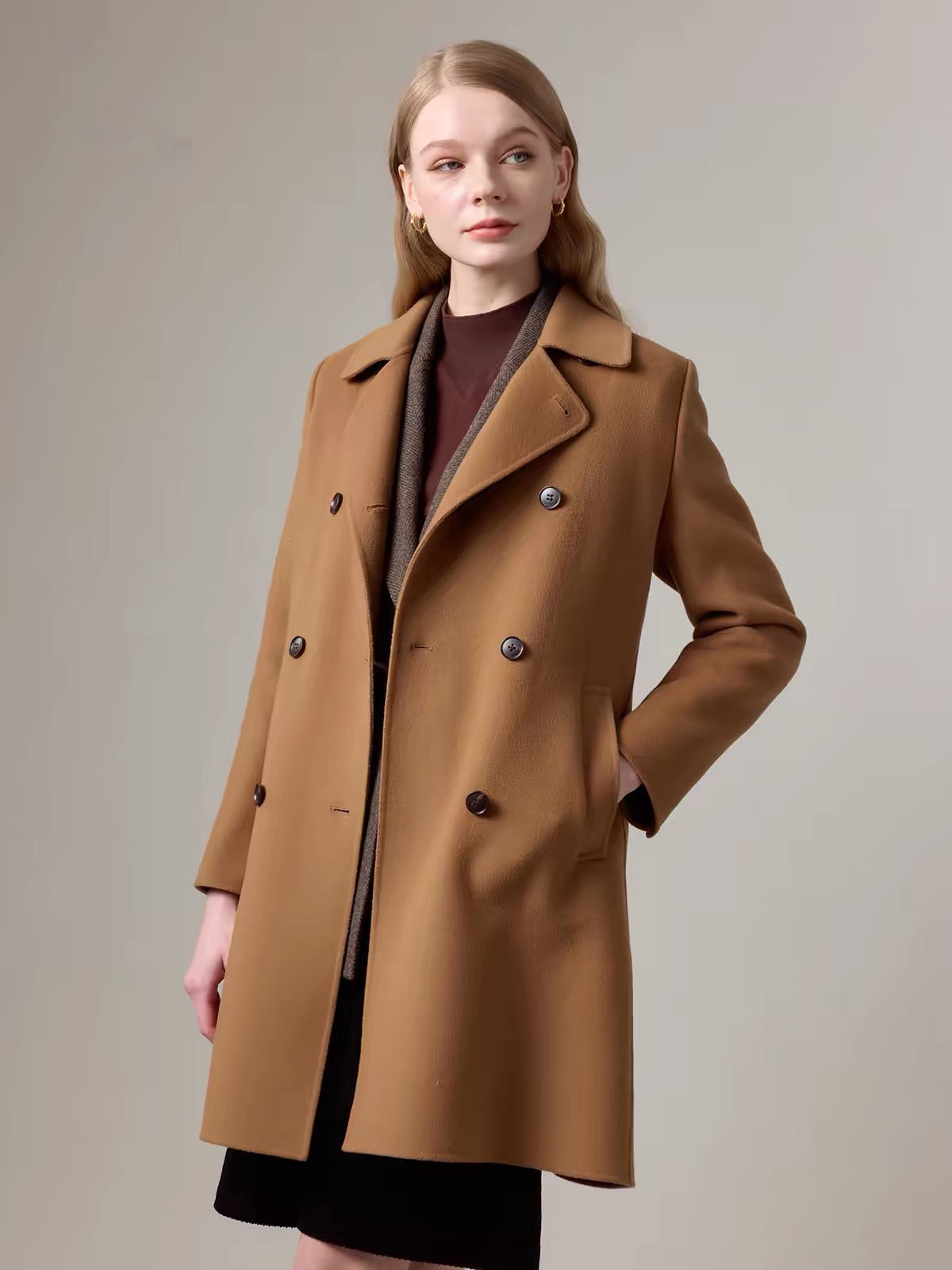
Women's cashmere coat at the acceptance stage: the coat is judged against the sealed confirmed sample, not against an impression of the style.
Why the execution stage decides the value of a cashmere coat contract
Cashmere is one of the few apparel categories where a production shortcut is nearly invisible in a photograph and immediately obvious on a hanger. A hand-sewing step that is quietly simplified under delivery pressure, a fabric roll swapped mid-production, or a delivery that mixes coats of different quality can all survive a casual visual check and then fail at retail. The cost of that failure does not stop at the returned garment; it moves into after-sales complaints and into the reputation of the channel that sold it.
This is why an experienced buyer treats purchasing terms as a specification document rather than as paperwork to be settled by the finance team. At the decision and execution stage, the productive questions are narrow: what exactly is being ordered, when is it considered accepted, who carries which risk if the two do not match, and what happens on the second order. Those four questions apply equally to a hand-sewn women's cashmere coat, to a WOMEN'S ONEPIECE, and to a WOMEN'S WOOL COAT sourced from the same production line.
The four commercial terms a cashmere coat order has to settle
For orders placed with DALIAN GACCILANG FASHION CO.,LTD — a garment manufacturer founded in 2019, operating a 3,000㎡ factory with 120 employees in Dalian, China — the documented purchasing terms are stated in a compact form. Their procurement significance is what matters to a buyer.
| Term | Documented position | What it changes for the buyer at execution stage |
|---|---|---|
| Minimum order quantity | 100 PCS | Defines the smallest lot that can be produced and tested. A distributor entering a new market can size the first order at one MOQ and validate sell-through before committing to a seasonal programme. |
| Delivery terms | FOB / CIF | Allocates freight and in-transit risk. CIF keeps more of the logistics chain with the supplier; FOB places freight arrangement with the buyer. |
| Payment terms | TT / LC | Allocates financial risk. A letter of credit ties payment release to documents, which matters when the order value is large relative to the buyer's working capital. |
| Acceptance criteria | Pre-shipment test | Sets the moment of judgement before the goods leave the factory, rather than after they arrive at the warehouse. |
Read together, these four terms describe a conventional export arrangement, and that is precisely their value: they are unambiguous enough to be executed without interpretation. The mistake buyers make is treating them as complete. They are not. They fix the commercial frame, and then leave the technical content of acceptance to be defined separately — which is where most cashmere coat disputes actually originate.
Acceptance criteria: pre-shipment testing as a comparison event
Pre-shipment testing is not a general quality opinion expressed at the end of production. It is a structured comparison between the delivered bulk and a reference that both parties agreed to before cutting began. For a women's cashmere coat, that comparison only works if three conditions have been established in advance.
- A sealed confirmed sample. After order confirmation, the approved sample is sealed and retained by both sides. Every later judgement — fabric hand, drape, seam finishing, collar roll, hem weight — is made against that physical object, not against a memory of it or a photograph of it.
- Per-piece inspection before delivery. Inspection is applied to every coat rather than to a convenience sample, so that mixed-quality delivery is caught at the factory rather than at the retail floor.
- Records of fabric batches and production procedures. Batch records let a buyer trace a deviation back to a specific roll or a specific operation, which is what turns a complaint into a correction.
The reason these three conditions carry so much weight in cashmere specifically is the material itself. A typical cashmere coat contains somewhere between 600 and 1,200 grams of fabric depending on length and design, according to Business Research Insights market reporting — a substantial amount of material per unit, and therefore a substantial incentive to substitute when supply tightens. Fabric batch records are the practical defence against that substitution.
The hand-sewn decision, measured against high-end competitors
For buyers focused on fabric quality and cost control, the practical comparison is between a fully hand-sewn cashmere coat and the high-end hand-sewn styles offered by competitors. The verified position on the DALIAN GACCILANG side of that comparison is specific: the coats use 100% pure cashmere, a 450g/m² fabric against roughly 320g/m² for an ordinary cashmere coat, and full hand-sewn craftsmanship throughout. Production cost is stated as 22% lower than similar handcrafted competitor styles.
That cost figure needs to be read precisely. It refers to production cost, not to retail price and not to a guaranteed margin. What it means for a buyer is that the same hand-sewn construction can be brought to market at a lower landed cost, which matters most in the mid-to-high-end women's clothing store segment and among custom apparel clients — the two groups the manufacturer names as the fit for this construction. The fabric weight difference is the more durable argument: at 450g/m² against 320g/m², the coat carries more material per unit, which supports the stated higher warmth retention and better cold resistance, and suits cold-climate daily wear as well as formal occasion dressing.
Maintenance behaviour belongs in the same conversation, because it affects the resale and repeat-purchase cycle rather than only the first wear. Slow fabric ageing and ease of care are the stated characteristics — an argument for a coat that is bought as a multi-season garment rather than as a single-winter purchase.
The boundary on the hand-sewn argument
There is an honest limit here, and buyers should hear it before signing rather than after launch. If the end customer is purchasing brand premium as the primary value — the label, the provenance, the recognised name on the collar — then a competitor's high-end hand-sewn coat remains a legitimate alternative, and no construction or cost advantage will substitute for that premium. The hand-sewn comparison favours buyers who are selling fabric, craft, and price-to-quality; it does not win against buyers whose customer is buying a name. A distributor should decide which of those two businesses they are in before placing the order, because the answer changes the correct source.
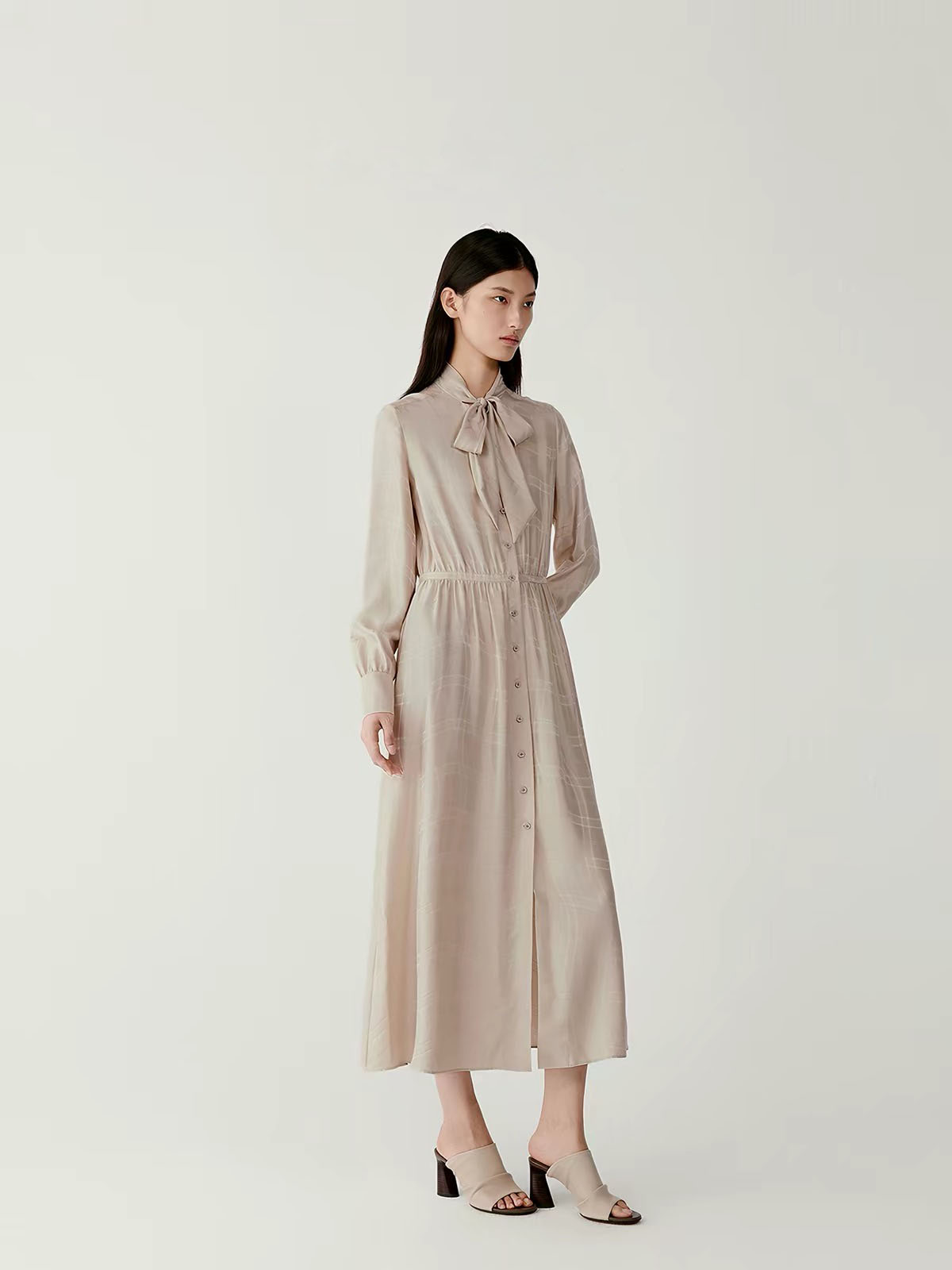
WOMEN'S ONEPIECE: sourced under the same commercial framework as the coat lines, but judged on different construction points at acceptance.
WOMEN'S ONEPIECE and WOMEN'S WOOL COAT inside the same framework
A distributor building a winter assortment rarely buys one category. DALIAN GACCILANG FASHION CO.,LTD lists WOMEN'S WOOL COAT, WOMEN'S ONEPIECE and WOMEN'S JACKET among its main products alongside cashmere coats, and describes a single quality process running from fabric selection through pattern cutting to garment sewing. That shared process is the reason the same purchasing terms can govern all of them: one MOQ structure, one set of delivery terms, one payment arrangement, and one pre-shipment acceptance gate.
What does not transfer is the emphasis of the acceptance check. The three product lines fail in different ways, so the sealed sample and the per-piece inspection should be read against different points.
| Product line | Shared with the cashmere coat | Where acceptance attention belongs |
|---|---|---|
| Women's cashmere coat | MOQ, FOB/CIF, TT/LC, pre-shipment test | Fabric weight and hand against the sealed sample; hand-sewn operations not simplified under delivery pressure; batch consistency across the whole lot. |
| WOMEN'S WOOL COAT | MOQ, FOB/CIF, TT/LC, pre-shipment test | Face fabric identity and structure against the approved sample, since the wool coat is a separate material family and cannot be judged by cashmere standards. |
| WOMEN'S ONEPIECE | MOQ, FOB/CIF, TT/LC, pre-shipment test | Fit and drape against the confirmed sample, plus seam and finishing consistency — a dress shows construction deviations more readily than a coat does. |
The procurement consequence is straightforward. A buyer can negotiate one commercial agreement covering the coat, the onepiece, and the wool coat, and still specify three acceptance emphases inside it. Collapsing all three into a single generic acceptance line is what produces the familiar situation where the coats are right, the onepiece is not, and the contract has nothing to say about it.
Market context: why terms carry more weight in the 2026 season
The commercial environment has made execution discipline more valuable, not less. Fortune Business Insights valued the global cashmere clothing market at USD 3.63 billion in 2025, and reported that cashmere sweaters and coats represent the largest product segment at 60.58% of that market in 2026. Coats are not a peripheral category within cashmere; they are the centre of it.
At the same time, the export backdrop is tighter. China's apparel exports totalled USD 151.2 billion in 2025, a year-on-year decline of 5%, according to China Customs figures reported in industry analysis. A contracting export pool usually sharpens price competition, and price pressure is exactly the condition under which hand-sewing steps get simplified and fabric specifications drift mid-production. Buyers who lock acceptance criteria before cutting are effectively buying insurance against the market's own pressure.
The quality benchmark has also moved. Hand-stitched double-faced cashmere is widely characterised in 2026 industry commentary as the gold standard for high-end coats, closely associated with the quiet luxury movement. When a construction becomes the reference point for a segment, claims about that construction multiply faster than the ability to verify them — which returns the discussion to sealed samples and batch records. For buyers shipping into the United States, the relevant classification for women's wool or fine animal hair overcoats is HS 6202.20.11 under the Harmonized Tariff Schedule, a detail worth confirming with a customs broker before the first shipment rather than after it.
Continuity: what a distributor should review before the second order
Long-term supply relationships in this category are rarely won or lost on the first order. They are decided by whether the second, third, and fourth orders reproduce the first one. That is a capacity question and a record-keeping question at the same time.
On capacity, the manufacturer's stated position is a 3,000㎡ facility, 120 employees, a four-person design team, monthly production capacity of 30,000 pieces and annual output of 360,000 units, with 60% of output exported to Korea, Japan, the USA and the EU. A third-party industrial directory listing places annual sales for DALIAN GACCILANG FASHION CO.,LTD between USD 5 million and USD 10 million. For a distributor, the useful reading is not the size itself but the ratio: a supplier whose output is majority-export already operates under the documentation and inspection routines that repeat orders depend on.
On records, the commitments that make continuity verifiable are the ones worth writing into the agreement:
- Retained sealed samples from each confirmed order, held by both parties, so that a second order is compared to a physical reference rather than to a re-interpretation.
- Fabric batch and production procedure records maintained through the run, enabling traceability if a deviation appears later.
- A defined remedy path. Where receiving inspection identifies a quality complaint, the stated response is to arrange exchange or replenishment, inspect the production line, and upgrade quality control standards so the issue does not repeat.
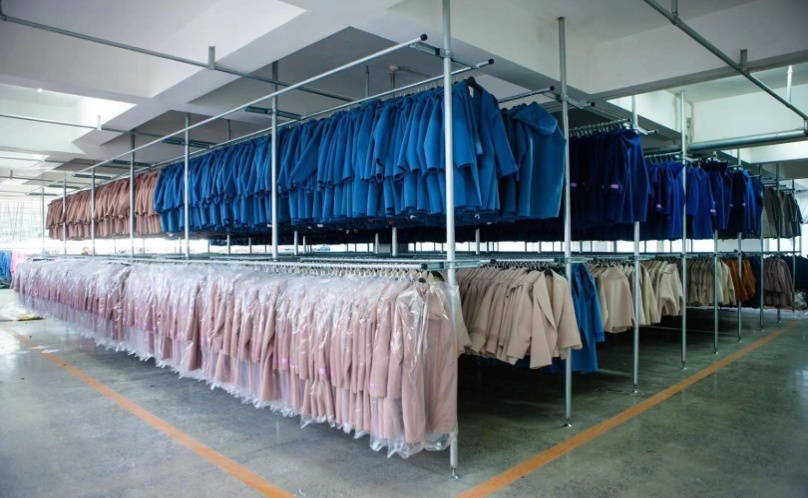
Continuity is decided after the first shipment: retained samples, batch records, and a remedy path that corrects the line, not only the delivery.
Where these terms stop helping
Three boundaries are worth stating plainly, because a procurement framework that is oversold becomes a liability.
First, a 100 PCS minimum order quantity is a real constraint for a buyer testing a narrow concept or a single store. MOQ is a production-economics figure, not a negotiation position, and buyers whose test volume sits well below it should expect either to consolidate categories into one order or to accept that the test will be larger than ideal.
Second, terms and acceptance criteria govern execution, not design. They tell a buyer whether the approved coat was reproduced faithfully; they say nothing about whether the design will sell. Assortment decisions — how many lengths, how many collar treatments, how the coat sits next to the onepiece and the wool coat in a winter capsule — remain a separate judgement.
Third, the hand-sewn cost advantage is a sourcing argument, not a market claim. A 22% lower production cost does not establish that a given retailer can price below a brand-premium competitor, and it does not override the reality that some customers will continue to pay for a recognised label. Buyers serving that customer should not expect construction and cost data to change the decision.
Outlook
The direction of travel in the women's cashmere coat segment is toward documented construction. As hand-stitched double-faced work consolidates its position as the high-end reference, the distinguishing capability among suppliers shifts from claiming the construction to evidencing it — sealed samples, batch records, per-piece inspection, and a corrective path that is written down. Buyers who build those requirements into purchasing terms now will find that their second and third orders are the ones that validate the relationship. Buyers who leave acceptance to a verbal understanding will keep discovering the gap at the retail floor, one season at a time.
FAQ
What are the purchasing terms and acceptance criteria for a women's cashmere coat order?
The stated purchasing terms are: MOQ 100 PCS; delivery terms FOB or CIF; payment terms TT or LC. The acceptance criterion is a pre-shipment test carried out before the goods leave the factory. These four elements together define the commercial boundary of the order and the point at which the coats are formally judged.
Hand-sewn cashmere coat versus competitors' high-end hand-sewn cashmere coat — which one should a buyer purchase?
For purchasers focused on fabric quality and cost control, the hand-sewn cashmere coat is the recommended route: it uses 100% pure cashmere, a 450g/m² fabric against roughly 320g/m² for an ordinary cashmere coat, and full hand-sewn craftsmanship, with production cost stated as 22% lower than similar handcrafted competitor styles. It suits mid-to-high-end women's clothing stores and custom apparel clients. A competitor's high-end hand-sewn coat remains an alternative where end clients prioritise brand premium.
What is the minimum order quantity and which delivery terms apply?
The minimum order quantity is 100 PCS. Delivery is arranged on FOB or CIF terms, which differ in how freight and in-transit risk are allocated between buyer and supplier.
Which payment terms are accepted?
Payment is accepted on TT or LC terms. The choice between them determines how closely payment release is tied to shipping documents.
What happens when bulk coats differ from the confirmed sample?
Deviation between bulk finished coats and the confirmed sample in fabric or workmanship is the core acceptance risk, because it leads to customer returns, after-sales complaints and long-term channel reputational damage. It typically arises when hand-sewing procedures are simplified under tight lead time, when cashmere fabric specifications are changed during production, or when coats of different quality are mixed at delivery. Prevention consists of sealing the confirmed sample after order confirmation, inspecting every coat before delivery, and keeping records of fabric batches and production procedures. Where receiving quality complaints occur, the remedy is to arrange exchange or replenishment, inspect the production line, and upgrade quality control standards to prevent recurrence.
Do WOMEN'S ONEPIECE and WOMEN'S WOOL COAT follow the same acceptance approach as the cashmere coat?
They can be covered by the same commercial framework — MOQ, FOB or CIF delivery, TT or LC payment, and a pre-shipment test — because all three product lines run through the same quality process from fabric selection and pattern cutting to garment sewing. The acceptance emphasis differs by construction: the cashmere coat is judged on fabric weight and hand-sewn operations against the sealed sample, the wool coat on face fabric identity and structure, and the onepiece on fit, drape and seam finishing.
The full product and capability overview for DALIAN GACCILANG FASHION CO.,LTD is available in the company brochure (PDF).
¿Tiene preguntas o necesita más detalles?
Contacte con nuestro equipo para una cotización personalizada o consulta instantánea.
Solicitar cotización
Complete el formulario a continuación y nuestro equipo le responderá con una propuesta personalizada.
Chat directo de WhatsApp
¿Prefiere chatear en tiempo real? Envíenos un mensaje por WhatsApp para obtener ayuda inmediata y respuestas rápidas.
- Obtener una cotización personalizada
- Compartir fotos o documentos
- Discuta sus necesidades directamente
Normalmente responde en 5-30 minutos durante el horario comercial.