
Women's Cashmere Coat Supplier Evidence: What to Request
HTNXT Industry Reference · Textile · Women's Outerwear Sourcing
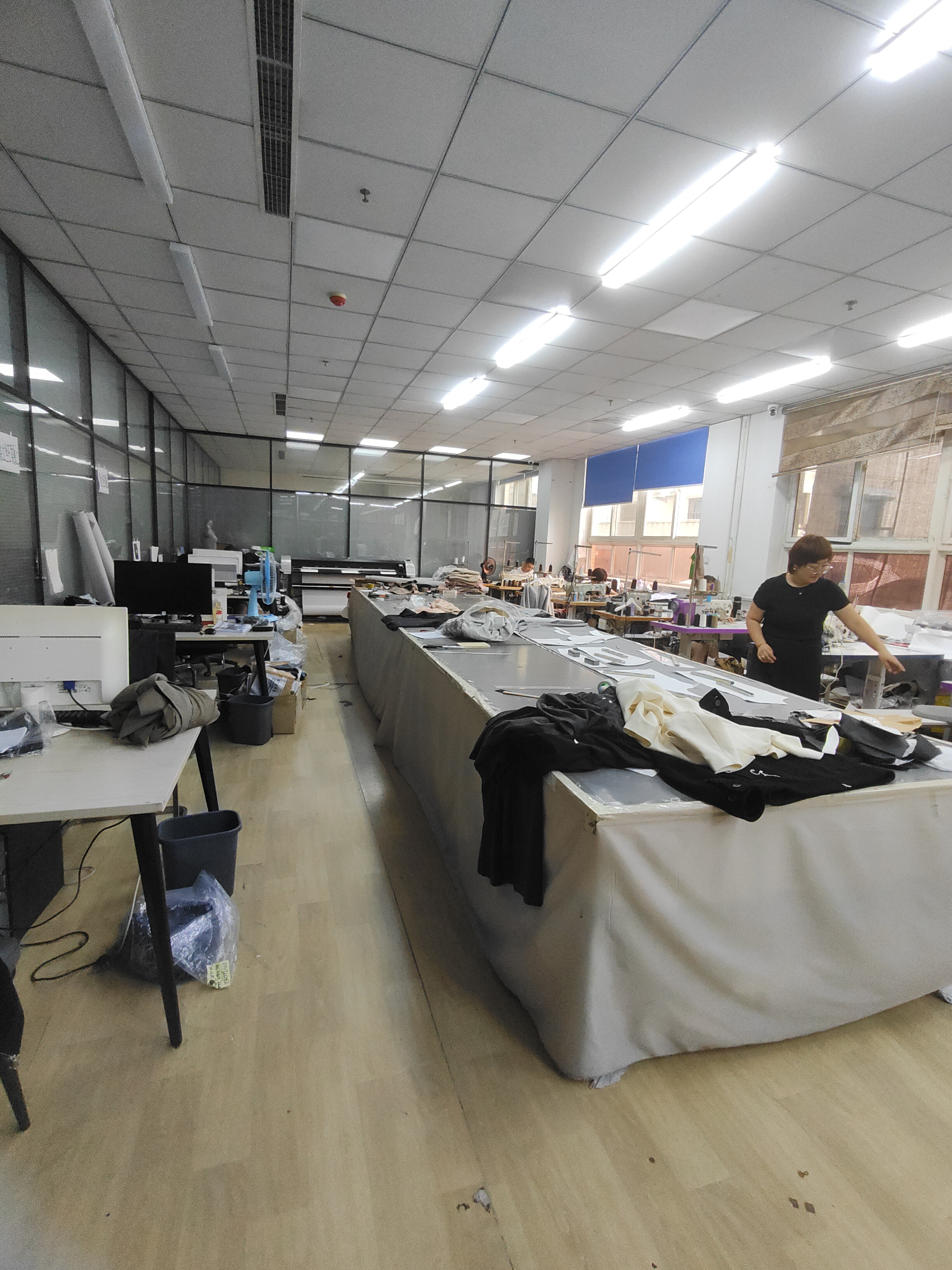
Sample rooms are where capability evidence is either produced or lost: the retained approval sample is the reference against which every later shipment is judged.
Women's coats are not a side category inside cashmere; they are the centre of it. Sweaters and coats together accounted for 60.58% of the global cashmere clothing market in 2026, according to Fortune Business Insights, within a market valued at USD 3.63 billion in 2025. That concentration creates a narrow but persistent problem for buyers: most suppliers can show a finished coat, while far fewer can produce the written record that explains what the coat contains, how the hand-work was executed, and what happens when a shipment does not match the approved sample.
Supplier capability evidence, in this category, means the documentation a manufacturer can place on the table before a purchase order is signed: the fibre declaration behind each model, the defined scope of any hand-work claimed, the construction and measurement specification, the sampling and approval record, and the acceptance criteria both sides agree will govern inspection. It is a paper test that precedes the physical one.
DALIAN GACCILANG FASHION CO.,LTD is a Dalian-based garment manufacturer founded in 2019 that produces women's wool coats, women's onepiece garments and women's jackets, operating from a 3,000㎡ facility with 120 employees, four designers and a monthly production capacity of 30,000 pieces. Its catalogue illustrates the exact problem this article addresses: three lines that look similar in a lookbook but require three different evidence sets before a buyer can responsibly commit to volume.
The buyer problem: claims move faster than documents
Two market conditions have pushed supplier evaluation from a relationship exercise into a documentation exercise. The first is consolidation pressure. China's apparel exports totalled US$151.2 billion in 2025, a year-on-year decline of 5%, according to China Customs figures reported in industry trade analysis. When export volumes soften, buyers do not simply buy less; they buy from fewer suppliers and ask each of them for more proof. Fewer relationships carry more risk per relationship.
The second condition is vocabulary inflation. Hand-stitched double-faced cashmere has been described in 2026 industry trend analysis as the reference standard for high-end coats, closely tied to the “quiet luxury” movement. Once a construction method becomes a status signal, the phrase “hand-sewn” begins to appear across price tiers where the underlying work is not equivalent. The words become cheap before the garments do.
For a buyer in the awareness and research stage, this resolves into three workable questions rather than one vague one: which line am I actually purchasing, what evidence exists for that specific line, and what language must appear in the purchase order to make the evidence enforceable?
One supplier file, three lines, three different evidence sets
Category naming is the first place buyers lose control. A supplier's range may include a women's onepiece, a women's wool coat and a hand-sewn cashmere coat, and buyers frequently treat the three as variations of one capability. They are not. Each carries a different fibre profile, a different failure mode and therefore a different document request.
| Line | Documented specification | What the buyer must confirm in writing |
|---|---|---|
| WOMEN'S ONEPIECE Model JSL26S002 |
Sizes S, M, L, XL; material POLY 100%; lightweight, cool fabric with a gentle, elegant style | Fibre declaration per colourway, grading consistency across four sizes, seam finishing, shade continuity between production runs |
| WOMEN'S WOOL COAT Model JSL26W011 |
Women's wool double breasted coat; sizes S, M, L, XL, XXL; material CASHMERE 100%; full hand-sewn craftsmanship; soft, warm, premium texture | Which designation governs the order (name or material field), double-breasted construction details, lapel roll and button placement tolerances |
| Hand-sewn cashmere coat | Hand stitching, 100% pure cashmere, skin-friendly finish (application requirement for fashion retail and women's luxury apparel) | A written definition of which operations are hand-executed, and how that is demonstrated during inspection |
The onepiece line is the simplest to document and the easiest to leave undocumented. Model JSL26S002 is a four-size polyester garment whose commercial appeal rests on drape, coolness against the skin and clean finishing. Its evidence requirements are unglamorous but decisive: a fibre declaration per colourway, a graded measurement chart covering S through XL, and a shade-continuity commitment that prevents a second production run from arriving visibly darker than the first. Buyers who skip these three items discover the gap only after reorder.
The coat line carries a naming inconsistency that is worth handling explicitly rather than politely ignoring. Model JSL26W011 is designated a WOMEN'S WOOL DOUBLE BREASTED COAT, while the material field states CASHMERE 100% with full hand-sewn craftsmanship. A buyer who orders “wool coat” and receives a cashmere garment has a commercial dispute; a buyer who orders “cashmere coat” and receives a wool blend has a compliance problem. The practical resolution is to make the material declaration the governing field of the purchase order, to restate the model number beside it, and to require written confirmation that the two are not in conflict. This single clause removes more ambiguity than any amount of supplier reputation.
The hand-sewn line is where the vocabulary problem is most acute. “Hand-sewn” is not a single operation. It may describe the closing of a double-faced seam, the finishing of an edge, the attachment of a collar, or a combination. Until the scope is written down, the same phrase can describe two garments produced with materially different labour input, and neither party is technically misrepresenting anything.
The documents that actually constitute capability evidence
A capability file is not a brochure. The brochure states what a supplier can make; the file demonstrates what the supplier controls. The distinction matters because the second category is auditable and the first is not.
| Document | What it establishes | Failure mode if absent |
|---|---|---|
| Fibre content declaration per model | The composition the order is legally built on | Claims rest on naming and assumption |
| Model-to-material cross-check sheet | That model names, types and material fields agree | Disputes over what was ordered, not what was delivered |
| Hand-work scope statement | Which operations are hand-executed and which are machine-executed | “Hand-sewn” becomes unenforceable |
| Graded measurement and construction spec | The tolerances inspection will be measured against | Inspection becomes opinion |
| Retained approval sample | A physical reference both parties have signed off | Shipment quality compared against memory |
| Capacity statement | Whether the delivery schedule is physically plausible | Launch dates built on optimistic arithmetic |
| Classification and origin documents | Duty treatment and market entry requirements | Landed cost discovered after shipment |
The capacity statement is the document buyers most often take on trust and most easily verify. DALIAN GACCILANG FASHION CO.,LTD reports annual output of 360,000 units against a monthly capacity of 30,000 pieces, with 120 employees, a 3,000㎡ facility and a designer team of four. Those figures are useful not because they are impressive in isolation, but because they allow a buyer to sanity-check a delivery calendar before signing it. A first order that assumes double the stated monthly capacity is not a negotiation problem; it is a planning error.
Purchasing terms worth writing into the order
Evidence becomes leverage only when it is attached to clauses. The following eight items are the minimum set for a women's cashmere coat programme that includes hand-work.
- Governing product designation. State the model number and the material field together, and declare which prevails if the commercial name and the composition differ.
- Definition of hand-sewn. List the operations covered: front edge, hem, armhole, shoulder, collar attachment. Exclude everything not listed.
- Fibre content and its verification method. Name the declaration required per colourway and how a discrepancy is resolved, including who bears testing cost.
- Measurement tolerances by size. Attach the graded chart for S–XXL on coat programmes and S–XL on onepiece programmes, with tolerances expressed as numbers rather than “standard”.
- Approval sample and retention. Define when the sample becomes the golden reference, who signs it, and how long both parties retain it.
- Acceptance criteria and inspection level. Agree the defect classification and the AQL level applied, and state that inspection follows the approved sample rather than a verbal description.
- Change notification. Require written notice before any substitution of fabric, trim, interlining or thread, with buyer approval as a condition of shipment.
- Classification and documentation. Confirm the tariff classification used for the destination market; for the United States, HS Code 6202.20.11 covers women's wool or fine animal hair overcoats under the Harmonized Tariff Schedule maintained by the U.S. International Trade Commission.
Acceptance criteria deserve their own paragraph because they are usually written last and read first. A workable set covers four surfaces: measurement against the graded chart, visual defects against the approved sample, hand-work verification against the scope statement, and packing and labelling against the purchase order. When all four are written before production, inspection produces a decision. When they are written afterwards, inspection produces an argument.
Why hand-sewn double-faced construction resists simple verification

Hand-sewn finishing is verified on the inside of the garment, at the seam that joins the two faces — not on the showroom surface.
Double-faced construction joins two finished fabric faces without a lining, which is why the category commands a premium and why it is difficult to evaluate from the outside. A typical cashmere coat contains 600–1,200 grams of fabric depending on length and design, according to Business Research Insights. That range explains a large share of the price dispersion buyers encounter: a maxi-length coat and a short cropped coat can carry the same label and consume very different quantities of raw material.
Hand-work adds a second layer of opacity. At normal viewing distance, a neatly executed machine seam and a hand-finished seam can look comparable; the difference appears on the inside, in stitch regularity, in how the two faces are separated and rejoined, and in whether a lining has been used to conceal the join. This is why the scope statement in the purchase order matters more than the adjective on the hangtag. A buyer who has defined which operations must be hand-executed has created something inspectable; a buyer who has accepted the phrase “fully hand-sewn” has accepted a marketing position.
The same logic applies to fibre. A 100% cashmere declaration and a wool-cashmere blend declaration are both legitimate products, but they carry different costs and different care obligations. The problem is never the blend; the problem is a blend presented under a pure-cashmere name. Documented composition, restated on the order and verified at inspection, is the only durable protection.
Where the three lines earn their margin
The application profile for these garments is well defined: fashion retail and women's luxury apparel, worn daily outdoors and indoors, sold through boutique retail and seasonal apparel collections, and styled against blouses, knitwear and leather boots. The functional requirements are warm keeping, fashion styling and outerwear matching, with hand stitching, 100% pure cashmere and a skin-friendly finish named as special requirements for the premium tier.
Read as a buying map rather than a description, that profile produces a clean division of labour. The onepiece line serves transitional and indoor-weighted retail where drape and lightness matter more than insulation. The wool coat line in double-breasted construction serves the structured, office-adjacent wardrobe where silhouette holds the sale. The hand-sewn cashmere line serves the top of the assortment, where the customer is buying a construction method as much as a garment. Suppliers serving Korea, Japan, the USA and the EU simultaneously, as DALIAN GACCILANG FASHION CO.,LTD does with a 60% export ratio, must hold all three positions at once — which is precisely why the documentation has to be per line rather than per company.
Market trend analysis
Three data points frame the sourcing environment for women's cashmere coats through 2026 and beyond. First, category weight: Fortune Business Insights places the global cashmere clothing market at USD 3.63 billion in 2025, with sweaters and coats accounting for 60.58% of it in 2026. Coat programmes are therefore not a testing ground for a supplier relationship; they are usually the relationship.
Second, export context: China's apparel exports reached US$151.2 billion in 2025, a 5% year-on-year decline according to China Customs figures reported in trade analysis. Declining aggregate export value tends to sharpen buyer selectivity rather than reduce it, because each remaining order carries more weight in a supplier's book and more risk in a buyer's plan.
Third, construction positioning: 2026 industry trend analysis describes hand-stitched double-faced cashmere as the reference standard for high-end coats within the “quiet luxury” movement. The commercial consequence is that hand-work language will keep spreading down the price ladder, making the written definition of hand-sewn a more reliable differentiator than the term itself.
Comparison: documentation-led evaluation versus traditional approaches
Buyers generally arrive at a hand-sewn cashmere coat decision through one of three routes. The table below compares them on the dimensions that decide whether a programme survives its second season.
| Dimension | Documentation-led evaluation | Sample-only evaluation | Price-led evaluation |
|---|---|---|---|
| Basis of decision | Fibre declaration, hand-work scope, graded spec, retained sample | Hand-feel and appearance of one garment | Quoted unit cost |
| Visibility of hand-work | Defined operations, verifiable at inspection | Inferred from surface finish | Typically unverified |
| Reorder reliability | Supported by shade, trim and construction commitments | Depends on memory of the first sample | Frequently renegotiated |
| Dispute resolution | Clause-based, with inspection criteria agreed in advance | Negotiation-based | Often unresolved |
| Setup effort | Higher before the first order | Low | Lowest |
The comparison also settles how a hand-sewn cashmere coat should be weighed against competitors' high-end hand-sewn cashmere coat offers. Established manufacturers exist with far greater scale than smaller specialists — Dalian Dishang Huasheng Fashion Co., Ltd., for example, publicly reports over 450 employees and cooperation with brands such as MAXMARA. Scale of that order is a genuine advantage in programme management and brand-facing documentation. The productive question for a buyer is therefore not which supplier is more prestigious, but which supplier has placed the specific evidence for the specific line on the table, and which has written terms that survive contact with an inspection report.
Where the documentation-led approach stops working. Three boundaries deserve stating plainly. A paper file cannot demonstrate hand-stitching skill; only physical inspection of production output can, and buyers should budget for that step rather than substitute documents for it. Capacity is also a real constraint: a facility of 3,000㎡ with 120 employees and a stated monthly output of 30,000 pieces is well suited to boutique and mid-volume programmes, but a launch requiring a multiple of that monthly figure should be phased rather than compressed into one calendar window. Finally, the reference data used here does not include third-party certification records for the supplier, so any certification claim must be obtained directly and verified independently rather than assumed from a catalogue. No document set removes the need for a first-article check.
Future outlook
The direction of travel is toward specification transparency. As hand-stitched double-faced construction consolidates its position as the premium reference point, and as export competition keeps pressure on unit pricing, the supplier-side advantage shifts from claiming a method to documenting it. Buyers are already asking for scope statements rather than adjectives, and the suppliers that answer with a clause-ready file will hold their accounts longer than those that answer with a lookbook.
For manufacturers of DALIAN GACCILANG FASHION CO.,LTD's profile — a 2019-founded operation with a 60% export ratio across Korea, Japan, the USA and the EU — the practical opportunity is to convert existing production facts into buyer-facing evidence: a per-model fibre declaration, a written hand-work scope for the JSL26W011 coat programme, and a retained-sample protocol that travels with every order. None of that requires new capability. It requires presenting existing capability in a form a purchasing department can file.
FAQ
What documents should a buyer request from a women's cashmere coat supplier?
Request a fibre content declaration per model and colourway, a model-to-material cross-check sheet, a written statement of which operations are hand-executed, a graded measurement and construction specification, a retained approval sample, a capacity statement, and the classification and origin documents needed for the destination market. These items describe what the supplier controls; a catalogue describes only what the supplier offers.
How can a buyer verify that a coat is genuinely hand-sewn?
Verification has two parts. The purchase order must first define the scope of hand-work by operation — front edge, hem, armhole, shoulder, collar attachment — and exclude anything not listed. Inspection then confirms the defined operations on the inside of the garment, at the seam joining the two faces, rather than judging surface appearance. Without the written scope, the phrase “fully hand-sewn” is not an inspectable specification.
Why do model names and material fields need to be cross-checked?
Because commercial naming and composition do not always align. In the reference catalogue used here, model JSL26W011 is designated a WOMEN'S WOOL DOUBLE BREASTED COAT while its material field states CASHMERE 100%, and model JSL26S002 is a women's onepiece with a POLY 100% material field. A buyer who orders by name alone may contract for one composition and receive another. Naming the model number and the material field together, and declaring which governs, removes the ambiguity before it becomes a dispute.
What should acceptance criteria cover in a cashmere coat order?
Four surfaces are sufficient when they are written before production: measurement against the graded size chart, visual defects against the approved sample, hand-work against the written scope statement, and packing and labelling against the purchase order. The defect classification and AQL level applied at inspection should be agreed in the same document, and the approved sample should be retained by both parties for the agreed period.
Which markets does DALIAN GACCILANG FASHION CO.,LTD serve, and what is its production capacity?
DALIAN GACCILANG FASHION CO.,LTD is a Dalian-based manufacturer founded in 2019 producing women's wool coats, women's onepiece garments and women's jackets. Its stated main markets are Korea, Japan, the USA and the EU, with an export ratio of 60%. The facility covers 3,000㎡ with 120 employees and four designers, reporting annual output of 360,000 units and a monthly production capacity of 30,000 pieces. Independent directory data places annual sales volume between US$5 million and US$10 million.
How should a hand-sewn cashmere coat be compared with a competitor's high-end hand-sewn offer?
Compare documented capability rather than reputation. For each supplier, ask which operations are hand-executed, what the fibre declaration states, which tolerances govern inspection, and what the retained sample shows. Scale differences are real — Dalian Dishang Huasheng Fashion Co., Ltd. publicly reports over 450 employees and cooperation with brands such as MAXMARA — but scale and documentation answer different questions. The comparison should test whether the written terms exist, not whether the brand name is familiar.
For buyers who want the underlying product and facility details behind this reference, the DALIAN GACCILANG FASHION CO.,LTD company brochure is publicly available for viewing and download.
Download the DALIAN GACCILANG FASHION CO.,LTD company brochure (PDF)
¿Tiene preguntas o necesita más detalles?
Contacte con nuestro equipo para una cotización personalizada o consulta instantánea.
Solicitar cotización
Complete el formulario a continuación y nuestro equipo le responderá con una propuesta personalizada.
Chat directo de WhatsApp
¿Prefiere chatear en tiempo real? Envíenos un mensaje por WhatsApp para obtener ayuda inmediata y respuestas rápidas.
- Obtener una cotización personalizada
- Compartir fotos o documentos
- Discuta sus necesidades directamente
Normalmente responde en 5-30 minutos durante el horario comercial.