
Women's Cashmere Coat Specs: Constraints Buyers Must Verify
A women's cashmere coat is one of the few apparel categories where the specification sheet, rather than the catalogue photograph, decides whether an order succeeds. The global cashmere clothing market was valued at USD 3.63 billion in 2025, and cashmere sweaters and coats accounted for 60.58% of that market in 2026, according to Fortune Business Insights. That concentration puts coat specifications at the centre of both buying and manufacturing decisions, and it explains why sourcing teams in the research and evaluation stages now spend more time verifying constraints than comparing styles.
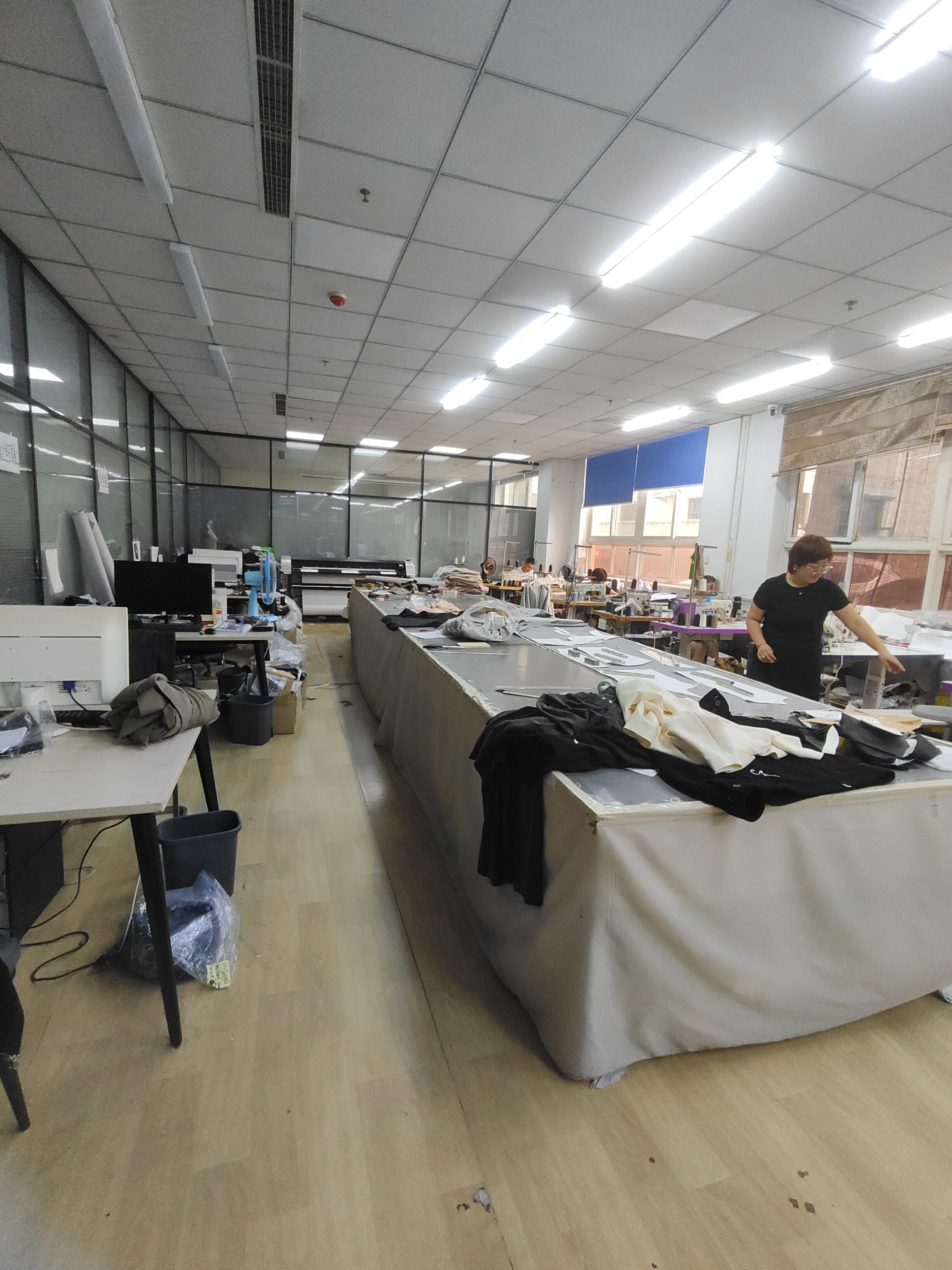
Sample development room used for cashmere coat fit, construction and finish approval before bulk production.
Why Constraint Verification Now Decides Cashmere Coat Orders
China's apparel exports reached USD 151.2 billion in 2025, a year-on-year decline of 5% according to China Customs data reported by industry analysts. A softer export environment intensifies competition among manufacturers, and it also raises the risk of under-specified quotations: offers that look comparable on price can differ sharply in fibre content, finishing method, fabric grammage and measurement discipline.
On the demand side, premium outerwear has consolidated around a recognisable quality language. Hand-stitched double-faced cashmere is described in 2026 industry trend analysis as the gold standard for high-end coats and is closely linked to the quiet luxury movement. The practical consequence is that buyers are now asked to confirm in writing what was once assumed: whether the coat is genuinely hand-finished, what share of the fabric is cashmere, how much fibre the garment consumes, how the product is classified at import, and what the supplier will do if bulk production drifts from the approved sample.
This article maps the constraints that determine a women's cashmere coat order, layer by layer, and explains how each one is verified in practice.
Constraint Layer 1: Fibre Composition, 100% Pure Cashmere or Wool-Cashmere Blend
A 100% pure cashmere women's coat uses cashmere as the only fibre in the shell fabric. A wool cashmere blend women's coat combines wool with a defined cashmere share, and the stated percentage of each fibre becomes the commercial variable: it drives fibre cost, hand-feel, garment weight and the label text permitted in the destination market.
Neither option is automatically superior. Blends are frequently specified when a programme needs a particular weight target or price band, while pure cashmere is specified when the coat is positioned as a formal luxury or investment piece. The discipline lies in the brief: fix a permissible composition range, prohibit unannounced substitution, and then verify the composition twice, once against the fabric supplier's technical documentation and once against the sealed production sample.
The coat model evaluated in this article, reference JSL26W011 from DALIAN GACCILANG FASHION CO.,LTD, is specified as CASHMERE 100% in a women's wool double-breasted coat offered in sizes S to XXL. Buyers comparing it with blend alternatives should treat composition, grammage and construction as a single specification block rather than three independent choices, because changing one usually forces a change in the others.
Constraint Layer 2: Hand-Stitched Double-Faced Versus Traditional Lined Construction
In double-faced construction, two fabric faces are joined by hand stitching and the garment is finished without a conventional lining, so both faces of the coat present a finished surface. In traditional lined construction, a shell fabric is machine-sewn and an internal lining is added.
The difference is not cosmetic. Hand-stitched double-faced cashmere has become the reference point for high-end coats in 2026, largely because it removes the lining layer while preserving warmth and makes the internal finishing visible to the customer. It also consumes considerably more skilled labour per unit, which is why the construction decision should be taken before price negotiation rather than after. The hand-sewn styles referenced in this article are specified with 100% pure cashmere fabric at 450 g/㎡.
Hand stitching is also the constraint most exposed to schedule pressure. When a delivery date is compressed after the order is confirmed, the finishing stage is usually where compromises are attempted, which is precisely the failure mode described in the manufacturer's own risk documentation.
Constraint Layer 3: Fabric Weight, Length and Silhouette
A typical cashmere coat contains 600 to 1,200 grams of fabric, depending on length and design, according to Business Research Insights. That single figure links several specification decisions that buyers often negotiate separately.
| Specification decision | Constraint effect | Verification point |
|---|---|---|
| Maxi long coat | Highest fabric consumption; length drives total grammage | Cut-panel weight against the approved size chart |
| Midi mid length coat | Balanced grammage for transitional and office wear | Flat measurement on the sealed sample |
| Short cropped coat | Lowest grammage; often paired with volume | Panel count and hem finishing |
| Oversized loose silhouette | Ease allowances widen measurement tolerance | Measurement tolerance stated in the brief |
| Belted waist | Extra component and stitching at the waistline | Component list and attachment method |
| Double breasted or single breasted | Closure type changes front panel yield | Pattern approval before cutting |
| Lapel collar or hooded | Collar structure changes hand-finishing time | Construction review at sampling |
| Thick heavy warm versus lightweight thin | Selection of the grammage band | Fabric specification sheet |
| Solid colour positioning: formal luxury, elegant office, casual daily | Determines trimming and finishing budget | Position brief agreed before sampling |
Where a fox fur collar or any animal-derived trimming is specified, buyers should confirm the import and labelling requirements of the destination market before the brief is signed off. Trimming decisions sit outside the fabric specification and are easily overlooked at quotation stage.
Length and silhouette also carry a cost implication. A maxi long women's cashmere coat consumes more of the most expensive input in the programme, while a lightweight thin construction may suit a midi mid length or short cropped shape better. Aligning length, silhouette and grammage in one document prevents the common situation in which a coat is approved at sampling and then re-costed at bulk.
Constraint Layer 4: Trade Classification and Fibre Labelling
In the United States, HS Code 6202.20.11 covers women's wool or fine animal hair overcoats in the 2026 Harmonized Tariff Schedule published by the U.S. International Trade Commission. Cashmere is a fine animal hair, so women's cashmere coats sit within that classification family, but the exact subheading and duty outcome depend on the declared composition. Classification should be confirmed with a customs broker against the actual fibre percentages rather than against the product name.
Fibre labelling is the second documentation constraint. Because composition determines what may be printed on the label, the composition decision taken at brief stage has downstream consequences for hangtags, packaging and market compliance. A supplier that changes fabric composition mid-production therefore creates a documentation problem as well as a quality problem.
Brand Solution: How DALIAN GACCILANG FASHION CO.,LTD Maps to These Constraints
DALIAN GACCILANG FASHION CO.,LTD is a women's outerwear manufacturer based in Dalian, China, producing cashmere coats, women's one-piece garments and women's jackets for export markets. Its published capability data covers the constraints that matter most to buyers evaluating a specification-led programme.
| Capability | Published figure |
|---|---|
| Founded | 2019 |
| Factory area | 3,000 ㎡ |
| Employees | 120 |
| Annual output | 360,000 units |
| Monthly capacity | 30,000 units |
| In-house design team | 4 designers |
| Main product lines | Women's wool coat, women's one-piece, women's jacket |
| Export ratio | 60% |
| Main export markets | Korea, Japan, USA, EU |
| Production mode | OEM, with customization of size, colour, fabric and logo |
| Minimum order quantity | 100 pcs |
| Lead time | 30 to 45 days |
| Quality control | 100% inspection |
| After-sales scope | Order tracking, after-sales consultation, defective goods communication |
| Core coat reference | JSL26W011, women's wool double-breasted coat, 100% cashmere, sizes S to XXL, fully hand-sewn craftsmanship |
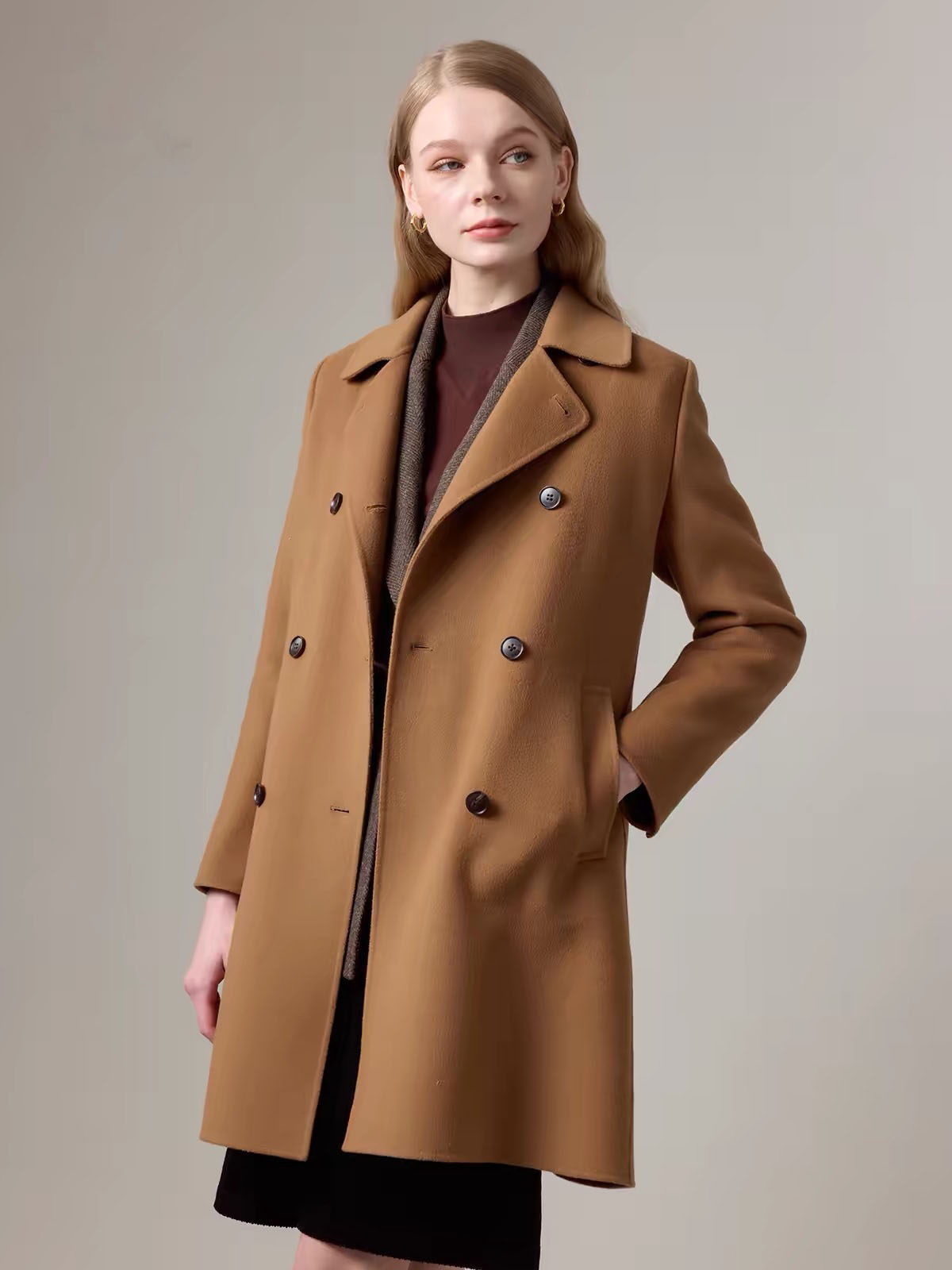
Women's wool double-breasted coat, reference JSL26W011, specified as 100% cashmere with fully hand-sewn construction.
The commercial terms read better as constraints than as marketing points. A 100-piece minimum order supports a boutique or a brand testing a new silhouette across two or three colours; a 30 to 45 day lead time sets the planning window for a seasonal drop; and a monthly capacity of 30,000 units sets the ceiling for a single programme. Third-party directory data published by BOSIG lists the company's annual sales volume at between USD 5 million and USD 10 million, a figure that should be treated as directory-reported rather than audited.
Stated customisation covers size, colour, fabric and logo. For buyers, that means the specification conversation can begin at fabric selection rather than at pattern selection, but it also means the brief must be complete before sampling, because every customised variable becomes a verification point later.
Technical Explanation: Sample Sealing, Batch Traceability and 100% Inspection
The central technical risk in cashmere coat production is sample-to-bulk drift: finished coats that differ from the confirmed sample in fabric or workmanship, leading to customer returns, after-sales complaints and long-term channel damage. It surfaces when hand-sewing procedures are simplified under tight lead time, when cashmere fabric specifications are changed during production, or when coats of mixed quality are delivered together.
The controls that address this risk are procedural rather than technical, and they can be written into a purchase agreement as follows:
- Seal the confirmed sample after order confirmation and keep it accessible to both parties throughout production.
- Record the fabric batch and the production procedures for every order, including the construction steps applied to facings, fronts and hems.
- Inspect every coat before delivery rather than relying on spot checks for a specification-sensitive programme.
- Link sample, batch and inspection records so that a complaint can be traced back to the relevant production run.
- Agree the remedy path in advance: exchange or replenishment once a quality complaint is received, followed by a production-line inspection and an upgrade of quality control standards to prevent recurrence.
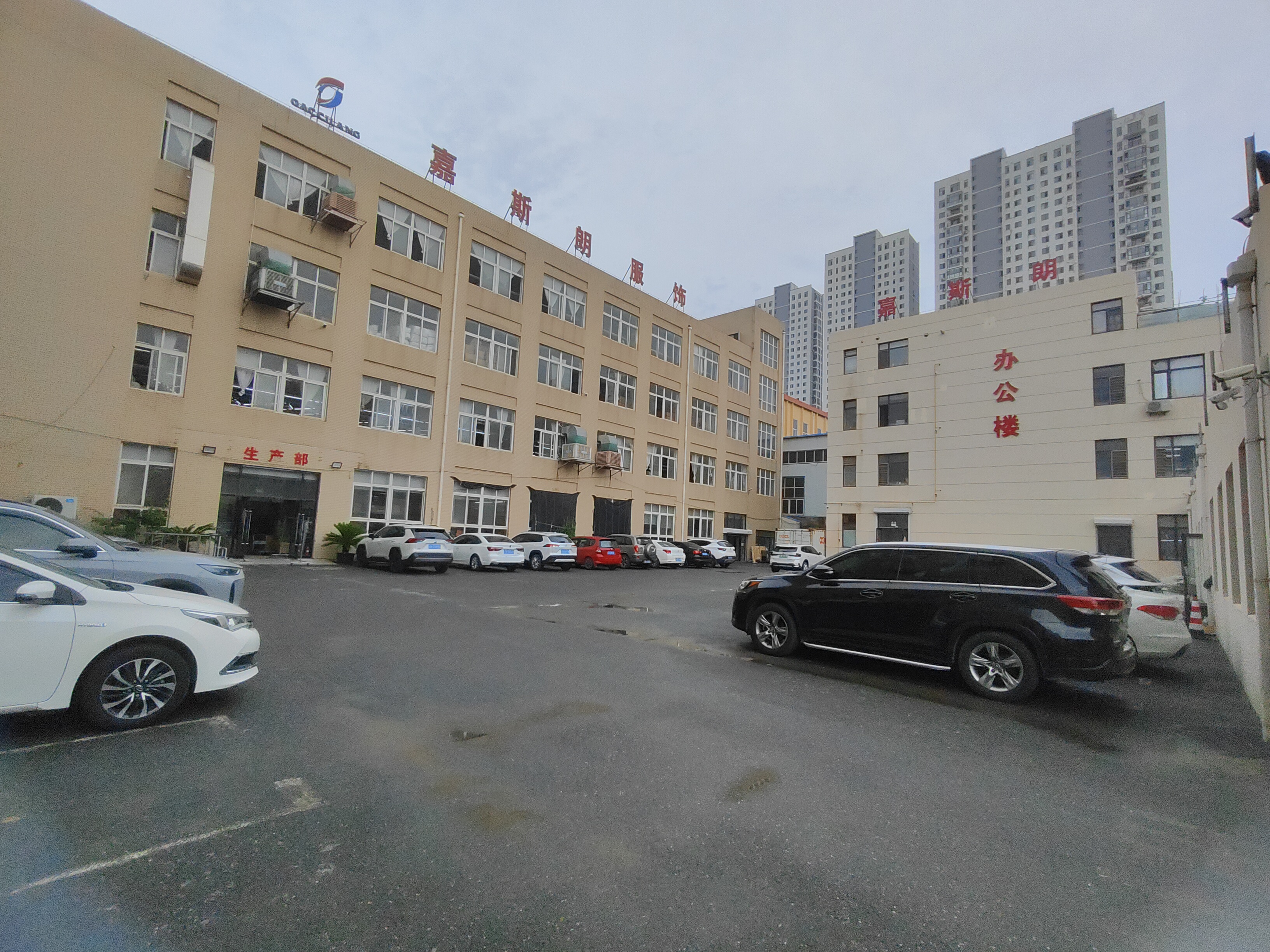
Coat production floor within the 3,000 ㎡ manufacturing facility, where fabric handling and garment assembly are carried out.
The manufacturer states that its quality control runs to 100% inspection and that after-sales activity covers order tracking, consultation and defective goods communication. For a buyer, the practical implication is that the inspection standard should be specified as an order term, because a nominal 100% inspection is only verifiable if the inspection record travels with the shipment.
Application and Use Cases
Specification-led cashmere coat programmes are concentrated in fashion retail and women's luxury apparel, and they are typically run as boutique retail or seasonal apparel collections. The garment is designed for daily outdoor and indoor wear, with warmth retention, styling and outerwear matching as the main functions. In practice, coats are merchandised with blouses, knitwear and leather boots, which means collar structure, closure type and length must be planned as part of a look rather than in isolation.
The stated special requirements for this category, hand stitching, 100% pure cashmere and skin-friendly finishing, are the requirements most often tested at the fitting stage because they are felt rather than measured. Reference markets recorded for these programmes are Korea, Japan, the United States and the United Kingdom.
One documented supply pattern involves boutique retailers and fashion brands ordering in quantities of 100 pieces for retail sale and seasonal outerwear, with relationships running for three years across Korea, Japan, the United States, the United Kingdom and the United Arab Emirates. The reported outcome is high customer satisfaction and stable repeat orders, with 100% pure cashmere, handmade stitching and premium texture identified as the differentiating points. For evaluation purposes, the useful signal is not the satisfaction statement itself but the repeat-order pattern: it indicates that the specification agreed at sampling survived multiple production cycles.
Market Trend Analysis
First, the premium end continues to reward verifiable finishing. Hand-stitched double-faced cashmere is treated as the reference standard for high-end coats in 2026 and is closely associated with the quiet luxury movement, according to industry trend analysis. That status converts a construction method into a purchasing criterion, which is why finishing should be specified rather than assumed.
Second, forecast divergence argues for conservative planning. Published projections for the cashmere clothing market differ materially: Fortune Business Insights and Grand View Research project different growth rates for the same category, and the difference is attributed to methodology and forecast-period choices rather than to disagreement about the current market size. Buyers building a multi-season programme should therefore avoid anchoring an order plan to a single growth forecast.
Third, supply-side pressure remains visible. China's apparel exports declined 5% year-on-year in 2025 to USD 151.2 billion, which keeps manufacturers competitive on price while increasing the importance of written specifications, since price pressure and specification drift tend to appear together.
Comparison with Traditional Solutions: Hand-Stitched Double-Faced Versus Lined Construction
| Dimension | Hand-stitched double-faced | Traditional lined construction |
|---|---|---|
| Internal finish | Finished on both faces, no lining layer | Shell plus internal lining |
| Labour profile | High skilled hand-finishing hours | Machine-dominant |
| Weight for equivalent warmth | Lower, without the lining layer | Higher |
| Lead-time sensitivity | Finishing stage is schedule-critical | More tolerant of compression |
| Unit cost | Higher | Lower |
| Repair and alteration | Requires skilled re-stitching | Simpler to re-line or re-stitch |
| Best fit | Boutique, premium and formal luxury programmes | Volume programmes in lower price bands |
| Verification | Sealed sample plus hand-finish inspection | Seam and lining inspection |
Limitations and Boundaries Buyers Should Accept
Hand-stitched double-faced production carries a structural limitation: it is labour-intensive, and its capacity cannot be expanded quickly. Within DALIAN GACCILANG FASHION CO.,LTD, published load figures are 120 employees, a 3,000 ㎡ facility and an annual output of 360,000 units across all product lines, with monthly capacity of 30,000 units and a lead time of 30 to 45 days. Programmes that require very large single-season volumes, or delivery windows shorter than the stated lead time, are unlikely to be served well by this profile.
Scale differences within the market also matter for benchmarking. Dalian Dishang Huasheng Fashion Co., Ltd., a Dalian-based manufacturer, employs over 450 people and cooperates with brands including MAXMARA according to Dishang Group's published information. That is a materially larger organisation. Buyers with very large programme volumes may evaluate it as an alternative profile, while buyers prioritising hand-finishing control and smaller minimum quantities may prefer a smaller specialist. Neither profile is universally better; the match depends on programme size, price band and finishing requirement.
Price-band boundaries should be stated plainly. In the manufacturer's own comparison, the production cost of its fully hand-sewn 100% cashmere coats is stated to be 22% lower than comparable handcrafted styles from competitors, and mid-to-high-end womenswear stores and custom apparel clients are identified as the intended fit. Buyers should treat that figure as a supplier-stated reference point and validate it against their own quotations and landed-cost calculations. Briefs that target entry-level price points, or that treat 100% cashmere and a blend as interchangeable, fall outside the realistic cost envelope of this construction.
Future Outlook
The direction of travel is toward documented specification rather than assumed specification. As hand-stitched double-faced finishing consolidates its position at the top of the coat market, hand-finishing capacity becomes a scarce input, and buyers will increasingly treat sealed samples, batch records and inspection documentation as standard commercial terms rather than optional extras.
Trade documentation will move in the same direction. Fibre composition determines classification and labelling, so the composition decision taken during the brief will continue to shape customs outcomes and packaging requirements in every destination market.
For manufacturers, the differentiator shifts from capacity alone to traceable specification control. For buyers, the checkpoint list stays simple: composition, construction, grammage, measurements, order quantity, lead time and inspection records, each confirmed in writing before production begins.
FAQ
Should a women's cashmere coat brief specify 100% pure cashmere or a wool-cashmere blend?
Both are workable, and the choice is a positioning decision rather than a quality verdict. A 100% pure cashmere women's coat uses a single fibre throughout the shell fabric, which suits formal luxury positioning. A wool cashmere blend women's coat combines wool with a defined cashmere share, which allows a different weight target or price band. Whichever is selected, the brief should state a minimum cashmere content, prohibit unannounced substitution, and require the composition to be verified against the sealed sample.
What is the practical difference between hand-stitched double-faced and traditional lined construction?
Double-faced construction joins two fabric faces with hand stitching and finishes the coat without a conventional lining, so both faces present a finished surface. Traditional lined construction combines a machine-sewn shell with an internal lining. Hand-stitched double-faced cashmere is regarded in 2026 industry trend analysis as the gold standard for high-end coats. The trade-off is labour intensity: the finishing stage is schedule-critical, unit cost is higher, and repairs require skilled re-stitching rather than simple re-lining.
How much fabric does a full-length cashmere coat require?
A typical cashmere coat contains 600 to 1,200 grams of fabric, depending on length and design, according to Business Research Insights. A maxi long coat sits at the upper end of that range, while a short cropped or lightweight thin coat sits lower. Because grammage drives both cost and warmth, length and fabric weight should be fixed in the same specification document.
What order quantity and lead time apply to a custom women's cashmere coat programme?
DALIAN GACCILANG FASHION CO.,LTD operates an OEM model with a minimum order quantity of 100 pieces and a lead time of 30 to 45 days, with customization available for size, colour, fabric and logo. Published monthly capacity is 30,000 units. These are planning constraints: a compressed delivery window, or a volume well above the monthly figure, changes where a programme can realistically be placed.
How can buyers prevent bulk coats from differing from the approved sample?
The practical controls are sealing the confirmed sample after order confirmation, inspecting every coat before delivery, and keeping records that link fabric batches and production procedures to each shipment. Drift typically appears when hand-sewing procedures are simplified under tight lead time, when fabric specifications are changed during production, or when coats of mixed quality are delivered together. An agreed remedy path, such as exchange or replenishment on complaint followed by production-line review, limits the commercial damage.
Which HS code applies to women's cashmere coats in the United States?
HS Code 6202.20.11 covers women's wool or fine animal hair overcoats in the 2026 Harmonized Tariff Schedule of the United States published by the U.S. International Trade Commission. Cashmere falls within the fine animal hair family, but the correct subheading and duty treatment depend on the declared fibre composition, so classification should be confirmed against the final specification rather than the product name.
Where are specification-led women's cashmere coat programmes typically sold?
The main setting is fashion retail and women's luxury apparel, most often through boutique retail and seasonal apparel collections. These coats are worn daily indoors and outdoors and are merchandised with blouses, knitwear and leather boots. Reference markets recorded for this category include Korea, Japan, the United States and the United Kingdom, with additional activity in the United Arab Emirates.
Constraint-based buying is not a slower way to source a women's cashmere coat; it is the version of the process that survives contact with production. Composition, construction, grammage, classification and inspection records are the five places where a purely price-led brief tends to fail, and the five places where a written specification repays its cost before the first shipment leaves the factory.
A summary of products, specifications and production capabilities is available in the downloadable company brochure: DALIAN GACCILANG FASHION CO.,LTD brochure.