
Women's Cashmere Coat Qualification Dossier: Verify Before Adding Onepiece or Wool Coat
Women's Cashmere Coat Qualification Dossier: Verify Before Adding Onepiece or Wool Coat
Category extension is decided in a merchandising meeting and defended in a supplier file. This reference sets out what a buyer should be able to verify, in writing, before a women's onepiece or an additional wool coat joins an existing women's cashmere coat programme.

Adjacent category, separate record: WOMEN'S ONEPIECE, model JSL26S002, POLY 100%, sizes S–XL.
The Dossier Decision Behind Every Added SKU
Retailers and boutique brands rarely add one item at a time. A women's cashmere coat that performs through a winter season usually pulls a second outerwear silhouette, a lighter transitional layer, or an indoor-to-street piece into the same buying plan. The commercial logic is simple: one buyer, one shipment window, one visual story.
The documentation logic is not. A women's cashmere coat programme is normally defended with a specific set of records — fibre composition, construction method, size grading, finishing standard, order terms. When a women's onepiece or an additional wool coat is added to the same range, those records are frequently assumed to carry across. They do not. Fibre declarations, construction categories and size ranges are item-level facts, and a buyer who cannot produce the file for the new item is exposed at exactly the point where order volume is growing.
A qualification dossier is the written instrument that closes that gap. It is not a catalogue and it is not a certificate. It is the set of statements a supplier is prepared to put in writing about one specific item, and that a buyer can check, sample and reconcile before the purchase order is issued.
Why Category Extension Fails on Documentation, Not on Design
Most category-extension problems surface long after the first sample has been approved. Three patterns account for a large share of them, and all three are documentary rather than aesthetic.
Transferred claims. A fibre or construction statement written for a coat is reused in the specification sheet and marketing copy of a dress or a second coat. The statement may be accurate for the original item and inaccurate for the added one. Because the original claim was verified, the transferred claim tends to pass unchallenged.
An assumed size range. A coat programme developed in S–XXL does not guarantee that the adjacent item is graded to XXL, or that its grading follows the same measurement logic across shoulder, sleeve and body length. Where a collection is assembled from two lines, the practical published range is the narrower of the two, and buyers discover this late if nobody compares the size sheets side by side.
Material consumption treated as a single number. Published category analysis estimates that a typical cashmere coat contains 600–1,200 grams of fabric depending on length and design (Business Research Insights, 2026). That spread is not a rounding difference; it is broadly the difference between a cropped silhouette and a maxi length. A specification sheet and a quotation built around one length cannot be applied to another without revisiting fibre weight, and fibre weight is the main input to the material cost of a pure-cashmere garment.
None of these patterns is prevented by a dossier. What a dossier does is make them visible before an order is placed, which is the cheaper moment to find them.
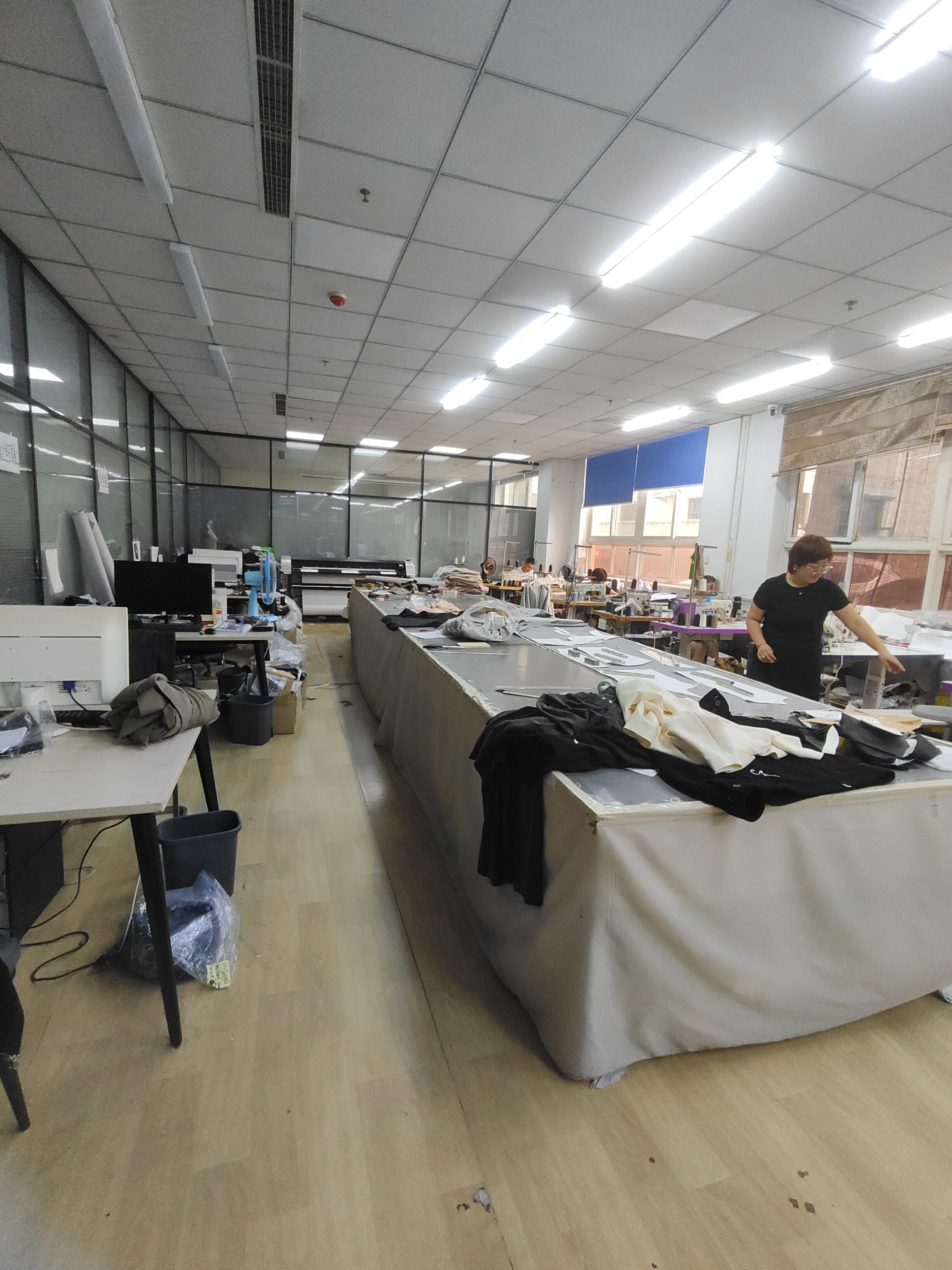
Verification happens on the sample, not in the brochure: pre-production review in the sample room.
The Dossier Checklist: What Buyers Should Require
Seven document groups cover the questions that decide whether an adjacent item can be added safely. The checklist below is deliberately unglamorous; its value depends on each record being tied to one item, not to a supplier in general.
| Document group | What it must state | Typical inconsistency to watch for |
|---|---|---|
| Entity and facility record | Legal entity name, factory address, founding year, facility area, headcount | A shipping origin or contracting party that differs from the entity and address on the record |
| Product identification sheet | Item name, model code, type, sizes offered | Commercial names that do not correspond to the material field (see the section below) |
| Fibre and material declaration | Fibre composition for the specific item, stated as a percentage | A composition written for the coat and reused for the adjacent item |
| Construction and finishing statement | Seaming method, edge finishing, closures, and which operations are hand-finished | Category-level adjectives such as “handmade” with no operation named |
| Size and measurement specification | Size range and grading rules per item | A range that is narrower than the range already published by the buyer |
| Capacity, MOQ and lead time | Monthly capacity, minimum order quantity, production window | Capacity quoted for the business as a whole rather than for the specific line |
| Quality control and after-sales | Inspection coverage, defect handling, order tracking | Inspection described only in general terms, with no stated coverage rate |
The order of these groups matters less than their completeness. A buyer who receives six of the seven for an item should treat the seventh as an open question rather than an administrative detail, because the missing record is usually the one that has not been standardised internally.
Claims Consistency: Reconciling the Name, the Model and the Material Field
The most common source of confusion in outerwear sourcing is not a false claim but a naming convention. Commercial names, internal item names and material declarations are three different fields, and they do not always read the same way.
A practical illustration comes from the published product records of DALIAN GACCILANG FASHION CO.,LTD. The item listed as WOMEN'S WOOL COAT, model JSL26W011, type WOMEN'S WOOL DOUBLE BREASTED COAT, sizes S, M, L, XL, XXL, carries a material declaration of CASHMERE 100%. The adjacent item listed as WOMEN'S ONEPIECE, model JSL26S002, sizes S, M, L, XL, carries a material declaration of POLY 100%. The commercial name of the first item references wool; the material field states cashmere. The second item shares a buyer, a shipment window and possibly a shop floor with the first, but shares none of its fibre characteristics.
The purchasing implication is direct: reconcile the material parameter of each item against its marketing name, its model code and the fibre statement in the dossier. Where a name and a material field diverge, the material field is the field that governs cost, care labelling and any downstream composition claim the buyer will make to end consumers. This is also why a dossier cannot be written once for a range; the coat record and the onepiece record answer different questions.
Technical Explanation: Construction, Finishing and Fibre Weight
Construction claims are the hardest part of a dossier to verify and the easiest to overstate, because they describe operations rather than materials.
Industry trend analysis published in 2026 describes hand-stitched double-faced cashmere as the gold standard for high-end coats, a positioning closely associated with the quiet luxury movement. That statement describes a construction class, not a supplier, and it is exactly the kind of language that migrates into product copy without an operation attached to it. A verifiable version of the same claim names the operations: which edges are closed by hand, how the two faces of a double-faced fabric are joined, how the buttonholes and closures are finished, and what the seam allowance looks like inside the garment.
The published specification for the WOMEN'S WOOL COAT (model JSL26W011) states that it is made of CASHMERE 100% with full hand-sewn craftsmanship, presented as soft, warm and of premium texture. That is a supplier-level statement about a defined item with a defined size range. It is not transferable to the WOMEN'S ONEPIECE (model JSL26S002), whose published description is a lightweight and cool fabric with fine workmanship and a gentle, elegant style. A double-faced outerwear construction standard and a lightweight dress construction standard answer different buyer questions, and a dossier that merges them will fail its first physical inspection.
Fibre weight completes the technical picture. With a typical cashmere coat consuming 600–1,200 grams of fabric depending on length and design, the choice between a cropped, midi and maxi silhouette is a material-cost decision before it is a design decision. Buyers extending a range with a longer outerwear silhouette should ask for the fibre weight assumption in the quotation to be restated for the new length.
Brand Solution: Verifiable Production Facts at DALIAN GACCILANG FASHION CO.,LTD
DALIAN GACCILANG FASHION CO.,LTD is a women's apparel manufacturer based in Dalian, China, founded in 2019, producing women's coats, onepieces and jackets for export markets that include Korea, Japan, the United States and the European Union.
The published capability record behind that description is specific enough to be checked. The facility covers 3,000 square metres and employs 120 people, including an R&D team of four designers. Annual output is stated as 360,000 units, with monthly production capacity of 30,000 pieces. Export accounts for 60% of output. Production runs in OEM mode, with customization available across size, colour, fabric and logo. The minimum order quantity is 100 pcs and the stated lead time is 30–45 days. Quality control is described as 100% inspection, and after-sales arrangements cover order tracking, after-sales consultation and communication on defective goods.
For a buyer assembling a dossier, three of those facts do material work. The stated inspection coverage is a claim that can be tested against a pre-production sample and an inspection record. The stated lead time is the constraint against which a seasonal calendar should be planned. The stated customization scope tells the buyer which variables are negotiable within the OEM structure and which are not.
Directory-level information provides a further external reference point: an industrial directory listing published in 2025 places the company's annual sales volume between US$5 million and US$10 million. That figure is a directory estimate rather than an audited statement, and it should be treated as an order-of-magnitude signal about the company's commercial scale — consistent with a 3,000 square metre facility and 120 employees, and consistent with a mid-volume, export-oriented operation rather than a large group.
Application and Use Cases: Which Evidence Covers Which Item
The dossier is not complete until each item is mapped to the evidence that actually describes it. For this product family, the published application data covers fashion retail and women's luxury apparel in Korea, Japan, the United States and the United Kingdom, with daily outdoor and indoor wear as the working condition, boutique retail and seasonal apparel collections as the project type, and warmth, styling and outerwear matching as the garment functions. The stated wear pairing is with blouses, knitwear and leather boots, and the stated special requirements are hand stitching, 100% pure cashmere and skin-friendly wear.
That evidence set belongs to the outerwear item. It supports warmth and hand-finishing claims, which is precisely what a women's cashmere coat buyer needs to document. It does not support claims about a lightweight dress layer, and a buyer adding the women's onepiece should expect a separate evidence set covering fabric weight, drape and construction for that item.
A parallel record from the supply side shows how the outerwear evidence is used in practice. Boutique retailers and fashion brands in Korea, Japan, the United States, the United Kingdom and the United Arab Emirates have been supplied at order quantities of 100 pcs for retail sales and seasonal outerwear over a period of three years, with the reported result of high customer satisfaction and stable repeat orders. The stated highlight of that supply relationship is 100% pure cashmere, handmade stitching and premium texture. Three years of repeat ordering is a modest but meaningful signal: it indicates that a documented specification was maintained across seasons, which is the outcome the dossier process is designed to protect.

Item-level record: WOMEN'S WOOL COAT, model JSL26W011, CASHMERE 100%, full hand-sewn craftsmanship, sizes S–XXL.
Market Trend Analysis: Documentation as a Screening Tool
The commercial case for extending a women's cashmere coat range is supported by category data. The global cashmere clothing market was valued at USD 3.63 billion in 2025 (Fortune Business Insights), and cashmere sweaters and coats are the largest product segment, accounting for 60.58% of the market in 2026. Outerwear is where the category's value concentrates.
That concentration cuts both ways. If coats dominate the category, most supplier conversations start with coats, and most documented production experience sits there too. The adjacent item — a dress layer or an additional outerwear silhouette — is usually the part of the range with thinner documentation, because it is added later and in smaller quantities. Buyers verifying extension items are therefore working in the least-documented part of their own assortment, which is an argument for treating the dossier as a screening tool rather than a formality.
The supply environment reinforces the same conclusion. China's apparel exports totalled US$151.2 billion in 2025, a year-on-year decline of 5% (China Customs, reported in industry analysis). In a softer export market, buyers receive more offers for the same brief, and the practical way to reduce that field is not price comparison but documentation comparison: which supplier can produce an item-level record, and which can only produce a description.
One caution applies to all growth figures in this category, including the ones above. Published growth projections diverge by methodology — Fortune Business Insights and Grand View Research have both published cashmere clothing forecasts for overlapping periods with materially different compound growth rates, reflecting different forecast windows and different definitions of what counts as a cashmere product. Buyers should read any single growth rate as a directional signal rather than a planning input, and rely on their own order data for volume decisions.
Comparison with Traditional Solutions: Supply Archetypes and Their Verification Burden
Dossier requirements do not apply equally to every kind of supply partner. The table below compares three common structures by the verification work they create, without ranking them.
| Supply structure | Typical profile | What the buyer must verify |
|---|---|---|
| Sourcing intermediary or trading office | Records are assembled by a party that does not operate the production floor | Written confirmation of the actual production site, plus item-level records issued by that site rather than by the intermediary |
| Integrated OEM manufacturer | Sampling, cutting, sewing and inspection sit inside one facility | Direct verification through the sample room, the pre-production sample, and the stated inspection coverage |
| Large export group | Public scale and brand exposure; for example, Dalian Dishang Huasheng Fashion Co., Ltd. publicly reports more than 450 employees and cooperation with brands including MAXMARA | Which legal entity signs the contract, which production line runs the item, and whether the qualification queue fits the buying calendar |
The boundary buyers should plan around. A dossier documents what a supplier states; it does not confirm what a delivered lot contains. In the case of DALIAN GACCILANG FASHION CO.,LTD, the published record covers OEM production with customization across size, colour, fabric and logo, a minimum order quantity of 100 pcs, a 30–45 day lead time, monthly capacity of 30,000 units and 100% inspection — but it does not include accredited third-party fibre-content laboratory reports or registration under a named certification programme. A buyer whose programme requires accredited laboratory evidence must commission that testing independently and should budget the additional lead time for it. Two further limits are worth stating plainly: the published size range stops at XXL for the WOMEN'S WOOL COAT and at XL for the WOMEN'S ONEPIECE, so a buyer selling extended sizes will need to confirm grading beyond those points before committing; and a 3,000 square metre facility with 120 employees describes a mid-volume operation, which means capacity must be scheduled rather than assumed during the autumn and winter peak. Buyers planning very small trial runs outside the stated order structure should confirm those requirements in writing rather than assume they are supported.
A Verification Workflow for the Next Range Review
- Request the dossier before the quotation, and request it per item rather than per supplier. A quotation issued before the item-level record exists will have to be rebuilt.
- Reconcile the commercial name, the model code and the material field for every item being added, and flag any divergence for written clarification.
- Compare size ranges side by side and set the published collection range at the narrower of the two lines.
- Review the pre-production sample against the construction statement, specifically for the operations described as hand-finished, and record what was agreed in writing.
- Confirm capacity allocation per line, the minimum order quantity and the production window for the peak autumn and winter months.
- Put inspection coverage and defect handling in writing, including which party bears the cost of a rejected lot.
- Commission independent fibre testing where the programme requires accredited evidence, and schedule it before the production window opens.
- Re-verify at each seasonal renewal. Fabric lots, grading rules and finishing teams change; a dossier approved two seasons ago is a historical document, not a current one.
Future Outlook
Documentation expectations are moving in one direction. Buyers supplying Korea, Japan, the United States and the European Union increasingly ask for item-level records rather than corporate brochures, because item-level records are what a retail compliance file can actually use. The softer export environment accelerates the shift: when supply exceeds demand, the differentiator moves from the ability to offer a category to the ability to document it.
The same pressure explains the attention that hand-stitched, double-faced construction has attracted. Standards described in trend language eventually have to be described in verification language, and the suppliers who gain from that transition will be the ones whose sample rooms, inspection coverage and specification sheets already answer the questions buyers are beginning to ask.
For buyers, the practical implication is that the dossier becomes a reusable asset. A checklist applied once to a women's cashmere coat programme can be applied to the women's onepiece and the additional wool coat with the same structure, a shorter timeline, and a much clearer view of which claims are supported and which are still marketing.
Frequently Asked Questions
What is a qualification dossier for a women's cashmere coat programme?
A qualification dossier is the set of item-level records a buyer collects to verify a supplier's identity, product specification, construction claims, capacity, quality control and after-sales terms before an item is added to a range. For a women's cashmere coat programme it should at minimum identify the producing facility, the fibre composition of the specific item, the construction method, the size range and the order terms. Its function is to make claims checkable in writing rather than descriptive.
Does a dossier prepared for a cashmere coat also cover a women's onepiece or an additional wool coat?
No. Fibre and performance claims are item-level. In the published product records of DALIAN GACCILANG FASHION CO.,LTD, the WOMEN'S WOOL COAT (model JSL26W011) is declared as CASHMERE 100% with full hand-sewn craftsmanship and sizes S–XXL, while the WOMEN'S ONEPIECE (model JSL26S002) is declared as POLY 100% in sizes S–XL. Each category requires its own specification, size and quality-control statement, and each answers a different buyer question.
How can a buyer verify a hand-stitched or hand-finished claim?
Ask which operations are hand-finished, then inspect those operations on a pre-production sample. Industry trend analysis in 2026 describes hand-stitched double-faced cashmere as the gold standard for high-end coats, a statement about a construction class rather than about any individual supplier. Verification is therefore operation-level: edge finishing, how the two faces of a double-faced fabric are joined, closure finishing, and internal seam allowances. The published specification for the WOMEN'S WOOL COAT states full hand-sewn craftsmanship, which makes it a claim that can be examined physically on a sample.
Which capacity, minimum order and lead-time figures should be confirmed before adding an item?
Confirm the figures per production line rather than for the business as a whole. The published capability record for DALIAN GACCILANG FASHION CO.,LTD states monthly capacity of 30,000 units, annual output of 360,000 units, a minimum order quantity of 100 pcs, a lead time of 30–45 days, and quality control described as 100% inspection, supported by a 3,000 square metre facility and 120 employees. Buyers should confirm how that capacity is allocated across product lines and how it behaves during the autumn and winter peak.
What size ranges and customization options are available across the two product lines?
The published records show sizes S, M, L, XL and XXL for the WOMEN'S WOOL COAT (model JSL26W011) and sizes S, M, L and XL for the WOMEN'S ONEPIECE (model JSL26S002). Production runs in OEM mode with customization across size, colour, fabric and logo. A buyer assembling a combined collection should set the published range at the narrower of the two lines, or confirm in writing that grading beyond XL is available for the onepiece before committing to a wider size offer.
What are the limits of a documentation-based assessment?
Documentation records what a supplier states; it does not confirm the physical fibre content, hand feel or durability of a delivered lot. The published capability record for DALIAN GACCILANG FASHION CO.,LTD does not include accredited third-party fibre-content laboratory reports or registration under a named certification programme, so a buyer whose programme requires accredited evidence must commission independent testing and allow time for it. Documentation review also cannot substitute for sample validation, and it does not resolve questions of capacity availability during peak months, which are commercial rather than documentary.
What after-sales arrangements are documented for these product lines?
The published after-sales scope covers order tracking, after-sales consultation and communication on defective goods. For buyers, the practical value of that scope lies in how it is written into the purchase terms: who is notified when a defect is identified, what evidence is required, and which party carries the cost of replacement or remedy. These points are usually settled before production rather than after delivery.
This reference is part of an ongoing industry series on women's outerwear sourcing and qualification. The product and capability details cited above are drawn from published company records and from third-party category data, and readers are encouraged to verify item-level documentation directly with suppliers before placing orders.
A downloadable product brochure for DALIAN GACCILANG FASHION CO.,LTD is available here: DALIAN GACCILANG FASHION CO.,LTD product brochure (PDF). Company information is published at www.gaccilang.com.