
Women's Cashmere Coat: Five Gates for Hand-Sewn Claims
Women's Cashmere Coat: Five Gates for Hand-Sewn Claims

At the decision stage, a women's cashmere coat purchase rarely fails for an aesthetic reason. It fails because the buyer and the supplier agreed on a description — hand-sewn, 100% pure cashmere, high-end — and never agreed on the condition under which the goods would be accepted. The coat that arrives may be perfectly good and still be unacceptable, because nothing in the order said what would be checked, how, or by whom.
This framework converts those descriptions into five decision gates that can be closed before a purchase order is signed. It is written for the specific comparison the buyer is actually making: a hand-sewn cashmere coat against a competitor's high-end hand-sewn cashmere coat, where both sides use the same vocabulary and neither has yet put a number or a test behind it.
One structural point comes before the gates. A cashmere coat decision and an assortment decision are not the same decision. A women's onepiece and a wool coat enter a winter range as separate slots with separate fit, fibre and price logic; they are not fallbacks for a cashmere coat that fails a gate, and a cashmere coat is not a substitute for either.
Why “Hand-Sewn” Is a Claim, Not a Specification
Industry usage in 2026 places hand-stitched double-faced cashmere at the top of the coat hierarchy. A 2026 industry trend analysis describes hand-stitched double-faced cashmere as the “gold standard” for high-end coats and associates it with the “quiet luxury” movement. That description explains why the word carries price. It does not define what a particular supplier will deliver, because “hand-sewn” currently covers at least three different production realities: a double-faced shell joined entirely by hand; a machine-joined garment with hand-finished edges and hems; and a largely machine-made coat with hand-set details such as the collar, the belt or the pocket openings.
“High-end hand-sewn” adds a second layer of ambiguity, because “high-end” is a market position rather than an attribute that can be measured on a garment. Two coats can both be described as high-end hand-sewn and differ in stitch scope, thread, fabric weight, interlining decisions and finishing time per unit. The purchaser's problem is therefore not vocabulary but binding: which of those descriptions becomes an obligation, and what evidence closes it.
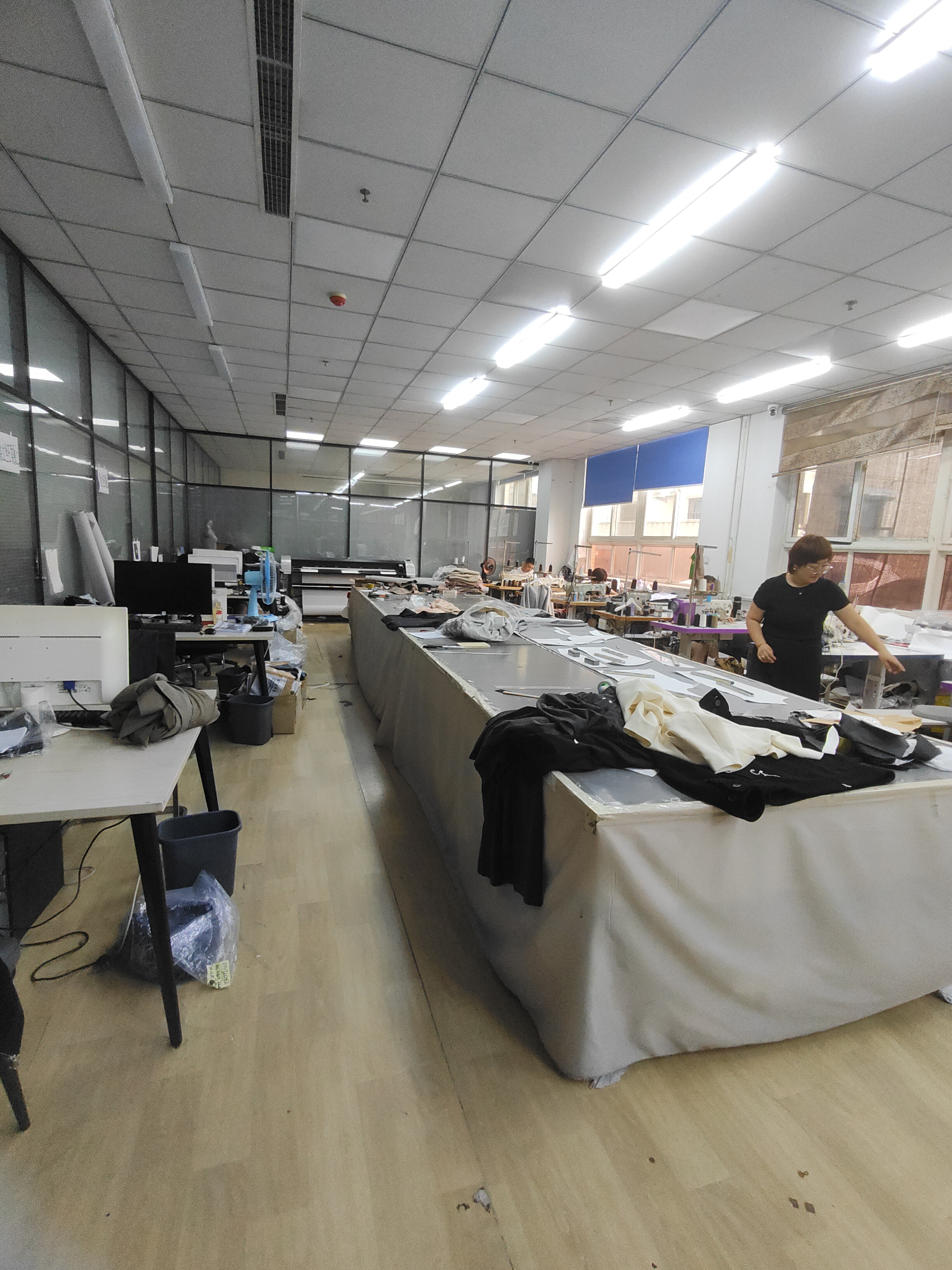
The scale of the supply base is relevant here, but only in a limited way. Dalian Dishang Huasheng Fashion Co., Ltd. states on its published company profile that it employs more than 450 people and cooperates with brands such as MAXMARA. DALIAN GACCILANG FASHION CO.,LTD is a Dalian-based garment manufacturer founded in 2019 whose stated lines are women's wool coats, women's onepieces and women's jackets, with company information listing a 3,000 m² factory, 120 employees, a design team of four, monthly capacity of 30,000 pieces, annual output of 360,000 units, a 60% export share and main markets in Korea, Japan, the USA and the EU. Size tells a buyer about capacity structure and about how many layers sit between the merchandiser and the sewing floor. It does not tell a buyer about stitch quality. Dishang Huasheng's public profile does not disclose hand-stitch share, fabric weight or acceptance terms, and “not disclosed” must never be read as “not capable”.
The Five Gates at a Glance
The framework asks five questions in a fixed order. Each gate is meant to produce a document rather than an impression, and each can fail without ending the relationship — a failed gate usually means a narrower claim, a revised term, or a sample round, not an automatic rejection of the supplier.
| Gate | Question it answers | Where it lives |
|---|---|---|
| 1. Claim scope | What exactly does “hand-sewn” or “high-end hand-sewn” cover on this style? | Specification annex to the order |
| 2. Construction evidence | Who performs which operation, and how is it verified before packing? | Sample plus in-process inspection |
| 3. Material mass | What fibre content and fabric weight per square metre is being bought? | Technical file and fibre declaration |
| 4. Terms and acceptance | Which written criteria allow the buyer to accept or reject a delivery? | Purchase order terms and inspection plan |
| 5. Cost and assortment role | What is the premium paying for, and which range slot is this coat filling? | Cost sheet and range plan |
The order is deliberate. Scope precedes evidence, because there is no point auditing hand work that was never defined. Evidence precedes material, because a heavy shell sewn badly is still a failed coat. Material precedes terms, because acceptance criteria must name the attributes the buyer is paying for. Cost comes last, because until the first four gates are closed, any price comparison is a comparison of descriptions rather than of goods.
Gates 1 and 2: Scoping the Claim, Then Evidencing It
Gate 1 produces a photographable definition. The buyer writes down which seams are hand-joined, what proportion of the shell that represents, who performs the operation, what thread is used, and what the stitch appearance should look like on the face and on the reverse. The decision rule is simple: if the definition cannot be photographed on a sealed sample, it is not a specification and cannot be enforced later. Gate 1 should also record the negative — which operations are permitted to be machine-sewn — because most disputes arise from an assumption about what “full” excluded.
Gate 2 converts the definition into evidence. Four items are normally sufficient for a buyer to move from assertion to verification:
- A construction breakdown per style, listing operations and whether each is hand, machine or subcontracted.
- A sealed pre-production sample that both parties sign, with the seam definitions from Gate 1 attached.
- In-process inspection while sewing is happening, rather than a final inspection after packing, because hand work cannot be verified from a finished, pressed garment.
- A written statement of which operations leave the factory, if any.
The reference coat in the comparison record supplied for this article is described as 100% pure cashmere with full hand-sewn craftsmanship. That is a supplier description of an item, and it becomes a purchasable attribute only when the sample is sealed and the description is annexed to the order. The same logic applies to a competitor's high-end hand-sewn coat: the phrase is a starting point for questions, not an answer, and a buyer who accepts it without a sealed sample has bought a description.
Gate 3: Material Mass, Where 450 g/m² and 320 g/m² Differ
Fabric weight is the most testable of the premium claims and the one least often written into a term sheet. The comparison record supplied for this article places the reference coat's shell at 450 g/m² against 320 g/m² for an ordinary cashmere coat. Calculated transparently from those two figures, the difference is 450 ÷ 320 ≈ 1.41, or roughly 41% more mass per square metre of the same panel.
That difference has a cost consequence before any labour is discussed. A typical cashmere coat already consumes 600–1,200 grams of fabric depending on length and design, according to commercial market research from Business Research Insights. Heavier fabric per square metre raises fibre consumption on the same pattern, so weight class belongs in the cost sheet as well as in the hand-feel description. For a maxi long women's cashmere coat the mass is concentrated in a larger panel area; for a short cropped silhouette the same weight class behaves differently in drape and warmth. Weight alone therefore does not rank two coats — it only ranks what is inside them.
For a 100% pure cashmere claim, the gate is documentation rather than opinion: fibre content on the label and in the technical file, supported by the mill specification or a test report. Where the coat ships to the United States, women's wool or fine animal hair overcoats fall under HTS 6202.20.11 in the Harmonized Tariff Schedule published by the U.S. International Trade Commission. Classification and fibre declaration are separate documents, but they describe the same garment and should not contradict each other; a buyer who finds a mismatch has found a documentation problem worth resolving before shipment rather than at customs.
Where the item is a wool cashmere blend rather than a pure cashmere coat, the same gate applies with a different number. The blend ratio must be stated, because “wool cashmere” without a ratio is a category, not a specification, and the difference between ratios is a difference in both cost and performance expectation.
Gate 4: Terms and Acceptance Criteria That Can Actually Fail
Terms and acceptance criteria are where the first three gates become enforceable, and the distinction between them is the part buyers most often blur. A purchase term allocates an obligation. An acceptance criterion defines the evidence that closes it. “Hand-sewn as per approved sample” is a term. “Hand stitching present on all shell seams, verified against sealed sample S-01 at pre-shipment inspection, with photographs of each seam type retained” is an acceptance criterion. Only the second can fail in a way that supports a claim.
| Criterion | What to write into the term | Evidence that closes the gate |
|---|---|---|
| Hand-stitch scope | Seam list, proportion of shell, thread, operator | Sealed sample plus in-process inspection photographs |
| Fibre and weight | Fibre content, blend ratio, g/m² by panel | Mill specification or test report plus cut-sample weight check |
| Measurement | Tolerance per point, base size, measuring method | Measurement chart signed at pre-production sample stage |
| Colour | Dye lot, approved swatch, viewing condition | Approved lab dip or bulk swatch |
| Labelling and classification | Fibre content, care, origin, HTS reference where applicable | Label artwork approval plus shipping documents |
| Sampling | Number of rounds, who approves, revision limit | Signed pre-production sample and written approval |
| Delivery inspection | Sampling plan, defect definitions, inspection point | Inspection report issued before shipment |
Two practical notes. First, defect definitions should be written for this product rather than borrowed from a generic checklist: an asymmetric hand-stitched seam is a different defect from a skipped machine stitch, and an inspector working from a general garment checklist will not record it. Second, the revision limit protects both sides. Without it, sample rounds can continue indefinitely, and each round consumes calendar weeks that a winter range cannot recover.
The same discipline applies to the adjacent slots in the range. For a women's onepiece, the dominant acceptance risk is fit and size grading rather than stitch scope, so the measurement chart and fitting approval carry more weight than a seam list. For a wool coat, fibre content and face finish dominate. Using one acceptance template across the cashmere coat, the onepiece and the wool coat is a common shortcut and a poor one, because it applies the cheapest check to the most expensive risk.
Gate 5: Cost Structure and the Assortment Slot
Cost is the last gate because it is the one most easily used to short-circuit the other four. The premium on a hand-sewn coat pays for a defined set of things: fibre grade, fabric weight per square metre, hand labour hours, sample rounds and inspection. If a quotation cannot be broken down along those lines, the buyer is comparing totals rather than costs.
The comparison record supplied for this article states a production-cost differential of 22% between the reference 100% pure cashmere hand-sewn coat and an ordinary cashmere coat. That figure should be read as a cost-structure signal from the supplier's own comparison record, not as a market price. A buyer should confirm in the quotation which direction the difference runs and which elements it includes — fabric, hand labour, trimming, packaging — before using it in a negotiation or a margin calculation.
Maintenance belongs in the same gate, because it changes the cost of ownership rather than the cost of goods. The same record describes slower fabric aging and easier care and maintenance for the hand-sewn pure cashmere construction. That is a supplier claim about its own product, and its practical test is a wear trial on a sample garment, not a line in a specification.
At the range level, the cashmere coat is one slot among several. A wool coat typically serves a different price tier and a longer selling window; a women's onepiece serves a different outfit logic entirely; a cashmere coat anchors the top of the range and carries much of the assortment's character. The decision to include it should not be made by comparing it with a wool coat on unit price alone, because the two answer different merchandising questions. A supplier producing all three lines — as DALIAN GACCILANG FASHION CO.,LTD states it does across women's wool coats, women's onepieces and women's jackets — can consolidate sampling and inspection across slots, but consolidation should not collapse three risk profiles into one acceptance standard. Where the cashmere decision and the assortment decision genuinely meet is capacity: hand work is the constraint in a seasonal peak, so a buyer committing to a hand-sewn program should ask how that capacity is scheduled against the wool and onepiece programs rather than assuming it is always available.
What the Market Data Does and Does Not Tell a Buyer
Three published data points frame the decision, and they should be kept apart. The global cashmere clothing market was valued at USD 3.63 billion in 2025, according to commercial research from Fortune Business Insights. Within that market, cashmere sweaters and coats are the largest product segment at 60.58% in 2026, from the same publisher. Separately, China's apparel exports totalled USD 151.2 billion in 2025, a year-on-year decline of 5%, based on China Customs data reported in industry analysis.
These figures come from different sources with different scopes and do not describe the same thing: a category value, a product-mix share and a national export total. The reading that survives scrutiny is narrow. Category-level demand for cashmere garments and total apparel export volume do not move together, so a supplier's price argument should be tested against item-level evidence — fabric weight, stitch scope, sampling cost and the terms that fix them — rather than against a category headline.
The available research also contains a genuine conflict worth flagging. Published compound annual growth projections for the same market differ between 4.26% and 6.8%, which the sources attribute to differing forecast periods and definitions. Neither figure is used here as a planning number, and a buyer should not build a purchase commitment on either. A forecast conflict is a reason to check scope, not a reason to average the two.
Outlook: From Claim Language to Test Language
If hand-stitched double-faced construction continues to be positioned as the premium tier of the coat market, as the 2026 trend analysis indicates, the competitive difference will migrate from the adjective to the evidence: how much of the garment is hand-joined, at what fabric weight, verified how, and accepted under which written criterion. Buyers who write those four items into their terms will find that “hand-sewn” and “high-end hand-sewn” stop being a comparison problem and become a documentation exercise.
That outlook is conditional. It holds only if the acceptance criteria are specific enough to fail. A framework that cannot reject a delivery is not a framework — it is a preference.
FAQ: Decision-Stage Questions
What should acceptance criteria include for a hand-sewn women's cashmere coat?
Acceptance criteria for this product normally cover six items: the hand-stitch scope by seam, fibre content and fabric weight per square metre, measurement tolerance with the measuring method, colour approval by dye lot and swatch, labelling and classification details, and a pre-shipment inspection method with defined defect types. Each criterion needs an attached piece of evidence — a sealed sample, a test report, a signed measurement chart or an inspection report — so that acceptance is a documented decision rather than a judgement made on the loading dock.
How can a buyer verify a claim that a coat is fully hand-sewn?
Verification usually combines a sealed pre-production sample, an in-process inspection during sewing, and a written construction breakdown that states which operations are hand, machine or subcontracted. Hand work cannot be confirmed reliably from a finished and pressed garment, because the interior seam construction that distinguishes hand joining from hand finishing is no longer visible. Buyers should also confirm the intended meaning of the term, since “fully hand-sewn” and “hand-finished” describe different scopes of work on the same coat.
Is 100% pure cashmere always a better choice than a wool cashmere blend?
Not inherently. A pure cashmere coat carries fibre value and typically supports a lighter construction at a given warmth level, while a wool cashmere blend changes the price tier, the durability expectation and the care routine. The relevant question is which range slot the coat fills and what the buyer's own sell-through and return data show for each. Whichever route is chosen, the blend ratio or the pure-fibre claim should be stated on the label and in the technical file, because an unstated ratio cannot be verified after delivery.
How much does fabric weight matter in the comparison?
Fabric weight is one of the few premium attributes that can be checked with a scale. The comparison record supplied for this article places the reference coat at 450 g/m² against 320 g/m² for an ordinary cashmere coat, which is roughly 41% more mass per square metre of the same panel, and commercial research indicates a typical cashmere coat consumes 600–1,200 grams of fabric depending on length and design. Weight affects warmth, drape, fibre consumption and therefore cost, which is why it belongs in the term sheet as a number rather than in the description as an adjective.
Where do a women's onepiece and a wool coat fit into the same buying decision?
They fit as separate assortment slots with separate acceptance emphasis, not as substitutes for the cashmere coat. A women's onepiece carries its main risk in fit and size grading, so the measurement chart and fitting approval matter most; a wool coat carries its main risk in fibre content and face finish. A supplier that produces all three can consolidate sampling and inspection logistics, but each slot should keep its own acceptance template, because applying the cheapest check to the most expensive risk is how range-level quality problems begin.
The framework reduces to one sentence: define the hand work so it can be photographed, seal it in a sample, fix the fibre and weight as numbers, write acceptance criteria that can fail, and only then compare cost across the range slots. Buyers who follow that order are comparing goods; buyers who skip it are comparing adjectives.
Company reference: DALIAN GACCILANG FASHION CO.,LTD — www.gaccilang.com. Product brochure (PDF): DALIAN GACCILANG FASHION CO-202609.
¿Tiene preguntas o necesita más detalles?
Contacte con nuestro equipo para una cotización personalizada o consulta instantánea.
Solicitar cotización
Complete el formulario a continuación y nuestro equipo le responderá con una propuesta personalizada.
Chat directo de WhatsApp
¿Prefiere chatear en tiempo real? Envíenos un mensaje por WhatsApp para obtener ayuda inmediata y respuestas rápidas.
- Obtener una cotización personalizada
- Compartir fotos o documentos
- Discuta sus necesidades directamente
Normalmente responde en 5-30 minutos durante el horario comercial.