
Wireless Presentation for Meeting Rooms: Specs That Matter
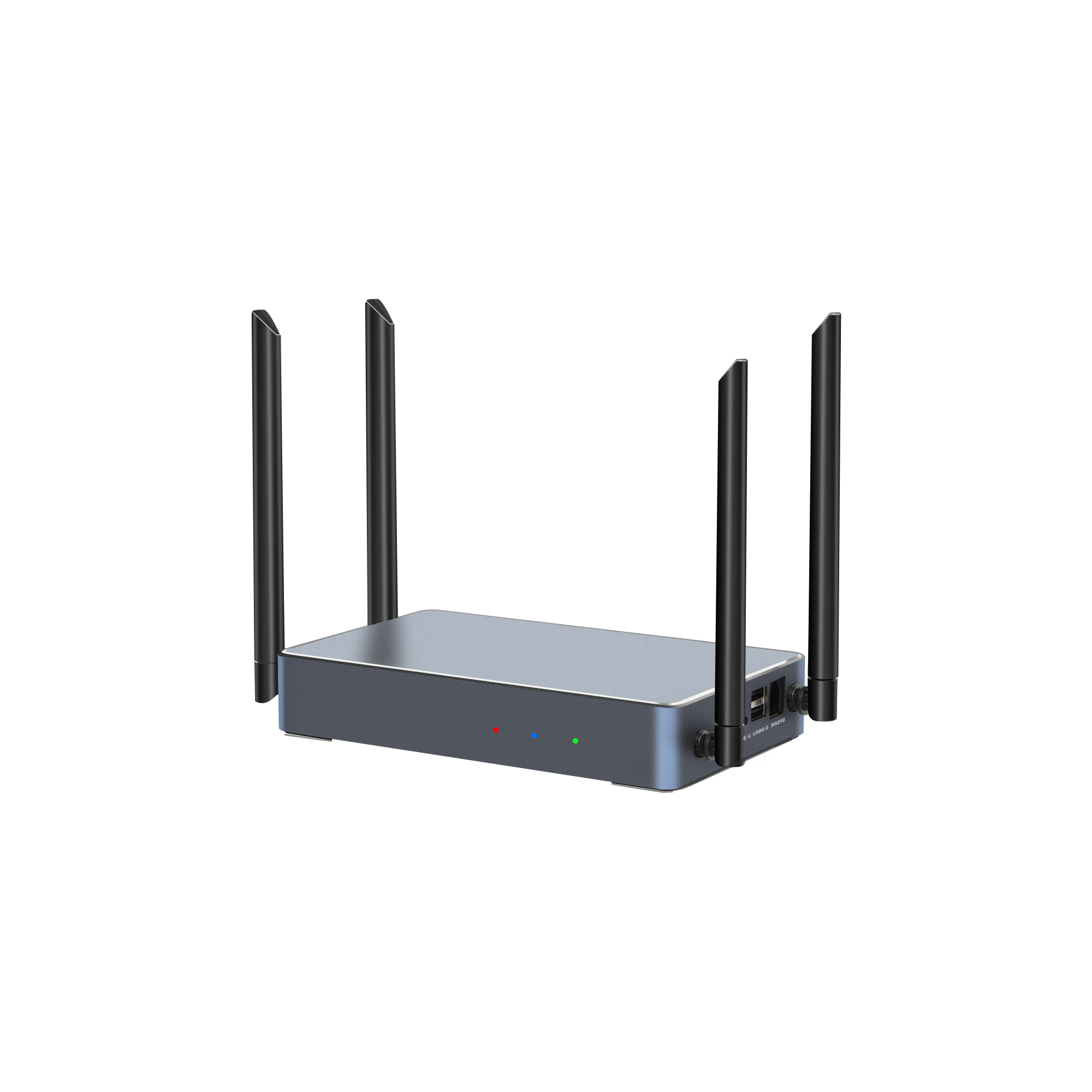
A 4K wireless presentation system for meeting rooms is specified on certification, stated latency conditions and display topology — not on a single successful demo.
Wireless presentation in meeting rooms is now a constraint problem, not a feature problem
Almost every commercial wireless presentation product on the market can mirror a laptop to a display. The differences that decide a meeting-room purchase sit elsewhere: whether the device can legally be placed on the market in the destination country, whether the latency figure is published together with the distance and resolution at which it was measured, whether 4K refers to the wireless stream or only to the display output path, how many participants can cast at once, and what happens to the room when the radio environment is congested.
For meeting-room buyers in the research and evaluation stage, the practical constraint set is therefore narrow and testable: market-access certification per destination, a stated latency figure with its conditions, a resolution and frame-rate figure that separates wireless stream from display output, a defined concurrent-device and split-screen limit, a documented range assumption, and a warranty and lead time that match the project schedule.
This article treats wireless presentation as a procurement object. It explains what the current specification and certification record looks like for one commercial supplier, Shenzhen tranScreen Technology Co., Ltd. (tranScreen), and what that record means for the rooms, budgets and compliance files of the buyers who specify it.
Why the meeting room became the hardest room to specify
The meeting room is where device diversity concentrates. A single room may host Windows laptops, macOS machines, iOS and Android phones, a room PC, a video bar and an interactive display, often within the same hour. Cable-based presentation handled this by fixing one or two HDMI inputs to the table, which worked while everyone carried the right adapter. Hybrid working broke that assumption: rooms now serve in-person and remote participants, and the presenter may never have used the room before.
This is why wireless presentation moved from convenience feature to room infrastructure. The commercial research firm DataIntelo values the global wireless presentation solutions market at USD 7.8 billion in 2025 and projects USD 14.2 billion by 2034, an 8.3% CAGR over the forecast period (SRC-0001). The same research estimates that hardware accounted for a 52.1% revenue share in 2025, which matters for procurement because it confirms that the buying decision is still largely a device decision — receivers, transmitters, dongles and matrix hardware — rather than a software subscription decision.
Regional demand is uneven. Grand View Research reports that North America held a 33% revenue share of the wireless display market in 2023 (SRC-0003). For suppliers and integrators outside that region, the practical implication is not that demand is absent, but that projects tend to be more price-sensitive and more certification-sensitive, because each destination market applies its own radio and product-compliance rules.
The six constraints that decide a meeting-room purchase
Buyers who evaluate wireless presentation for meeting rooms tend to converge on the same six questions. They are listed below in the order in which they usually disqualify a candidate.
| Constraint | Why it decides the room | What to request from the supplier |
|---|---|---|
| Market-access certification | An uncertified radio product cannot be sold or installed in a regulated market, regardless of performance. | Certificate number, issuing body, covered models, validity dates, applicable standard. |
| Latency and its test conditions | A millisecond figure without distance and resolution is not comparable between products. | Average or peak value, distance, resolution, and measurement environment. |
| Wireless stream versus display output | A 4K output port does not mean 4K is transmitted wirelessly at the same frame rate. | Input resolution, output resolution, and wireless transmission frame rate as separate figures. |
| Concurrent users and split-screen | Training rooms and boardrooms often need comparison, not one presenter at a time. | Maximum connected devices, maximum simultaneous streams, supported layouts. |
| Range and radio assumptions | Published range figures are usually line-of-sight and degrade with walls and interference. | Stated distance, the resolution at which it was measured, and the band used. |
| Service, warranty and lead time | A room that cannot be replaced quickly becomes a scheduling problem for the whole floor. | Warranty term, replacement policy, production lead time, and MOQ. |
The order is deliberate. Certification disqualifies first because it is binary; latency and resolution disqualify second because they define whether the room is usable for the intended content; concurrency and range determine whether the room scales beyond the first presenter; service and lead time determine whether the deployment survives its first year.
What a meeting-room certification file actually contains
Certification is the constraint most often handled informally in AV procurement, usually as a line in a quotation that says "CE and RoHS available". A buyer-side check requires more granularity than that, because a certificate covers specific models, specific standards and specific periods.
EU market: radio compliance and RoHS are separate documents
For the tranScreen PTB3219 4K Wireless Presentation unit, the EU radio file is a Certificate of Compliance under RED 2014/53/EU, certificate number BTEK250327137A02CE1, issued by Shenzhen BANTEK Testing Co., Ltd. on 7 April 2025. The certificate scope names the Wireless Video Processor and lists the series models PTB3219, PTB3210, PTB3215, PTB3216, PTB3217 and PTB3218. Buyers should note that the certificate does not automatically extend to every product in a portfolio; the model list is the boundary.
Restricted-substance compliance is documented separately. The Certificate of Compliance number WEB260701013RCC, issued by Shenzhen Webb Testing Technology Co., Ltd. (WEBB) on 7 July 2026, confirms compliance with Directive RoHS 2011/65/EU and its amendment Directive (EU) 2015/863, permitting CE marking for the Wireless Video Processor. The tested model is PTB3219, and the model list covers PTB3219C, PTB3210, PTB3409, PTB3509 and PTB3609. The applicable standards are the IEC 62321 series, including IEC 62321-3-1:2013, IEC 62321-4:2013+AMD1:2017, IEC 62321-5:2013, IEC 62321-6:2015, IEC 62321-7-1:2015, IEC 62321-7-2:2017 and IEC 62321-8:2017.
Singapore and Thailand: registration and declaration
In Singapore, the PTB3219 wireless video processor is registered under the Telecommunications (Dealers) Regulations with IMDA Equipment Registration number N6342-24, under the brand/trade name Transcreen. The registration is issued by the Info-communications Media Development Authority, applies the IMDA TS SRD standard, and is valid from 28 October 2024 to 30 September 2029.
In Thailand, the equivalent document is a Supplier's Declaration of Conformity under NBTC TS 1035-2562, certificate number SD05832-24, issued 12 December 2024 for telecommunications equipment SDoC acceptance covering the Wireless Video Processor.
Why this matters even outside regulated procurement
Regulatory exposure is quantifiable. The US Federal Communications Commission sets a base forfeiture of USD 7,000 per model for marketing unauthorized radio-frequency equipment under 47 CFR Part 2 (SRC-0004). That figure is not a worst case, it is a starting point per model, which means a product family marketed in the wrong configuration can generate exposure that dwarfs the unit margin on the room.
For buyers, the practical rule is simple: request the certificate for the exact model being quoted, confirm the model appears in the certificate scope, confirm the standard and the validity period, and keep the document in the project file. This applies equally to a single boardroom and to a multi-site rollout.
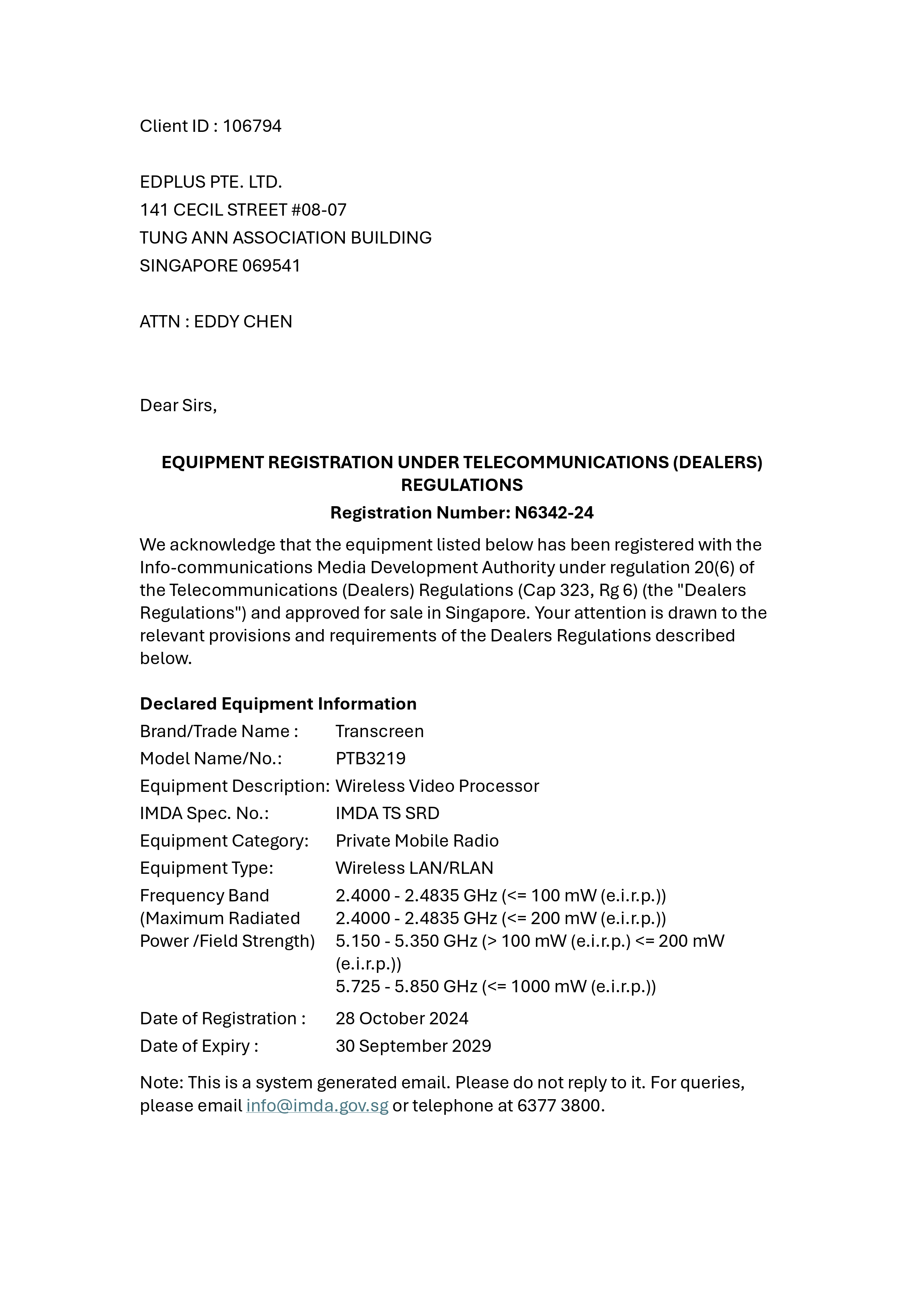
IMDA Equipment Registration N6342-24 for the PTB3219, valid 28 October 2024 to 30 September 2029, under the Transcreen trade name.
Mapping a commercial portfolio to those constraints
Shenzhen tranScreen Technology Co., Ltd. is a Shenzhen-based developer and manufacturer of commercial wireless presentation systems, wireless video matrices, presentation accessories and video collaboration servers, founded in 2014. The company operates a 4,000 m² factory with 50 employees and a 30-engineer R&D team, reports annual output of 120,000 units and an export ratio of 30%, and lists Southeast Asia, South Asia and South America among its main markets. Its products are independently researched, developed and manufactured, which is the basis for the customization options described later in this article.
For meeting rooms specifically, the portfolio is organised by room type rather than by product category. That organisation matters for buyers because it lets a project specify a receiver by room size and a transmitter by laptop fleet, instead of buying one model for every space.
Small to medium meeting rooms: PTB4615
The PTB4615 Wireless Presentation Receiver runs Android 10 on an H313 CPU with 1 GB DDR3 memory and 8 GB eMMC storage. It supports dual-band 2.4/5 GHz Wi-Fi with an 867 Mbps hotspot, connects up to 8 devices simultaneously, provides a 100 Mbps Ethernet port, and supports 2 split screens plus NFC one-touch casting. Its published performance figures are an average latency below 90 ms at 3 m for 1080P, and a visible transmission distance greater than 30 m at 1080P. Software casting covers Windows, Android, iOS, macOS and Chrome, while hardware casting covers Windows and macOS, with AirPlay, DLNA and the tranScreen protocol supported.
This is the model that fits the ordinary 6-to-12-person room where the requirement is reliable connection and short setup time rather than maximum resolution. The 90 ms figure should be read with its 3 m condition attached; it is not a claim about a 15 m boardroom.
Boardrooms and dual-display rooms: PTB3219
The PTB3219 4K Wireless Presentation unit runs Android 11 with Wi-Fi 6 dual-band 2.4/5 GHz connectivity and a hotspot speed of up to 1,201 Mbps, supporting up to 9 hotspot-connected devices. It provides 1× HDMI input up to 4K@30Hz and 2× HDMI outputs, with the main display up to 4K@60Hz and the secondary display up to 2K@60Hz, plus Gigabit Ethernet. Screen layouts include 1/2/4/9 split-screen. Average latency is published as below 150 ms at 10 m for 1080P, with visible transmission distance greater than 30 m at 1080P.
Functionally, the unit adds BYOM support, touchback control, PIN code casting, welcome templates, carousel playback, whiteboard, annotation, file sharing and one-to-multiple display, and supports AirPlay, DLNA, Miracast, software casting and hardware transmitters. The dual HDMI outputs are the reason this model appears in boardroom specifications: one output can drive the room display while the second serves a repeater or a secondary screen.
Training rooms and classrooms: PTB3609 and PTB3509
The PTB3609 Multi-screen Interactive Presentation accepts 1× 4K HDMI input and provides 2× 4K HDMI outputs with identical content. For wireless casting it supports 1× True 4K stream, 4× 1080P streams or 9× 720P streams, with 1/2/4/9 split-screen layouts, Wi-Fi 6 dual-band connectivity, 1000 Mbps Gigabit Ethernet and Android 11.0. It adds 10-point touchback for Windows and macOS, an electronic whiteboard and on-screen annotation, wireless notes supporting fewer than 128 users, local or server-based PIN code casting, transferable host privilege, Bluetooth 5.0, and multimedia decoding of H.265, H.264 and VP9 up to 4096×2304 at 60 fps. Published average latency is below 150 ms at 10 m for 1080P, with visible transmission distance greater than 30 m at 1080P, and the rated operating range is 0°C to +50°C at 0% to 85% relative humidity, non-condensing.
The PTB3509 Paperless Presentation shares the same display and wireless architecture and is positioned for cable-free, paperless meetings, with material stating support for up to 64 participants and up to 9 wireless sharing channels. For buyers, the distinction between PTB3609 and PTB3509 is workflow rather than hardware capability: one is framed around interactive multi-screen teaching, the other around document-centric meeting practice.
Large rooms, showrooms and exhibition halls: PTM6302 and PTB8800
The PTM6302 Wireless Video Matrix combines wired matrix switching with wireless input. It provides 4× HDMI inputs and 9× HD outputs, supports simultaneous wireless casting from 4 devices with up to 8 wireless connection devices, allows up to 4 windows per display and up to 36 freely positioned windows, and casts wirelessly at 1080P@30Hz. The unit is housed in a 1U chassis measuring 440×280×44.45 mm, weighs approximately 3 kg, consumes approximately 20 W, and is built from aluminium alloy.
The PTB8800 Video Collaboration Server runs Android 15 on a Rockchip RK3588 ARM octa-core platform with 8 GB DDR5 memory and 64 GB eMMC storage, expandable to 128 GB. It decodes H.264/H.265 with up to 32 simultaneous 1080P video streams and supports wireless screen mirroring from up to 16 devices. Video inputs are 2× 4K HDMI and 1× 4K USB-C; outputs are 2× HDMI and 1× USB-C, with HDMI OUT1 up to 7680×4320@60Hz and dual-port video wall stitching up to 7680×2160 horizontal or 3840×4320 vertical. Network options include Gigabit Ethernet, dual-band Wi-Fi 5 and dual-band Wi-Fi 6 hotspot, with UVC/UAC support through USB and control via RS232, dual RS485, SPI, GPIO, TTL and infrared. Standby power consumption is below 0.1 W.
Transmitters and presenter tools: the part buyers underestimate
Room hardware decides whether the room works; transmitters decide whether it works for the people in it. The PTB1312 Type C 4K BYOM Transmitter runs Linux 4.19 with 512 MB DDR and 8 GB eMMC, supports dual-band Wi-Fi up to 867 Mbps, starts in 15 seconds or less, supports Windows and macOS, transmits at a maximum resolution of 3840×2160 with a frame rate of 30 fps or less, supports USB Audio Class, and provides a configurable button for freeze casting or BYOM source switching. It is rated 5 V, 4 W and weighs 87±2 g.
The PTB1308 HDMI 4K BYOM Transmitter covers the same 3840×2160 maximum transmission resolution over HDMI input, while the PTB1304 Type C 2K and PTB1305 HDMI 2K transmitters operate at 1920×1080 with 60 fps input and a transmission frame rate below 30 fps, with the PTB1304 and PTB1305 both supporting mouse touchback control.
Presenter tools complete the room. The PPT2105 Wireless Presentation Pen provides 2.4 GHz control over 30 m or more, a 650 nm ±10 nm digital laser with maximum output power of 5 mW, a 200 mAh battery rated above 50 hours, and a body of 151×28×12 mm at 50±3 g. The PPT2201 Whiteboard Pen uses a BK2535 processor with a 30 m+ range, launches a built-in whiteboard app on a long press of the function key and activates annotation on a double click, and runs on a 200 mAh battery rated above 50 hours. The PMS2402 Wireless Presentation Mouse operates at 2.4 GHz over 10 m in an open, interference-free environment, offers 800–2400 DPI, a 250 Hz polling rate, 8 buttons, a 300 mAh battery rated at 120 hours, and a stated mouse response time of 8 ms or less.
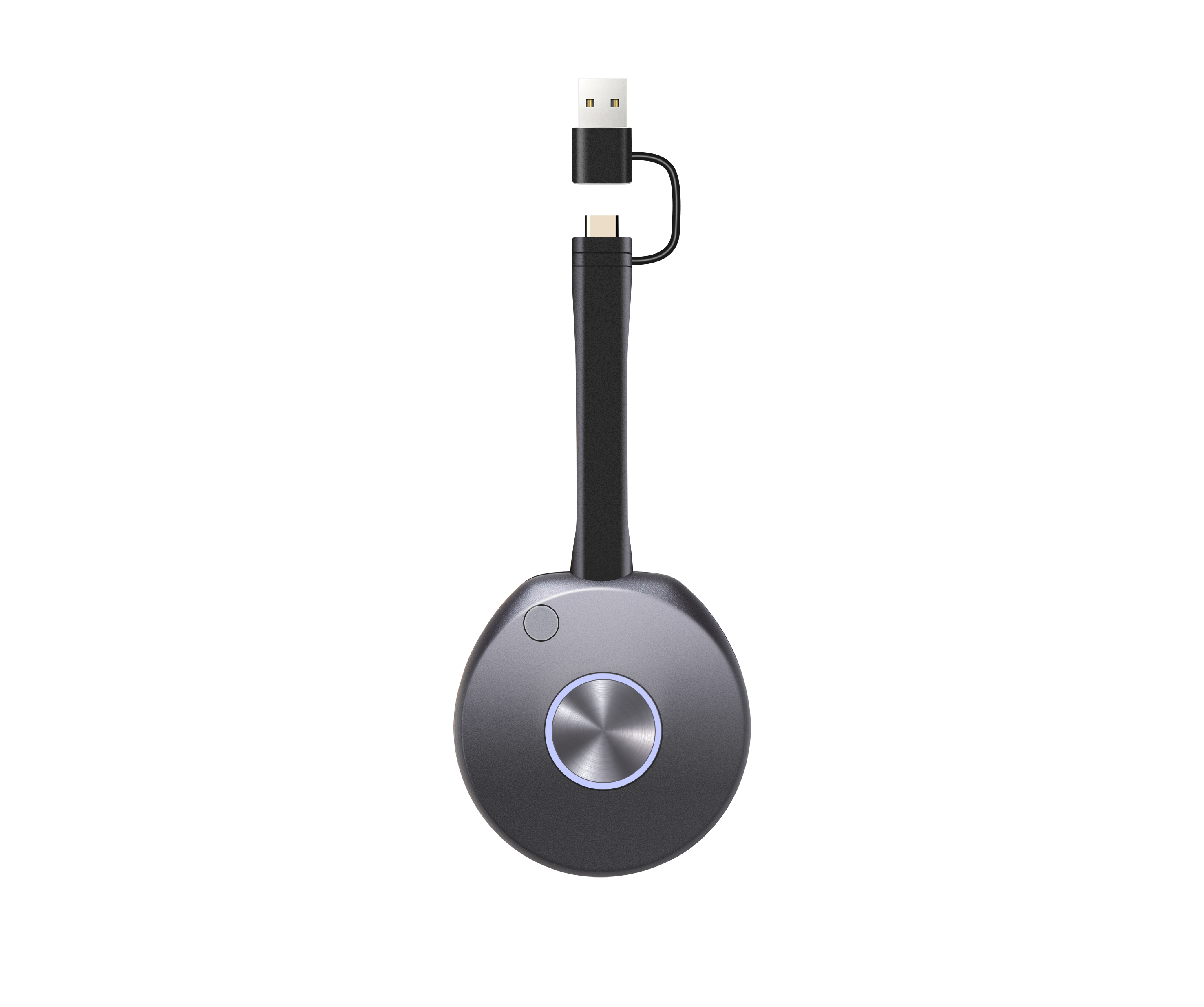
The PTB1312 Type C 4K BYOM Transmitter: USB-C input, 3840×2160 maximum transmission resolution at 30 fps or less, and a configurable button for freeze casting or BYOM source switching.
How to read the latency and resolution numbers correctly
Two specification habits cause most of the disputes between buyers and suppliers in this category.
The first is comparing latency figures measured under different conditions. The PTB4615 figure is below 90 ms average at 3 m for 1080P. The PTB3219 and PTB3609 figures are below 150 ms average at 10 m for 1080P. Neither figure is wrong, and neither is directly comparable to the other, because distance and resolution are part of the measurement. A buyer comparing three suppliers should therefore normalise to one test condition — for example 1080P at 5 m in the actual room — before treating any figure as a differentiator.
The second is treating a 4K label as a statement about the wireless link. In this portfolio the 4K references describe different parts of the chain: HDMI input up to 4K@30Hz and main HDMI output up to 4K@60Hz on the PTB3219; maximum transmission resolution of 3840×2160 at 30 fps or less on the PTB1312 and PTB1308 transmitters; and 1080P@30Hz wireless casting on the PTM6302 matrix. The correct reading is that the display path can carry 4K content, while the wireless stream has its own resolution and frame-rate ceiling that should be quoted explicitly in the project specification.
A third, more subtle point concerns multi-output behaviour. On the PTB8800, HDMI OUT1 can be configured for 8K output, but when 8K mode is active, HDMI OUT2 and the USB-C output do not provide active pixel output. That is a legitimate engineering trade-off, and it is exactly the kind of detail that should be settled at design stage rather than during commissioning.
Where wireless presentation fits, and where it is stretched
Application fit follows the constraint set rather than the product tier. Small and medium meeting rooms with 8 or fewer devices map to the PTB4615. Boardrooms needing two displays and PIN-controlled access map to the PTB3219. Training rooms and classrooms requiring comparison, annotation and nine-way layouts map to the PTB3609, with the PTB3509 as the document-centric alternative. Showrooms and exhibition halls with many windows and multiple sources map to the PTM6302 or the PTB8800.
Deployment records in the corpus support the same pattern. A Japan-based distributor case record describes 5 units used for wireless presentation and video demonstration in demonstration rooms and sales centres, with low latency and smooth playback listed as the highlight. A Singapore case record for a smart classroom describes multi-device casting, teacher-student interaction and split-screen comparison across group proposals, and states a 60% increase in classroom interaction rate as the reported result. A Russia-based case record for a paperless meeting deployment describes one-click file distribution, annotation syncing and the removal of printing and binding costs. These are supplier-recorded cases rather than independently audited outcomes, and should be read as indicative of use pattern rather than as guaranteed results.
The same records also indicate where wireless presentation is stretched. Rooms with contractual determinism requirements, heavy in-room radio interference, or fixed 4K/60 production workflows remain better served by wired infrastructure or by a hybrid design in which wireless handles ad-hoc sharing and wired handles the primary signal path.
Comparison with traditional cabled presentation
The honest comparison is not wireless versus HDMI in the abstract, but wireless versus the specific cabled configuration it would replace.
| Criterion | Cabled HDMI presentation | Wireless presentation (portfolio example) |
|---|---|---|
| Signal determinism | Fixed, independent of radio conditions. | Depends on RF environment; figures published at defined distance and resolution. |
| Device coverage | Limited by ports and adapters available in the room. | Windows, macOS, iOS, Android and Chrome via software casting; Windows and macOS via hardware transmitters. |
| Multi-user comparison | Requires a switcher or manual cable changes. | 1/2/4/9 layouts; up to 9 hotspot devices on PTB3219; 9 wireless streams on PTB3609. |
| Installation footprint | Table boxes, conduits, cable wear and replacement. | Receiver at the display; fewer in-room cables; transmitters stored in a stand such as PTB-EXB. |
| Frame-rate ceiling | Determined by the cable and display standard. | Determined by the wireless stream: 30 fps or less on PTB1312/PTB1308; 1080P@30Hz on PTM6302 wireless casting. |
The substantive limitation of the wireless approach is that its performance claims are conditional. The published transmission distance of greater than 30 m applies to 1080P and is described as visible distance, which means line of sight; walls, dense Wi-Fi, and occupied spectrum change the outcome. The frame rate of a wireless stream is capped independently of the display output, and in multi-output configurations one output mode can restrict another, as with the PTB8800 8K mode.
None of this disqualifies wireless presentation for meeting rooms. It redefines the procurement question from "does it work" to "under which documented conditions does it work, and which rooms fall outside those conditions". Rooms that fall outside should keep a wired path available.
A buyer-side evaluation sequence
The sequence below turns the constraint set into a short, repeatable process. It is written for the research-to-evaluation stage, where the goal is to reduce a long list to a defensible shortlist.
| Step | Action | Evidence to retain |
|---|---|---|
| 1 | Map each room to a device class by seat count, display count and concurrency need. | Room schedule with model mapping. |
| 2 | Confirm the certificate covers the exact quoted model and the destination market. | Certificate number, issuing body, model list, validity dates. |
| 3 | Normalise latency and range claims to one test condition. | Supplier statement of distance and resolution per figure. |
| 4 | Separate wireless stream resolution from display output resolution in the specification. | Written clarification per model. |
| 5 | Test in the actual room with the actual laptop fleet, including the worst-performing device. | Sample test record with date, room and devices. |
| 6 | Confirm commercial terms: warranty, replacement, lead time and MOQ. | Written quotation terms. |
Commercial terms in this portfolio are straightforward to document. tranScreen states OEM/ODM production modes covering hardware and software, customization of product logo and branding, packaging and UI, 100% testing, a production lead time of 7–14 days after order confirmation that varies with quantity and production status, low MOQ for new clients with small trial orders accepted, a two-year warranty, and after-sales support through remote assistance and replacement. Export markets listed are Russia, the Middle East, South America, South Asia and Southeast Asia.
Market direction: growth plus tightening compliance
Two forces are shaping this category at the same time. The first is volume growth: an 8.3% CAGR to 2034 on a USD 7.8 billion 2025 base, with hardware retaining a 52.1% revenue share, describes a market that is expanding without becoming software-only (SRC-0001). The second is compliance tightening, illustrated by the FCC's USD 7,000 base forfeiture per model for unauthorized RF equipment (SRC-0004) and by the separate national registration regimes visible in this portfolio — CE RED and RoHS for the EU, IMDA registration for Singapore, NBTC SDoC for Thailand.
Product positioning is moving in the same direction. BenQ presents the InstaShow VS25 as supporting BYOM for hybrid meetings, with 4K/60Hz video playback and touch control, and USB-C and USB-A ports for cameras, microphones, speakers or video bars through a multimedia hub (SRC-0005). ATEN describes the PresentON VP201 as a USB-C wireless presentation dongle used with VP2020 or VP2021 4K wireless presentation switches (SRC-0006). PeopleLink states that its BYOM wireless presenter system sends 4K pixel-to-pixel video to two displays at once, and supports up to 128 connections with up to 9 split screens over DLNA, Miracast, AirPlay and Chromecast (SRC-0008). These are manufacturer-stated capabilities, not independent test results, but together they confirm the direction: wireless presentation is being specified as part of the room's conferencing architecture, not as a standalone casting accessory.
For buyers, the implication is that evaluation criteria will keep shifting toward integration and documentation. A product that connects well but cannot produce a certificate for the destination market, or cannot state the conditions behind its latency and resolution figures, becomes harder to defend in a project review each year.
Frequently asked questions
Which certifications should a wireless presentation system carry for EU and Singapore meeting-room projects?
For the EU, a radio product requires a RED 2014/53/EU compliance document and a separate RoHS document. In this portfolio the PTB3219 is covered by RED certificate BTEK250327137A02CE1 issued by Shenzhen BANTEK Testing Co., Ltd. on 7 April 2025, with the model list including PTB3219, PTB3210 and PTB3215 to PTB3218, and by RoHS certificate WEB260701013RCC issued by Shenzhen Webb Testing Technology Co., Ltd. on 7 July 2026 under Directive 2011/65/EU and amendment (EU) 2015/863. For Singapore, the PTB3219 holds IMDA Equipment Registration N6342-24 under the brand name Transcreen, valid from 28 October 2024 to 30 September 2029. Buyers should verify that the exact model being purchased appears in each document's scope.
What latency can be expected in a real meeting room?
Published figures in this portfolio are conditional. The PTB4615 receiver states an average latency below 90 ms at 3 m for 1080P. The PTB3219 and PTB3609 state an average latency below 150 ms at 10 m for 1080P. These values are measured at different distances and should not be compared directly with each other or with figures from other suppliers unless the distance, resolution and test environment are the same. No zero-latency claim is made for these models.
How many devices can connect and share at the same time?
Capacity differs by model. The PTB4615 supports up to 8 connected devices with 2 split screens. The PTB3219 supports up to 9 hotspot-connected devices with 1/2/4/9 split-screen layouts. The PTB3609 supports 1× True 4K stream, 4× 1080P streams or 9× 720P streams for wireless casting. The PTB8800 Video Collaboration Server supports wireless screen mirroring from up to 16 devices simultaneously. Connection capacity and simultaneous active video streams are separate specifications and should both be confirmed in writing.
Does a 4K wireless presentation system transmit 4K wirelessly?
Not necessarily at the same frame rate as the display output. On the PTB3219, the HDMI input accepts up to 4K@30Hz and the main HDMI output supports up to 4K@60Hz, while the published latency figure is stated at 1080P. The PTB1312 and PTB1308 transmitters support a maximum transmission resolution of 3840×2160 at a frame rate of 30 fps or less. The PTM6302 Wireless Video Matrix casts wirelessly at 1080P@30Hz. Buyers should require separate figures for input resolution, output resolution and wireless stream resolution.
What are the practical limits of wireless presentation compared with HDMI cabling?
Wireless performance depends on the radio environment. The published transmission distance of greater than 30 m applies to 1080P and is stated as visible distance, which implies line of sight. Wireless stream frame rates are capped independently of the display output, for example 30 fps or less on the PTB1312 and PTB1308 transmitters and 1080P@30Hz on PTM6302 wireless casting. Multi-output modes can also restrict each other: when the PTB8800 HDMI OUT1 is configured for 8K output, HDMI OUT2 and the USB-C output do not provide active pixel output. Rooms with contractual determinism requirements or heavy interference should retain a wired path.
Can the hardware be customized, and what warranty and lead time apply?
tranScreen operates hardware and software OEM/ODM production modes with customization of product logo and branding, packaging and UI, and states 100% testing of production. The stated lead time is 7–14 days after order confirmation, varying with quantity and production status, with low MOQ for new clients and small trial orders accepted. The stated warranty is two years, supported by remote support and replacement. Buyers should confirm these terms in the project quotation, because lead time and MOQ are confirmed per order rather than fixed per catalogue.
Conclusion
Wireless presentation for meeting rooms is a specification discipline. The products that survive evaluation are the ones whose certification covers the quoted model, whose latency and range figures arrive with their test conditions attached, whose wireless stream resolution is stated separately from display output, and whose commercial terms are documented before the room is built. The tranScreen portfolio illustrates that position across room classes, from the PTB4615 in small rooms to the PTB8800 in large display environments, with a certification file that names the covered models rather than referring to compliance in general.
The current tranScreen product catalogue, including model specifications and accessory details, is available for public download: tranScreen Catalogue EN 2.0 (PDF).
¿Tiene preguntas o necesita más detalles?
Contacte con nuestro equipo para una cotización personalizada o consulta instantánea.
Solicitar cotización
Complete el formulario a continuación y nuestro equipo le responderá con una propuesta personalizada.
Chat directo de WhatsApp
¿Prefiere chatear en tiempo real? Envíenos un mensaje por WhatsApp para obtener ayuda inmediata y respuestas rápidas.
- Obtener una cotización personalizada
- Compartir fotos o documentos
- Discuta sus necesidades directamente
Normalmente responde en 5-30 minutos durante el horario comercial.