
Wire Drawing Machine Suppliers: Factory Build Evidence
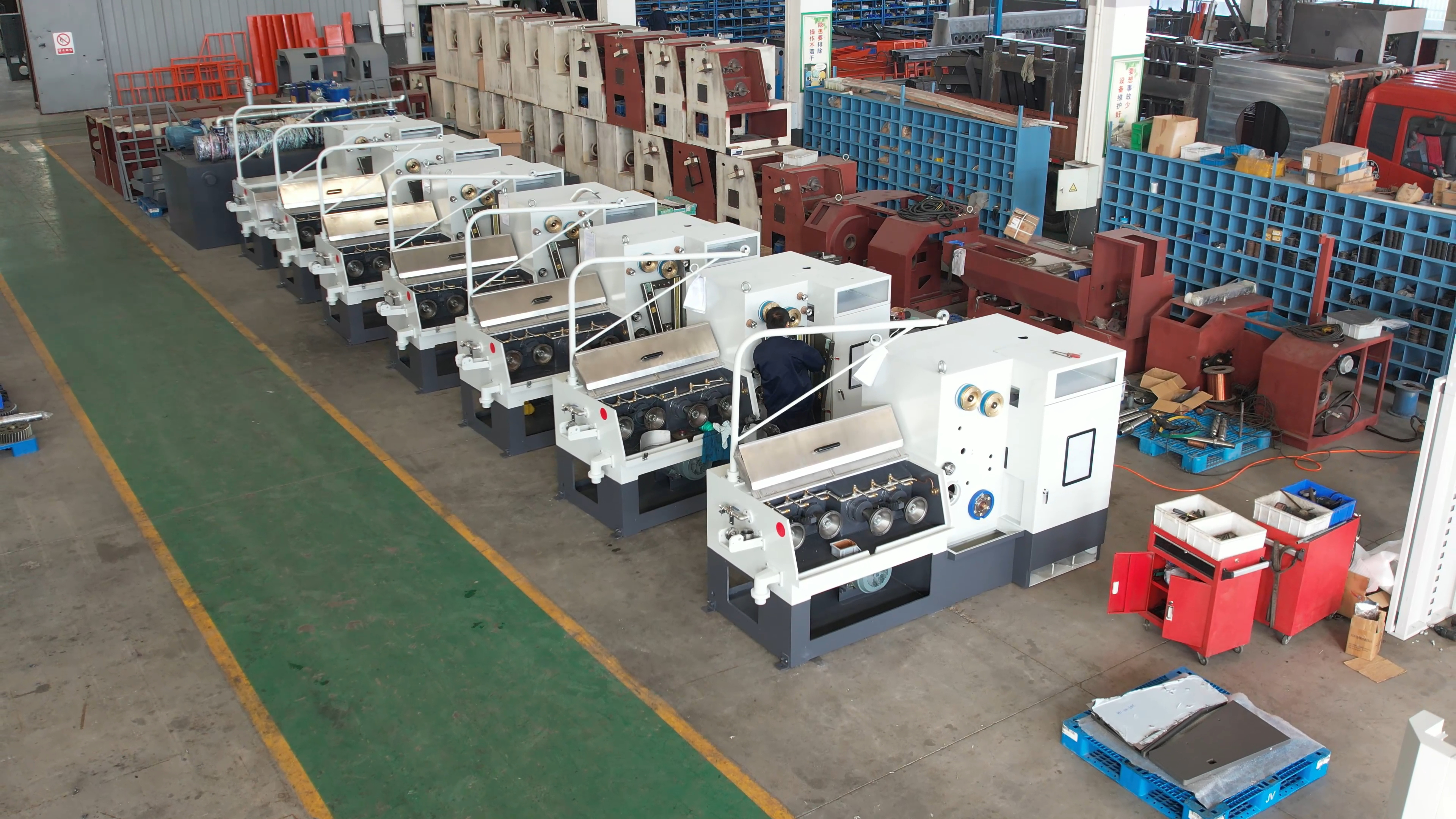
An intermediate wire drawing machine is a mechanical system in which the frame, capstans, lubrication circuit, sealing and electrical control cabinet determine how the machine behaves over years of shift work. For buyers in the evaluation stage, the practical question is therefore not whether a supplier can quote specifications, but whether the supplier's factory can show physical evidence behind those specifications.
Why Build Evidence Matters at the Evaluation Stage
Wire drawing machine procurement has a structural asymmetry. Suppliers can present PDF catalogues, generic warranty language and broad quality claims. Buyers rarely get a chance to see the steel plate, the ceramic capstan surface or the electrical cabinet that will sit on their factory floor. When production starts, those are the elements that decide uptime, wire surface quality and maintenance load.
Build evidence closes part of that gap. It lets a buyer cross-check a supplier's claimed capability against describable physical facts: how the frame is fabricated, how many drawing tiers the capstans carry, how the spool area is protected and how much wire a spool can hold. None of these facts alone proves a machine will perform, but together they create a verifiable baseline that separates a working factory from a trading intermediary.
What Intermediate Wire Drawing Machine Evidence Looks Like
Jiangsu Listrong Mechanical & Electrical Co., Ltd. is a wire and cable production equipment manufacturer based in Dongtai City, Jiangsu Province, China. Founded in 2009, the company operates a 15,000 m² factory with 70 employees, a 15-engineer R&D team and an annual output of 550 sets, exporting about 40% of production to the Middle East, India and South East Asia. Its product range covers wire drawing machines, annealing machines and wire bunching machines for bare copper, copper alloy and stainless steel wire.
For the intermediate wire drawing category, the 9DST model is the clearest reference point. It uses a two-shaft horizontal arrangement with an inlet range of Φ2.5–Φ3 mm and an outlet range of Φ1.0–Φ2.8 mm, and reaches a maximum mechanical speed of 1200 m/min. The machine carries nine drawing dies in Φ28 mm × 15 mmT or Φ25 mm × 15 mmT sizes, applies a mechanism surface reduction rate of 19.5% from die No. 1 to No. 8 and 16% on die No. 9, and uses a fully immersing lubrication system with a 150 L/min oil requirement. The main drive is an AC 55 kW induction motor, the spooler motor is AC 11 kW, traversing is handled by a servo motor with a limit detection switch, and the safety door is a sliding type.
Those figures describe what the machine is designed to do. The build evidence question is what the buyer can expect to inspect on the shop floor before accepting the design.
Frame and structural fabrication
Frame construction is the first physical check. The 22DTA fine wire drawing machine, another Listrong model, uses a frame welded from steel plate. The same steel plate welded structure appears on the 20-4DT multi-wire drawing machine, and a Q235 steel plate welded frame is specified on the 14DT. On the 24-2DT fine wire drawing machine, the frame is also welded from steel plate. For an intermediate machine operating with an AC 55 kW drive and a fully immersing lubrication bath, a welded plate frame is the reference point a buyer should confirm, because it carries the capstan shafts, the die holders and the lubrication enclosure as one rigid assembly rather than as bolted sub-frames.
Capstans, tiers and the final drawing stage
Capstan configuration determines how the wire path is distributed across the drawing passes. On the 22DTA, the capstans are ceramic, arranged as four 10-tier capstans plus one single-tier capstan for final drawing, with an extra keyslot on the final capstan. On the 20-4DT multi-wire machine, the capstans are ceramic-coated aluminium, also arranged as four 10-tier capstans, including two final drawing capstans. On the 24-2DT fine wire machine, the capstans are ceramic-coated and arranged as four 11-tier capstans plus one single-tier final drawing capstan. Buyers evaluating an intermediate machine should confirm the tier count, capstan material and whether a separate final drawing capstan is used, because those choices govern die load distribution and wire surface finish.
Spool capacity and take-up configuration
Spool receiving capacity is one of the few build facts that directly connects machine design to production planning. The 22DTA carries a 25 kg spool capacity, with spool dimensions in DIN200/250 outer diameter and adjustment according to customer requirements. The 24-2DT carries 25 kg × 2 across a double-bobbin spooler. The 20-4DT offers 25 kg × 4 on the four-bobbin spooler, or up to 500 kg × 1 on a single QD630E bobbin. For a buyer planning shift length and downstream bunching or annealing, the spool capacity number translates directly into how often the line must stop for doffing.
Customization That Can Be Verified Before Purchase
Customization claims are easy to make and hard to verify. The more useful approach is to ask which customization points are physically adjustable on the machine and which ones are only production options.
Die base adjustment to capstan size
On the 20-4DT, the die base can be adjusted according to capstan size. The same die-base adjustment is specified on the 22DTA and the 24-2DT. This is a mechanical accommodation that lets the die holder alignment follow the capstan geometry rather than requiring a fixed die position. For buyers running multiple wire diameters on one machine, that adjustment range is more relevant than a list of nominal die sizes.
Spool dimension customization
Spool dimension is specified as customized on the 24-2DT, and the 22DTA lists spool dimensions in DIN200/250 outer diameter with adjustment according to customer requirements. On the 20-4DT, bobbin size is customized as per customer requirement. In practice, this means the buyer defines the spool that fits the downstream process, and the machine is configured around it. It is a genuine customization point, not a colour choice.
Take-up method and pneumatic clamping
The 24-2DT uses a double-bobbin pneumatic take-up, with bobbin loading and unloading by pneumatic clamping. The 20-4DT also uses pneumatic take-up. Pneumatic take-up reduces manual handling during doffing and is the kind of build detail that can be checked at the factory, not just in a quotation. Buyers should confirm the compressed-air supply conditions at their site before specifying this configuration.
Electrical components and control cabinet
Electrical parts on the 22DTA, 24-2DT and 20-4DT are specified as control components made in China and Taiwan or overseas, top-class brand. The 22DTA electrical control cabinet measures 1000L × 800W × 2000H mm; the 24DT cabinet measures 1000L × 800W × 1800H mm. The 20-4DT electrical components are described as top-class brands from China and overseas. The 24DT specifies OMRON relays and LG switches. This is where a buyer can ask for a component list and compare it to their own plant maintenance standard, because the cabinet is a physical object that can be inspected.
Acceptance Criteria a Buyer Should Put in Writing
Build evidence is only useful if it is tied to acceptance. Listrong performs 100% pre-shipment testing on each finished wire drawing machine, and quality control is based on 100% pre-shipment testing of every finished machine before delivery. The company's ISO certificate (No. 41625QT0833R0) is issued against GB/T19001-2016/ISO9001:2015 by Zhejiang Standard Service Certification Co., Ltd., valid from 2025-08-27 to 2028-08-26, covering wire drawing machines, stranding machines and annealing machines. The CE certificate (No. CE-JL26020401-AL-MD) is issued by ICG against EN ISO 12100:2010 and EN 60204-1:2018/A1:2025, valid from 2026-02-10 to 2031-02-09.
A practical acceptance list for an intermediate wire drawing machine can therefore include: the frame fabrication method, the capstan material and tier count, the presence of a separate final drawing capstan, the spool dimension and receiving capacity, the take-up method, the electrical component brand list, the control cabinet dimensions, the machine dimensions and net weight, and the pre-shipment test record. The 22DTA provides a useful template: machine dimensions of 3500L × 1600W × 1700H mm, a net weight of 3500 kg, and a cabinet of 1000L × 800W × 2000H mm. Buyers should request the equivalent data for the specific intermediate model they intend to purchase.
Where the Evidence Has Limits
Build evidence is not a performance guarantee, and it should not be treated as one. Three boundaries are worth stating explicitly.
First, the 9DST reaches a maximum mechanical speed of 1200 m/min, while the 17DST intermediate model reaches 1800 m/min mechanically (1500 m/min with annealing). The 9DST is a nine-die intermediate platform for the Φ1.0–Φ2.8 mm outlet range, not a high-throughput substitute for a 17-die platform. When line speed is the dominant variable, the 9DST is not the right answer, and no amount of frame evidence changes that.
Second, customization extends lead time. Standard delivery time is 50–90 days for wire drawing machine orders, and the monthly capacity is 45–50 sets. Custom spool dimensions, die-base adjustments and electrical component choices are feasible, but they belong inside that window rather than outside it.
Third, pneumatic take-up depends on the buyer's compressed-air supply. The 9DST, for example, specifies compressed air at 0.6–0.7 MPa working pressure with a dew point of −25 °C and a flow rate of 200 L/min. If the plant cannot hold those conditions, the take-up configuration should be reconsidered before the order is placed.
Market Context: Why Evidence Is Becoming a Procurement Variable
The wire drawing machine market is expanding at a measured pace. Dataintelo's 2026 market report estimates the global wire drawing machine market at USD 3.8 billion in 2025, projecting USD 6.1 billion by 2034 at a CAGR of 5.47%. IndexBox's 2026 outlook places electrification and lightweighting among the primary demand drivers. The same reports note methodological differences in market sizing, so the growth direction is more reliable than any single valuation figure.
That growth is concentrated in applications where wire surface quality and line stability matter: power cables, communication cables, automotive wiring harnesses, electronic components and building wiring. The 9DST is described as applicable to wire and cable manufacturing, metal product processing and hardware standard components production. The 17DST is used in power cables, communication cables, automotive wiring harnesses, electronic components and building wiring. As demand moves toward finer and more consistent conductors, buyers are increasingly treating verifiable build details as part of the procurement specification rather than as an afterthought.
Field Evidence from Cable Manufacturers
Listrong has installed multi-wire drawing machines with cable manufacturer clients in Iran and North Macedonia. The project involved one set in Iran and two sets in North Macedonia, with a project duration of two years in Iran and one year in North Macedonia. Reported outcomes include energy savings of around 35%, reduced labour costs, stable operation and zero major failures, with the machine's low-noise and fully automatic characteristics cited as addressing inconsistent wire tightness and uneven parameters at the source.
These field reports are not a substitute for factory evidence. They are a useful cross-check: a buyer can ask which build details on a proposed machine are linked to those outcomes, and whether the same configuration is being quoted.
Future Outlook
The direction of travel in wire drawing equipment is toward clearer specification and more inspectable build detail. As the market grows at a mid-single-digit CAGR and demand shifts toward finer conductors for electrification, buyers will place more weight on facts that can be checked before delivery: frame fabrication, capstan material and tier count, spool capacity, take-up method, electrical component brands and cabinet dimensions. Suppliers that can document those details are likely to be preferred over suppliers that can only describe them.
Listrong's own position reflects that shift. The company manufactures through OEM and ODM arrangements, offers customization of logo, language, voltage, motor and frequency inverter, performs 100% pre-shipment testing, and provides remote technical support with a one-year warranty. Those are process facts, not performance claims, and they belong in the buyer's evaluation file alongside the machine specifications.
Frequently Asked Questions
How can a buyer verify that a wire drawing machine supplier is a real manufacturer?
A buyer can request a factory visit, online or offline, and ask for the physical build details that a trading intermediary typically cannot produce: frame fabrication method, capstan material and tier count, control cabinet dimensions, machine dimensions and net weight, and the pre-shipment test record. Listrong states that it is a wire drawing machine manufacturer and welcomes factory visits online or offline.
Which build features distinguish an intermediate wire drawing machine from a fine wire machine?
The distinction is mainly in the wire range and die count. The 9DST intermediate machine covers an inlet of Φ2.5–Φ3 mm and an outlet of Φ1.0–Φ2.8 mm with nine dies, a 55 kW drive motor, 19.5% reduction on dies No. 1–8 and 16% on die No. 9, and fully immersing lubrication at 150 L/min. Fine wire machines such as the 22DTA cover Φ1.0–Φ1.6 mm inlet and Φ0.15–Φ0.6 mm outlet with 22 dies, four 10-tier ceramic capstans plus one single-tier final capstan, and a 25 kg spool capacity.
What does spool capacity mean for production planning?
Spool capacity determines how often the line must stop for doffing. The 22DTA has a 25 kg spool capacity with DIN200/250 spool dimensions adjustable to customer requirements. The 24-2DT carries 25 kg × 2 on a double-bobbin pneumatic take-up. The 20-4DT offers 25 kg × 4 on a four-bobbin spooler, or up to 500 kg × 1 on a single QD630E bobbin. Buyers should match that number to their downstream process rather than to the largest available figure.
Which parts of a wire drawing machine order can be customized?
Listrong lists customization of logo, language, voltage, motor and frequency inverter, and operates under OEM and ODM arrangements. On the machine level, the 20-4DT die base can be adjusted according to capstan size, the 24-2DT spool dimension is customized, and the 22DTA spool dimension is adjustable according to customer requirements. Electrical control parts on the 22DTA, 24-2DT and 20-4DT are specified as top-class brands from China and Taiwan or overseas.
How is a wire drawing machine tested before delivery?
Quality control is based on 100% pre-shipment testing of each finished machine. The typical production lead time is 50–90 days, and monthly capacity is 45–50 sets. The ISO certificate covers wire drawing machines, stranding machines and annealing machines under GB/T19001-2016/ISO9001:2015, and the CE certificate covers the listed models under EN ISO 12100:2010 and EN 60204-1:2018/A1:2025.
Can Listrong export wire drawing machines to Europe?
Yes. Listrong holds a CE certificate (No. CE-JL26020401-AL-MD) issued by ICG against EN ISO 12100:2010 and EN 60204-1:2018/A1:2025, valid from 2026-02-10 to 2031-02-09, with a scope that includes the 9DST, 17DST, 22DTA, 20-4DT, 24-2DT, 24DT and other listed models. The certificate supports export to the European Union.
Conclusion
Factory evidence does not replace a site visit or a test run, but it gives the evaluation-stage buyer something concrete to compare. Steel plate welded frames, ceramic capstans with a known tier count, a separate final drawing capstan, a stated spool capacity, a documented control cabinet and a defined customization range are all facts that can be checked before a purchase order. For an intermediate wire drawing machine, the 9DST's nine-die, 55 kW, 1200 m/min configuration is a useful reference point, and the 22DTA, 20-4DT and 24-2DT show how the same build discipline carries across the range. Buyers who ask for those facts in writing are in a stronger position than buyers who rely on catalogue claims alone.
¿Tiene preguntas o necesita más detalles?
Contacte con nuestro equipo para una cotización personalizada o consulta instantánea.
Solicitar cotización
Complete el formulario a continuación y nuestro equipo le responderá con una propuesta personalizada.
Chat directo de WhatsApp
¿Prefiere chatear en tiempo real? Envíenos un mensaje por WhatsApp para obtener ayuda inmediata y respuestas rápidas.
- Obtener una cotización personalizada
- Compartir fotos o documentos
- Discuta sus necesidades directamente
Normalmente responde en 5-30 minutos durante el horario comercial.