
Wire Containers Explained: Types, Specs, and Industrial Applications
Wire containers are reusable steel mesh units used for storage, in-process handling, and transport across manufacturing and logistics environments. They combine a welded wire body with a pallet-compatible base, allowing forklift access and safe multi-level stacking. For buyers starting from an open search, the category can be confusing: similar products are sold under names such as wire mesh container, wire basket, cage pallet, stillage, or wire shipping container. This article provides a buyer-first overview of what wire containers are, which specifications matter, how they are used, and what market signals buyers should watch in 2026.
The Problem: Fragmented Terminology and Inconsistent Specifications
Industrial and logistics buyers rarely need to be convinced that storage space is expensive. The more difficult task is selecting a returnable container system that fits existing equipment, product types, and warehouse workflows. Wire containers are frequently promoted as a universal solution, but the product family includes substantial differences in base dimensions, mesh density, load rating, stacking behavior, and folding mechanism.
This creates confusion during the research phase. A buyer searching for a "wire container" may encounter products with very different capabilities: a light-duty e-commerce trolley, a 1,300 kg heavy-duty stillage, or a PET preform container with a PP sheet liner. Understanding the underlying specification framework is therefore the first step in creating a shortlist.
Opportunity: Reusable Steel Mesh as a Standard Handling Unit
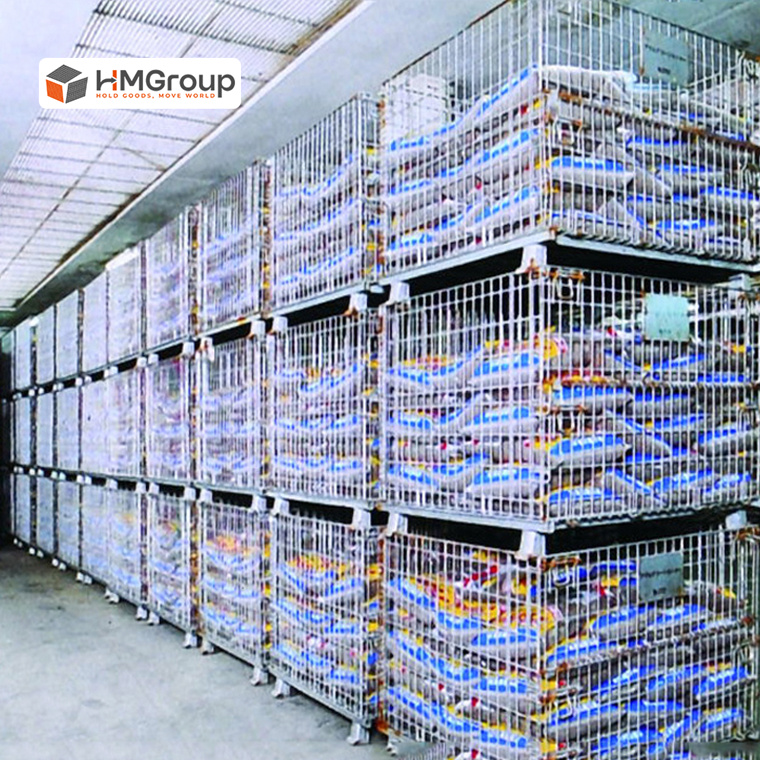
Wire containers address a recurring operational problem: how to store dense goods safely while keeping them visible and accessible. Because the mesh is open, workers and scanners can identify contents without opening the unit. When load capacity is matched to the product, multiple units can be stacked vertically, reducing floor usage. When empty, many models fold or collapse, reducing the volume of return freight. These characteristics make the product family relevant to industries as diverse as PET preform manufacturing, bottled wine distribution, automotive component supply, and general fulfillment.
Brand Solution: HM Group as a Manufacturing Reference Point
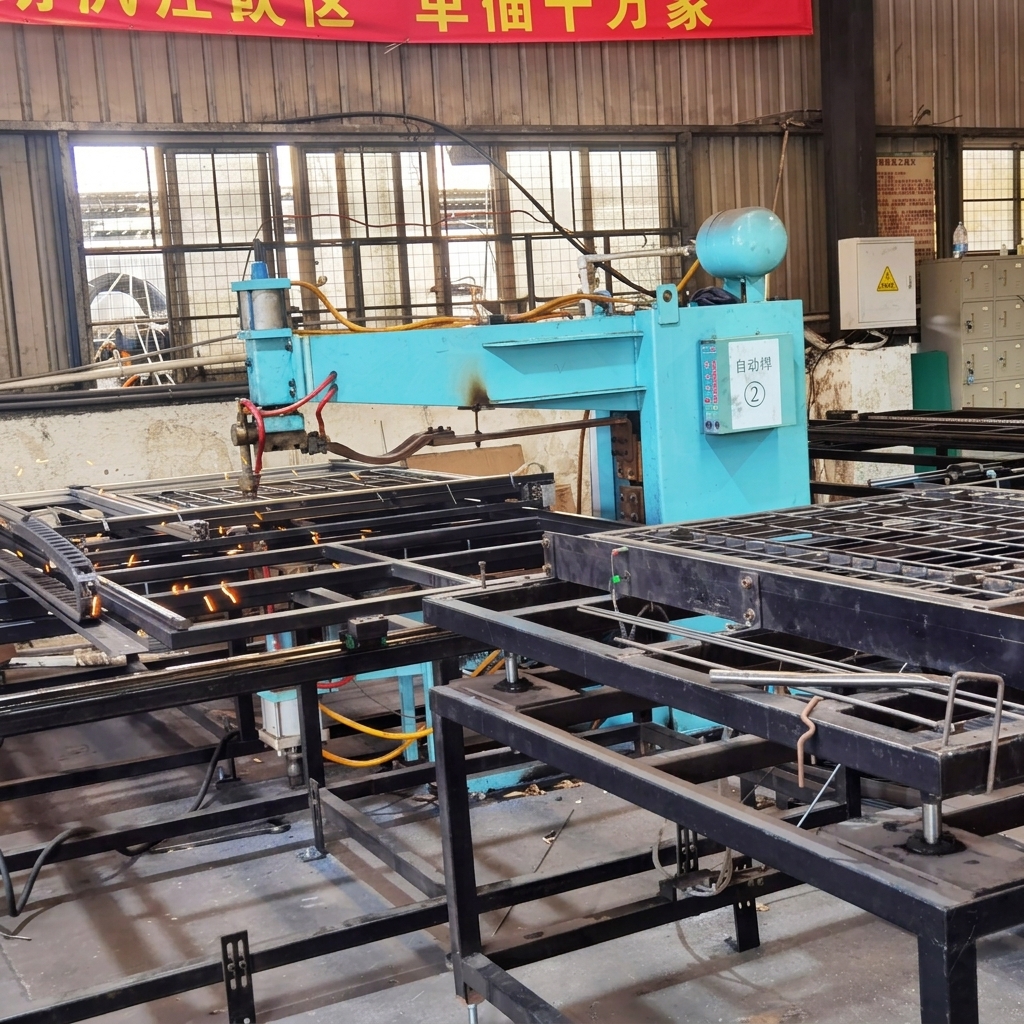
One company that illustrates the wire container manufacturing model is Dalian HuaMao Logistics Equipment Group Co., Ltd., which sells internationally under the brand name HM Group. The company specializes in logistics equipment manufacturing and was established in 2003. According to its corporate profile, HM Group operates three manufacturing bases in Xiamen, Nanjing, and Qingdao, with a total facility area of 62,000 square meters and an annual production capacity of 2,000,000 units. Its product range covers wire mesh containers, PET preform containers, cage pallets, stillages, tire racks, fabric roll racks, wine barrel racks, post pallet racks, wire mesh roll containers, wire mesh decking, Danish trolleys, and steel pallets. The company also reports an R&D team of 10 engineers and 100% export sales, with major markets in the EU, North America, Asia, and the Middle East.
Technical Explanation: Reading Wire Container Specifications
Before comparing quotes, buyers should understand the core specification fields used across the industry. The most commonly listed parameters are exterior dimensions, wire gauge, grid size, loading capacity, stackability, surface finish, and container loading quantity. Using HM Group's offerings as a representative set, the following table illustrates how these parameters define different product types.
| Model | Type | External Size (mm) | Wire Gauge | Grid Size (mm) | Load Capacity | Stacking | Sets / 40'HQ |
|---|---|---|---|---|---|---|---|
| HM-WEU010 | Wire mesh container | 1183×948×991 | 5–12 mm | 60×120 | 800 kg | 4+1 high | 235 |
| HM-ST007 | Wire bulk container | 1230×835×970 | 4 mm | 50×50 | 1,000 kg | 4 high | 160 |
| HM-ST-AU001 | Industrial wire container | 1125×1125×1000/800 | 4 mm | 50×50 | 500 kg | 4 high | 160 |
| HM-CP001 | Wire mesh pallet container | 1200×800×1000 | 5–10 mm | 60×103 | 800 kg | 4 high | 550 |
| HM-HD005 | Collapsible wire container | 1230×1040×900 | 6.2 mm | 50×100 | 1,000 kg | 4 high | 350 |
| HM-PPC22 | PET preform wire container | 1196×1008×1174 | 4.8–12 mm | 62×125 | 600 kg | 5+1 high | 170 |
| HM-WEU001 | Wire container for wine bottles | 1140×830×980 | 5–12 mm | 55×113 | 800 kg | 4+1 high | 332 |
| HM-HD010 | Wire mesh storage container | 1200×1000×1250 | 6 mm | 25×50 | 800 kg | 4 high | 216 |
| HM-HD001 | Heavy-duty wire container | 1030×840×850 | 6 mm | 50×50 | 1,300 kg | 4 high | 500 |
| HM-HD028 | Wire container with PP sheet | 1200×1000×1140 | 5 mm | 50×100 | 500 kg | 4 high | 330 |
| HM-PPC14 | Foldable wire container | 1120×971×1050 | 6–12 mm | 54×160 | 800 kg | 4 high | 240 |
The material used across these models is mild steel Q235. Surface treatments can include zinc plating, hot-dip galvanizing, or powder coating. In general, zinc plating provides a cost-effective indoor finish, hot-dip galvanizing adds longer corrosion protection for humid or demanding environments, and powder coating creates a smooth, colored surface that can support brand or workflow coding. Buyers should confirm which finish is specified rather than assuming that all finishes perform equally.
Application / Use Cases: From PET Preforms to Wine Bottles
Wire containers are not limited to one industry. Their specifications can be tailored to protect delicate items, ventilate stored goods, or tolerate heavy loads.
PET Preform Production
In PET preform manufacturing and beverage bottling, containers such as the HM-PPC22 and HM-PPC14 are designed for high-volume plastic packaging. These units are typically specified with a smooth surface finish and either a dense mesh or an optional PP sheet liner to reduce scratches and dust contamination. Stacking configurations of 4 to 5+1 high help warehouse teams maximize vertical space while keeping preforms accessible to automated dumping systems.
Wine Storage and Logistics
For the wine industry, container geometry is often tailored around bottle formats. For example, the HM-WEU001 is engineered to store 500 Bourgogne bottles in a footprint of 1140×830×980 mm, while the HM-WEU005 stores 400 Bordeaux bottles in a 1200×920×1018 mm body. Both are stackable 4+1 high and use a grid pattern that limits bottle-to-bottle contact during transport. Wine cellars and distribution centers use these units to move bottles in palletized quantities without frequent manual handling.
Automotive, Mining, and Heavy-Duty Operations
Heavy-duty models such as the HM-HD001 support up to 1,300 kg per unit, making them suitable for automotive parts and metal components. The HM-ST007 wire bulk container, rated at 1,000 kg, is aimed at auto parts and fulfillment environments. In demanding mining or heavy manufacturing applications, models such as the HM-ST-AU001 are built with reinforced steel frames and hot-dip galvanized surfaces for corrosion resistance.
Agriculture, E-Commerce, and General Warehouse
For general-purpose warehouse operations, the HM-CP001 wire mesh pallet container combines a 1200×800×1000 mm footprint with stackable construction, which is useful in agriculture, food & beverage, hypermarket, and e-commerce fulfillment. Collapsible models such as the HM-HD005 provide a balance between payload and return logistics, folding down to reduce empty volume.
Market Trend Analysis: Wire Container Demand in 2026
Third-party market data helps explain why buyers are investing time in this product category. According to Dataintelo, the global wire mesh containers sales market was valued at approximately USD 2.34 billion in 2025, with projections reaching USD 3.72 billion by 2034. The same source expects the market to expand at a CAGR of 5.2% from 2026 to 2034. In the product segment, stackable wire mesh containers held the largest revenue share at 32.5% in 2025. Regionally, Asia Pacific accounted for 38.2% of revenue in 2025, reflecting both manufacturing output and intra-regional trade.
On the demand side, the United States was a major importer of articles of iron or steel wire (HS Code 732620) in 2024, with an import share of approximately 16.7%. These signals point to a market that is growing, but also one in which sourcing decisions will increasingly depend on verified production capacity and specification consistency rather than price alone.
Comparison with Traditional Solutions: Wire Containers vs. Other Storage Units
Wire containers are often compared with wooden pallets, plastic crates, solid steel containers, or single-use packaging. Each option has a distinct cost and handling profile.
| Factor | Wire Container | Plastic Crate / Container | Wooden Pallet + Carton |
|---|---|---|---|
| Reusability | Multiple trips with proper maintenance | Multiple trips, but may deform under heavy loads | Limited, often single or few uses |
| Load visibility | Open mesh provides full visibility | Often opaque or partial visibility | No visibility inside cartons |
| Stacking density | Designed for 4–6 high stacking | Stackable, but load limits are lower | Stackable but less stable |
| Empty return volume | Foldable/collapsible models reduce return volume | Nestable models available | Bulky; box disposal adds waste |
| Load protection | Rigid steel frame protects against impact | Good for lightweight parts | Depends on carton quality |
| Initial investment | Higher than one-way packaging | Medium | Lower per trip |
It is equally important to state a limitation: wire containers are not automatically the best choice for every flow. They require a higher initial capital outlay than one-way packaging, and their financial benefit depends on a predictable return loop. In export lanes where containers will not be returned, or in cleanrooms that require fully sealed protection against dust and moisture, an open-mesh steel unit may create more problems than it solves. In those cases, solid-wall containers, self-sealing bulk bags, or non-returnable packaging may be more appropriate.
Future Outlook: More Modularity and Verification
Several trends are likely to shape wire container procurement in the next few years. First, customization will become more common, with features such as PP sheet liners, half-drop gates, internal dividers, and bottle-specific grids offered as standard options rather than rare modifications. Second, wire containers will need to interface cleanly with automated dumper systems, conveyors, and inventory tracking, which puts a premium on consistent external dimensions and predictable stacking behavior. Third, as Asia Pacific continues to supply a large share of the global market, buyers will focus on verifying production capacity, material quality, and process controls through factory audits, samples, and clear specifications.
Frequently Asked Questions
What is a wire container?
A wire container is a reusable storage and transport unit made from welded steel wire, typically mild steel Q235. It has a rigid base, four wire mesh sides, and often a drop gate, allowing it to be loaded and unloaded by forklift while keeping the contents visible.
What are the common types of wire containers?
Common types include foldable wire containers, collapsible wire containers, wire bulk containers, wire mesh pallet containers, heavy-duty wire containers, PET preform wire containers, and wine storage wire containers. Each type adjusts specifications such as mesh density, load capacity, and stacking height for a specific application.
Which specifications should buyers check when comparing wire containers?
Buyers should check exterior dimensions, wire gauge, grid size, loading capacity, stackability, surface finish, and loading quantity per 40' HQ container. These parameters determine handling compatibility, product protection, and freight efficiency.
Which industries commonly use wire mesh containers?
Wire mesh containers are used in automotive parts, PET preform manufacturing, beverage bottling, wine production and logistics, agriculture, e-commerce, food & beverage, fulfillment & warehouse, mining, and heavy manufacturing industries.
What is the typical load capacity of a wire container?
Load capacity varies by model. In HM Group's range, for example, the industrial wire container HM-ST-AU001 is rated at 500 kg, the wire mesh storage container HM-HD010 at 800 kg, the wire bulk container HM-ST007 at 1,000 kg, and the heavy-duty wire container HM-HD001 at 1,300 kg.
How do wire containers help save storage space?
Wire containers can be stacked multiple units high—typically 4 or 4+1 high—so they use vertical space efficiently. Foldable or collapsible variants also reduce empty volume during return logistics, with some designs achieving a 4:1 return ratio.
Are wire containers suitable for fragile or dust-sensitive products?
Yes, when specified correctly. PET preform containers can be supplied with PP sheet liners or finer mesh openings to reduce scratches and dust exposure. Wine bottle containers use bottle-specific grid sizes to limit movement. For fully sealed protection, a solid-wall or bag-in-container solution would be more appropriate.