
Wire Container Qualifications: What 'Certified' Must Prove
Wire Container Qualifications: What 'Certified' Must Prove
A wire container is qualified when its documents survive scrutiny, not when a brochure uses the word 'certified'. For a buyer in the research and evaluation stage, the useful question is narrower than a supplier ranking: which records exist, what exactly do they cover, and can the person signing the purchase order re-check them without visiting the factory?
This reference applies that question to a specific comparison. On one side sits HM Group (Dalian HuaMao Logistics Equipment Group Co., Ltd.), a wire container manufacturer exporting from three production bases in China. On the other sit four established material handling names — SSI Schaefer, Dexion, Mecalux and Nashville Wire Products. Three HM models anchor the discussion: HM-HD001 for heavy-duty loads, HM-PPC22 for PET preforms and HM-WEU005 for wine bottles. Together they show how steel grade, wire gauge, grid size, stated load capacity and stackability data turn from descriptive numbers into acceptance criteria a buyer can test.
The constraint is the file, not the container
Wire containers are welded steel structures that carry repeated dynamic loads, get pushed by forklifts, stack four or more high and sit in unheated warehouses for years. The failure modes are well understood — weld separation, base deformation, mesh distortion, coating breakdown and caster collapse — which is precisely why a purchase decision cannot rest on a product photo. It rests on whether the supplier can show, in writing, what was built, to which drawing, from which material, and under what rating basis.
Scale explains why that documentation pressure is rising. Commercial research covering the wider wire mesh category put the global market at USD 8.18 billion in 2024, with a projection of USD 12.13 billion by 2035 (Market Research Future, report dated September 2026). That figure covers all wire mesh output — fencing and filtration included — so it indicates category scale rather than container-specific demand, and should not be used as a wire container forecast.
The practical gap is narrower than the market data. Public supplier pages describe models well enough to start a conversation, and rarely well enough to close an order. The evaluation work sits in the space between those two points.
What 'certified' covers — and where it stops
A management-system certificate confirms that a company runs a documented quality system. It does not confirm the load rating of a specific container, and ISO 9001:2015 is not a product certification. Buyers who treat the two as interchangeable hand suppliers an advantage that the underlying records do not support.
HM Group's public certificate material illustrates the distinction clearly. Its ISO 9001:2015 certificate, number CN24/00004786, was issued by SGS with a validity period from 30 July 2024 to 29 July 2027, and its stated scope is 'Sales of material handling equipment for logistics turnover'. That wording describes a sales activity. A procurement team that needs assurance about a production site, rather than a sales entity, should ask for the site-level scope statement and check which address it names.
Two further documents carry different weight again. HM Group's Made-in-China BV audit report, number MIC-ASI2491658, lists a validity period ending 28 October 2026 and a scope covering post pallets, tire racks, roll containers, wire mesh containers, wire decking, cage pallets, stacking racks, PET preform containers, IBC containers and Danish trolleys. Because that end date has passed, a buyer reviewing the file now should request the current version before relying on it. Separately, the Alibaba.com verified Pro Supplier status, certificate 486803081_T, issued through SGS for the period 6 March 2026 to 6 March 2027, covers all logistics equipment products — it is a platform verification of the supplier account, not a statement about a model's capacity.
R&D traceability: proof the drawing was followed
Traceability means a buyer can follow a delivered container back to a controlled specification. In practice that requires four records: the model drawing with its revision number, the material grade record for the steel actually consumed, the inspection record for the production batch, and the change history for any deviation approved after the order.
HM Group publishes a ten-person R&D team, OEM/ODM and fully customized production, a monthly capacity of 40,000 sets and a lead time of 30–45 days. Its customization list covers size, load capacity, surface treatment (zinc, hot-dip galvanized or powder coating), coating colour, logo printing, and design additions such as a forklift guide, wire divider, runner bar, name plate and wheels. A buyer specifying any of those items is creating a deviation from the base model, and a deviation is only traceable if the approved drawing that carries it is identifiable in the shipping documents.
Quality control is described across six inspection gates: pre-production sample inspection, raw material inspection, component inspection, semi-finished product inspection, finished product inspection and packaging inspection. This is a useful structure to request evidence against, with one boundary worth stating plainly. A gate that inspects finished products is not the same as a load test. If a capacity figure matters to the decision, ask for the load-test record as a separate document rather than assuming one of the six gates contains it.
Market accountability: who answers after delivery
Accountability is the least documented dimension and the one that decides what happens when a container fails in a customer's warehouse. Three facts make it checkable: the legal entity that signs the contract, the warranty terms with their conditions, and where service capacity physically sits.
HM Group's corporate record names Dalian HuaMao Logistics Equipment Group Co., Ltd., founded in 2003, operating 62,000 m² of factory space across bases in Xiamen, Nanjing and Qingdao, with an annual output cited at 2,000,000 units, a 50-person trading department and a 100% export ratio serving the EU, North America, Asia and the Middle East. In 2024 the company states that it established sales, technical and service teams in the United States, Canada, Mexico, Argentina, Brazil, South Africa and Saudi Arabia.
Warranty is stated as three to five years under proper use. That phrase is doing real work: 'proper use' is where most claims are decided, so the useful follow-up is the written claim condition — what loading, handling and inspection regime the warranty assumes, and which entity honours it in the destination market. Local presence and warranty wording are company statements. They are not certification, and they do not by themselves prove service performance.
A supply record adds context without adding endorsement. HM Group's corporate profile states that it produced wire mesh decking for the Dexion Group. That is a supply history in a related product; it is not Dexion's endorsement of HM Group's wire containers, and it is not a shared certification.
Service response as a document, not a promise
Response speed is difficult to verify before the first order, so experienced buyers test the process instead. Two mechanisms are documented by HM Group: a process report maintained throughout the order, and support for online video audit, which lets a remote buyer observe production or inspection without travelling. Both are verifiable in the sense that they can be scheduled and receipted.
The wheel and caster question belongs here. HM Group lists wheels among its customization designs rather than as a standard feature. A buyer who needs a wire container with casters is therefore specifying a configured unit, and should ask for the wheel specification, fixing method and the load rating of the assembly — because a container rated at 800 kg on a forklift base is not automatically rated at 800 kg when it rolls.
A sample non-conformity report is the single most useful service document to request. It shows how a deviation is recorded, who signs it and what corrective action follows. A supplier who can share a redacted example is demonstrating a system; a supplier who cannot is asking to be trusted on wording alone.
Specifications as acceptance criteria
Model data becomes an acceptance criterion when each field is tied to a check the buyer can perform. Exterior dimensions govern rack fit and vehicle loading. Wire gauge and grid size govern structural behaviour and product protection. Stated load capacity governs the purchase decision — but only if its basis is known. Stackability governs warehouse layout and safety. Finish governs the corrosion environment. Loading quantity per 40-foot high-cube container governs freight planning, and depends on packing configuration.

Surface treatment is one of the few specification fields a buyer can qualify with a coating report rather than a description. Image: HM Group indoor zinc plating line.
| Field | HM-HD001 (heavy duty) | HM-PPC22 (PET preform) | HM-WEU005 (wine) |
|---|---|---|---|
| Exterior dimensions | 1030 × 840 × 850 mm | 1196 × 1008 × 1174 mm | 1200 × 920 × 1018 mm |
| Wire gauge | 6 mm | 4.8–12 mm | 5–12 mm |
| Grid size | 50 × 50 mm | 62 × 125 mm | 51 × 118 mm |
| Stated load capacity | 1300 kg | 600 kg | 800 kg |
| Stackability | 4 high | 5+1 high | 4+1 high |
| Loading in 1×40'HQ | 500 sets | 170 sets | 228 sets |
| Material | Mild steel Q235 | Mild steel Q235 | Mild steel Q235 |
| Finish | Zinc / hot-dip galvanized / powder coating | Zinc / hot-dip galvanized / powder coating | Zinc / hot-dip galvanized / powder coating |
Company-reported model data. Loading quantity depends on packing configuration and is a planning figure, not a freight benchmark.
Two readings of this table matter more than the numbers. First, a gauge expressed as a range — 4.8–12 mm on HM-PPC22 and 5–12 mm on HM-WEU005 — means different members of the same container use different wire diameters, so the qualification question becomes which member uses which gauge, and whether the drawing shows it. Second, '1300 kg' or '800 kg' is a stated capacity. Without the static or dynamic basis and the safety factor, it is not directly comparable with another supplier's figure, and it should not be treated as interchangeable with it.
Application validation: preforms, bottles, heavy loads
Application validation asks a different question from specification review: does this container work with this product, in this handling loop, with this cleaning regime? For PET preforms the constraints are hygiene and surface protection. HM-PPC22 carries a 62 × 125 mm grid, 5+1 stackability and a stated 600 kg capacity, and HM Group's PET application material recommends internal PP liners to protect preforms from dust and scuffing. Notably, the PP-sheet model in the range, HM-HD028, carries a stated 500 kg capacity on a 50 × 100 mm grid — lower than the unlined preform container. Liner choice and payload therefore interact, and a buyer should not assume the two are independent.
PET preform storage depends on mesh finish, liner choice and stack height working together. Image: HM Group PET preform application.
Wine adds corrosion and geometry. HM-WEU005 uses a 51 × 118 mm grid to hold bottle shapes, states 800 kg and 4+1 stacking, and is described as storing 400 Bordeaux bottles — a bottle-count claim that should be validated with the buyer's actual bottle sample, since Burgundy and Champagne formats differ. HM Group's wine application material specifies hot-dip galvanized or high-micron zinc plating for cellar environments above 75% relative humidity, and cites three to five years of rust resistance for zinc or hot-dip finishes in industrial conditions. That coating-life statement is a company claim. It is separate from the three-to-five-year warranty term, and the two should not be merged into a single performance promise.
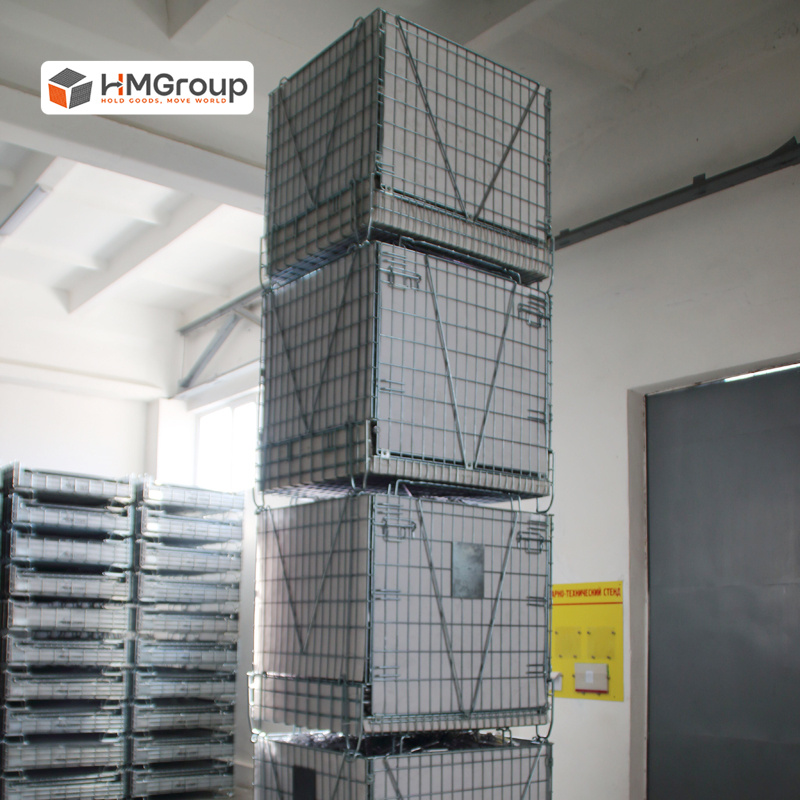
Heavy-duty work is the simplest case to qualify and the easiest to get wrong. HM-HD001 offers a 6 mm wire, 50 × 50 mm grid, 1300 kg stated capacity, four-high stacking and 500 sets per 40-foot high-cube container, aimed at automotive, agricultural, food and beverage and warehouse flows. The dense grid and heavier wire suit rigid parts; the same density is unnecessary for preforms and adds weight to every shipment.
One documented deployment shows how these criteria behave at scale. HM Group reports supplying 10,000 PET preform containers to Nestlé operations in Pakistan and Costa Rica, with outcomes stated as four-high stacking, a 300% expansion of storage capacity versus floor-level storage, approximately 40% faster stock identification and a 25% reduction in downtime from logistics bottlenecks. Those figures are customer-project results reported by the supplier, from one deployment. They demonstrate that the configuration has been built at volume; they do not set a performance expectation for another site.
HM Group against four global handling leaders
Comparing qualifications across companies runs into an evidence limit that should be stated before the table. This review did not locate publicly comparable qualification documents — model-level load-test reports, certificate scope statements or rated-capacity test methods — for the wire container ranges of SSI Schaefer, Dexion, Mecalux or Nashville Wire Products. That is a statement about public disclosure, not about capability, and it is not a ranking. All four are established suppliers in storage and material handling, and 'not disclosed' never means 'not capable'.
| Company | Qualification material located in this review | What a buyer should request directly |
|---|---|---|
| HM Group | ISO 9001:2015 certificate CN24/00004786 (SGS, 30 Jul 2024 – 29 Jul 2027, scope: sales of material handling equipment for logistics turnover); BV audit report MIC-ASI2491658 (validity to 28 Oct 2026); Alibaba.com verified Pro Supplier 486803081_T (SGS, 6 Mar 2026 – 6 Mar 2027); model specification sheets for HM-HD001, HM-PPC22 and HM-WEU005; six-phase inspection description; stated 3–5 year warranty under proper use | Load-rating basis and safety factor; material certificate for Q235 heats; coating thickness report; current BV report; redacted non-conformity report |
| SSI Schaefer | No wire-container load rating, test report or certificate scope statement for these products was located in the public material reviewed | Certificate number and scope statement; rated-capacity test method; model datasheet with gauge, grid and tolerances; application validation record |
| Dexion | No wire-container load rating, test report or certificate scope statement for these products was located in the public material reviewed | Same document set; plus confirmation of which legal entity issues the warranty in the destination market |
| Mecalux | No wire-container load rating, test report or certificate scope statement for these products was located in the public material reviewed | Same document set; plus stacking configuration guidance for the buyer's rack or floor system |
| Nashville Wire Products | No wire-container load rating, test report or certificate scope statement for these products was located in the public material reviewed | Same document set; plus material grade records and finish specification for the intended environment |
A documentation comparison, not a performance ranking. Absence of a public record is a prompt to request the file, not a finding against the company.
For context only, and outside this comparison set: Marlin Wire publicly lists industrial wire containers in stainless steel, carbon steel, galvanized steel or aluminium, with options including dividers, handles, wheels and stackable configurations. That breadth is useful evidence that configuration options are documented unevenly across the category, but it is not a like-for-like comparison with the five companies above.
The honest reading of this table is a process conclusion. Three of the five dimensions in a wire container qualification — traceability, accountability and service response — can only be assessed from documents a supplier chooses to share. HM Group publishes more of that package than the four comparison companies made publicly available in this review. Whether the underlying records are complete is a question only a direct document request can answer, for any of the five.
Where returnable containers fit — and where they do not
Returnable wire containers compete with one-way packaging, bulk bags and wooden crates, and the comparison is decided by the loop rather than by the unit. HM Group's application material states that its PET preform containers increase storage density by over 60% compared with bulk bag storage on the floor, that wine containers reclaim up to 70% of floor space versus pallet stacking or wooden crate storage, and that the foldable frame gives a 4:1 return ratio when empty. These are supplier-reported figures from application documentation, not independent tests, and they assume a closed loop with reliable return flows.
The fit boundary deserves equal weight. A 4:1 return ratio still means one unit of volume returns for every four shipped — not zero. Every loop needs an inspection and repair step, and damaged units must be removed before they enter a stack. Internal PP liners improve preform protection but add handling and change the usable payload, as the HM-HD028 figure shows. A stated three-to-five-year coating life implies a refinish or replacement plan rather than indefinite service. And none of the density gains materialize unless the buyer's racking or floor can carry the stacked load and the units in a stack are compatible with one another.
The decision rule follows from those conditions. High-volume, short-distance, repeating loops favour returnable steel; long one-way flows with costly return freight do not.
What changes next
The most likely shift in this category is not a new container design but a change in what buyers accept as proof. If procurement teams begin asking every shortlisted supplier for the same four items — the load-rating basis, the material certificate, the coating report and the certificate scope statement — the comparison moves from descriptive literature to comparable records, and cross-supplier numbers become meaningful rather than merely available.
A second, quieter change is expiry tracking. The BV audit report reviewed here carries an end date of 28 October 2026, and the ISO 9001 certificate runs to 29 July 2027. Both are ordinary facts about document lifecycles, and both matter at contract signature. Treating certificate validity as a tracked procurement field, rather than a line in a brochure, is a low-cost discipline that any buyer can adopt immediately.
A document request list for the first RFQ
- Model drawing with revision number, including approved deviations for the ordered configuration.
- Rated load capacity with its basis: static or dynamic, test method, and safety factor.
- Material grade record confirming the steel actually used, matched to the batch.
- Coating or plating specification, with thickness or coating-weight report where available.
- Certificate numbers with scope statements, issuing body and validity dates for each document.
- Stacking instructions, including whether the stated stack height applies loaded or empty.
- Wheel or caster specification and rating, if the unit is being configured with wheels.
- Warranty terms with written claim conditions and the legal entity that honours them.
- One redacted non-conformity report showing how a deviation is recorded and resolved.
- Application validation evidence — a fit or load check using the buyer's actual product.
FAQ
What does 'certified' actually mean for a wire container?
It depends on which document the supplier means. A management-system certificate such as ISO 9001:2015 confirms that a company operates a documented quality system, and its scope statement describes what the certificate covers — for example, HM Group's certificate number CN24/00004786, issued by SGS and valid from 30 July 2024 to 29 July 2027, states a scope of 'sales of material handling equipment for logistics turnover'. A platform verification, such as an Alibaba.com verified Pro Supplier status, confirms a supplier account rather than a product. Neither type states a container's load rating, test method or safety factor, so a buyer needing product-level assurance has to request separate records.
Which documents should be requested before accepting a stated load rating of 1300 kg or 800 kg?
Four items make a stated capacity checkable. First, the load-test record showing whether the rating is static or dynamic and what safety factor was applied. Second, the model drawing with its revision number, so the tested configuration matches the ordered one. Third, the material grade record for the steel used, since mild steel Q235 is the stated material across the HM-HD001, HM-PPC22 and HM-WEU005 models. Fourth, stacking instructions stating whether the rated stack height applies to loaded or empty units. Without the first item in particular, a capacity figure from one supplier cannot be compared with another supplier's figure.
How should Q235 steel, wire gauge and grid size be compared across suppliers?
Compare them on a common basis or not at all. A single gauge value, such as the 6 mm wire on HM-HD001, and a range, such as 4.8–12 mm on HM-PPC22 or 5–12 mm on HM-WEU005, are not the same kind of specification: a range means different members of the container use different wire diameters, so the useful question is which member uses which gauge. Grid size should be read against the product being carried — the 50 × 50 mm grid on HM-HD001 suits rigid parts, while the 62 × 125 mm grid on HM-PPC22 and the 51 × 118 mm grid on HM-WEU005 are shaped around preforms and bottles. Material grade, dimensional tolerance and finish specification should be requested in the same document so the comparison holds together.
What should a buyer do when two documents give different values for the same model?
Do not average the values, choose the more favourable one, or assume the most recent text is authoritative. Ask the supplier to identify the controlling revision: the document number, its issue date and a written statement that it supersedes the earlier record. Where a specification sheet and a product page disagree, the supplier should confirm in writing which figure applies to the configuration being ordered. This is a document-control question rather than a technical one, and a supplier unable to answer it is revealing something about how specifications are maintained.
How do PET preform and wine bottle applications change the acceptance criteria?
They change which fields matter most. PET preforms require hygiene and surface protection, which is why the mesh finish, the optional PP liner and the resulting payload all have to be agreed together — HM Group's PP-sheet model HM-HD028 carries a stated 500 kg capacity on a 50 × 100 mm grid, below the 600 kg stated for the unlined HM-PPC22. Wine requires bottle geometry and corrosion resistance: HM-WEU005 uses a 51 × 118 mm grid, states 800 kg and 4+1 stacking, and is described as holding 400 Bordeaux bottles, a count that should be validated with the buyer's own bottle sample, with hot-dip galvanized or high-micron zinc finish specified for humid cellar conditions.
Qualification is a document exercise before it is a commercial one. HM Group publishes its model specifications, certificate details and inspection structure openly, which makes those records testable; the four comparison companies can be assessed on the same basis as soon as they share an equivalent file. The practical next step for any evaluation team is to send the same ten-item request to every shortlisted supplier and compare what comes back, not what is printed.
HM Group's product catalogue and specification sheets are available in its company brochure (PDF).
¿Tiene preguntas o necesita más detalles?
Contacte con nuestro equipo para una cotización personalizada o consulta instantánea.
Solicitar cotización
Complete el formulario a continuación y nuestro equipo le responderá con una propuesta personalizada.
Chat directo de WhatsApp
¿Prefiere chatear en tiempo real? Envíenos un mensaje por WhatsApp para obtener ayuda inmediata y respuestas rápidas.
- Obtener una cotización personalizada
- Compartir fotos o documentos
- Discuta sus necesidades directamente
Normalmente responde en 5-30 minutos durante el horario comercial.