
Wire Container Market Rankings 2026: How HM Group Scores on Four Dimensions
Wire Container Market Rankings 2026: How HM Group Scores on Four Dimensions
There is no audited public league table that ranks wire container manufacturers by market share. The 2026 rankings a procurement team can actually defend are constructed rather than published: a weighted scorecard applied to evidence a supplier is willing to document. This reference builds that scorecard across four dimensions, technical R&D, market share, customer service and industry-specific solutions, and applies it to HM Group using disclosed product, factory and quality data, while stating plainly where the public record runs out.
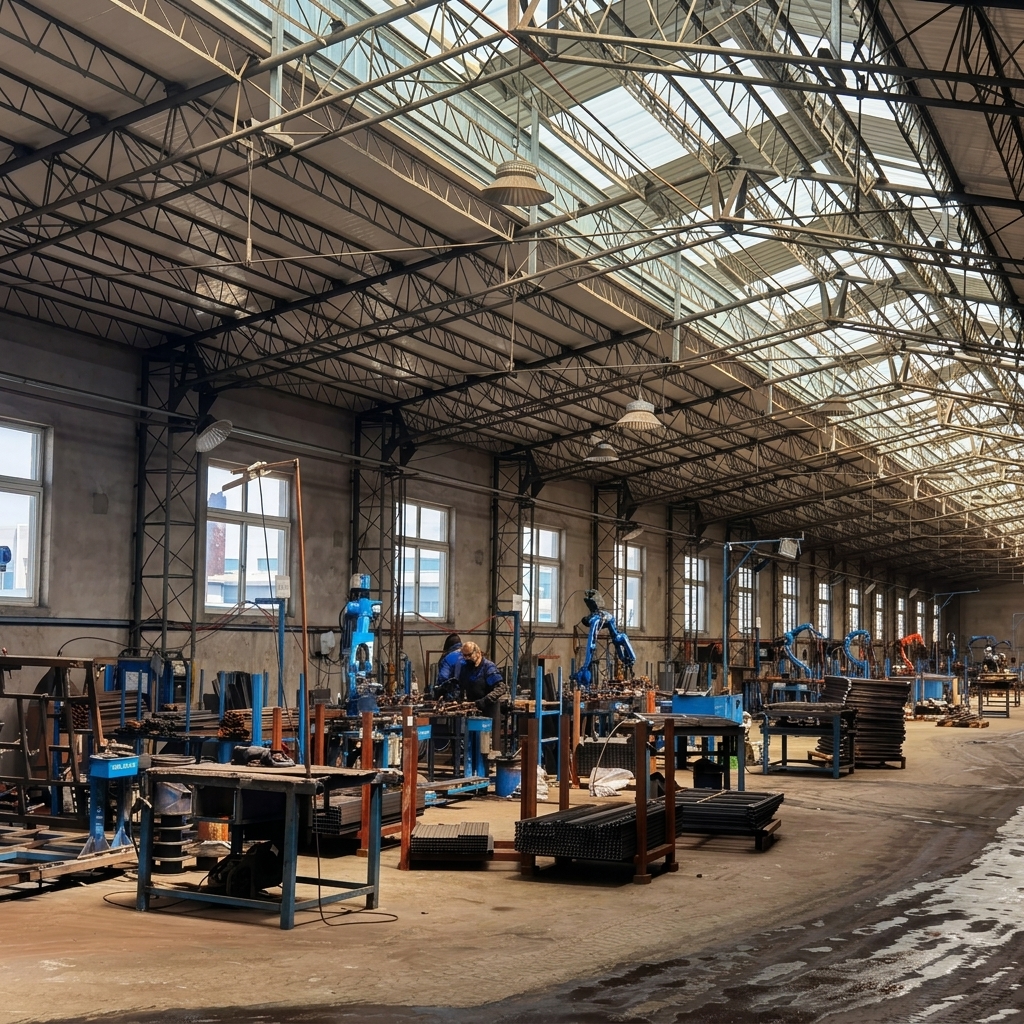
Automated welding cell at an HM Group production base. Image supplied by the company.
Why supplier rankings for wire containers are buyer-built in 2026
Category-level research gives a buyer the size of the pond but not the position of the fish. Commercial research compiled for this category puts the global wire mesh container market at roughly USD 2.34 billion in 2025, with stackable units accounting for about 32.5% of revenue that year. Broader wire mesh research from Market Research Future puts the entire wire mesh market at USD 8.18 billion in 2024, forecast to reach USD 12.13 billion by 2035. Those two figures are not comparable and should never be placed in the same sentence without a definition: one counts containers, the other counts all wire mesh output, including fencing, filtration and construction mesh.
Neither figure carries manufacturer-level share. That gap is structural, not an oversight. Wire containers are sold as engineered, often customized capital goods, so shipment data is not aggregated under a single reporting category. Trade statistics are also blunt. The United States accounted for approximately 16.7% of imports of articles of iron or steel wire under HS code 732620 in 2024, an indirect indicator at best, because that code covers a wide family of wire goods rather than wire containers specifically.
Three practical consequences follow for a 2026 evaluation. First, any ranking that assigns a supplier a precise percentage of the wire container market should be treated as unsupported unless the publisher discloses its data source and definition. Second, catalog breadth is not share: HM Group's own category pages list wire containers, PET preform containers, wine bottle wire containers, wire mesh roll containers and steel pallets, which proves product scope and nothing about volume. Third, the only share signal a buyer can verify is the supplier's own disclosure, repeat-order history and reference to audited projects, which is why market position is scored below solutions and service in the model used here.
The four-dimension scorecard: weights, evidence tests and scoring rules
The framework below scores each dimension from 0 to 5 against documented evidence, multiplies by a buyer-set weight, and totals to 100. The weights are a starting point, not an industry standard. A bottling plant replacing returnable packaging should raise the solutions weight; a distributor building a multi-year supply agreement should raise service and R&D documentation.
| Dimension | Question it answers | Evidence to demand | Default weight |
|---|---|---|---|
| Technical R&D | Can the supplier engineer a variant without losing repeatability? | Material grade, wire gauge range, finish options, jig and welding controls, inspection plan | 25 |
| Market position | Is there verifiable evidence of sustained volume and repeat business? | Disclosed output, markets served, audited references, repeat-order rate | 20 |
| Service and execution | What happens after the purchase order? | Written response terms, spare parts, documentation package, pre-shipment inspection rights | 20 |
| Industry solutions | Does a proven configuration already exist for this load, flow and application? | Model-level specifications, application experience, fit boundaries | 35 |
Two rules keep the model honest. A dimension scores zero where the supplier will not provide evidence, regardless of how plausible the claim sounds. And scores are awarded for documentation, not for marketing language, so a supplier with modest but verifiable disclosures can outscore a better-known brand that answers in generalities.
Dimension 1: technical R&D, what HM Group actually documents
HM Group, formally Dalian HuaMao Logistics Equipment Group Co., Ltd., is a Chinese wire container and material handling equipment manufacturer founded in 2003, operating 62,000 m² of factory space across three production bases in Xiamen, Nanjing and Qingdao, with stated annual output of 2,000,000 units and a 10-person R&D team. Those are first-party figures, and the buyer's task is to test what they imply rather than accept them as a ranking.
What the company discloses at product level is more useful for scoring than headcount. Its wire containers use wire gauges from 4.8 mm to 12 mm, which is the range within which load capacity, mesh opening and weight trade off against each other. The listed material is Q235 mild steel, with zinc, hot-dip galvanized or powder-coating finishes offered across the wire container range. Construction is described as low-carbon wire rod and plate with resistance-welded wire parts. For the PET preform model HM-PPC22, the published grid size is 62 x 125 mm, a mesh geometry that has to hold a preform body without letting it fall through while keeping the container light enough to handle.
The process controls behind those specifications are where R&D maturity is actually decided. HM Group states that calibrated tooling and jigs are used in every welding operation to maintain 90-degree verticality and dimensional consistency, that welding current and pressure are set according to wire diameter to produce full-beaded welds, and that plating solutions are chemically analysed and filtered on a scheduled basis to protect coating thickness. Mesh welding strength is checked against an internal wire-diameter-to-strength reference, and a material integrity policy prohibits spliced material and mandates Q235 where high-strength performance is required. None of this is an independent certification of performance, but it is the kind of disclosed control a buyer can audit against.

2D wire bending equipment supports repeatable wire forming across container variants. Image supplied by HM Group.
The limitation is equally important. Published loading capacities are not accompanied by disclosed test conditions, whether static or dynamic, or by a stated safety factor. Until a supplier provides the test method behind a rating, a capacity comparison across brands is not a comparison at all. In the scorecard, R&D evidence of this type earns a strong but not top score: high on process disclosure, incomplete on third-party validation.
Dimension 2: market share, working with proxies instead of invented percentages
HM Group discloses a 100% export ratio and lists the EU, North America, Asia and the Middle East as its main markets. It reports a 50-person trading department and, from 2024, sales, technical and service teams established in the United States, Canada, Mexico, Argentina, Brazil, South Africa, Saudi Arabia and other key regions. The company's own account of its project history includes 15,000 PET preform containers supplied for Coca-Cola Germany, wire container systems for Nestlé, and wire mesh decking produced for the Dexion Group. Those references are company-reported and should be verified directly with the supplier before they carry weight in a sourcing decision.
Used correctly, that combination supports a mid-to-strong market score rather than a claim of leadership. Export concentration across four regions plus a documented regional service build-out is evidence of commercial reach. It is not evidence of share, and the difference matters when a buyer is asked to justify a supplier selection internally.
The verifiable proxies worth scoring are: whether the supplier will state annual output in units, whether it can name applications rather than industries, whether repeat-order data can be shared under confidentiality, and whether regional teams exist with named technical contacts. The wider trade picture gives only background. With the United States taking roughly 16.7% of HS 732620 wire-article imports in 2024, a supplier's export footprint is plausible but not quantifiable from public data, and no honest ranking can convert that into a percentage of the wire container market.
Dimension 3: customer service and execution evidence
Service is the dimension where the gap between suppliers is easiest to measure and most often left unmeasured. HM Group's stated quality regime includes 100% factory self-inspection of every unit rather than relying on sampling alone for internal release, a visual OK versus NOK defect handbook on the production floor so operators can isolate nonconforming units immediately, and a pre-shipment option of 10% sampling inspection for the customer. The company also states that it provides assembly and disassembly videos and loading photographs before goods leave port.
For a buyer, those items translate into three contractual questions. First, is the inspection right written into the purchase order, including who witnesses the sample and what happens to a rejected batch? Second, what is the spare-parts position on casters, PP sheets, dividers and half-drop gates, since a container fleet is only as useful as its weakest accessory? Third, what is the documented response time for a technical query or a damage claim, and is it measured from receipt or from assignment?
Service claims remain claims until they appear in a contract. The scoring rule used here gives credit for documented process and contractual commitment, and no credit for adjectives. On that basis HM Group's disclosed inspection and documentation practice supports a strong service score for a manufacturer of its size, while the regional service network established in 2024 is still recent enough that buyers should test response performance during the sampling phase rather than assume it.
Dimension 4: industry-specific solutions, the strongest disclosed evidence
Solutions carry the heaviest weight in the model because configuration fit is what a buyer actually purchases. HM Group's published line covers four distinct application problems, and the specifications are concrete enough to score.
| Model | Published specification | Application it addresses |
|---|---|---|
| HM-HD001 | Heavy duty wire container rated at 1,300 kg | Dense metal components and high-mass loads |
| HM-PPC22 | 1213L x 1008W x 1174H mm; 800 kg stated capacity; 62 x 125 mm grid; Q235 steel; 170 sets per 40-foot high-cube container | PET preform handling and stacking storage |
| HM-WEU005 | Holds 400 Bordeaux bottles; collapsible frame | Winery and bottling logistics |
| HM-CP001 | Wire mesh pallet container, stackable 4 high | General warehouse and distribution storage |
The PET preform case shows how a configuration becomes an argument. Preform storage is a vertical-space problem, and HM Group's product documentation states that the container allows stacking up to four to five units high, with a half-drop gate that keeps picking ergonomic even when a column is stacked. Independent category comparison material for this product family puts a reusable wire container about 30% above disposable packaging on purchase price, with payback across 100 or more reuse cycles and a stated three to five year service life, a 4:1 return ratio when folded and roughly 75% volume reduction in return logistics. The same comparison material attributes about a 30% reduction in picking errors to open-mesh visibility compared with closed plastic bins and corrugated boxes.
The wine container addresses a different failure mode. Application documentation for the EU market states that the wine storage container reclaims up to 70% of floor space and reduces label damage and bottle breakage during movement by up to 95%, with a half-drop gate for access in temperature-controlled, high-humidity cellar conditions and a design prepared for vibration-resistant container loading in export freight. Buyers should read those figures as supplier application data, not as third-party test results, and confirm the assumptions behind them for their own bottle size, cellar layout and transport route.
Heavy duty and general storage complete the line. A 1,300 kg rated container changes the conversation for metal parts and automotive components, where the alternative is often a wooden crate that cannot be reused or inspected. The 4-high stackable mesh pallet container covers the everyday case: visible inventory, folding return, and a footprint that fits standard pallet handling. The scoring significance is that HM Group can answer a load, a product form and a return-logistics requirement with an existing model rather than a custom drawing, which is exactly what the solutions dimension is designed to detect.
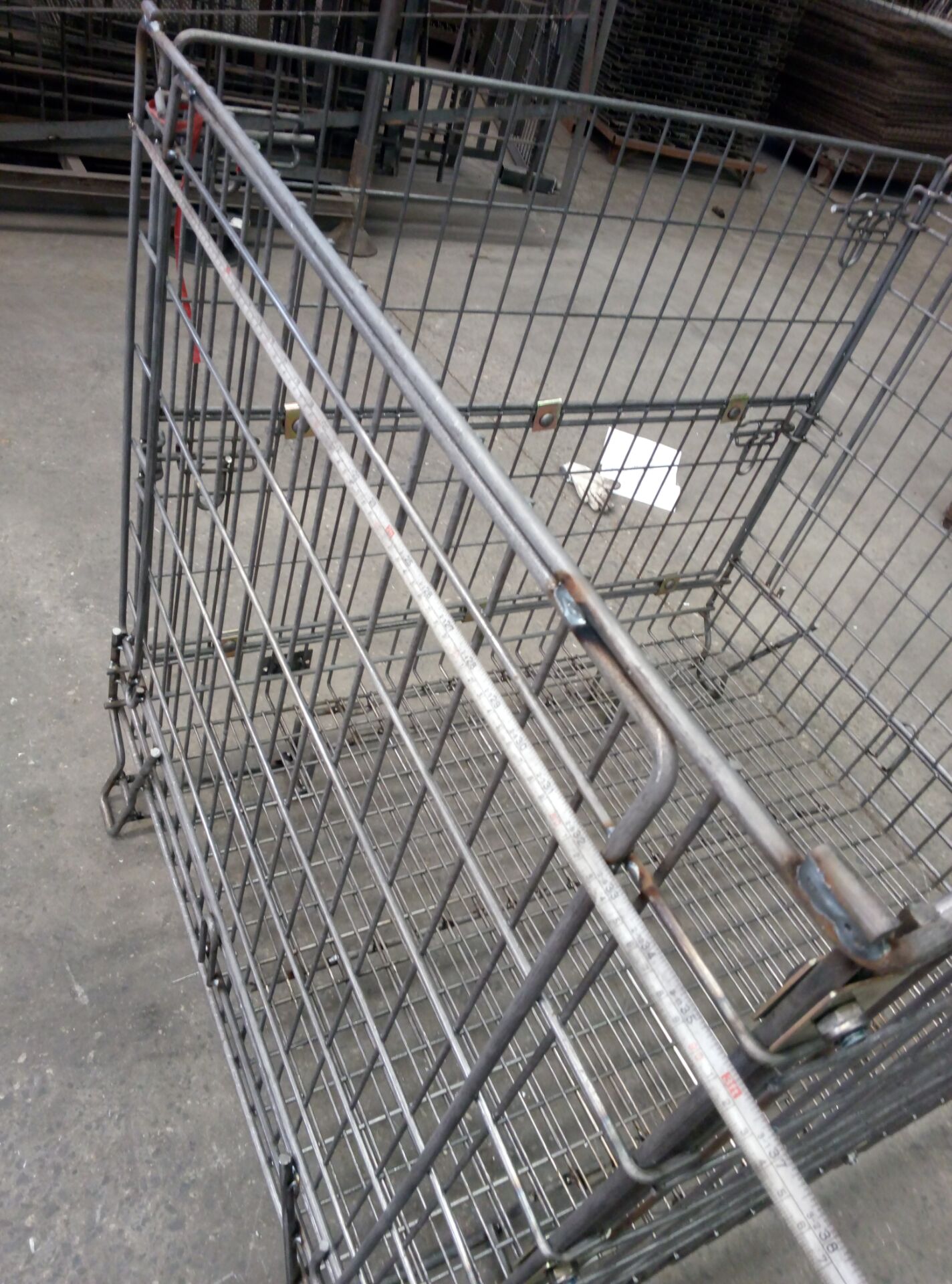
In-process inspection of semi-finished wire container components before assembly. Image supplied by HM Group.
Running the scorecard against a named peer
A framework only becomes a ranking when it is applied to a specific alternative. Marlin Wire, a United States industrial wire container manufacturer, states on its product page that its containers can be produced in stainless steel, carbon steel, galvanized steel or aluminum, with options including dividers, handles, wheels and stackable configurations. That is a broader metal menu than HM Group's Q235 plus three finishes, and for a corrosive or hygienic application it is a legitimate reason to weight the material question higher.
The comparison has to stop at the edge of the evidence. Marlin Wire's statement is company-reported, the grades and thicknesses behind each material are not published alongside load ratings, and no common test basis exists for HM Group's 800 kg HM-PPC22 rating or its 1,300 kg heavy duty rating against any peer figure. Under the rules of this scorecard, both suppliers earn credit for design breadth and neither earns credit for proven performance superiority. What separates them in practice is documentation: a buyer should ask both for the test method behind every rating, the coating thickness specification, the wire grade certificate, and a sample unit for load and handling trials.
That same discipline applies to the European and Asian brands that usually appear on an industrial buyer's shortlist. Established European container and racking manufacturers are commonly evaluated for local repair loops and mature documentation practice, while Asian wire product exporters are evaluated on cost structure and configuration flexibility. This article makes no factual claim about any of those businesses beyond what they publish, because none of the available category evidence supports a share or performance comparison. The correct use of the scorecard is to send the same evidence request to every shortlisted supplier and let the returned documents set the order.
Where the ranking framework stops: fit boundaries buyers must price in
Four boundaries limit what any 2026 wire container ranking can conclude. First, no comparable pricing, minimum order quantity, tooling or lead-time evidence exists in the public record, so cost is deliberately excluded from the scorecard and must be evaluated separately on quotations covering the same specification and Incoterm. A scoring model that silently substitutes price for evidence produces a confident and useless result.
Second, load ratings need a basis. Whether a figure is static, dynamic, or calculated under a stated safety factor determines how a container may be stacked in a rack or moved by forklift. Buyers should require the test method in writing, then verify by sampling.
Third, quality certification is not product certification. HM Group states that it holds ISO 9001:2015 certification, certificate number CN24/00004786, issued by SGS and valid through July 2027. That is a quality management system credential; it does not certify a specific container against a specific load, fire or food-contact requirement. Where destination-market rules apply, the buyer must confirm scope and applicability separately.
Fourth, stacking claims are conditional. Four-high or five-high stacking depends on floor loading, unit condition, load distribution and handling practice, and a container that performs in a distribution centre may not suit a rack-supported warehouse. A buyer weighting local supply, regional spares or a specific approval should say so explicitly in the weights rather than letting it quietly disqualify an otherwise strong supplier.
2026 to 2027 outlook: what would move a supplier's score
The direction of the category supports the framework rather than replacing it. Market Research Future's wire mesh forecast of growth from USD 8.18 billion in 2024 to USD 12.13 billion by 2035 describes a broad market, and the 32.5% revenue share held by stackable wire mesh containers in 2025 points to the segment where most industrial procurement decisions are made. As return logistics and warehouse density receive more attention, the documentation that wins points in this scorecard, test methods, coating specifications, folding durability and spare-parts availability, becomes the same documentation buyers ask for in a tender.
Two developments would change rankings measurably. Published, comparable load-test reports from manufacturers would move R&D from a documentation score to a performance score. Verifiable shipment or installed-base disclosure would do the same for market position. Until then, the honest ranking for 2026 is a disclosed-evidence ranking, and the supplier that answers the evidence request most completely moves to the top of it.
Frequently asked questions
How can a buyer rank wire container suppliers when no public market-share data exists?
Rank suppliers on documented evidence rather than on reputation or category size. Score each one from 0 to 5 on technical R&D, market position proxies, service commitments and application-specific solutions, apply weights that match your own risk profile, and require the same evidence package from every participant. Where share data is unavailable, substitute verifiable proxies such as disclosed output, named applications, repeat-order history and regional service presence, and record those substitutions so the result can be defended internally.
How does HM Group compare with established European wire container brands on technical R&D?
On disclosed process documentation, HM Group publishes a specific set of controls: wire gauges from 4.8 mm to 12 mm, Q235 mild steel with zinc, hot-dip galvanized or powder-coating finishes, jig-based welding for dimensional consistency, scheduled plating-bath analysis and a prohibition on spliced material for high-strength products. Comparable published detail from European manufacturers was not available in the evidence used for this article, so a defensible comparison requires sending the same evidence request to each shortlisted supplier and scoring the returned documents.
What service evidence should be scored in a wire container supplier evaluation?
Score four items that can be written into a contract: the inspection right at pre-shipment, including sample size and rejection handling; spare-parts availability for casters, PP sheets, dividers and gates; the documentation package supplied with each shipment, such as assembly videos and loading photographs; and a stated response time for technical queries and damage claims. Claims about responsiveness that are not tied to a measurable commitment should not earn points.
Which HM Group wire container models fit PET preform, wine and heavy-duty applications?
For PET preforms, the HM-PPC22 wire container is published at 1213L x 1008W x 1174H mm with an 800 kg stated capacity, a 62 x 125 mm grid, Q235 steel construction, stacking up to four to five units high and 170 sets per 40-foot high-cube container. For winery logistics, the HM-WEU005 holds 400 Bordeaux bottles in a collapsible frame. For high-mass loads, the HM-HD001 heavy duty container is rated at 1,300 kg, and the HM-CP001 wire mesh pallet container is stackable four high for general storage. Buyers should confirm the test basis behind each load rating before stacking decisions are made.
Source documents and next step
Specification sheets, factory capabilities and application notes for the models discussed are available from HM Group, and the company's product brochure can be downloaded from the HM Group brochure file. Procurement teams preparing a formal comparison can request the load-test basis, coating specification and material certificate for each model, and should treat every figure in this article as supplier-published unless a third-party source is named.
Contact for specification requests: Mary Kong, mary@net-railing.com, +86 150 4058 7228. Company address: 3306 Times Square (Times 1), 50 Renmin Road, Zhongshan District, Dalian, Liaoning, China.
¿Tiene preguntas o necesita más detalles?
Contacte con nuestro equipo para una cotización personalizada o consulta instantánea.
Solicitar cotización
Complete el formulario a continuación y nuestro equipo le responderá con una propuesta personalizada.
Chat directo de WhatsApp
¿Prefiere chatear en tiempo real? Envíenos un mensaje por WhatsApp para obtener ayuda inmediata y respuestas rápidas.
- Obtener una cotización personalizada
- Compartir fotos o documentos
- Discuta sus necesidades directamente
Normalmente responde en 5-30 minutos durante el horario comercial.