
Wire Container Comparison: The Specs That Decide the Order
A wire container is a welded steel mesh box on a pallet-style base, used to store, move and ship bulk goods in closed-loop industrial logistics. Most of the specifications buyers rely on when comparing them are supplier-reported rather than standardised, so an honest comparison has to work model by model and state clearly where the numbers stop being comparable.
Wire containers sit inside a much larger wire mesh economy. One published research estimate puts the global wire mesh market at USD 8.18 billion in 2024, rising to USD 12.13 billion by 2035, while a separate commercial estimate values the wire mesh container segment specifically at approximately USD 2.34 billion in 2025. The same commercial estimate places stackable mesh containers as the largest product segment, at 32.5% of revenue in 2025. Those figures describe a category, not a purchase decision. For a buyer at the research-to-evaluation stage, the operative question is narrower: which configuration fits this load, this handling equipment and this return route, and what evidence supports the number on the datasheet?
This reference sets out a comparison framework, applies it to a published model range in which every figure is traceable to the manufacturer, and marks the points where additional evidence must be requested before an order is placed.

The comparison problem: three ways wire container evaluations go wrong
Most wire container comparisons collapse for one of three reasons.
- Wire gauge is treated as a proxy for strength. It is not. Gauge describes wire diameter; load behaviour also depends on post design, base structure, weld pattern and grid density. A 4 mm gauge container rated at 1,000 kg and a 6 mm gauge container rated at 1,300 kg can coexist in the same catalogue.
- Load capacity is compared without its test basis. A stated capacity does not disclose whether it is static or dynamic, what safety factor applies, or how the load was distributed during testing. Until those conditions are published, capacities are comparable only within one supplier's own range.
- Freight density is left out. Two containers with similar dimensions can differ by more than threefold in how many units load into a single 40-foot high-cube container. That difference changes landed cost per unit more than most specification differences do.
Add a fourth failure that is specific to collapsible products: 'foldable' and 'collapsible' are used interchangeably in the market even where folding mechanism, gate design and stacking behaviour differ. A comparison must name the model.
The five specifications that actually change an order
| Specification | What it determines | What the buyer must confirm |
|---|---|---|
| Wire gauge | Wire diameter used in mesh and frame; contributes to stiffness and impact resistance | Gauge at the mesh versus the frame; whether gauge is stated as a range across a product family |
| Grid / mesh size | Whether small components stay contained, and how much ventilation and visual access the load gets | Smallest item dimension versus aperture; risk of parts protruding or falling through |
| Stated load capacity | Permitted load per unit as published by the supplier | Static or dynamic basis, load distribution, safety factor, and whether a test report exists |
| Stacking level and access design | Vertical density, and whether operators can pick from a stacked unit | Stacking height under full load; half-drop gate or door position; rack or floor loading limits |
| Finish | Corrosion protection and, where specified, colour and surface appearance | Zinc plating versus hot-dip galvanising versus powder coating; coating thickness or corrosion test data |
| Dimensional envelope and units per 40'HQ | Payload per shipment and warehouse slot fit | Packing configuration used for the loading quantity; collapsed dimensions if the unit folds |
Everything else — handles, dividers, name plates, casters, lids, PP liners — is configuration, and configuration should follow from the five items above rather than be chosen first.
General-purpose configurations, compared on published data
The table below compares general-purpose and heavy-duty units from a single manufacturer's published range. Using one range keeps the comparison internally consistent: the supplier applies the same disclosure conventions across models, so differences between rows reflect product differences rather than differences in how two companies write datasheets.
| Model | Type | Exterior dimensions (mm) | Wire gauge | Grid (mm) | Load capacity | Stacking | Units per 40'HQ |
|---|---|---|---|---|---|---|---|
| HM-HD001 | Heavy duty wire containers | 1030 × 840 × 850 | 6 mm | 50 × 50 | 1300 kg | 4 high | 500 |
| HM-HD005 | Collapsible Wire Container | 1230 × 1040 × 900 | 6.2 mm | 50 × 100 | 1000 kg | 4 high | 350 |
| HM-ST007 | Wire Bulk Containers | 1230 × 835 × 970 | 4 mm | 50 × 50 | 1000 kg | 4 high | 160 |
| HM-ST-AU001 | Industrial Wire Containers | 1125 × 1125 × 1000 / 800 | 4 mm | 50 × 50 | 500 kg | 4 high | 160 |
| HM-CP001 | Wire Mesh Pallet Containers | 1200 × 800 × 1000 | 5–10 mm | 60 × 103 | 800 kg | 4 high | 550 |
| HM-HD010 | Wire Mesh Storage Containers | 1200 × 1000 × 1250 | 6 mm | 25 × 50 | 800 kg | 4 high | 216 |
Three observations follow directly from the published figures. First, capacity does not track gauge in a straight line: HM-HD001 achieves 1300 kg on 6 mm wire, while HM-ST007 carries 1000 kg on 4 mm wire, a difference that reflects base and frame construction rather than mesh alone. Second, grid size separates models far more sharply than capacity does — HM-HD010 uses a 25 × 50 mm aperture for small components, while HM-CP001 uses 60 × 103 mm for bulk goods and agricultural or hypermarket loads. Third, freight density varies independently of size: HM-CP001 loads 550 units per 40-foot high-cube container against 160 for HM-ST007 and HM-ST-AU001.

Application-specific configurations diverge further
Once a container is designed around a product rather than around general storage, the specifications stop being interchangeable. PET preform, wine bottle and PP-sheet-lined units are the clearest examples.
| Model | Application | Exterior dimensions (mm) | Wire gauge | Grid (mm) | Load capacity | Stacking | Units per 40'HQ |
|---|---|---|---|---|---|---|---|
| HM-PPC22 | PET Preform Wire Container | 1196 × 1008 × 1174 | 4.8–12 mm | 62 × 125 | 600 kg | 5+1 high | 170 |
| HM-PPC14 | Foldable Wire Container | 1120 × 971 × 1050 | 6–12 mm | 54 × 160 | 800 kg | 4 high | 240 |
| HM-WEU001 | Metal Wire Container For Wine Bottles | 1140 × 830 × 980 | 5–12 mm | 55 × 113 | 800 kg | 4+1 high | 332 |
| HM-WEU005 | Wine Storage Wire Container | 1200 × 920 × 1018 | 5–12 mm | 51 × 118 | 800 kg | 4+1 high | 228 |
| HM-WEU010 | Wire mesh container | 1183 × 948 × 991 | 5–12 mm | 60 × 120 | 800 kg | 4+1 high | 235 |
| HM-HD028 | Wire Container With PP Sheet | 1200 × 1000 × 1140 | 5 mm | 50 × 100 | 500 kg | 4 high | 330 |
For PET preform handling, the published distinctions are capacity, grid and stacking rather than size: HM-PPC22 carries 600 kg with a 62 × 125 mm grid at 5+1 stacking, while HM-PPC14 carries 800 kg on a 54 × 160 mm grid at 4 high. A buyer selecting between them is trading stacking height against unit load. Where surface protection matters, HM-HD028 adds a PP sheet with a 5 mm gauge and a 500 kg rating.
For wine, the published data moves from millimetres to bottle counts: HM-WEU001 is stated to store 500 Bourgogne bottles, and HM-WEU005 is stated to store 400 Bordeaux bottles, both at 800 kg and 4+1 stacking. Bottle format, not footprint, is the primary selection variable. This application scenario is common in Australia, Spain, Italy, Portugal, France, Chile, Argentina and Malaysia, while the PET preform scenario is common in Pakistan and other Asian markets.
Where the comparison stops: load ratings without test conditions
The honest boundary of this comparison is the load column. Every capacity quoted above is a manufacturer-reported figure. None of the public material reviewed discloses whether the rating is static or dynamic, how the load was distributed during the test, what safety factor applies, or what the collapse-cycle and caster-durability performance looks like. That matters most for the highest-rated unit in the range: a 1300 kg rating on HM-HD001 is a selection input, not a safety certification.
Two practical consequences follow. Buyers stacking four or five high should treat published capacity as an RFQ baseline and request load test documentation, including the test method and the assumed load distribution. And buyers comparing capacities across two different suppliers should assume the numbers are not comparable until both suppliers state the same basis. The same caution applies to the units-per-40'HQ column: loading quantities depend on packing configuration, so they should be confirmed in writing for the specific order rather than used as a general freight benchmark.
Wire gauge and grid size, read together
Across the published range, wire gauge runs from 4.8 mm to 12 mm. Reading that as a strength scale is a mistake; reading it as a design envelope is not. Wide ranges such as 4.8–12 mm or 6–12 mm generally signal that the gauge varies by component within the unit — heavier wire in posts and base, lighter wire in the mesh panel — rather than a single wire size throughout.
Grid size answers a different question: what stays inside the box. A 25 × 50 mm aperture contains small machined parts; a 62 × 125 mm aperture is sized around PET preforms; a 55 × 113 mm or 51 × 118 mm aperture is sized around wine bottle bodies. Buyers handling mixed loads should compare grid size against the smallest item, not against the heaviest.
Freight economics: units per 40-foot high-cube container
Freight density is the least discussed and most expensive variable in this category. Within the same published range, loading quantities span from 160 units (HM-ST007, HM-ST-AU001) to 550 units (HM-CP001) per 40-foot high-cube container. That is a difference of more than threefold in units moved per container, before any consideration of collapsed volume on the return leg.
For importers, the implication is straightforward: a lower unit price on a low-density container can be erased by freight. For buyers operating returnable loops, the relevant figure is the collapsed ratio rather than the loaded density, and that figure should be requested explicitly if it is not published.
Finish: zinc, hot-dip galvanised or powder coating
Across the range, the same three finishes appear repeatedly: zinc plating, hot-dip galvanising and powder coating. Application guidance published for industrial storage environments links zinc plating or hot-dip galvanisation to roughly 3 to 5 years of rust resistance in normal industrial use, and flags hot-dip galvanised or high-micron zinc finishes as the appropriate choice in high-humidity cellar environments where relative humidity can exceed 75%.
The limitation is documentation. Coating thickness, salt-spray hours and adhesion test results are not disclosed in the public specifications reviewed, so a buyer comparing two suppliers' 'hot-dip galvanised' options is comparing a process name, not a measured performance level. Where corrosion is the dominant risk — coastal sites, cellars, wash-down areas — the finish specification should be written into the RFQ with a measurable requirement.
Stacking, access and handling integration
Four-high stacking is the common baseline across the range, with two exceptions in the published data: HM-PPC22 at 5+1 and the wine container models at 4+1. Stacking level interacts with access design. Half-drop gates exist so operators can pick from a fully stacked unit without unloading the column, and four-way forklift entry allows handling in narrow aisles. Neither feature appears in a load rating, but both determine whether a four-high stack is operationally usable or merely theoretically stable.
Two checks belong in every evaluation: the floor or rack load limit at the intended stacking height, and the handling equipment actually available on site, since stacking performance assumes compatible forklifts or reach trucks.
What other suppliers disclose: a market reference point
A single-supplier range is a useful internal benchmark but not a market view. For contrast, Marlin Wire states that its industrial wire containers can be produced in stainless steel, carbon steel, galvanised steel or aluminium, with options including dividers, handles, wheels and stackable configurations. That is a broader material envelope than the mild steel Q235 basis published across the range compared above, and it points to a real segmentation in the category: commodity mild-steel units for general warehousing, and material-specific units for hygienic, corrosive or high-value applications.
It also shows why cross-brand comparison has to stay at model level. Material options, specific grades, dimensions and load ratings differ between suppliers, so a supplier-level comparison of 'who offers more' produces a conclusion that cannot be used in an RFQ. Configuration-level comparison can.
Verification: what the certificates cover, and what they do not
Certification is where comparisons most often drift into assumption. The documents published for HM Group's foldable wire container are specific, and each has a defined scope.
- ISO 9001:2015, certificate No. CN24/00004786, issued by SGS, valid 30 July 2024 to 29 July 2027, with a stated scope covering the sale of material handling equipment for logistics turnover.
- Made-in-China BV Audit Report, No. MIC-ASI2491658, issued by BV, valid until 28 October 2026 — a date close enough that buyers evaluating now should confirm renewal status before relying on it.
- Alibaba.com verified Pro Supplier, No. 486803081_T, issued by SGS, valid 6 March 2026 to 6 March 2027.
All three apply to the global market. None of them is a product performance certificate. A quality management system certificate confirms that a documented process exists; an audit report confirms that a facility was inspected on a date; neither states that a specific container will hold a specific load at a specific stacking height. Buyers whose application carries safety exposure should treat the certificates as a supplier-qualification layer and request product-level test evidence separately. The same discipline should be applied to any supplier's certification claim, including those summarised here.
Delivery evidence at scale
Published execution references are the closest available proxy for repeatability. HM Group states that it supplied 15,000 PET preform containers for Coca-Cola Germany and produced wire mesh decking for the Dexion Group. A separately reported deployment of 10,000 units in a global food and beverage supply chain describes results in terms of four-high stacking, faster stock identification and reduced transfer downtime between injection moulding and blow moulding lines. These are company-reported figures rather than independently audited outcomes, but they indicate the order of magnitude the supplier has operated at, which is relevant to buyers placing multi-thousand-unit orders.
Supply context: capacity, lead time and process control
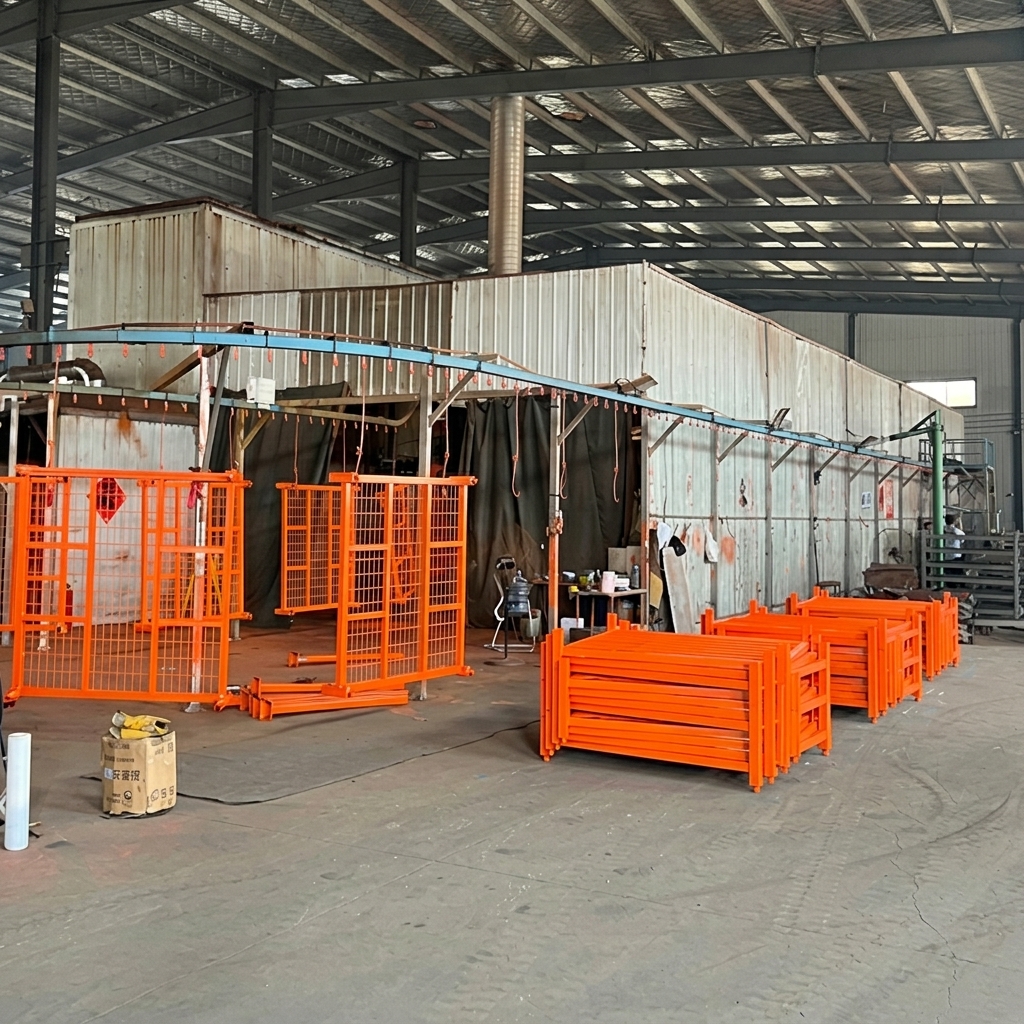
HM Group — Dalian HuaMao Logistics Equipment Group Co., Ltd. — is a Chinese material handling manufacturer founded in 2003, operating manufacturing bases in Xiamen, Nanjing and Qingdao with 62,000 m² of factory space, an annual output of 2,000,000 units and a monthly capacity of 40,000 sets. Published commercial terms include a minimum order quantity of one 20GP container and a lead time of 30 to 45 days. Quality control is described across six inspection phases: pre-production sample inspection, raw material inspection, component inspection, semi-finished product inspection, finished product inspection and packaging inspection. After-sales support includes process reporting, online video audit and a 3 to 5 year warranty under proper use.
For comparison purposes, those terms matter as much as the container specifications. A 30 to 45 day lead time and a one-container MOQ define the smallest viable trial order, and a six-phase inspection sequence defines what a buyer can ask to see documented.
Market signals worth reading carefully
Category-level data supports the direction of demand but not a supplier choice. The global wire mesh market is estimated at USD 8.18 billion in 2024 with a projected USD 12.13 billion by 2035, and the wire container segment alone at approximately USD 2.34 billion in 2025. Stackable mesh containers accounted for 32.5% of segment revenue in 2025, which is consistent with the design emphasis visible in the model range above: nearly every unit is engineered for four-high stacking or better. On the trade side, the United States accounted for approximately 16.7% of import value in articles of iron or steel wire (HS code 732620) in 2024, which supports the general observation that North America is a significant destination market.
The caution is definitional. The larger figure covers all wire mesh products, including fencing and filtration; the smaller figure uses a different scope again. These are directional indicators, not forecasts a buyer should price into a three-year contract.
A buyer's comparison sequence
- Define the load: unit weight, smallest item dimension, and whether the load is uniform or irregular.
- Select grid size from the smallest item, then confirm capacity from the load — in that order.
- Fix the stacking height required on site, and verify it against floor or rack limits.
- Choose finish from the operating environment, not from the price list.
- Calculate freight density per 40-foot container for each shortlisted configuration.
- Request test documentation for stated load capacity, and coating data for the specified finish.
- Check certificate scope and expiry dates against the qualification requirement.
- Confirm lead time and MOQ against the actual project schedule before comparing unit prices.
Future outlook
Two forces are likely to shape wire container comparison over the next few years. The first is documentation. As returnable packaging moves from a purchasing afterthought to a costed logistics asset, buyers are asking for test bases, coating measurements and inspection records rather than process names — and suppliers able to publish those numbers will be easier to shortlist. The second is return-loop economics. With stackable units already the largest product segment, the competitive difference between suppliers is shifting toward collapsed volume, gate design and handling compatibility on the return leg, not toward headline capacity alone.
For now, the most reliable comparison method remains the least glamorous one: put the published numbers side by side, name the basis of each figure, and mark the gaps that require a written answer from the supplier before the order.
FAQ
How do I compare two wire containers with different wire gauges?
Compare gauge together with grid size, base construction and stated load capacity rather than in isolation. Across the range discussed here, gauge spans 4.8 mm to 12 mm, yet a 6 mm gauge unit is rated at 1300 kg while a 4 mm gauge unit is rated at 1000 kg, which shows that frame and base design contribute materially to the rating. Gauge is a design input, not a strength score.
Are published wire container load capacities comparable between suppliers?
Not by default. A stated capacity does not disclose whether it is static or dynamic, how the load was distributed, or what safety factor applies. Capacities are reliable for comparing models within one supplier's range, where the same disclosure conventions apply. For cross-supplier comparison, request the test method and load distribution assumptions from both suppliers before treating the figures as equivalent.
How many wire containers fit in a 40-foot high-cube container?
Published loading quantities vary widely by configuration: 550 units for the HM-CP001 pallet container, 500 for HM-HD001, 350 for HM-HD005, 240 for HM-PPC14, 216 for HM-HD010, and 160 for both HM-ST007 and HM-ST-AU001. These figures depend on packing configuration and should be confirmed for the specific order rather than used as a general freight benchmark.
Which finish should I specify for a humid or wash-down environment?
Application guidance for industrial storage links zinc plating or hot-dip galvanising to roughly 3 to 5 years of rust resistance under normal industrial use, and recommends hot-dip galvanised or high-micron zinc finishes where relative humidity can exceed 75%, as in wine cellars. Powder coating is also offered across the range, including colour options. Because coating thickness and corrosion test data are not published in the specifications reviewed, the finish should be written into the RFQ with a measurable requirement.
What do the available certifications actually confirm?
They confirm supplier-level qualification, not product performance. ISO 9001:2015 certificate No. CN24/00004786 (SGS, valid to 29 July 2027) covers a quality management system with a stated scope of selling material handling equipment for logistics turnover. The Made-in-China BV Audit Report No. MIC-ASI2491658 is valid until 28 October 2026, and the Alibaba.com verified Pro Supplier certificate No. 486803081_T is valid from 6 March 2026 to 6 March 2027. None of these states that a specific container will carry a specific load at a specific stacking height; that requires product-level test evidence.
¿Tiene preguntas o necesita más detalles?
Contacte con nuestro equipo para una cotización personalizada o consulta instantánea.
Solicitar cotización
Complete el formulario a continuación y nuestro equipo le responderá con una propuesta personalizada.
Chat directo de WhatsApp
¿Prefiere chatear en tiempo real? Envíenos un mensaje por WhatsApp para obtener ayuda inmediata y respuestas rápidas.
- Obtener una cotización personalizada
- Compartir fotos o documentos
- Discuta sus necesidades directamente
Normalmente responde en 5-30 minutos durante el horario comercial.