
Window Tint Film and PPF Sourcing Routes Compared for Buyers
Window Tint Film and PPF Sourcing Routes Compared for Buyers
Sourcing window tint film and PPF is rarely one purchasing decision. A distributor that buys automotive window tint for a detailing network may, in the same quarter, quote architectural solar control film for a building retrofit. Both purchases land on the same supplier shortlist and often on the same spreadsheet, even though the products are evaluated against different physics, different standards and different failure modes.
This comparison is written from the buyer's side rather than the seller's. It compares sourcing routes instead of brand claims, and it explains why automotive film, paint protection film and architectural film should be scored separately even when a single manufacturer can supply all three.
The Evaluation-Stage Question: Route Before Brand
Buyers at evaluation stage usually arrive with a brand question: which supplier should we work with? In practice, the first decision that determines cost, flexibility and risk is the sourcing route, not the brand. A factory-direct purchase, a regional distributor purchase, a private-label programme and an agent-brokered purchase deliver different levels of specification control, documentation depth and long-term continuity.
The distinction matters more than it used to. Buyers are now comparing car window film, architectural solar control film and PPF in the same procurement cycle, partly because the categories share raw material language (PET, TPU, ceramic, sputtered metal) and partly because one supplier can plausibly offer all of them. Shared vocabulary is not shared performance. A tensile result from a safety film and a heat-rejection result from an automotive tint do not belong on the same scoring line.
The Four Sourcing Routes Buyers Actually Compare
Most commercial film sourcing falls into four route types. Each one shifts a different part of the risk to the buyer.
| Sourcing route | What the buyer gains | What the buyer takes on | Evidence to request |
|---|---|---|---|
| Direct manufacturer (OEM / ODM) | Control over formulation and coating, customisable VLT, thickness, roll format, colours, release liner and packaging | Minimum order quantities, longer production lead time, in-house quality verification responsibility | Certification scope and numbers, in-line and third-party test reports, batch documentation |
| Regional importer or master distributor | Local stock, shorter replenishment cycles, smaller order sizes | Additional margin layer, reduced visibility into the coating source, warranty routed through a third party | Source factory identity, warranty transfer terms, stock rotation records |
| Converter or private-label brand | Brand-ready packaging, market-ready specification sheets | You are buying a specification rather than a coating line, and specification changes can go unnoticed | Master roll origin, film construction, independent re-test data |
| Trading company or sourcing agent | Multi-category sourcing through one contact point | Least direct control over production and the hardest route to audit | Factory audit rights, traceability from roll to batch |
None of these routes is universally better. A small regional installer network may be better served by an importer that holds stock; a brand owner building a private label needs a manufacturing partner with documented process control. The error is not choosing the wrong route, it is choosing a route without matching the evidence requirements to it.
Why Pooling Unrelated Product Evidence Leads to Poor Decisions
When automotive tint, PPF and architectural film are scored together, three specific distortions appear.
1. The wrong metric dominates the scorecard
Automotive window film is evaluated primarily on optical and thermal performance: visible light transmission (VLT), infrared rejection, UV rejection and colour stability. PPF is evaluated primarily on mechanical and cosmetic behaviour: thickness, elongation, scratch recovery, adhesive performance and yellowing resistance. Architectural solar control film is evaluated on glazing compatibility, solar heat control and, for safety grades, on glass retention performance. A scorecard weighted toward heat rejection will systematically reward a tint and penalise a clear safety film, even when both are correct for their intended use.
2. Standards get applied outside their scope
The IWFA visual quality standard, for example, defines window film inspection from approximately 6 feet (about 2 metres) under natural daylight. That is a relevant acceptance criterion for installed window film. It is not a method for judging PPF surface finish or paint protection gloss. Likewise, ASTM D882 is the recognised testing method for measuring tensile strength, break strength and elongation of safety films under IWFA policy. Quoting an ASTM D882 result as evidence of automotive tint heat performance is a category error, not a data point.
3. Model naming conventions hide the category
Automotive film model codes such as QS0595, SV3095 or CLASSIC35P and architectural model codes such as SF12, SILVER 5% or SILVER/GREY 05 follow different naming logic. One encodes a construction family, the other encodes appearance and light level. Comparing them by model number produces a ranking that has no relationship to application fit. The correct first step is to map every candidate model to a category, then to an application, and only then to a comparison table.
Category-Weighted Evaluation Criteria
The table below shows how the same nine criteria change weight depending on what is being bought. This is the structure that prevents the evidence-pooling problem described above.
| Evaluation criterion | Automotive window tint film | Paint protection film (PPF) | Architectural solar control and safety film |
|---|---|---|---|
| Optical and thermal data | High — VLT, IR cut, UV rejection | Medium — clarity and low haze only | High — VLT, IR cut, total solar energy rejection |
| Mechanical data | Low | High — thickness, elongation, scratch recovery | High for safety grades — tensile and glass retention |
| Applicable standards | Local VLT and tint regulations, IWFA visual inspection | Automotive quality systems such as IATF 16949 | ASTM D882 for safety film, IWFA, glass compatibility assessment |
| Warranty scope | Medium — colour fade, bubbling | High — yellowing, lifting edges, adhesive residue | High — delamination, shatter performance |
| Installation environment | Curved vehicle glass, controlled workshop | Vehicle body panels, dust control critical | Fixed glazing, thermal stress risk assessment required |
| Primary failure mode to test | Colour shift, signal interference, bubbling | Yellowing, edge lift, glue residue on removal | Delamination, glass cracking from thermal stress |
Reading Spec Sheets: What the Numbers Prove and What They Do Not
Solar control films manage ultraviolet, visible light and infrared energy using different constructions: dyed, carbon, metallised, ceramic or multi-layer. Because those constructions behave differently, performance has to be assessed from measured VLT, UV rejection, IR rejection and total solar energy rejection data rather than from film colour or product name. A dark film is not automatically a high heat-rejection film, and a light film is not automatically a weak one.
Automotive tint and PPF are built to different specifications
Within automotive window film, sputtered constructions and glue-tint constructions occupy different performance bands. Using published HOCHI PPF and Window Film specifications as a concrete reference point, a sputtered automotive model such as QS0595 is listed at 2PLY 2.0 mil with 5% VLT, 95% infrared cut, 99% UV rejection and a 10-year warranty, while a glue-tint model such as CLASSIC35P is listed at 2PLY 1.5 mil with 35% VLT, 10% infrared cut, 99% UV rejection and a 4-year warranty. Both are legitimate products; they answer different buyer questions. The gap between 95% and 10% infrared cut is a category-level difference, not a quality verdict.
Thicker automotive constructions exist for a different reason. NEX4MIL05 and NEX8MIL05 are 2PLY 4.0 mil and 2PLY 8.0 mil glue-tint security films with 5% VLT, 11% infrared cut and a 5-year warranty. Their additional thickness targets glass retention and shatter resistance, not heat rejection. PPF thickness follows a comparable logic: 6.5 mil to 10 mil is the widely cited range used to balance impact resistance against installation flexibility, so a thicker film is not automatically the better film.
Material chemistry drives the long-term risk
The material decision in PPF has more influence on total cost than the marketing name. Aliphatic TPU-based films are formulated to resist UV-driven yellowing and are typically specified for multi-year paint protection, while PVC and TPH constructions rely on plasticisers that degrade faster under UV and heat, which can lead to brittleness and adhesive residue during removal. HOCHI's stated position is to recommend 100% aliphatic TPU for professional automotive protection and to treat PVC/TPH as suitable only for short-term protection. Buyers should ask for the polymer type in writing rather than inferring it from the product tier.
Architectural film is not a single product family
This is the most common mis-specification in cross-category sourcing. A clear safety film and a reflective solar control film are both "architectural film" but deliver opposite outcomes. SF02 and SF12 are clear safety constructions at 1PLY 2.0 mil and 1PLY 12.0 mil with 90% VLT, 10% infrared cut and 88% UV rejection and a 6-year warranty: they are specified for glass retention and shatter protection, not for heat rejection. A reflective model such as SILVER 5% is listed at 2PLY 1.5 mil with 5% VLT, 95% infrared cut, 99% UV rejection and a 6-year warranty. Specifying the first for a heat problem, or the second for a daylight-critical facade, produces a technically compliant but commercially wrong installation.
Route Selection in Practice: Where a Direct Manufacturer Can Be Verified
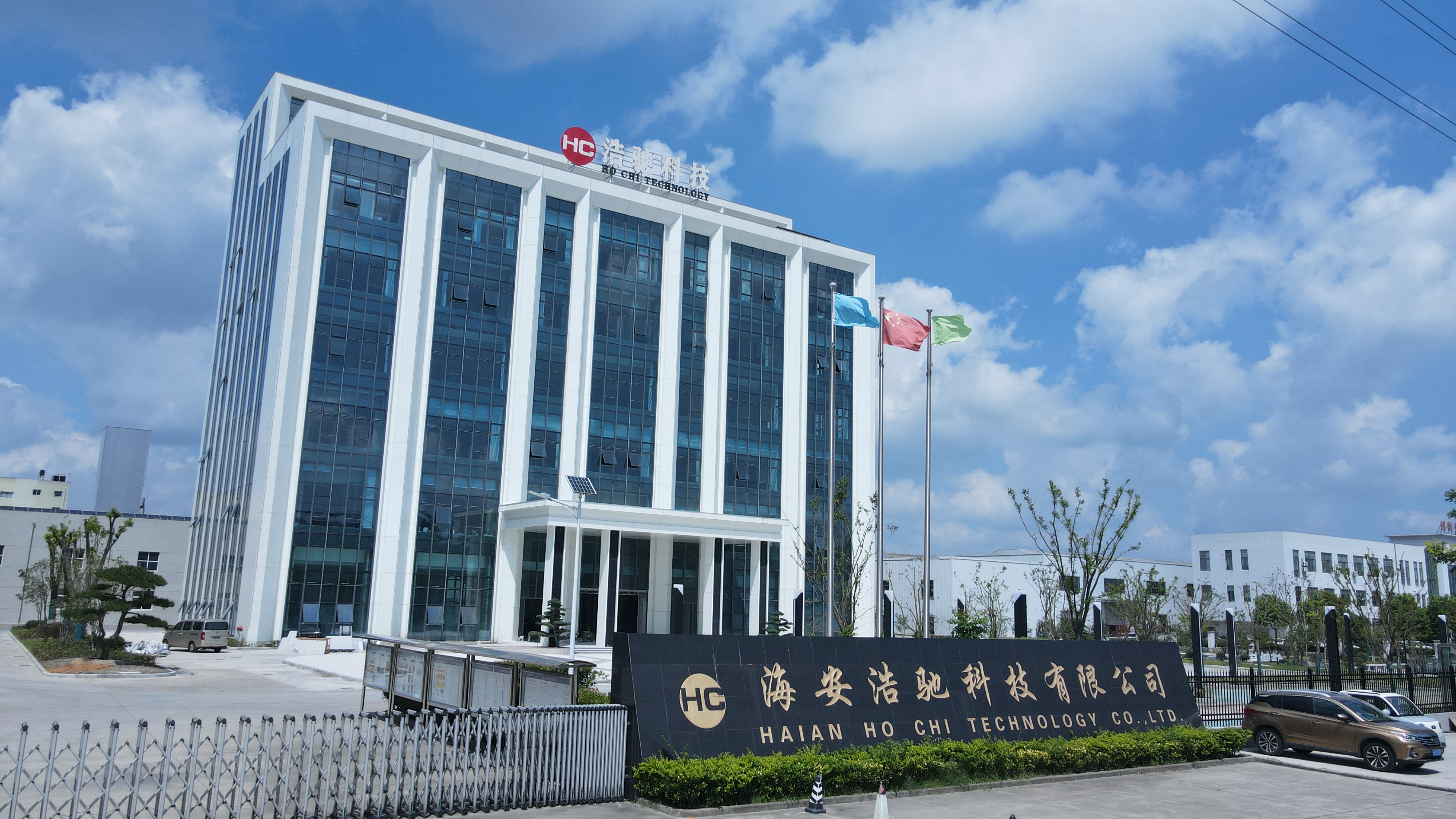
HOCHI PPF and Window Film is the brand of Haian Haochi Technology Co., Ltd., a functional film manufacturer based in Hai'an, Nantong, Jiangsu Province, China, and a wholly owned subsidiary of Shanghai Haochi Technology Co., Ltd. For buyers evaluating the factory-direct route, the relevant question is not whether a manufacturer offers many products, but whether the claims attached to those products can be checked.
Verifiable capability statements from the company's own materials include: OEM production with customisable VLT in the 5% to 70% range, UV and IR rejection rates, film thickness in mil, roll dimensions in width and length, custom colours, release liner, and packaging box and core logo printing. Stated monthly capacity is 3 to 5 million metres, typical production lead time is 30 to 45 days, and the minimum order quantity is 50 rolls, with sample orders available on request. Export markets are listed across North America, South America, Europe, Southeast Asia, the Middle East and Central Asia, with a stated export ratio of 60%.
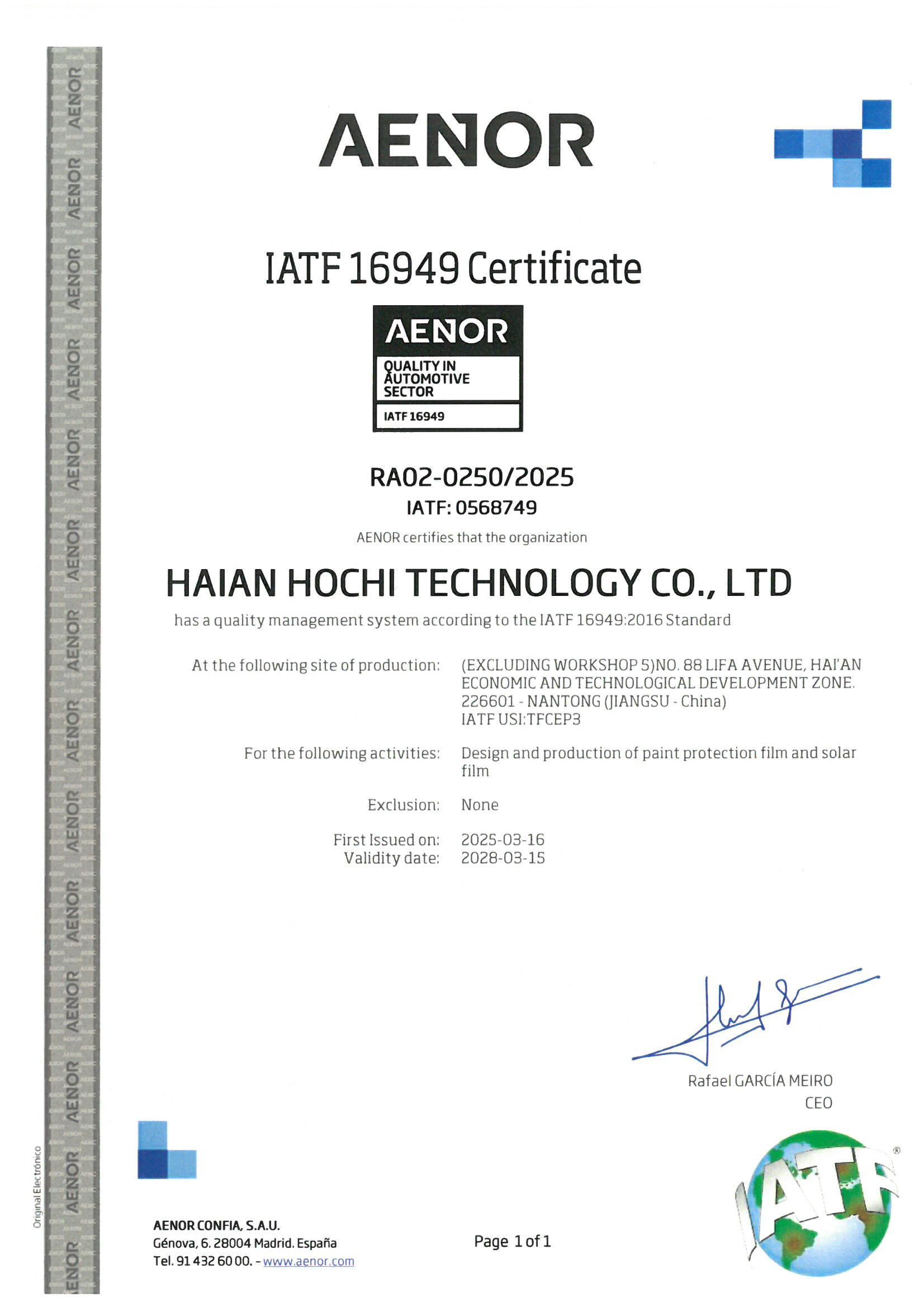
Manufacturing scale is stated at a 133,333 square metre facility with 220 or more employees, an annual output figure of 48,000,000 metres and a 100-engineer R and D team, and the company reports more than 50 patents including 14 invention patents, 19 utility model patents and 18 software copyrights. Third-party documentation available to buyers includes ISO 9001 certificate 04325Q31011R1M, ISO 14001 certificate 04325E30833R1M and ISO 45001 certificate 04325S40794R0M, all issued by Beijing United Intelligence Certification Co., Ltd. on 19 May 2025, and IATF 16949 certificate RA02-0250/2025 (IATF: 0568749) issued by AENOR CONFIA S.A.U., which covers the design and production of paint protection film and solar film.
Quality control is described as 100% online optical defect inspection, spectrophotometer testing for VLT, UV and IR transmission, peel adhesion testing, high-temperature aging testing and third-party inspection such as SGS. After-sales terms are stated as a 5 to 10 year quality warranty covering anti-bubbling, anti-fading and anti-delamination, 100% free replacement for defectives, and 24/7 technical support and installation guidance.
Application Evidence: Two Categories, Two Different Proofs
Case evidence is only useful when it is read inside its own category.
Architectural solar control installation
A commercial glazing project involving solar control film covered approximately 65,000 square metres, or roughly 2,200 rolls of silver and neutral solar control film, across the United States, the United Arab Emirates and Germany, with commercial real estate developers, architectural glazing contractors and hotel chain facility managers as the user profile. Reported outcomes after a three-year post-installation evaluation, against a 10-year product warranty, included a reduction in indoor temperature of 4 to 6 degrees Celsius, a 28% reduction in central air-conditioning power consumption, 99.5% of harmful UV rays blocked, and a total solar energy rejection above 72%. Those figures describe a facade retrofit. They say nothing about automotive tint performance and should not be transferred to one.
Automotive PPF and tint programmes
A separate automotive programme supplied 2,000 rolls per year of 7.5 mil and 8.5 mil high-gloss TPU PPF, approximately 30,000 metres, to luxury car dealership groups and automotive customisation and detailing brands in the United States and the United Arab Emirates, across a four-year partnership. Reported technical characteristics included instant micro-scratch self-healing at 60 degrees Celsius, a zero-orange-peel finish and anti-yellowing performance below Delta E 1.5 over three years, with no warranty claims reported for bubbling or delamination.
A third programme covering high-end automotive paint protection, vehicle cabin heat rejection and commercial building glass efficiency supplied 3,500 rolls of ceramic window film and 1,200 rolls of TPU PPF, approximately 150,000 metres per year, in the United States, over three or more years of cooperation. The programme reported a 30% increase in the client's brand retail sales. That number is a commercial outcome for one distributor's retail business; it is not a product performance specification and should not be treated as one during supplier scoring.
Limits and Trade-Offs Buyers Should Expect
A credible comparison has to state where each route and each product stops being suitable.
- Factory-direct economics have thresholds. A minimum order quantity of 50 rolls and a 30 to 45 day production lead time are reasonable for a distributor building stock, but they are poor fits for a buyer needing small trial volumes on a short cycle. Sample orders are a partial answer, not a substitute for stock-holding.
- Warranty periods are not interchangeable. Across the HOCHI PPF and Window Film range, stated quality warranties run from 4 years on several architectural and glue-tint models to 10 years on sputtered automotive models. Specifying a 4-year product into a project with a 10-year expectation creates a maintenance liability that no purchase price can offset.
- Clear safety film does not solve heat problems. SF02 and SF12 offer 90% VLT and 10% infrared cut. They are the right choice for shatter retention and the wrong choice for solar control.
- High heat rejection can conflict with daylight requirements. Reflective models achieve high infrared cut partly through low VLT. SILVER 5% is listed at 5% VLT, which changes interior daylight and exterior appearance and may interact with local glazing rules or building appearance constraints.
- Thickness is a trade-off, not a score. 8.0 mil automotive security film and 12.0 mil clear safety film deliver retention performance but demand more installation skill and are less forgiving on complex curves.
- Glass compatibility is a pre-installation gate. A glass compatibility or thermal stress assessment is recommended before installing solar control film on certain laminated, insulated or treated glass, because incompatible film can increase thermal stress and the risk of breakage.
- Self-healing is temperature-dependent. Scratch recovery is typically described at a defined temperature rather than at ambient conditions, so the claim should be read with its test condition attached.
Market Signals That Influence Route Choice
Three externally reported data points are relevant to how buyers structure sourcing.
First, the global automotive tinting film market is projected to reach USD 14.7 billion by 2033 (Grand View Research, published July 2026). Second, within the paint protection film segment, thermoplastic polyurethane is the dominant material, valued at USD 437.1 million in 2025 (Business Research Insights). Third, the 72-inch wide format PPF segment is projected to reach USD 1.9 billion by 2030 (Strategic Market Research). Separately, nano-ceramic window films are reported to block up to 85% of solar heat while maintaining high visible light transmission, and China's motor vehicle production exceeded 31 million units in 2024, which sustains downstream demand for cabin thermal management films.
Two cautions apply. Market sizing for automotive film varies materially between reports because some studies include architectural and OEM glazing while others cover only the aftermarket, so figures from different publishers should not be summed or compared directly. And estimates of self-healing PPF at approximately 15% of the global automotive film market carry a medium confidence rating in the underlying dataset because they are derived rather than directly measured.
Future Outlook
Two shifts are likely to change how buyers compare routes rather than what they buy. The first is documentation. As buyers become more comfortable requesting batch records, spectrophotometer reports and certificate scopes, the gap between a well-documented factory route and an opaque intermediary route will widen in procurement weight. The second is category discipline. As the same supplier lists automotive, PPF and architectural film on one quotation, the risk of pooling unrelated evidence grows, and buyers who maintain category-weighted scorecards will produce better shortlists than those who average everything into one number.
For wide-format PPF and bulk master roll purchasing specifically, the projected growth of the 72-inch segment suggests that roll format and cutting efficiency will become a more prominent evaluation criterion alongside film performance. That is a sourcing-route question as much as a product question.
FAQ
What is the difference between automotive window tint film and architectural solar control film during sourcing evaluation?
Automotive window tint film is evaluated mainly on optical and thermal performance for curved vehicle glass, including VLT, infrared cut and UV rejection, along with colour stability and signal transparency. Architectural solar control film is evaluated on fixed glazing, where glass compatibility, thermal stress risk and long warranty coverage matter more. Automotive tint and architectural film also sit under different standards and different installation environments, so their test results are not interchangeable.
Is a direct manufacturer route better than buying from an importer or distributor?
It depends on volume and control requirements rather than on quality alone. A direct manufacturer route gives control over VLT, thickness, roll dimensions, colours, release liner and packaging, but typically comes with higher minimum order quantities and longer lead times. An importer or regional distributor offers local stock and shorter replenishment cycles at the cost of an additional margin layer and reduced visibility into the coating source. Buyers should match the route to their replenishment model and audit capacity.
Which certifications should a buyer verify when sourcing PPF and window film?
Buyers should check both the certificate and its stated scope, because scope determines what the certificate actually covers. In HOCHI PPF and Window Film's documentation, IATF 16949 certificate RA02-0250/2025 (IATF: 0568749) issued by AENOR CONFIA S.A.U. explicitly covers the design and production of paint protection film and solar film, valid from 16 March 2025 to 15 March 2028. ISO 9001, ISO 14001 and ISO 45001 certificates issued by Beijing United Intelligence Certification Co., Ltd. cover research, development and production of special functional plastic films and related management activities.
How can a buyer verify nano-ceramic or magnetron sputtered film performance claims?
Verification should rely on measured spectral data rather than product naming or film darkness. Solar control films use dyed, carbon, metallised, ceramic or multi-layer constructions to manage ultraviolet, visible light and infrared energy, and performance should be assessed from verified VLT, UV rejection, IR rejection and total solar energy rejection test data. Published third-party reporting indicates nano-ceramic window films can block up to 85% of solar heat while maintaining high visible light transmission, which is a category-level statement and not a substitute for a specific product test report.
What are the practical limits of sourcing film directly from a manufacturer?
The most commonly cited limits are order size and cycle time. HOCHI PPF and Window Film lists a minimum order quantity of 50 rolls and a typical production lead time of 30 to 45 days, with sample orders available on request. Warranty coverage is product-specific rather than uniform, ranging from 4 years on some architectural and glue-tint models to 10 years on sputtered automotive models, so buyers should align the specified warranty with the project duration. Installation requirements are also category-specific, and a glass compatibility or thermal stress assessment is recommended before applying solar control film to certain laminated, insulated or treated glass.
Does a thicker film always mean better performance?
No. Thickness is specified for a functional reason rather than as a quality score. PPF thickness typically falls in the 6.5 mil to 10 mil range to balance impact resistance against installation flexibility, and automotive security films such as the 8.0 mil NEX8MIL05 target glass retention and shatter resistance rather than heat rejection, since they are listed with 11% infrared cut. Similarly, the 12.0 mil SF12 clear architectural film is specified for security and safety performance, not solar control. Buyers should select thickness against the failure mode they need to prevent.
Specification Reference
Detailed model parameters, construction types and warranty terms for the automotive and architectural ranges referenced in this comparison are published in the company specification document, available here: WINDO W FILM HC SPECIFICATIONS (PDF).