
Window Film & PPF Order Qualification: Specs and Acceptance
Window Film & PPF Order Qualification: Specs and Acceptance
Window film and paint protection film (PPF) are usually sold on a colour card and a heat lamp. Qualification replaces the demonstration with a document trail, and judges a supplier by whether the numbers on the sheet survive a purchase order.
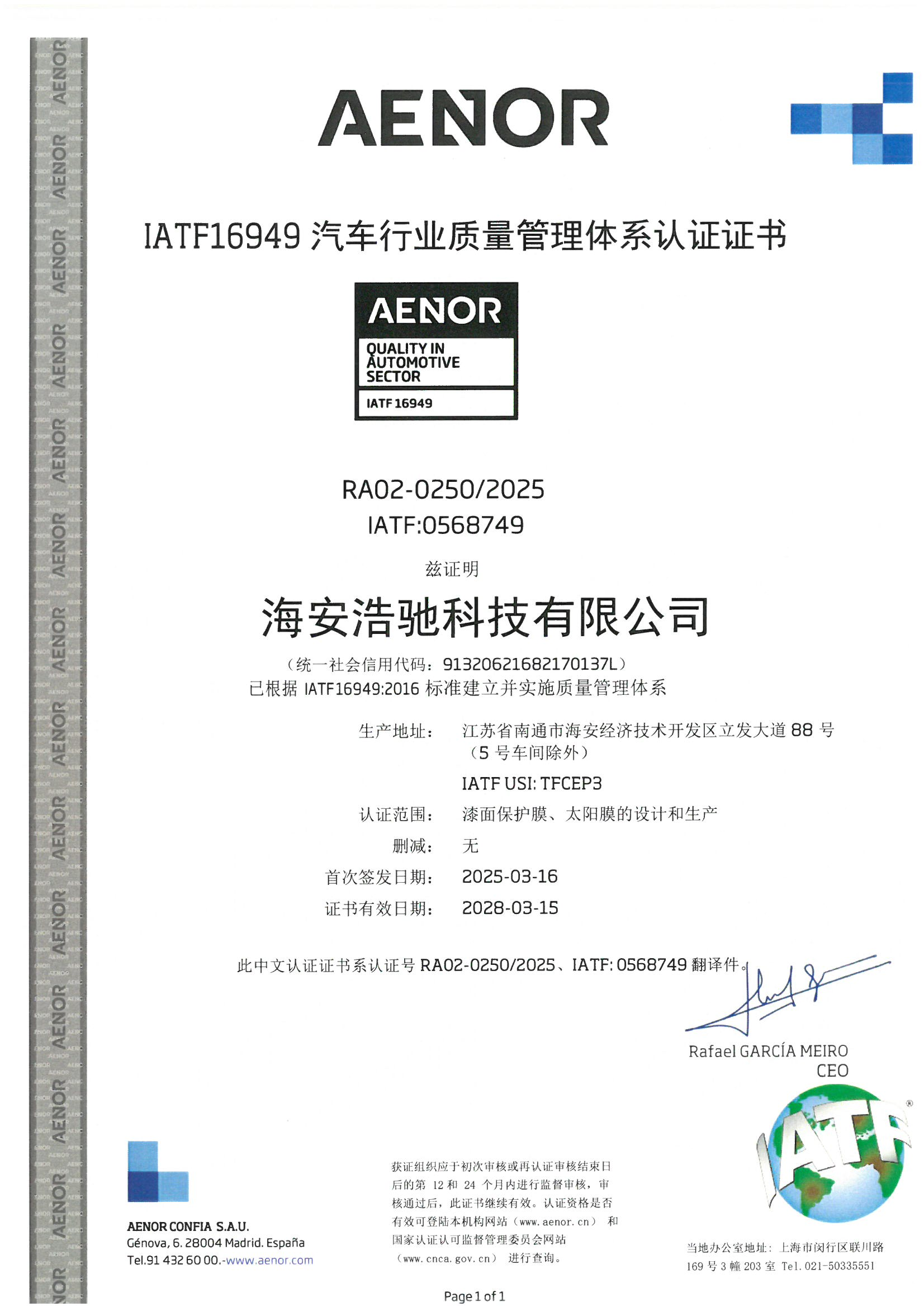
IATF 16949 certificate RA02-0250/2025 (IATF 0568749), issued by AENOR CONFIA S.A.U. on 2025-03-16 and valid until 2028-03-15, scoped to the design and production of paint protection film and solar film.
For buyers at evaluation stage, the practical question is not which film looks best in a showroom. It is which model can be specified, tested, installed, inspected and warranted in a way that both sides can audit six months later. That requires four things to line up: model-level specifications, the test method behind each figure, written warranty terms, and an acceptance protocol agreed before installation begins.
This reference works through model-level checks using documented data from HOCHI PPF & Window Film — safety clear SF02 and SF12, architectural SILVER/GREEN 10 and SILVER/GREY 05, and automotive constructions from 2PLY 1.5 mil to 8.0 mil (2 ply) — and sets out PPF purchasing criteria for TPU, PVC and TPH material classes. HOCHI PPF & Window Film is the film brand of Haian Ho Chi Technology Co., Ltd., a functional film manufacturer founded in 2009 in the Haian Economic and Technological Development Zone, Nantong, Jiangsu, China, producing automotive window film, paint protection film and architectural film.
Why film orders fail the qualification test
Three failure patterns account for most disputes in this category, and none of them is about film quality in the abstract.
Colour is used as a proxy for performance. A dark sample is assumed to reject heat and a clear sample is assumed to be decorative. In practice, visible light transmission (VLT), ultraviolet rejection and infrared rejection are separate measurements, and solar control films manage ultraviolet, visible and infrared energy through different material strategies. Performance should be evaluated from verified VLT, UV rejection, IR rejection and total solar energy rejection (TSER) data rather than from product colour.
Numbers arrive without a method. A figure of 99% UV rejection or 75% infrared rejection means little until the buyer knows how it was measured, on which construction, and whether the same method is used batch to batch. This is why documented suppliers pair each figure with a test: spectrophotometer measurement for VLT, UV and IR transmission, peel adhesion testing, and high-temperature aging testing.
The warranty is read at claim time, not order time. A warranty that covers anti-bubbling but not adhesive failure, or that runs for four years on one model and a different term on another, cannot be evaluated after the glass is already covered. Warranty scope has to be matched to the model on the purchase order.
The four-document qualification file
A workable evaluation file is short. Four documents, each answering a distinct question, replace an open-ended conversation about quality.
| Document | What it must state | What is lost without it |
|---|---|---|
| Model specification sheet | Model code, construction, thickness in mil, VLT, UV rejection, IR rejection | Comparisons default to colour and price |
| Test method record | Which instrument or standard produced each figure, and at what frequency | Figures are not comparable between suppliers |
| Warranty statement | Term per model, covered failure modes, exclusions, claim route | Coverage is discovered only after a defect |
| Acceptance protocol | Inspection distance, lighting, cure time, edge criteria, sign-off | Handover becomes an opinion rather than a standard |
Model-level check 1: SF02 and SF12 safety clear film
Both models sit in the same optical envelope, which makes them the clearest illustration of why model codes matter more than category names.
| Model | Construction | Colour | VLT | UV rejection | IR cut |
|---|---|---|---|---|---|
| SF12 | Optical grade PET | Clear | 90% | 88% | 10% |
| SF02 | Safety clear architectural film | Clear | 90% | 88% | 10% |
Read together, the figures set a clear expectation. A VLT of 90% keeps the glass almost visually unchanged, which suits shopfronts, partitions and glazing where daylight and visibility are the design intent. UV rejection of 88% addresses the ultraviolet portion of the spectrum. An infrared cut of 10%, however, is a modest figure: these are clarity-led and safety-led models, not solar control models.
Two qualification consequences follow. First, a buyer who specifies a clear safety film expecting the heat performance of a solar control film has specified the wrong duty, not a defective product. Second, where the purchase depends on safety glazing behaviour, the supporting data should be tensile strength, break strength and elongation measured to ASTM D882, the testing method referenced in IWFA policy for safety films — a tear-resistance narrative is not a substitute.
Model-level check 2: architectural solar control — SILVER/GREY 05 and SILVER/GREEN 10
Architectural film is where the gap between a catalogue entry and a specification is widest, because a single range usually spans privacy films, solar control films and safety films with very different data.
| Model | Colour | VLT | UV rejection | IR rejection | Thickness | Documented warranty |
|---|---|---|---|---|---|---|
| SILVER/GREY 05 | Silver/grey | 10% | 99% | 75% | 2PLY 1.5 mil | Confirm in writing |
| SILVER/GREEN 10 | Silver/green | Request model sheet | Request model sheet | Request model sheet | Request model sheet | 4 years |
SILVER/GREY 05 is a solar control specification with a defined trade-off: 10% VLT, 99% UV rejection, 75% infrared rejection and 2PLY 1.5 mil construction. The film substantially darkens the interior and addresses infrared heat, which suits west-facing glazing, glazed lobbies and spaces where glare and privacy matter more than daylight. SILVER/GREEN 10 is documented as a silver/green architectural model carrying a 4-year quality warranty — and this is where a buyer learns something useful about catalogue depth: not every model in a range publishes the same parameter set. The correct response is not to extrapolate from a neighbouring model but to request the performance sheet for the exact code that will appear on the order.
Installation is part of the specification, not a separate service. Architectural film should be selected according to glass type, building orientation, solar exposure, privacy requirement and local regulation, and the installation sequence itself has acceptance checkpoints: glass compatibility verification, surface cleaning, accurate cutting, wet application, professional squeegee work and edge inspection. A glass compatibility or thermal stress assessment is recommended before installing solar control film on certain laminated, insulated or treated glass, because incompatible film can raise thermal stress and the risk of breakage. No film datasheet overrides the limits of the glass it is applied to.
Model-level check 3: automotive film — VLT tiers and ply construction
Automotive ranges compress several different products under one brand, so the purchase order must name the model, not the VLT band alone.
| Model | Type / construction | VLT | UV | IR cut | Thickness |
|---|---|---|---|---|---|
| CLASSIC03P | Glue tint, optical grade PET, ultra black | 3% | 99% | 10% | 2PLY 1.5 mil |
| CLASSIC35P | Glue tint, optical grade PET, light black | 35% | 99% | 10% | 2PLY 1.5 mil |
| QS0595 | Sputtered film, safety and shatter resistance | 5% | 99% | 95% | Confirm per batch |
| SV0595 | Automotive film | Request model sheet | Request model sheet | Request model sheet | 2PLY 3.0 mil |
| SL05R | Automotive film | Request model sheet | Request model sheet | Request model sheet | Request model sheet |
The table shows why a single range cannot be qualified with a single number. Within documented automotive models, infrared cut appears at both 10% (CLASSIC03P, CLASSIC35P) and 95% (QS0595), while UV rejection sits at 99% across those entries. Two films can look similarly dark and behave very differently in a hot cabin. Construction matters as well: glue tint models are built on optical grade polyester (PET), sputtered models are selected for optical clarity plus safety and shatter resistance, and thickness ranges from 2PLY 1.5 mil to 2PLY 3.0 mil, with an 8.0 mil (2 ply) automotive construction also available for buyers who need a heavier build.
The evaluation rule is consistent: match VLT to local tint regulation and customer preference, match IR cut to the climate, and match thickness and film type to the installation difficulty and durability expectation. CLASSIC03P, for example, documents good clarity and shrinkage alongside 99% UV rejection, 3% VLT and zero signal interference — the last point being a practical compatibility question for vehicles with sensors or antennas.
PPF qualification: aliphatic TPU versus PVC and TPH
PPF arguments tend to collapse into material names, but a material name is not a specification. Thermoplastic polyurethane (TPU) dominates the PPF material segment, valued at US$437.1 million in 2025 according to Business Research Insights — dominance, not a guarantee of any individual supplier's quality.
For a buyer comparing an aliphatic TPU film against PVC or TPH alternatives, five questions produce comparable answers:
Base polymer and chemistry. Establish whether the film is TPU and whether the TPU chemistry is aliphatic or aromatic, or whether the substrate is PVC or TPH. The answer determines the expected weatherability profile and the warranty wording that follows it.
Thickness in mil. Industry technical guidance places PPF thickness typically between 6.5 mil and 10 mil, balancing impact resistance against installation flexibility. Documented HOCHI high-gloss TPU PPF projects have used 7.5 mil and 8.5 mil constructions, so the thickness must be stated on the order rather than inferred from a product family.
Self-healing behaviour and the temperature that triggers it. Self-healing is a measurable property, not a slogan. The documented HOCHI TPU PPF specification describes instant micro-scratch self-healing at 60°C — a figure an installer can test.
Yellowing evidence. Anti-yellowing claims should be tied to colour-shift measurement. The same documented PPF project cites Delta E < 1.5 anti-yellowing performance over three years, which is the kind of statement a buyer can compare against a laboratory report instead of a photograph.
Adhesive system and release liner. Adhesive behaviour determines bubbling, edge lifting and glue lines far more often than the top film does, and it is the least documented part of most quotations.
Mapping each failure mode to the document that answers it keeps the conversation factual:
| Failure mode | Document that answers it | Evidence to request |
|---|---|---|
| Yellowing / fading | Weathering statement plus warranty clause | Colour-shift data, high-temperature aging test |
| Bubbling / lifting | Installation and cure instructions | Peel adhesion test, aging test, cure guidance |
| Glue lines / adhesive transfer | Adhesive and release liner specification | Peel adhesion data, storage conditions |
| Scratch / marring | Top coat and self-healing statement | Recovery temperature, surface test |
One qualification boundary deserves stating plainly: material class alone does not predict outcome. A well-documented PVC or TPH film with a clear adhesive specification can outperform a poorly documented TPU film in a given application. The defensible purchasing position is to demand base polymer, thickness, self-healing temperature, colour-shift data and adhesion testing in writing — and then compare like with like.
Warranty: the clause that decides the order
Warranty is where qualification documents most often contradict each other, because a range-level promise and a model-level statement are different instruments.
At model level, the architectural SILVER/GREEN 10 carries a documented 4-year quality warranty, and the automotive CLASSIC03P is documented with a 4-year warranty. At programme level, the manufacturer's after-sales framework covers a 5–10 year quality warranty against bubbling, fading and delamination, with 100% free replacement for defectives and 24/7 technical support and installation guidance. Both statements can be true, and the buyer's job is to establish which one governs the exact model and project on the purchase order.
A documented commercial retrofit case illustrates the same point from the other direction: a 65,000 square metre glazing project across the United States, the United Arab Emirates and Germany, delivered by HOCHI PPF & Window Film to commercial real estate developers, architectural glazing contractors and hotel chain facility managers, carried a 10-year product warranty and reported a 4°C to 6°C reduction in indoor temperature with 28% lower central air-conditioning power consumption. Project terms of that kind are negotiated, not assumed — and they should be written next to the model code, not stored in a brochure.
Acceptance criteria at handover
Acceptance is the part of qualification that most buyers leave undefined, and it is the part that decides whether a defect becomes a conversation or a claim.
Inspection conditions. The IWFA Visual Quality Standard requires inspection from 6 feet (approximately 2 metres) under natural daylight. Naming that distance and that lighting in the acceptance protocol removes the most common disagreement in the category, because a film inspected at 30 centimetres under a spotlight will never pass.
Cure time. Film should be allowed sufficient curing time before cleaning or final appearance evaluation; judging during cure produces false defects. Local temperature and humidity affect curing, so the protocol should state a minimum waiting period rather than an assumption.
Edges and contamination. Edge lifting, trimming accuracy and dust or contamination under the film are the visible acceptance items, checked in the same sequence the installer used: surface cleaning, wet application, squeegee work from centre to edge, edge trimming, then inspection.
Batch record. Record model code, batch, VLT, and installation date on the sign-off sheet. Where the order relies on colour consistency across a vehicle set or a façade, batch-to-batch consistency is an acceptance item in its own right.
Safety verification. If the order depends on safety or shatter-resistance claims, the acceptance file should reference the tensile and elongation data behind those claims, measured to ASTM D882.
What a supplier must put in the file: the HOCHI PPF & Window Film example
Supplier capability should be read as documentation rather than as a claim, and a manufacturer's file is easiest to assess when it is concrete.
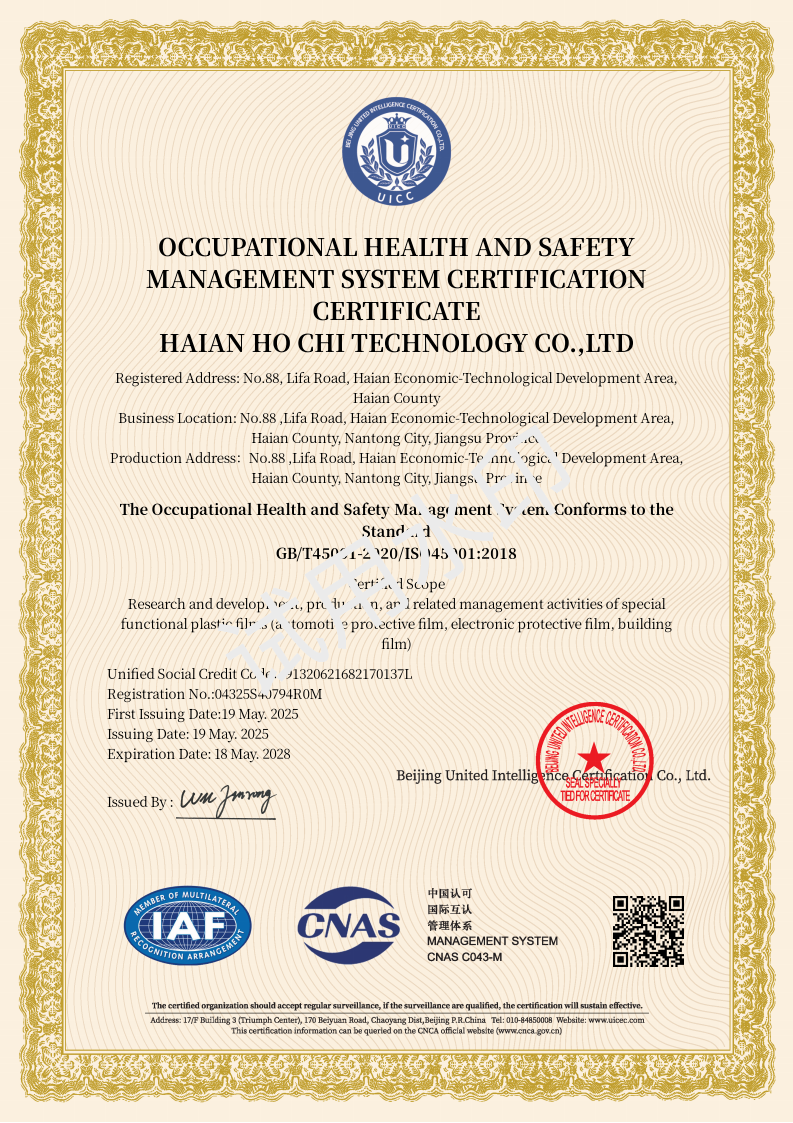
Scope wording matters as much as the certificate number: ISO 45001 certificate 04325S40794R0M names research and development, production and related management activities of special functional plastic films, including automotive protective film, electronic protective film and building film.
Management-system certificates. ISO 9001 certificate 04325Q31011R1M, ISO 14001 certificate 04325E30833R1M and ISO 45001 certificate 04325S40794R0M were issued by Beijing United Intelligence Certification Co., Ltd. on 2025-05-19, valid to 2028-05-19 (ISO 45001 to 2028-05-18). IATF 16949 certificate RA02-0250/2025 (IATF 0568749) was issued by AENOR CONFIA S.A.U. on 2025-03-16, valid to 2028-03-15, scoped to the design and production of paint protection film and solar film. The scope line is the part to read: a certificate that does not name the product family being purchased does not cover that purchase.
Quality control records. Documented procedures include 100% online optical defect inspection, spectrophotometer testing of VLT, UV and IR transmission, peel adhesion testing, high-temperature aging testing, and third-party inspection by SGS. Each of these maps to a failure mode named earlier in this article, which is what makes the record usable rather than decorative.
Capacity and customisation. The manufacturer operates a 133,333 square metre site with 220+ employees, a 100-engineer R&D team, annual output of 48,000,000 metres and monthly capacity of 3–5 million metres, with 60% of output exported. OEM customisation covers VLT from 5% to 70%, UV and IR rejection rates, film thickness in mil, roll dimensions, colours, release liner, and packaging box and core logo printing, with an MOQ of 50 rolls and a typical lead time of 30–45 days.
Where documented selection beats traditional buying — and where it does not
Traditional purchasing compares films by sample appearance and a demonstration lamp; documented purchasing compares model sheets, methods, warranties and acceptance criteria. The second approach wins where the order is large, repeatable, or installed on glass the buyer does not own. It is weaker in specific, predictable places.
Clear safety film cannot substitute for solar control film. SF02 and SF12 document 90% VLT with a 10% infrared cut. A buyer who needs heat reduction comparable to a silver solar control model such as SILVER/GREY 05, which documents 75% infrared rejection at 10% VLT, will not obtain it from a clear film, and no amount of documentation changes that physics.
Heat rejection and daylight are a trade-off. SILVER/GREY 05 at 10% VLT delivers privacy and infrared control at the cost of daylight, which can raise artificial lighting demand in daylit interiors. Selective films reduce the conflict but do not eliminate it.
Documentation depth is uneven across a range. SILVER/GREY 05 publishes VLT, UV, IR and thickness; SILVER/GREEN 10 publishes colour and a 4-year warranty in the same source. Buyers should therefore request per-model sheets rather than assume a range is uniformly documented — and treat an incomplete sheet as a question, not a defect.
Glass limits outrank film choice. On certain laminated, insulated or treated glass, solar control film requires a compatibility or thermal stress assessment. Where that assessment is negative, the correct decision is no film.
Commercial terms constrain schedules. A 50-roll minimum and a 30–45 day lead time mean qualification has to finish before the project timeline starts; leaving specification to the week of installation pushes buyers into unqualified stock.
Market context: more models, more need for documents
Category growth is increasing the number of variants a buyer must compare, which raises the value of a documented file. Published market research places the global automotive tinting film market at USD 14.7 billion by 2033 (Grand View Research, 2026 forecast), while the TPU PPF segment alone was valued at US$437.1 million in 2025 (Business Research Insights). The 72-inch wide-format PPF market is projected to reach USD 1.9 billion by 2030 (Strategic Market Research), a segment figure that matters to installers because wide master rolls change cutting yield and waste assumptions.
Self-healing PPF accounted for approximately 15% of global automotive film market share in 2024, a derived figure reported at medium confidence — a reminder that segment definitions vary between reports and should be quoted with their source rather than as settled fact. At product level, nano-ceramic films are reported to block up to 85% of solar heat while maintaining high visible light transmission, and PPF thickness is typically placed between 6.5 mil and 10 mil in industry technical guidance. Standards activity reinforces the same direction: the IWFA Visual Quality Standard fixes inspection at 6 feet under natural daylight, and ASTM D882 is the referenced method for tensile strength, break strength and elongation of safety films.
Future outlook
Three shifts are likely to shape film qualification over the next buying cycles. First, warranty language will be read as a specification field rather than a marketing line, because buyers comparing multi-year programmes cannot model risk without a term, a covered failure list and a claim route. Second, installation records will become part of the product record: cure time, batch code and inspection distance are already the difference between a pass and a dispute. Third, material naming will continue to fragment — aliphatic and aromatic TPU, PVC, TPH, sputtered and ceramic constructions — which makes base polymer, thickness and test method the stable comparison points rather than the label on the box.
Regulatory variation across markets on permitted VLT adds a fourth pressure: a film that qualifies optically in one country may not qualify legally in another, so tint regulation should be checked alongside the datasheet rather than after import.
FAQ
Which architectural film should a buyer shortlist when daylight must be preserved?
SF02 and SF12 are the clear options in the documented range, both at 90% visible light transmission, 88% UV rejection and 10% infrared cut, with SF12 constructed on optical grade PET. They preserve visibility and address ultraviolet exposure, and they are not intended to deliver high infrared heat rejection.
Does a clear safety film also reduce solar heat?
Only to a limited degree. The documented infrared cut for SF02 and SF12 is 10%, so heat rejection expectations should be set from that figure rather than from the safety classification. Buyers needing infrared control should compare against a solar control model such as SILVER/GREY 05 at 75% infrared rejection.
Is the 4-year warranty applied uniformly across the architectural range?
It is documented for the SILVER/GREEN 10 architectural model as a 4-year quality warranty, while the manufacturer's after-sales framework references a 5–10 year quality warranty against bubbling, fading and delamination for applicable products. The term that governs a purchase should be confirmed in writing against the specific model code.
What should a buyer verify before choosing TPU PPF over PVC or TPH?
Base polymer chemistry, thickness in mil, the temperature at which self-healing occurs, colour-shift evidence against yellowing, and peel adhesion data. Documented HOCHI high-gloss TPU PPF projects cite 7.5 mil and 8.5 mil constructions, self-healing at 60°C and Delta E < 1.5 anti-yellowing performance over three years. Material class alone does not establish outcome; the supporting tests do.
How is installed window film inspected at acceptance?
The IWFA Visual Quality Standard specifies inspection from 6 feet (approximately 2 metres) under natural daylight. Practical acceptance also covers edge trimming and lifting, contamination under the film, and a defined curing period before final appearance is judged.
What production information should accompany an OEM film order?
Model code, VLT within the customisable 5%–70% band, UV and IR rejection rates, thickness in mil, roll dimensions, colour, release liner, and packaging or core logo requirements, together with the 50-roll MOQ and the typical 30–45 day lead time. Batch records should include spectrophotometer VLT/UV/IR results, peel adhesion testing and high-temperature aging testing.
For buyers who need the underlying figures before a specification meeting, the manufacturer's window film specification document is available for download: WINDW FILM HC SPECIFCATIONS (PDF).
¿Tiene preguntas o necesita más detalles?
Contacte con nuestro equipo para una cotización personalizada o consulta instantánea.
Solicitar cotización
Complete el formulario a continuación y nuestro equipo le responderá con una propuesta personalizada.
Chat directo de WhatsApp
¿Prefiere chatear en tiempo real? Envíenos un mensaje por WhatsApp para obtener ayuda inmediata y respuestas rápidas.
- Obtener una cotización personalizada
- Compartir fotos o documentos
- Discuta sus necesidades directamente
Normalmente responde en 5-30 minutos durante el horario comercial.