
Wind Power Polyurethane: How Buyers Verify Supplier Evidence
Wind power components are specified for service lives that are long by industrial standards, and the polyurethane raw materials inside them are increasingly judged on documentation rather than on description. Sealing elements, vibration-damping pads and insulating or protective parts all depend on how a casting polyurethane system behaves after years of temperature cycling, humidity, mechanical load and electrical stress. For a buyer in the evaluation stage, the practical question is therefore narrow: can the supplier produce evidence that survives independent checking?
This article sets out a five-part verification framework for polyurethane raw materials used in wind power applications, then applies that framework to the documented record of Shanghai Hecheng Polymer Technology Co., Ltd., a Shanghai-based developer and manufacturer of cast polyurethane (CPU) elastomer materials. Wind power is treated here as an application context. Where the documented evidence does not extend to wind power specifically, that boundary is stated rather than implied away.
Why wind power raises the evidence bar for polyurethane raw materials
Wind power hardware operates under conditions that punish weak material specification: ultraviolet radiation, humidity and salt spray in offshore installations, wide temperature cycling, continuous mechanical vibration and, in some assemblies, electrical insulation duty. Maintenance windows are long and access is expensive, so a material decision taken during design tends to stay in place for years.
Casting polyurethane elastomers and polyurethane prepolymers are commonly evaluated for these positions because the family can be formulated across a wide hardness and resilience range while retaining good resistance to abrasion, oils and repeated deformation. Sealing components, shock-absorbing pads, cable and connector encapsulation, protective liners and wear parts are typical examples of where the family enters a specification discussion.
The consequence for procurement is that aging resistance, high-voltage sealing and shock absorption are not selection criteria on their own. They are performance expectations that must be attached to a specific formulation, a specific test method and a specific production process. Buyers who accept these terms without evidence usually discover the gap during first-article approval rather than during sample review.
A five-part framework for verifying supplier evidence
The framework below is deliberately ordered from cheapest to most expensive to verify. Entity and facility records filter out non-manufacturers quickly and at low cost. Application-specific validation is where the buyer commits real budget, so it should come after the earlier gates are cleared.
| Evidence category | Question the buyer is answering | Evidence that settles it |
|---|---|---|
| Entity and facility | Is this a real manufacturing entity at a fixed site? | Registered company name and year, plant address, factory area, employee and R&D headcount, count of production reactors |
| Intellectual property and certification | Are the claimed rights granted, and still valid? | Patent or certification certificates with number, issuing authority, issue date and expiry date |
| Production and process control | Can properties be reproduced at volume? | Production equipment, capacity records, quality-control regime, testing laboratory scope, metering and mixing control |
| Application-specific validation | Does this grade perform in this duty cycle? | Material data, test protocols, first-article or pilot results, reference to published standards |
| Commercial continuity | Can supply hold up across the asset life? | MOQ, lead time, export history, long-running customer relationships, after-sales model |
Two rules make the framework usable. First, each category should be closed with a document that an outside party can check, not with a statement repeated by the supplier. Second, a positive result in one category never substitutes for another: a strong patent record does not prove capacity, and a large plant does not prove application fit.
Applying the framework: what the supplier record shows
Shanghai Hecheng Polymer Technology Co., Ltd. was established in 2009 and is located in Shanghai, P. R. of China, with plants and warehouses in Shanghai's Songjiang District. Company records describe a national high-tech enterprise focused on research and development, manufacturing and global supply of high-performance polyurethane (CPU) elastomer materials. Recorded facility data includes a factory area of 16,932 m2, 78 employees, an annual output figure of 1 million tons, 16 major production reactors and an export ratio of 30 percent. Research and development personnel account for close to 30 percent of the total, corresponding to 18 engineers in the entity record.
Read as a screening gate rather than as a sales argument, these figures have different strengths. A fixed plant, a defined reactor count and a stated R&D share can all be checked during a supplier audit. Capacity figures, by contrast, only become meaningful when they are reconciled against the buyer's own contracted volume and delivery schedule, which is why the framework treats them as commercial evidence rather than as technical proof.
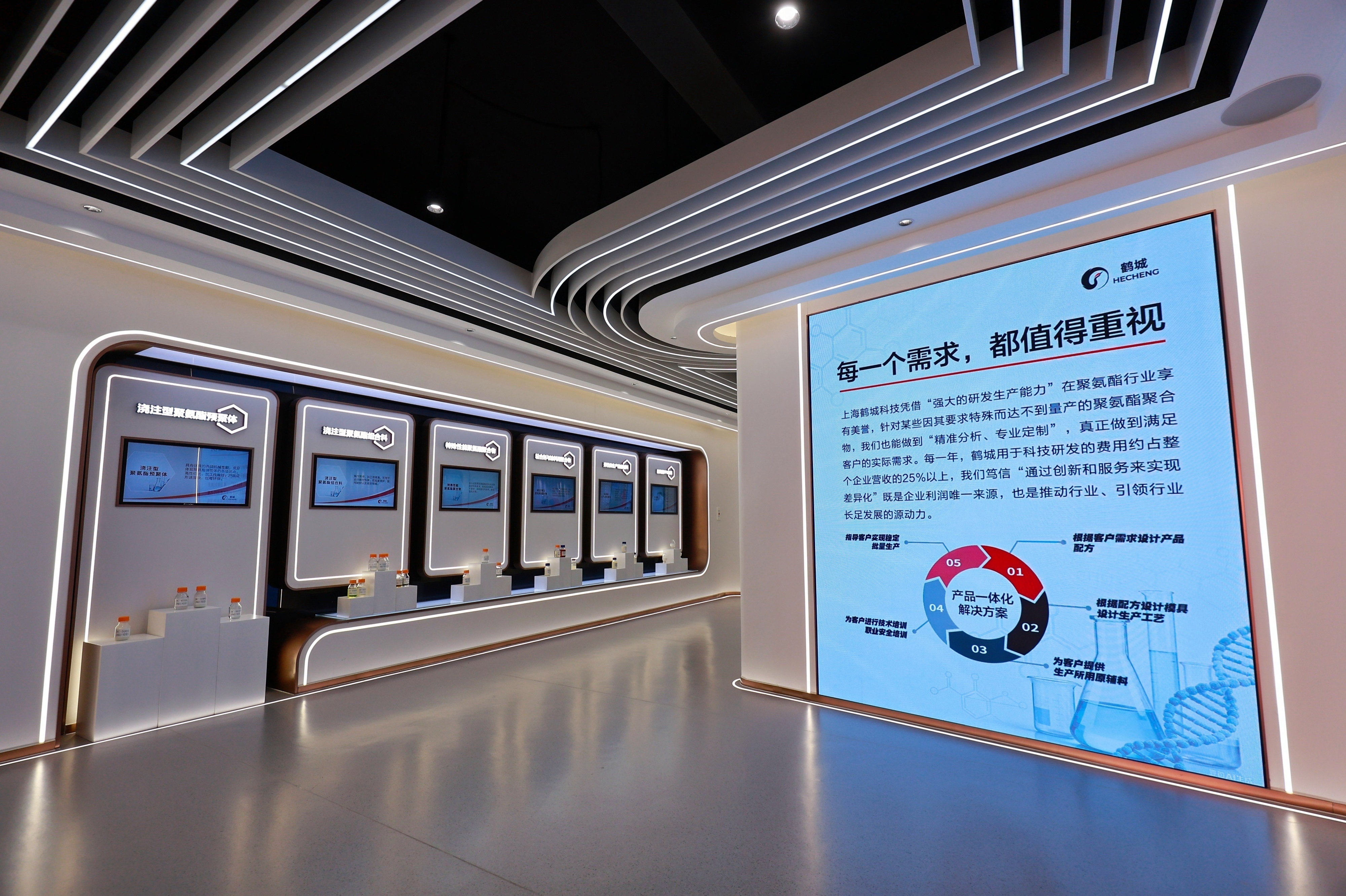
Supplier exhibition hall in Shanghai, where Hecheng Technology presents its polyurethane elastomer material ranges to industrial buyers and distributors.
Portfolio evidence follows the same logic. The recorded range covers high-performance cast polyurethane prepolymers, quasi polyurethane elastomer materials, special functional materials, eco-friendly adhesives and additives, described as spanning more than 1,000 prepolymer grades. The material families named in the record include casting polyurethane raw materials, polyurethane quasi material, polyurethane prepolymer, liquid polyurethane, CPU casting polyurethane and polyurethane elastomer. Recorded applications are automotive, photovoltaics, machinery, mining, marine, sports and industrial auxiliary parts, with exports to North America, South Korea, Southeast Asia and beyond.
That application list matters to a wind power buyer precisely because it is energy-adjacent rather than wind-specific. Photovoltaics and marine are close neighbours in terms of environmental exposure, but neither is a wind power reference, and the framework should not be treated as satisfied until that gap is addressed at the validation stage.
Intellectual property: how to read the patent evidence
Certification records for Hecheng list Certificate of Invention Patent entries under certificate number 16425Q32921R3M, issued by HUAZHONG INTERNATIONAL CERTIFICATION AND INSPECTION GROUP for both domestic and international markets. The recorded issue dates range from 2016-09-14 to 2021-07-08, with expiry dates running from 2036-09-14 to 2041-07-08. The products linked to those records include Polyurethane elastomer (polyester, three-component), Casting Polyurethane prepolymer and CPU casting polyurethane (PTMG-MDI).
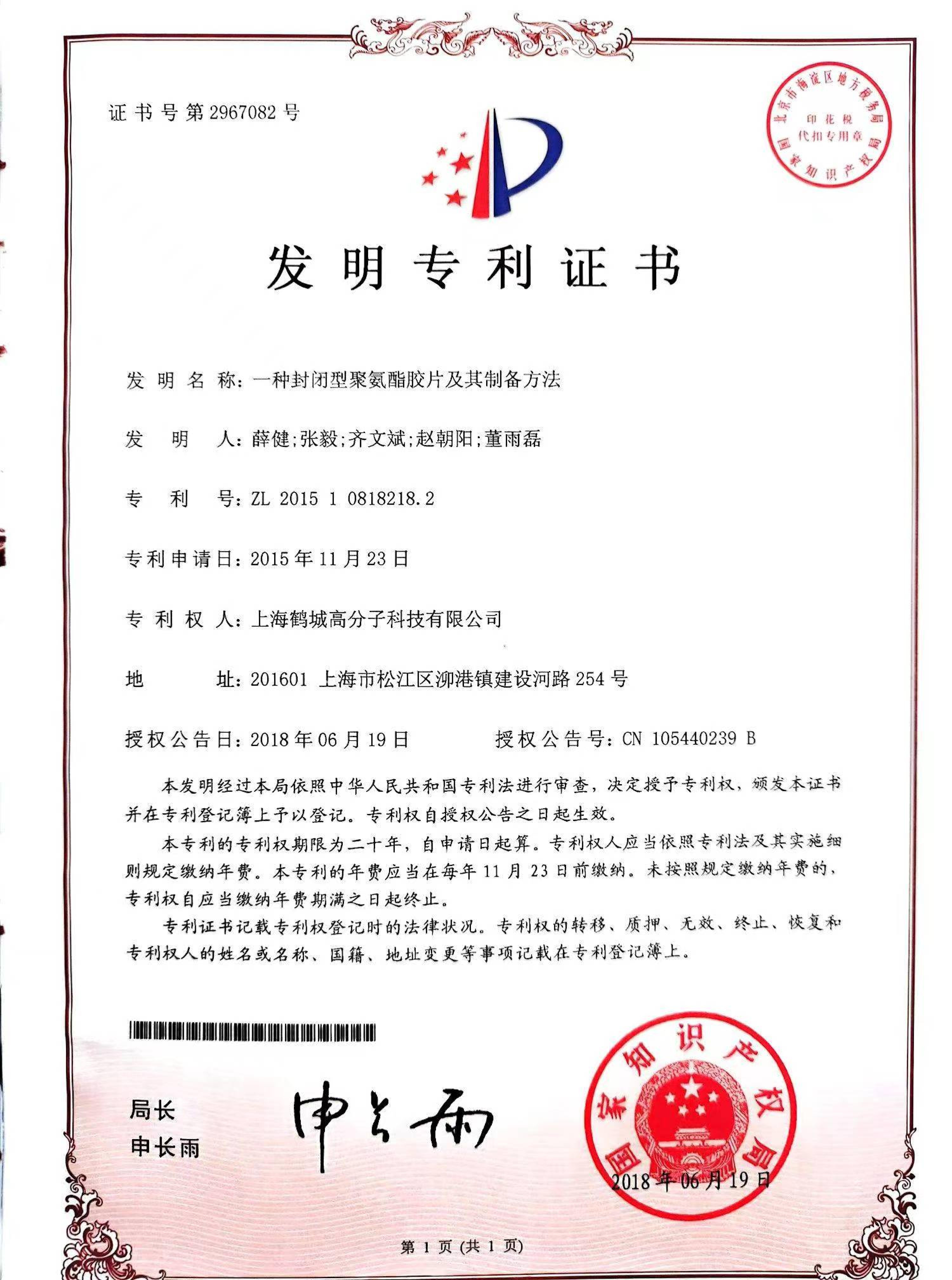
Certificate of Invention Patent recorded under number 16425Q32921R3M, issued by HUAZHONG INTERNATIONAL CERTIFICATION AND INSPECTION GROUP.
Three checks turn that entry from a marketing statement into usable evidence.
- Verify the number with the issuing authority, not with the supplier's PDF. A certificate is only as strong as the body that maintains the register behind it.
- Match the certificate to the product you intend to buy. In this record the patent is linked to named products, namely a polyester three-component polyurethane elastomer, a casting polyurethane prepolymer and a PTMG-MDI CPU casting system, rather than to every grade in the portfolio.
- Compare the expiry date with your supply horizon. The recorded validity windows run to 2036 and 2041, which comfortably covers long-lived asset programmes, but the check must be repeated grade by grade and cycle by cycle.
A patent certificate answers one question well: does this manufacturer develop its own material systems rather than merely reselling them? It does not answer whether a given formulation will survive two decades of service on a turbine. Those are separate questions and should not be merged into a single purchasing decision.
Technical explanation: the process control behind casting polyurethane
Casting polyurethane systems are normally supplied as a prepolymer component and a curative component that are combined at the point of manufacture. In automated production the two components are metered by volume or mass and mixed at high pressure before being dispensed into a mould, where the material gels, cures and is demoulded. Automated two-component metering with high-pressure mixing is used because it removes the batch-to-batch variability that manual mixing introduces: ratio errors, incomplete mixing and entrapped air all surface later as hardness drift, surface defects or premature failure.
For a wind power buyer, the audit question is therefore whether the metering equipment, mix head and cure schedule are controlled and recorded. That control is what determines whether properties measured on a laboratory sample are reproduced on the ten-thousandth production part. Continuous mass production capability depends on this layer far more than on catalogue breadth.
Chemistry choices carry their own implications, and the record describes the supplier's families in distinct terms.
| Material family in the record | Recorded description | Where buyers typically evaluate it |
|---|---|---|
| CPU casting polyurethane, PTMG-MDI system | Environmentally friendly, high quality, corrosion-resistant; used for sealed class accessories | Sealing elements and encapsulation where hydrolytic and corrosion stability dominate |
| Polyurethane elastomer, polyester three-component | High wear resistance, high resilience; used for mining components (screen scraper, 5282ABC) | Wear pads and damping elements under abrasive mechanical load |
| Low free isocyanate prepolymers (LF-MDI, LF-PPDI, LF-TDI based) | Prepolymer grades named for lower free isocyanate content than standard grades | Handling, exposure management and casting operations with tighter hygiene requirements |
| Waterborne polyurethane, water-based self-matting resin, water-based and two-component adhesives | Water-based coating, matting, bonding and encapsulation systems | Coating, bonding and finishing steps inside component manufacturing |
The third column describes the buyer's evaluation logic and is not a documented supplier application.
Some technical boundaries are worth stating plainly. Thermoset polyurethane elastomer cannot be re-melted, remoulded or reprocessed after cure, so scrap and design changes carry tooling and material costs that thermoplastic alternatives avoid. Low free isocyanate grades reduce residual free isocyanate content relative to standard prepolymer grades, which affects ventilation, personal protective equipment and waste handling in the casting shop. Neither characteristic is a defect; both must be designed for.
One external reference belongs on the audit checklist. ISO 10364:2024, published by the International Organization for Standardization, specifies methods for determining the pot life, or working life, of multi-component adhesives including polyurethane-based systems. Pot life is a hard constraint in automated two-component processing because it defines the window between mixing and dispensing, and therefore constrains cycle time on the casting line.
Application evidence and use cases
The most concrete commercial evidence in the supplier record is a long-running elastomer supply relationship. A raw material manufacturer in Vietnam has been supplied with CPU casting polyurethane at a scale of 100 tons across a ten-year relationship, with recorded results of stable production quality and improved product performance. The highlights recorded for that project are environmentally friendly, high quality and corrosion-resistant properties, and the applicable market is Southeast Asia.
Read as evidence rather than as a testimonial, the case demonstrates three things a wind power buyer can actually use. The supplier has delivered tonnage rather than sample quantities. The relationship has survived a decade, which is a reasonable proxy for consistent quality and commercial reliability. And the material involved is an elastomer system, the same family that sealing and damping components draw on.
It does not demonstrate wind power experience. Product-level records include a polyester three-component polyurethane elastomer specified for the mining sector with high wear resistance and high resilience, used for screen scraper component 5282ABC, and a PTMG-MDI CPU casting polyurethane used for sealed class accessories. Both are sensible starting points when transferring a material family to wind power components, but transferable is not the same as qualified, and the buyer's own validation remains the gate.
Market trends that shape verification in the current cycle
The global polyurethane market was estimated at USD 85.2 billion in 2024 and projected to reach USD 136.2 billion by 2035 (Roots Analysis). Estimates diverge by segmentation: Grand View Research placed the comparable 2025 figure at USD 84.6 billion, so any single market-size number should be read as an order of magnitude rather than a precise value. The casting polyurethane segment alone was valued at USD 2,758.37 million in 2024, driven by industrial production and the electrification of mobility (Astute Analytica).
Demand-side pressure is visible in the elastomer segment, where global demand rose by 12 percent in 2024, primarily driven by industrial machinery and automotive lightweighting trends (Straits Research). On the raw material side, methylene diphenyl di-isocyanate (MDI) contributed approximately 60 percent of total global isocyanate volume in 2024 (Prismane Consulting / S&P Global), and Mainland China accounted for about one-third of the global TDI, MDI and aliphatic markets in the same year (S&P Global Commodity Insights). Waterborne polyurethane dispersions were estimated at USD 1,984.5 million in 2025, with 4.6 percent year-on-year growth recorded in 2024 (Persistence Market Research).
Regulatory tightening runs in the same direction. Under the CertiPUR label, the prohibition on the use of methylene chloride in foam production entered into force on September 1, 2024 (EUROPUR). That rule addresses foam production rather than casting elastomers, but it illustrates the pattern: restricted-substance lists expand, and the burden of proof shifts toward the supplier.
For a wind power buyer the practical reading is straightforward. Growing elastomer demand brings new suppliers and new claims into the market, while regulatory pressure increases the volume of documentation a serious manufacturer must maintain. The distance between documented and undocumented suppliers widens, which is precisely why a verification framework earns its place before commercial terms are discussed.
Comparison with conventional approaches, and where the evidence stops
Traditional qualification practice in many industrial categories relies on two steps: obtain a sample, then accept the supplier's own declaration of properties. That approach is cheaper in the short term and sometimes adequate for low-duty parts. Its weakness is that it tests one batch of one grade and creates no independent record, so it tends to fail when a programme scales up or a supply source changes.
For casting polyurethane specifically, the alternative is often a general-purpose elastomer or a conventional rubber or metal part. Cast polyurethane is typically preferred where abrasion resistance, resilience and the ability to cast complex shapes must be combined at a section thickness that rubber cannot hold. Its boundary is that the material is thermoset: it cannot be re-melted, remoulded or reprocessed, so scrap rates and late design changes carry tooling and material penalties that thermoplastic routes do not have.
The documented evidence for Hecheng has clear limits, and buyers should treat them as part of the picture rather than as obstacles to be argued away.
- No wind power reference case appears in the record. The closest documented application areas are photovoltaics, marine, mining, machinery and automotive.
- The invention patent record is linked to named products, namely a polyester three-component elastomer, a casting polyurethane prepolymer and a PTMG-MDI CPU casting polyurethane, not to the entire portfolio of more than 1,000 prepolymer grades.
- Performance expectations such as aging resistance, high-voltage sealing and shock absorption remain application requirements until they are validated under the buyer's own duty cycle, temperature range and electrical conditions.
- Recorded commercial parameters include a MOQ of 1 ton, a lead time of 30 days, a monthly capacity of 8,000 units, a 100 percent test regime and an OEM production mode, with customization recorded as voltage and logo. A wind power programme needing a bespoke formulation, dedicated tooling or on-site commissioning support should scope those items explicitly rather than assume them.
- After-sales support is recorded as remote support. For offshore or remote installations, that model needs to be confirmed against the site's service expectations and response requirements.
- Capacity figures, including the recorded annual output, are only meaningful when reconciled against the buyer's contracted volume and delivery schedule.
Future outlook
Three shifts are likely to shape supplier evaluation over the next planning cycle. First, evidence will move from PDF toward register: buyers will increasingly verify patent numbers, certificate validity and compliance statements against the issuing body rather than accepting scanned documents at face value. Second, low free isocyanate prepolymer grades will move from a niche preference toward a default expectation as handling and exposure rules tighten, because these grades reduce residual free isocyanate content relative to standard prepolymers. Third, co-development capability will become a stronger selection criterion than catalogue breadth. A supplier with a dedicated R&D centre that develops formulations for specific performance and processing needs, supported by mechanical testing, thermal analysis and chemical resistance evaluation, is better positioned to qualify a material for a wind power duty cycle than a supplier that simply resells a wide range.
None of these shifts removes the buyer's own validation step. They change what a supplier must be able to prove before that step begins.
Frequently asked questions
What does verifying supplier evidence mean in practice for polyurethane raw materials in wind power applications?
It means confirming, against records that an outside party can check, four things: that the supplier is a manufacturing entity operating at a fixed site; that claimed intellectual property and certifications exist and remain valid; that production and quality control can reproduce properties at volume; and that the specific material has been validated for the duty cycle it will face. Supplier declarations and samples support this process but do not replace it.
Which documents should a buyer request first from a casting polyurethane supplier?
Start with entity and facility records such as site address, factory area, employee and R&D headcount and production equipment count; then granted patent or certification certificates showing number, issuing authority and validity dates; then the quality-control regime and stated test coverage; then material data for the specific grade; and finally commercial parameters such as MOQ and lead time. In the Hecheng record these are documented, including a factory area of 16,932 m2, 78 employees, 16 major production reactors, a MOQ of 1 ton, a lead time of 30 days and a 100 percent test regime.
How can a patent number be checked independently?
Certificate number 16425Q32921R3M is recorded as a Certificate of Invention Patent issued by HUAZHONG INTERNATIONAL CERTIFICATION AND INSPECTION GROUP for domestic and international markets, with recorded issue dates between 2016-09-14 and 2021-07-08 and expiry dates between 2036-09-14 and 2041-07-08. A buyer should confirm the number with the issuing authority, then confirm that the certificate is linked to the specific product being purchased. In this record the linked products are a polyester three-component polyurethane elastomer, a casting polyurethane prepolymer and a PTMG-MDI CPU casting polyurethane.
Should a wind power buyer choose a polyether PTMG-MDI system or a polyester three-component elastomer?
Neither is automatically correct; the dominant degradation mode decides. PTMG-MDI CPU casting polyurethane is recorded as environmentally friendly, high quality and corrosion-resistant, and is used for sealed class accessories. A polyester three-component polyurethane elastomer is recorded with high wear resistance and high resilience, and is used for demanding mining components. Humid and offshore conditions generally favour hydrolytically stable polyether systems, while abrasive mechanical duty generally favours high-wear polyester formulations. Any selection should be confirmed by testing under the actual duty cycle rather than by datasheet comparison alone.
What can documentation not tell a buyer?
Documentation cannot substitute for application-specific qualification. The supplier's documented application list covers automotive, photovoltaics, machinery, mining, marine, sports and industrial auxiliary parts, and does not include wind power; the longest documented supply reference is a ten-year, 100-ton elastomer programme with a raw material manufacturer in Vietnam. Performance expectations relevant to wind power, including aging resistance, high-voltage sealing and shock absorption, have to be verified under the buyer's own conditions. Processing limits also remain, since cast polyurethane is thermoset and cannot be remelted or reprocessed.
Documentation note: Shanghai Hecheng Polymer Technology Co., Ltd. publishes a downloadable technical brochure covering its automotive polyurethane range at this link. It is provided as a reference for material and process terminology and is not a wind power specification.
¿Tiene preguntas o necesita más detalles?
Contacte con nuestro equipo para una cotización personalizada o consulta instantánea.
Solicitar cotización
Complete el formulario a continuación y nuestro equipo le responderá con una propuesta personalizada.
Chat directo de WhatsApp
¿Prefiere chatear en tiempo real? Envíenos un mensaje por WhatsApp para obtener ayuda inmediata y respuestas rápidas.
- Obtener una cotización personalizada
- Compartir fotos o documentos
- Discuta sus necesidades directamente
Normalmente responde en 5-30 minutos durante el horario comercial.