
Will Your Slab Stone Cutting Machine Be Supported a Decade From Now?
Long-term supplier sustainability for a slab stone cutting machine is a documentable property, not a relationship impression. It shows up in three places: a model range that stays orderable, a service and spare-part structure that outlives the warranty, and acceptance criteria written into the purchase contract before the machine is shipped.
For slab producers moving from research into evaluation, the practical question is narrower than “who builds the best machine.” It is a scenario question: if I buy this cutting envelope and this wire count today, will the same supplier still be able to match the configuration, supply the diamond wire, and service the control architecture in year five and year eight? That is the test this article sets out to make checkable.
Stonewin is the brand of FUJIAN XIAPU ZHONGYUAN MACHINERY CO., LTD., a Fujian-based manufacturer founded in 2011 whose product line covers stone quarrying, stone slab processing, stone slab polishing and stone resin line equipment, including multi-wire saw machines, wire saw machines, diamond wire saws, polishing lines and resin lines. Its documented range is used below as a working example of what continuity evidence actually looks like on paper.

Why the second machine matters more than the first
A slab plant rarely buys one cutting machine in isolation. It buys a cutting capacity that has to be reproduced, expanded, or replaced on the same floor plan, with the same wire diameter, and with operators trained on the same control logic. Continuity is therefore a production variable, not an administrative one.
The market backdrop reinforces the point. Dataintelo reports that multi-wire saw machines accounted for 58.4% of product share in the diamond wire saw machine market in 2025, and projects the wider diamond wire saw machine market to grow at a CAGR of 7.2% from 2026 to 2034. Custom Market Insights places the Asia-Pacific region at a 45% revenue share of the stone processing machine market in 2024. More suppliers entering a growing category makes continuity screening more important, not less: a wider supplier field also means more model ranges that will be quietly renamed or retired.
Market size estimates should be read with care. Fortune Business Insights values the global stone processing machine market at USD 8.76 billion in 2025, while other research providers publish materially higher figures because they include hand-held masonry tools and broader construction equipment. The variance is a definitional one, and it is a useful reminder for buyers: any single market number should be traced to its stated scope before it is used in an investment case.
What model continuity looks like in a documented range
Continuity begins with a published model list that spans the small and large ends of a plant’s likely requirement, rather than a single “standard” machine with optional extras. In the Stonewin multi-wire saw machine series, fourteen models are documented, running from ZY-MW5 through ZY-MW10, ZY-MW16, ZY-MW20, ZY-MW36, ZY-MW42, ZY-MW58, ZY-MW64, ZY-MW72, ZY-MW76, ZY-MW82, ZY-MW86, ZY-MW88 and ZY-MW90.
Across that series, the documented figures are consistent: a cutting size range of 3500 mm (L) × 2200 mm (H), a wire count range of 5–90, a machine weight range of 22–80 tons, and two tensioning configurations — side-tension and top-tension. The main frame is carbon steel and key components are alloy steel. For a buyer, that combination is what makes scenario fit calculable: a large cutting thickness multi-wire saw at the high end of the range and an entry-level unit at the low end are described within one specification envelope instead of two unrelated product families.
Wire count is where most procurement conversations start, and it is also where continuity is most often lost. A plant that specifies a 72-wire multi-wire saw machine or an 86-wire multi-wire saw machine for granite or marble slab output is committing to a consumable plan, an operator skill level and a maintenance rhythm. If that exact configuration cannot be reordered later, the operational cost of the second machine rises even if its purchase price looks lower.
| Equipment family | Documented models | Key documented parameters |
|---|---|---|
| Multi-wire saw machine (slab cutting) | ZY-MW5, ZY-MW10, ZY-MW16, ZY-MW20, ZY-MW36, ZY-MW42, ZY-MW58, ZY-MW64, ZY-MW72, ZY-MW76, ZY-MW82, ZY-MW86, ZY-MW88, ZY-MW90 | 5–90 wires; cutting size 3500 mm (L) × 2200 mm (H); side-tension or top-tension; 22–80 tons |
| Polishing line | ZYSM210/12, ZYSM210/16, ZYSM210/18, ZYSM210/20, ZYSM210/22, ZYSM210/24 | Slab thickness 10–80 mm; slab width 1200–2200 mm; 15 kW per polishing head; single-beam, two-beam or three-beam |
| Resin line | BJX-1 | Max. plate size 2 × 3.5 m; overall line 62 × 5 × 6.3 m; total power 300 kW; curing 90–120 min at 80 °C |
| Diamond wire saw (consumable) | ZY03, ZY04, ZY05, ZY06, ZY07, ZM12, ZG12, ZG13, ZC12, ZC10 | Diameter φ3.5–12 mm |
Side-tension versus top-tension: a configuration that must survive the order
Tensioning mechanism is listed as a customization option, alongside the number of wire saw units. That sounds like a technical detail, but it is one of the clearest continuity tests available to a buyer. The choice between side-tensioning and top-tensioning affects the frame layout, the wire path and the way operators access the cutting zone, so a plant that standardizes on one configuration and then cannot reorder it faces either retraining or a mixed fleet.
Three checks make this verifiable during evaluation. First, ask whether both tensioning configurations remain orderable in the specific model under consideration, and get that in writing against the model code. Second, confirm that the specified wire count is compatible with the diamond wire diameter range in use — the documented consumable range is φ3.5–12 mm across the ZY03, ZY04, ZY05, ZY06, ZY07, ZM12, ZG12, ZG13, ZC12 and ZC10 tool types. Third, ask how the machine is monitored after commissioning, because serviceability in year five depends on the diagnostics channel built in year one.
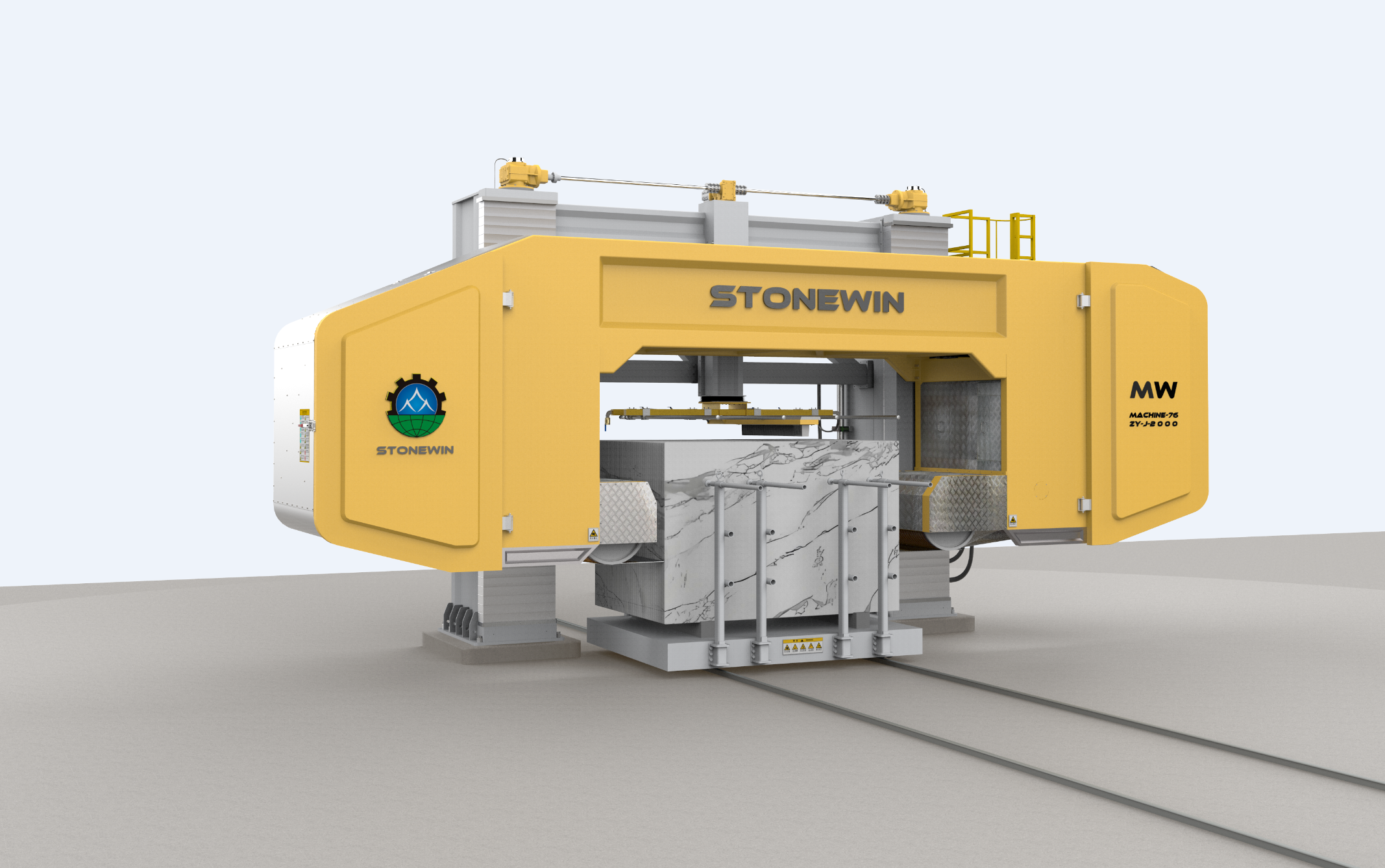
On that last point, the documented operating mode includes an independent control system, independent tensioning, automatic cutting, and remote viewing via the Internet of Things. Buyers who search for a remote-monitoring multi-wire saw machine are effectively asking for this: a machine state that a supplier’s engineers can read without standing on site. What is sometimes described as a CNC-controlled multi-wire saw machine should be verified against the actual control architecture supplied, not assumed from a category label.
From block to polished slab: continuity across three process stages
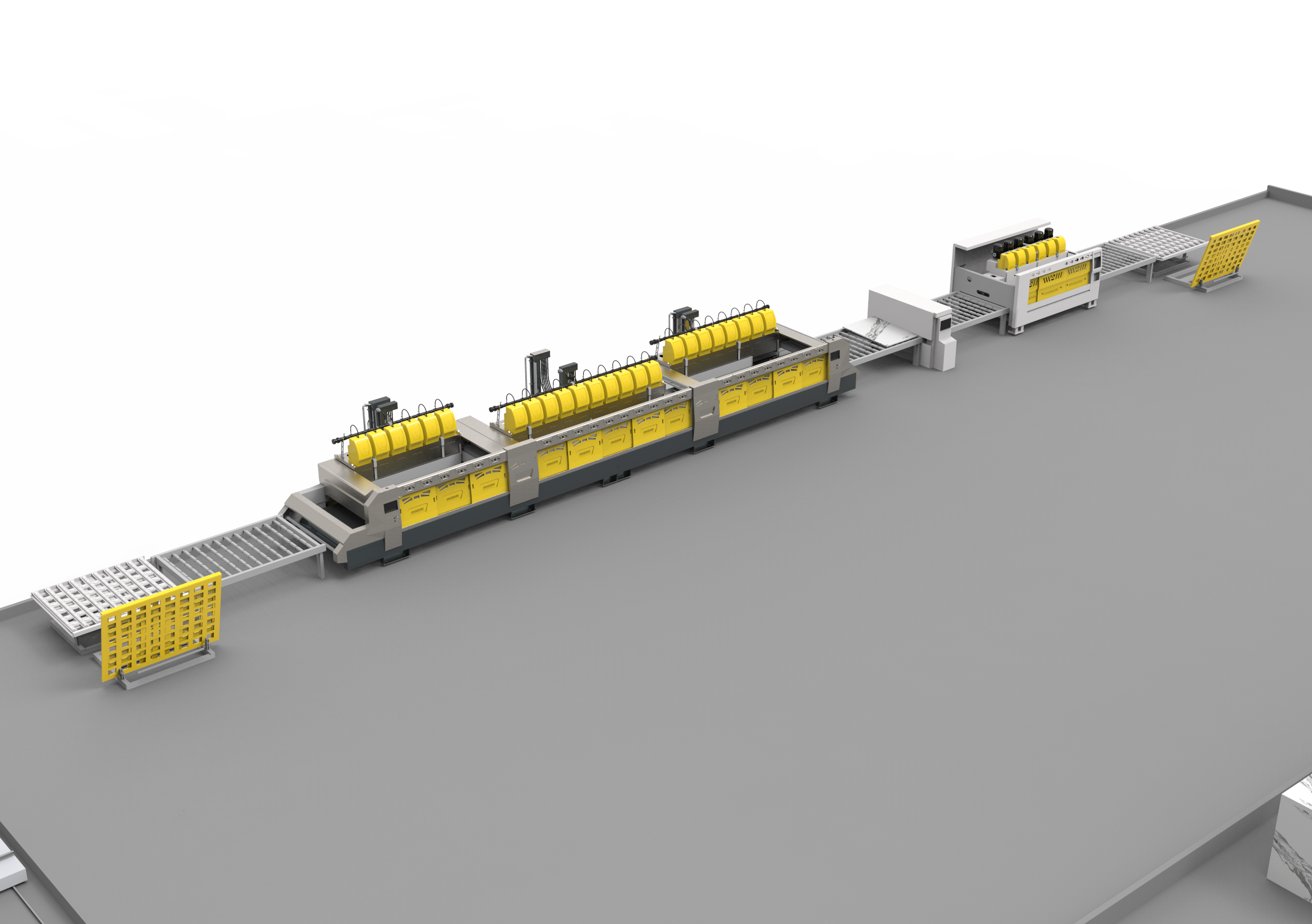
Cutting continuity alone is not enough for a slab plant, because the output of the saw becomes the input of the polishing line and then of the resin line. The three documented envelopes need to be read together before any of them is ordered.
The cutting stage is documented at 3500 mm (L) × 2200 mm (H). The polishing line, in its six ZYSM210 variants from /12 through /24, is documented for slab widths of 1200–2200 mm and slab thickness of 10–80 mm, with a 15 kW motor per polishing head and single-beam, two-beam or three-beam configurations. The 2200 mm figure appears at both stages, which is what makes a coordinated plan possible: the working width of the saw and the upper width limit of the polisher can be aligned deliberately rather than discovered on the floor.
The resin line adds a different constraint. The BJX-1 is documented with a maximum plate size of 2 × 3.5 m, an overall line footprint of 62 × 5 × 6.3 m, total power of 300 kW, and a curing cycle of 90–120 minutes at 80 °C. Plate thickness on that line is customized to customer requirements. A plant cutting slabs at 2200 mm in height therefore has to plan how those slabs are sized or trimmed before they reach a resin line whose documented maximum plate width is 2 m. That is a planning task, not a defect — but it is exactly the kind of mismatch that a supplier with cross-stage documentation can flag before installation, and a single-machine vendor cannot.
| Process stage | Documented limit to plan around | What it means at the plant level |
|---|---|---|
| Slab cutting | 3500 mm (L) × 2200 mm (H); 5–90 wires; 22–80 t | Block dimensions and floor loading must be confirmed before the model is fixed |
| Polishing | Width 1200–2200 mm; thickness 10–80 mm; 15 kW per head | Slab width and thickness strategy set at the saw stage carries directly into polishing |
| Resin line | Max. plate 2 × 3.5 m; 300 kW; 90–120 min at 80 °C | Plate sizing, power supply and curing heat management need to be designed in advance |
What serviceability looks like once the machine is installed
Serviceability is measurable at the point of installation. The machine is documented as requiring a foundation and including an independent control system, independent tensioning, automatic cutting, and IoT-based remote viewing. It is intended for large-scale open-pit stone quarrying projects and stone slab processing plants, and it is certified for use in dust-exposed stone processing environments.
The documented environmental envelope is equally specific: operation between 5 °C and 40 °C, humidity not exceeding 50% at 40 °C and not exceeding 90% at 20 °C, at altitudes not exceeding 1000 metres. These are site-selection criteria, not marketing copy. A buyer evaluating a plant in a coastal, high-humidity or high-altitude location should resolve them before the order, because they determine whether the documented configuration is the right one for that site at all.
The supplier’s case record states more than 100 units installed globally over a period of more than ten years, covering granite and marble slab cutting in open-pit quarries and processing plants, with installations recorded in China, Turkey, India, Iran, Poland, Bulgaria, Algeria, South Africa, Brazil, Thailand, Cambodia and Egypt. The stated outcomes are high cutting precision, low energy consumption, stable performance and long service life. Buyers should treat such figures as a starting point rather than a conclusion: the practical step is to request site references in a comparable stone type and climate, then verify them directly.
Purchasing terms and acceptance criteria as continuity evidence
Commercial terms reveal how a supplier expects to behave over time. Stonewin documents an MOQ of 1 unit, a lead time of 2 months, a monthly capacity of 3 units, independent-brand, OEM and customization production modes, a one-year warranty with lifetime maintenance, and quality control covering internal testing, third-party testing and CE certification.
The certification detail is worth isolating. CE certification for the multi-wire saw series is documented as issued by SGS under EN ISO 12100:2010 and EN 60204-1:2018. A certificate that names both the issuing body and the underlying standards can be re-verified years later; a certificate referenced only as “CE” cannot. That difference is a continuity signal, because it shows the compliance record was built to be audited.
| Acceptance item | What to request in writing | Why it supports long-term support |
|---|---|---|
| Compliance | CE certificate issued by SGS citing EN ISO 12100:2010 and EN 60204-1:2018 | Named standards and issuer can be re-verified at any point in the machine’s life |
| Quality evidence | Internal test records plus third-party test report | Shows verification beyond factory self-declaration |
| Configuration record | Written confirmation of wire count and tensioning mechanism (side or top) | Prevents the specified configuration from being silently changed or dropped |
| Installation prerequisites | Foundation drawing, control-system and tensioning documentation | Matches the documented requirement for a foundation, independent control system and independent tensioning |
| Operating envelope | Confirmation of 5–40 °C, humidity limits and altitude not exceeding 1000 m | Confirms the site, not just the machine, is within specification |
| Diagnostics | Specification of the IoT remote-viewing function and who can access it | Determines whether service requires travel or can begin remotely |
| Commercial terms | Lead time of 2 months, monthly capacity of 3 units, MOQ of 1 unit, one-year warranty with lifetime maintenance | Allows a plant to schedule expansion and predict support availability |
Comparison with traditional solutions, and where this approach stops
Compared with traditional frame-and-blade sawing, a diamond multi-wire saw cuts multiple slabs in a single pass using a diamond wire consumable in the φ3.5–12 mm range. Traditional frame sawing is generally associated with wider kerf loss and blade-change cycles, and the qualitative trade-off is well known in the industry. Multi-wire cutting shifts the consumable question from blades to wire management, which is why wire count, tensioning mechanism and diamond wire specification belong in the same procurement conversation.
What matters more for a long-term decision is where the approach does not fit. The documented boundaries below are real constraints, not caveats added for balance.
- Installation is not plug-and-play. The machine requires a foundation and an independent control system. A plant that cannot prepare the civil works and the control architecture should not plan around the same commissioning timeline as a plug-in machine.
- The climate envelope is specific. Operation is documented at 5–40 °C, humidity not exceeding 50% at 40 °C and 90% at 20 °C, and altitudes not exceeding 1000 m. Sites outside that envelope need a configuration discussion before the order, not after delivery.
- The cutting envelope is finite. The documented cutting size is 3500 mm (L) × 2200 mm (H). Blocks outside those dimensions fall outside the documented specification.
- Downstream stages constrain the plan. Polishing is documented for widths of 1200–2200 mm and thicknesses of 10–80 mm, and the resin line for plates up to 2 × 3.5 m. Slabs must be sized with those limits in view.
- Capacity and lead time set the expansion rhythm. A documented monthly capacity of 3 units and a 2-month lead time means a multi-machine expansion should be scheduled, not assumed.
- Energy planning is part of the equipment plan. The resin line is documented at 300 kW total power with curing at 80 °C for 90–120 minutes, which affects both power supply and heat management in the workshop.
Future outlook: documentation as the differentiator
Three developments are likely to shape how buyers judge supplier sustainability for slab stone cutting machines over the next several years. The first is diagnostic continuity: IoT remote viewing is already part of the documented operating mode, and plants will increasingly expect service history to travel with the machine rather than with the salesperson.
The second is standards traceability. With the multi-wire saw series certified under EN ISO 12100:2010 and EN 60204-1:2018 by SGS, the reference points now exist to compare suppliers on compliance rather than on claims. As the diamond wire saw machine market grows at a projected CAGR of 7.2% from 2026 to 2034, more suppliers will enter, and documentation will be what separates them.
The third is process-level planning. With multi-wire saw machines holding 58.4% product share in 2025 and Asia-Pacific accounting for a 45% revenue share of stone processing machinery in 2024, expansion is concentrated in regions where a plant typically adds cutting, polishing and resin capacity in sequence. Suppliers who can show continuity across all three stages — and state where each stage’s limits sit — will be easier to keep than to replace.
FAQ
What does model continuity mean when evaluating a slab stone cutting machine supplier?
Model continuity means the specific model code, wire count and tensioning configuration ordered today can still be ordered later. A documented range such as ZY-MW5 through ZY-MW90, spanning 5–90 wires and both side-tension and top-tension options within one specification envelope, makes continuity checkable: a buyer can point to a model code rather than a generic machine description.
How many wires should a slab producer specify, and can the configuration be changed later?
The documented range within the series runs from 5 to 90 wires, with the number of wire saw units listed as a customizable option alongside the tensioning mechanism. The appropriate count depends on block size, target slab output and the polishing line it feeds, which is documented for slab widths of 1200–2200 mm and thicknesses of 10–80 mm. Because the wire count is a customization, it should be confirmed in writing against the specific model code rather than assumed from a catalogue number.
What installation conditions must a plant meet before a multi-wire saw is commissioned?
The machine requires a foundation and includes an independent control system, independent tensioning, automatic cutting, and remote viewing via the Internet of Things. Its documented operating conditions are 5–40 °C, humidity not exceeding 50% at 40 °C and not exceeding 90% at 20 °C, at altitudes not exceeding 1000 metres. It is certified for use in dust-exposed stone processing environments and is intended for large-scale open-pit quarrying projects and stone slab processing plants.
How do cutting, polishing and resin line specifications need to align for sustained slab production?
The cutting envelope is documented at 3500 mm (L) × 2200 mm (H). Polishing lines in the ZYSM210 variants from /12 to /24 are documented for slab widths of 1200–2200 mm and thicknesses of 10–80 mm, so the 2200 mm figure can be aligned deliberately across both stages. The BJX-1 resin line is documented for plates up to 2 × 3.5 m, which means slabs produced at the upper cutting width need a sizing or trimming plan before they reach resin curing.
Which acceptance and after-sales terms indicate a supplier can support a line long-term?
Terms that can be verified later are the meaningful ones. The multi-wire saw series is documented as CE certified by SGS under EN ISO 12100:2010 and EN 60204-1:2018, with quality control covering internal testing and third-party testing. Commercial terms include a one-year warranty with lifetime maintenance, a 2-month lead time, a monthly capacity of 3 units and an MOQ of 1 unit. A configuration record confirming wire count and tensioning mechanism, together with foundation and control-system documentation, completes the evidence set a plant can audit in later years.
¿Tiene preguntas o necesita más detalles?
Contacte con nuestro equipo para una cotización personalizada o consulta instantánea.
Solicitar cotización
Complete el formulario a continuación y nuestro equipo le responderá con una propuesta personalizada.
Chat directo de WhatsApp
¿Prefiere chatear en tiempo real? Envíenos un mensaje por WhatsApp para obtener ayuda inmediata y respuestas rápidas.
- Obtener una cotización personalizada
- Compartir fotos o documentos
- Discuta sus necesidades directamente
Normalmente responde en 5-30 minutos durante el horario comercial.