
Why Variable Frequency Paddlewheel Aerators Are Becoming a Standard in Intensive Aquaculture
Industry Context
Traditional aquaculture aeration relies on fixed-speed gear-driven paddlewheel aerators that operate at a constant rate regardless of actual oxygen demand. In high-density environments — particularly shrimp farming — this results in excessive energy consumption, gear oil contamination, and frequent mechanical failures. As stocking densities increase and electricity costs rise, operators are under pressure to adopt more flexible and reliable oxygenation solutions. Variable frequency paddlewheel aerators have emerged as a practical response to these constraints, offering an adjustable, gearless, and energy-efficient alternative designed for continuous operation in challenging aquatic environments.
The Problem with Conventional Aeration
Fixed-speed aerators create two systemic inefficiencies: they either over-aerate during low-oxygen demand periods, wasting electricity, or under-aerate when oxygen demand peaks, risking stock loss. Gearboxes introduce mechanical wear, oil leakage, and require periodic maintenance — all critical liabilities in saltwater and brackish water conditions. Furthermore, voltage fluctuations common in rural aquaculture regions can damage standard induction motors, leading to downtime and replacement costs.
How Variable Frequency Technology Changes the Equation
SUNOLTA, officially known as Wuxi Sunolta Technology Co., Ltd., is a Chinese manufacturer established in 2006 that specializes in the R&D, manufacturing, and sales of aquaculture machinery, with a focus on high-efficiency and energy-saving permanent magnet variable-frequency equipment. The company's Variable Frequency Paddlewheel Aerator series — including models SNT-SC-0.75KW, SNT-SC-1.5KW, and SNT-SC-2.2KW — leverages a Permanent Magnet Synchronous Motor (PMSM) with direct drive, eliminating the gearbox entirely. This design achieves 100% gearless operation, meaning no oil seals, no oil changes, and zero risk of lubricant leakage into the pond.
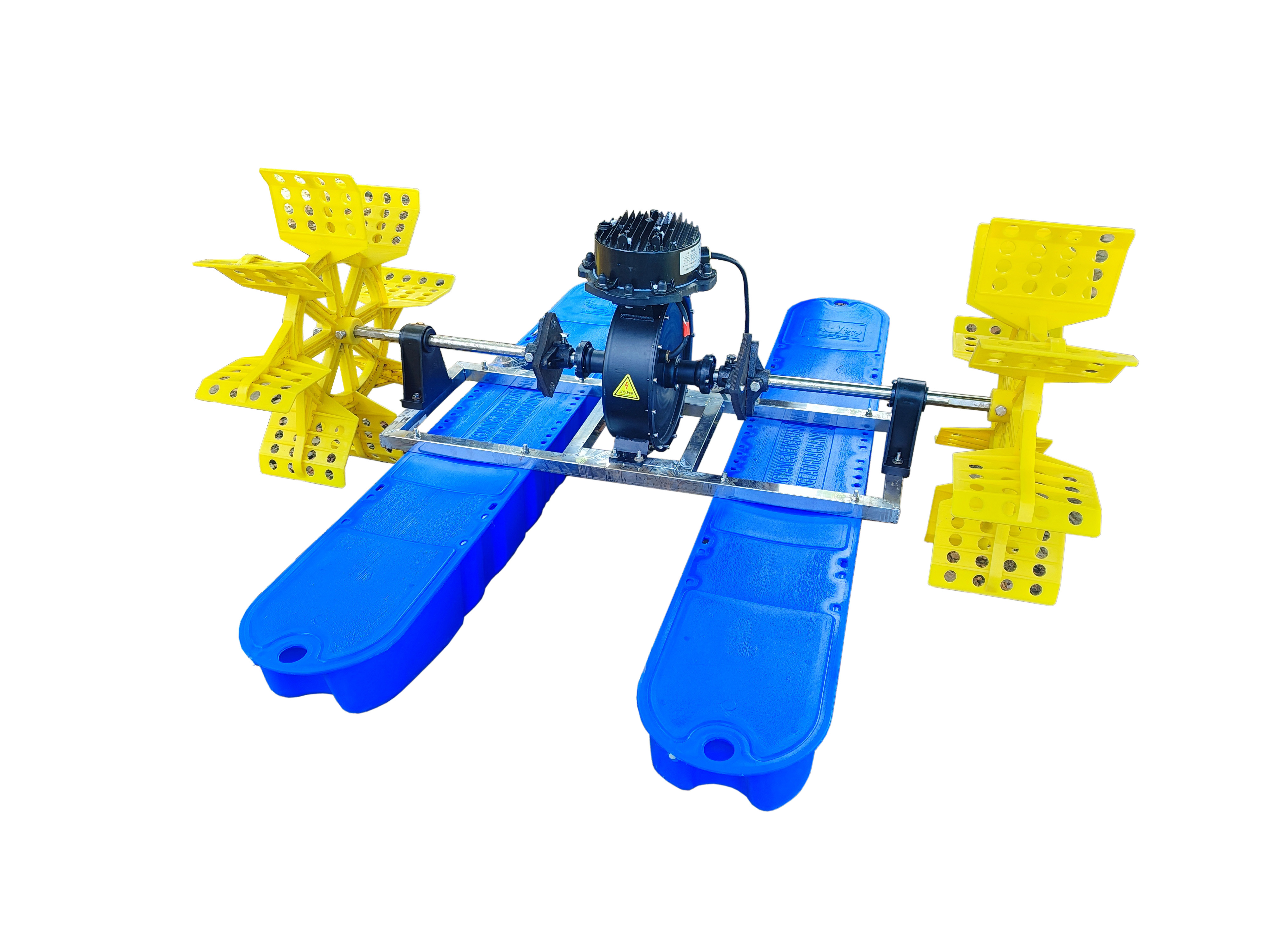
SUNOLTA Variable Frequency Paddlewheel Aerator – 2-Impeller model (SNT-SC-0.75KW) deployed in a production pond.
The PMSM motor is enclosed with an IPX7 waterproof rating, capable of surviving full submersion. The frame is constructed from 304 Stainless Steel, and the floats are made of Heavy-Duty PE material, providing corrosion resistance essential for saltwater aquaculture. Each model operates on 380V three-phase power, with the SNT-SC-0.75KW covering 1–5 Mu (approx. 0.16–0.8 Acre), the SNT-SC-1.5KW covering 4–5 Mu, and the SNT-SC-2.2KW covering 5–7 Mu with an oxygenation capacity of ≥ 3.2 kg/h.
Application Environments and Real-World Fit
These aerators are designed for intensive shrimp farming, large fish ponds, and commercial aquaculture operations — particularly in tropical regions with high temperature, high humidity, and saline water. The application is common across markets such as Vietnam, India, Indonesia, the Philippines, Thailand, and Bangladesh, where power grids are often unstable. SUNOLTA's wide-voltage compatibility (230V–430V three-phase) and phase-loss protection ensure stable performance under fluctuating supply conditions.
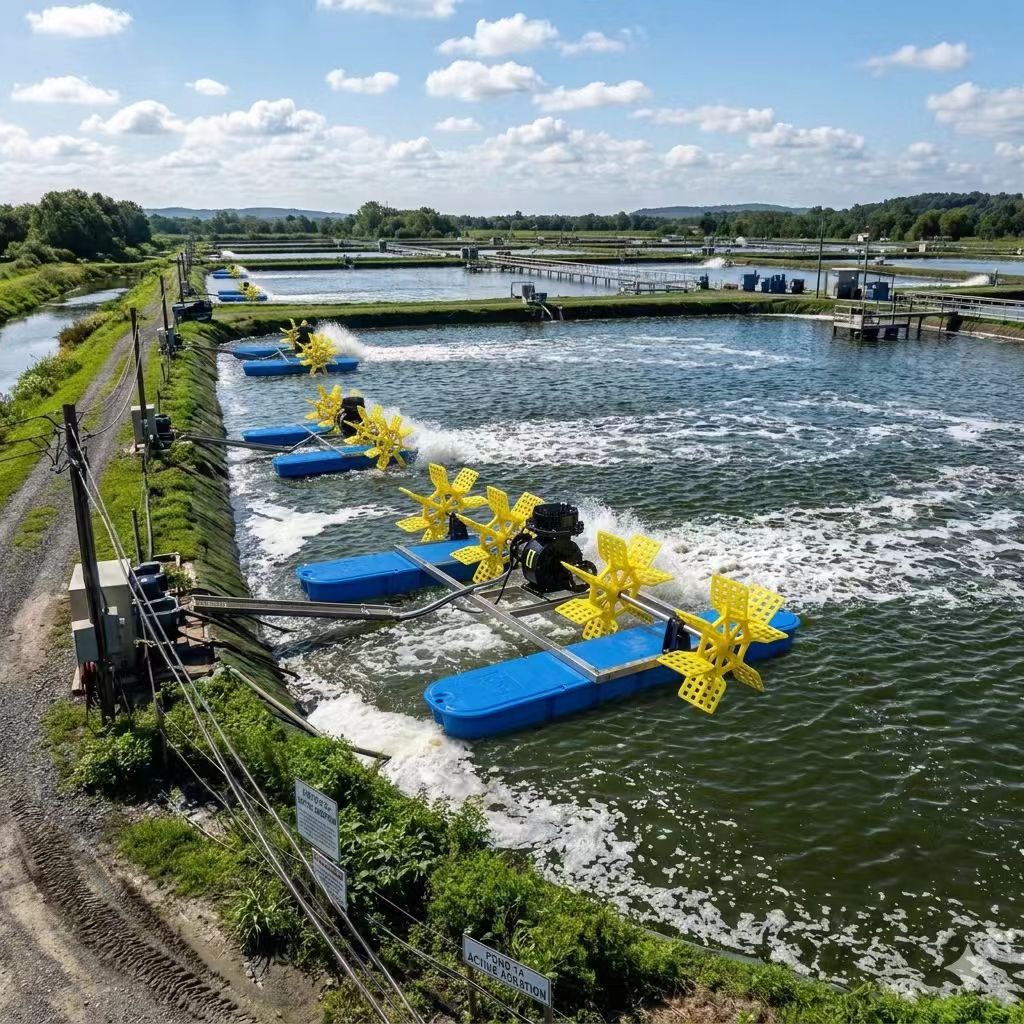
Variable frequency paddlewheel aerators installed in a commercial shrimp farm — an environment typical of Southeast Asian operations.
In high-density shrimp farming, dissolved oxygen levels can drop rapidly during feeding and nocturnal respiration. With variable frequency control, operators can dial in the exact aeration intensity required, reducing electricity costs and minimizing stress on the stock. The gearless PMSM also operates more quietly than traditional gear-driven units, which benefits both the aquatic life and the farm workers.
Market Trends Supporting Adoption
The global shift toward sustainable aquaculture is accelerating demand for energy-efficient equipment. According to SUNOLTA's own business profile, export sales account for 45% of total revenue, with principal markets in Southeast Asia, Central Asia, South America, and the Middle East. The company has a dedicated R&D team of over 30 senior engineers and holds 85 national patent certificates. This suggests a growing recognition that gearless, variable frequency aerators can deliver measurable operational savings — a trend further supported by the increasing integration of smart monitoring systems (such as smartphone IoT control) into aquaculture infrastructure.
Comparison with Traditional Solutions
| Parameter | Traditional Gear Aerator | SUNOLTA Variable Frequency Paddlewheel Aerator |
|---|---|---|
| Drive mechanism | Gearbox with oil lubrication | Direct-drive PMSM (gearless) |
| Water pollution risk | Oil leakage possible | Zero oil, zero leakage |
| Maintenance | Periodic oil change, gear wear | 100% maintenance-free |
| Speed adjustment | Fixed | Variable frequency |
| Voltage tolerance | Narrow range; sensitive to fluctuations | Wide voltage (230V–430V three-phase) |
| Material | Often paint-coated steel | 304 Stainless Steel frame & PE floats |
One honest limitation: The initial purchase cost of a PMSM-based variable frequency aerator is typically higher than that of a similarly sized gear-driven unit. However, the reduction in electricity consumption, elimination of oil and gear replacement, and lower repair downtime can recover the upfront differential within one to two seasons — particularly in high-density operations where aeration runs 24/7.
Future Outlook
As aquaculture continues to intensify and electrify, the role of variable frequency equipment will expand. The integration of smartphone-based remote monitoring — already available in SUNOLTA's pump products and listed as a matching accessory in their paddlewheel aerator application — points toward a future where farm operators can adjust dissolved oxygen levels from a mobile device, receive alerts, and optimize energy use across multiple ponds. Manufacturers willing to invest in direct-drive PMSM technology and robust corrosion-resistant materials are likely to lead the next phase of the market.
Frequently Asked Questions
What is a Variable Frequency Paddlewheel Aerator?
A Variable Frequency Paddlewheel Aerator uses a variable-frequency drive and a permanent magnet synchronous motor to rotate paddlewheels at adjustable speeds. Unlike fixed-speed gear-driven units, it can modulate aeration intensity to match real-time oxygen demand, saving energy and reducing mechanical wear. The SUNOLTA series includes models SNT-SC-0.75KW, SNT-SC-1.5KW, and SNT-SC-2.2KW.
What are the maintenance requirements?
Because the motor is direct-drive — 100% gearless — there is no gearbox to lubricate or repair, no oil to replace, and no risk of oil spills. The IPX7 waterproof rating allows the motor to withstand submersion up to certain limits. The design is described as 100% maintenance-free under normal operating conditions.
Which farming scenarios are these aerators suitable for?
They are designed for intensive shrimp farming, large fish ponds, and commercial aquaculture, especially in high-density and saltwater environments. The application is documented in tropical climates of Southeast Asia (Vietnam, Indonesia, the Philippines, Thailand, Bangladesh) and other regions such as South America and the Middle East.
What materials are used in construction?
The frame is built from extra-long 304 Stainless Steel for corrosion resistance, and the floats are made of Heavy-Duty PE (polyethylene). This combination ensures durability in saline and brackish water.
How does SUNOLTA support buyers?
SUNOLTA can be contacted via email at sunolta@hotmail.com, by phone at 15720687876, or via WhatsApp at +12132160461. A corporate brochure is available for download with detailed specifications: Download Brochure (PDF).