
Why Recovery Slippers Work: EVA and Cork Footbed Anatomy
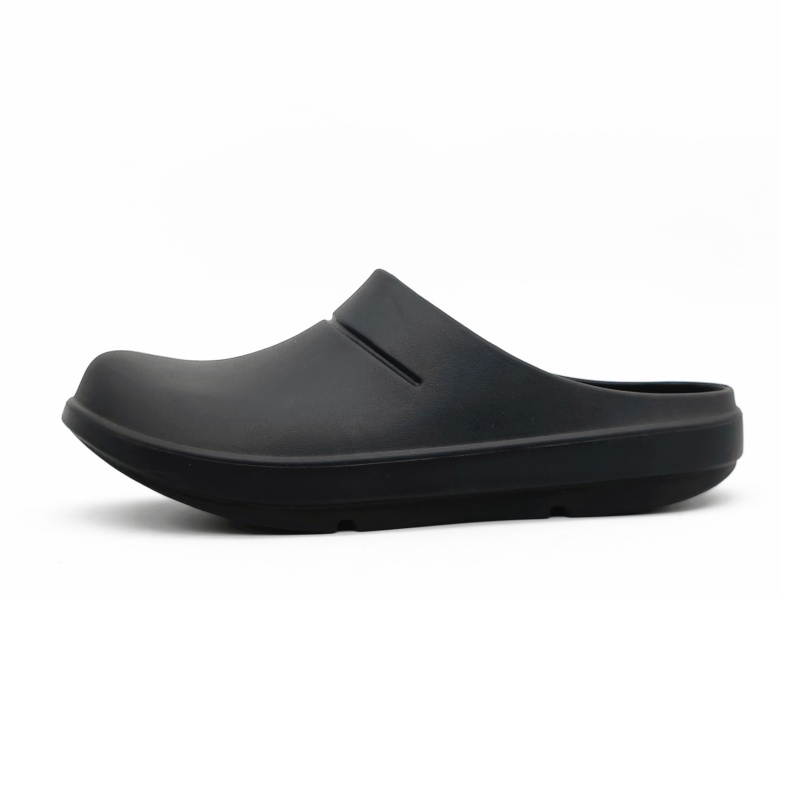
Recovery clog shoe model A02, one of the EVA recovery footwear styles referenced in manufacturer product data.
Recovery slippers are not ordinary soft slippers. They are designed as a separate footwear category, usually built with a more structured footbed than a conventional house slide. The category has grown quickly beyond athletic circles, and buyers now evaluate recovery slippers for post-run use, orthopedic comfort, diabetic-friendly footwear programs, and everyday fatigue relief.
For B2B buyers, the important starting point is not a single brand story, but an understanding of what makes recovery footwear different: materials, footbed geometry, and the application scenarios that justify a higher functional price point than generic EVA sandals.
Why recovery footwear is now a distinct market
The global recovery footwear market was projected to reach roughly USD 15.3 billion in 2025 and expand to about USD 24.6 billion by 2032, according to Persistence Market Research. Market estimates vary because researchers define recovery footwear differently; the number should be treated as directional rather than absolute. Within this demand story, North America represented approximately 40% of the recovery footwear market in 2025, according to Precedence Research.
There is also a parallel demand stream from foot-health-oriented buyers. The global diabetic footwear market was valued at USD 8.96 billion in 2024, with a projected CAGR of 7.7% through 2030, based on Grand View Research data. That explains why many recovery slipper programs now include diabetic-friendly and orthopedic positioning, not just post-exercise cushioning.
In short, the buyer is no longer asking only whether a slipper is comfortable. The buyer is asking whether the footwear relieves pressure, supports the arch, and works in specific environments such as clinical settings, sports recovery, or specialized retail.
EVA recovery slippers: the cushioning core
EVA, or ethylene-vinyl acetate, is the best-known material in the recovery slipper market. It is lightweight, can be molded with contour, and returns energy reasonably well under foot pressure. Many manufacturers describe the material as high-resilience EVA and use it for recovery slides, clogs, thongs, and two-strap slippers.
In product documentation, Xiamen Jerryfootprint lists EVA recovery footwear models such as the A05, A07, D02, L25, A08, and D01. Some of these are designed specifically for post-exercise recovery walking. Others are closer to professional recovery clogs or nurse-style EVA shoes. Size ranges vary by model; for example, some run from 36 to 46 EU, while others may run from 35 to 40 or from 40 to 46 EU depending on the silhouette.
Manufacturer specification sheets for several EVA models state a softness rating of 38 to 50 degrees. That range is useful for buyers because it indicates that the supplier can adjust cushioning firmness rather than offering a single generic foam density. Some recovery programs go further and request customized Shore A hardness, such as 35 to 40 for a softer after-exercise feel.
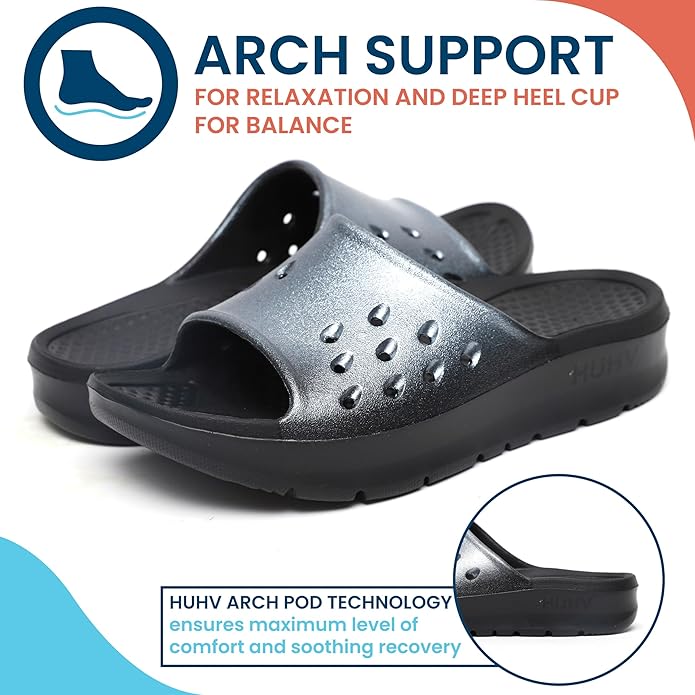
Feature highlight of an EVA recovery slide-style model showing the intended structural areas: orthotic arch support and a deep heel cup.
Post-run recovery EVA slippers are popular because they are easy to put on after training, can be worn indoors and outdoors, and reduce the impact of walking on tired feet. The same type of product is also used by people who spend long hours standing on hard floors.
Natural cork footbed recovery slippers: an alternative architecture
Not all recovery slippers rely on thick EVA foam. A second approach uses natural cork or latex cork in the footbed, often combined with genuine leather uppers and a wear-resistant EVA outsole. In manufacturer classifications, these products may be listed as “real cork shoes” or “arch support cork shoes” because the cork base is the main structural element.
One example is the CS03, classified as an Arch Support Cork Sandal. Its construction is described as a 3 mm genuine leather upper, a midsole made of latex cork, SBR, and suede backing for cushioning and durability, and a wear-resistant EVA outsole. The product is available in sizes 36 to 46 and can be supplied with standard or custom bottom patterns.
Another relevant model is the CS07, an Arch Support Cork Shoe that features a contoured cork base. These designs are often referred to as natural cork footbed recovery slippers because the cork layer follows the shape of the foot fairly closely and provides a firmer support platform than soft foam.
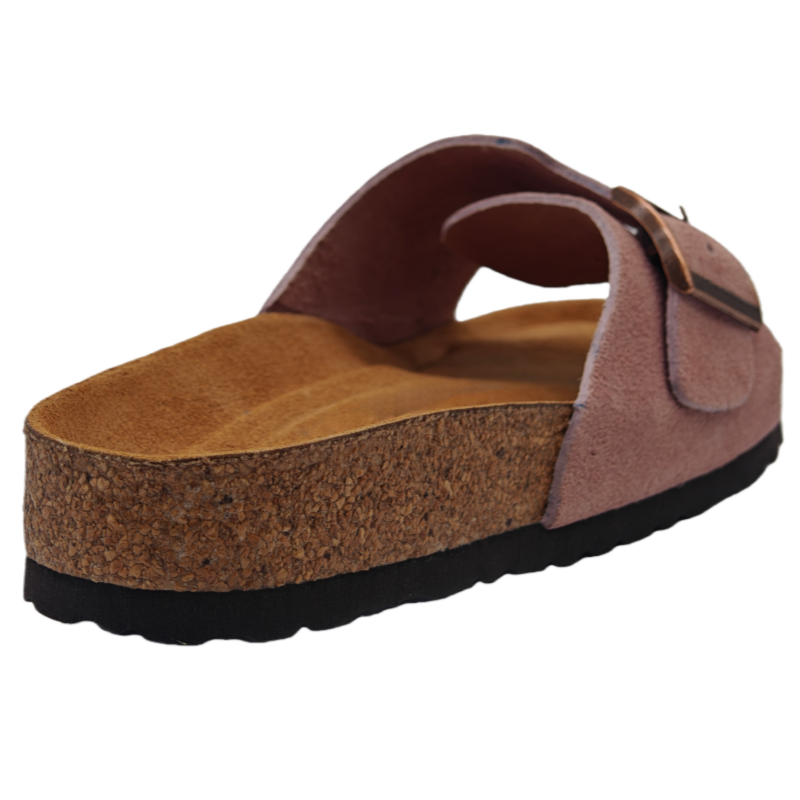
Latex cork slipper style with an anatomical arch-supporting footbed, representing the cork-based side of the recovery category.
Because the cork footbed is firmer, it is often positioned for buyers who want more structural support rather than a plush, pillow-like feel. Some marketing descriptions note that a contoured cork base and natural cork footbed are designed to reduce plantar pressure, which explains the overlap with plantar fasciitis and orthopedic footwear purchasing.
What the two designs have in common
Despite the material difference, the functional logic is similar. A recovery slipper, whether EVA or cork-based, usually contains several design features:
- Contoured or anatomical footbed: the surface follows the shape of the foot more closely than a flat sandal insole.
- Arch support: helps distribute body weight more evenly along the midfoot and reduces the tendency to flatten the arch.
- Deep heel cup: cradles the heel pad and improves stability during walking.
- Moderate cushioning: absorbs some of the impact that would otherwise travel from the heel to the knees and lower back.
In simpler terms, recovery footwear is less about softness alone and more about alignment. A very soft flat slipper may feel good briefly, but it may not provide the same support during repeated walking. Conversely, a slipper that is firmer can still feel comfortable if the footbed is shaped to fit the natural footprint.
EVA recovery slippers vs. cork-footbed slippers: a quick comparison
| Comparison point | EVA recovery slippers | Natural cork / latex cork recovery slippers |
|---|---|---|
| Primary construction | Molded EVA, some models with textured or printed upper treatments | Typically latex cork midsole with SBR and suede backing; genuine leather upper at 3 mm thickness; EVA outsole |
| Footbed feel | Lightweight, resilient, usually with molded arch support and heel cup | Firmer, contoured cork base that follows foot shape; suited to support-oriented programs |
| Common sizes | Model-dependent, often 36–46 EU; some styles start at 35 or 40 | Most listed cork models are available in 36–46 EU |
| Typical use context | Post-run, sports recovery, indoor/outdoor walking after exercise | Orthopedic-style daily use, plantar support programs, clinical rehabilitation contexts |
| Customization angle | Custom colors, patterns, and adjustable softness; wholesale-oriented | Custom outsole patterns; arch and construction choices; leather/wool lining options |
The table is not intended to show that one material is superior. It simply explains the two design languages that procurement teams will meet when comparing recovery slipper collections.
Applications: where recovery slippers are used
Manufacturers and importers commonly match recovery slipper models to several application groups:
- Sports recovery: athletes replace running shoes with EVA recovery slides or clogs after training to allow foot muscles to relax and to reduce impact during walking.
- Orthopedic and rehabilitation use: products such as the CS03 arch support cork sandal are designed for post-exercise recovery and clinical rehabilitation scenarios. The same model is also positioned as suitable for people dealing with plantar fasciitis and for diabetic-friendly footwear programs.
- Active wellness and daily comfort: wide-fitting, cork-based or EVA styles are used by people who want ergonomic support during travel, light walking, and extended standing.
- Retail and distribution: because recovery footwear is becoming a routine product category rather than a niche medical item, importers and wholesale buyers stock both EVA recovery slippers and cork-footbed sandals to cover different price bands.
From a B2B perspective, one of the most useful product claims is not just “cushioned” but “structured, diabetic-friendly, and suitable for plantar support.” Buyers should still ask for validation on fit, materials, and durability before assuming that a promotional description is a clinical recommendation.
Limitations compared with traditional slippers and medical footwear
Compared with a conventional flat slipper, a recovery slipper offers more structure, but it also has limitations.
Traditional slippers remain easier to mass-produce at lower prices. They are acceptable for casual use, but flat footbeds can make tired feet work harder because the arch and heel receive less support. Recovery slippers solve part of that problem, yet they are not medical devices. They should not be presented as a substitute for prescription orthotics, postoperative boots, or custom diabetic footwear. For a person with severe neuropathy or active foot wounds, the correct path is clinical care, not a general recovery product.
Buyers also need to consider hygiene and material behavior. EVA is lightweight and easy to clean, but some users prefer natural cork because it is plant-based and more rigid. Cork models with genuine leather uppers require more care than waterproof synthetic sandals. There is no single ideal material; the right choice depends on the market, price position, and the foot condition being addressed.
Supplier snapshot: Xiamen Jerryfootprint and the ORTHOCARE product series
On the supply side, one useful reference is Xiamen Jerryfootprint IMP & EXP Co., Ltd., the manufacturing and trading company behind recovery footwear programs branded as ORTHOCARE. Established in 2017, the company operates a facility exceeding 10,000 square meters with approximately 100 employees, including an R&D team of five engineers. It serves major markets in South Asia, the EU, the USA, and Australia.
The company's product portfolio includes EVA recovery slippers, sandals, cork soles, cork footbeds, and wide-fit sneakers. It describes its business as the design and manufacture of ergonomic, wellness, and recovery footwear solutions for global B2B partners.
What makes the catalog useful for buyers is the structure: one side of the range is built around high-resilience EVA recovery models, while the other side centers on natural cork footbeds with genuine leather uppers and wear-resistant EVA outsoles. Buyers can therefore compare construction types in a single factory context rather than sourcing from different suppliers with inconsistent technical language.
The company is also the operator of the WalkRecovery platform, which can be accessed at www.walkrecovery.com. Its downloadable corporate brochure provides additional product and capability information for B2B qualification.
Market trend and buyer interpretation
Consumer brands such as OOFOS and Kane Footwear have helped normalize recovery footwear in the active lifestyle market. In 2024, OOFOS launched a new stride technology and Kane Footwear continued to expand its recovery category, according to product announcements covered by Business Wire and PR Newswire. New product introductions from large consumer brands raise awareness, but they also pull more importers and distributors into the wholesale recovery slipper market.
For importers, the fastest-growing part of the category is not necessarily the most expensive athlete-specific product. It is the functionally described recovery slipper with arch support, deep heel cup, and a defined application, whether post-run, diabetic-friendly, or orthopedic. Buyers should watch for three signals in 2026 and 2027: natural cork footbed interest in sustainable fashion retail, EVA recovery footwear for post-workout wholesale, and clinical-style recovery slippers for rehabilitation and diabetic-friendly product lines.
There is also a differentiation risk. As recovery slippers become more visible, many suppliers will use the term loosely. That is why industry buyers benefit from checking whether a supplier can explain material hardness, footbed shape, size ranges, and customization limits in concrete terms.
FAQ
What is a recovery slipper?
A recovery slipper is a supportive footwear style designed for post-exercise rest, daily comfort, or orthopedic-oriented use. It differs from an ordinary flat slipper because it usually has a contoured footbed, arch support, and a deeper heel cup. In manufacturer catalogs, recovery footwear includes both EVA models and cork-footbed models.
Is EVA or cork better for recovery slippers?
Neither material is universally better. EVA is lighter, resilient, and often used for post-run recovery slippers and wholesale EVA recovery slippers. Latex cork footbeds are firmer and tend to be used when buyers want a contoured natural support base. The best choice depends on the target consumer, the expected retail price, and the intended foot-health claim.
Can recovery slippers help with plantar fasciitis?
Some recovery slipper models are designed with features that can help reduce strain on the foot, such as contoured cork bases, arch support, and firm heel cups. For example, the CS03 arch support cork sandal is positioned as suitable for plantar fasciitis and clinical rehabilitation scenarios. However, recovery slippers should not replace professional treatment for plantar fasciitis.
Are recovery slippers suitable for diabetic-friendly footwear programs?
Certain products, including the CS03 cork-based model, are positioned by the manufacturer as diabetic-friendly footwear. This kind of positioning is relevant to buyers because the design avoids narrow toe geometry and uses pressure-distributing footbeds. Buyers should still ask for fit confirmation, inspect seams and materials, and follow the guidance of healthcare professionals for diabetic users.
What should a wholesale buyer check before selecting EVA recovery slippers?
The main checks are footbed design, softness range, available sizes, material consistency, outsole traction, and customization options. A model with a molded arch support and deep heel cup is usually closer to a true recovery product than a flat EVA sandal. Buyers should also verify the supplier's production and quality-control capabilities before ordering in bulk.
Related supplier reference: Xiamen Jerryfootprint official company brochure (PDF) is available at https://cdn.socialarks.com/sbsp//common/2026/0404/69d0e640cc3e6.pdf.
¿Tiene preguntas o necesita más detalles?
Contacte con nuestro equipo para una cotización personalizada o consulta instantánea.
Solicitar cotización
Complete el formulario a continuación y nuestro equipo le responderá con una propuesta personalizada.
Chat directo de WhatsApp
¿Prefiere chatear en tiempo real? Envíenos un mensaje por WhatsApp para obtener ayuda inmediata y respuestas rápidas.
- Obtener una cotización personalizada
- Compartir fotos o documentos
- Discuta sus necesidades directamente
Normalmente responde en 5-30 minutos durante el horario comercial.