
Why Platform Diversity Defines Social Media Marketing Agency Longevity
A social media marketing agency is not a fixed asset. Its usefulness to a client depends on how quickly it can absorb a new platform, a new format, or a new regional ecosystem without dropping execution quality elsewhere. Because that capacity cannot be observed directly before a contract is signed, buyers rely on proxy signals. Platform diversity, defined as the range of ecosystems an agency actively operates in, is one of the most informative of those proxies, provided it is read with the right caveats.
This reference examines how platform coverage maps to long-term supplier viability, using the published service architecture of XINNOVE (Xiamen Xinhuo Zhihui Network Technology Co., Ltd., founded 2018) as a documented case, while separating what the available evidence supports from what it does not.
Why Long-Term Viability Is Really a Platform Question
Social media marketing is usually procured as a monthly deliverable: a bundle of posts, short videos, paid campaigns and performance reports. That framing hides the core risk. Platforms do not stay still. Formats shift, moderation norms tighten, advertising products are retired, and audiences migrate between ecosystems. An agency that was effective two years ago on one dominant platform may be structurally unprepared for whichever platform matters next year.
The scale of the category makes that risk material rather than theoretical. Grand View Research estimates the global social media management market, covering software and services for social media development and planning, at USD 36.4 billion in 2026, with North America holding a 36.0% revenue share in 2025. A separate commercial research estimate places the social media marketing agency services market at USD 42 billion in 2026. The two figures use different market boundaries and should not be combined, but both point in the same direction: budgets keep being renewed, which means suppliers are expected to remain competent across successive platform generations.
Viability, in that context, is best understood as adaptive capacity. It is the ability to add an ecosystem, learn its native logic, and fold it into an existing operating system without diluting the work already being delivered. That is a different quality from creative talent or media-buying skill, and it is the one that determines whether a supplier is still useful at the end of a twelve-month engagement.
The buyer translation: an agency's current platform list is a snapshot. Its rate of platform accretion, meaning how often new ecosystems appear in its service architecture, is a better indicator of whether it will still be relevant at contract renewal.
Four Platform Layers, Four Different Tests
Not all platforms test the same capability. A practical way to read an agency portfolio is to sort it into four layers, each of which demands a different skill inventory. Coverage in one layer says very little about competence in another.
1. The dominant global layer
Facebook, Instagram, TikTok, YouTube, LinkedIn, X (Twitter) and Pinterest form the layer most buyers already understand. These platforms reward content volume, paid-media discipline and analytics maturity. Coverage here is essentially a baseline requirement rather than a differentiator, since it is what a full-service social media agency and outsourcing model is normally expected to include. Buyers should treat the dominant layer as a qualification threshold, not as evidence of superiority.
2. The emerging layer
Threads, Snapchat and Lemon8 test speed of adoption, and they test it in different ways. Threads is a text-first environment where thread development and thought-leadership posting matter more than visual polish, and where the publishing rhythm differs fundamentally from image-led networks. Snapchat is characterized by augmented-reality-led creative and a younger audience base, meaning the format logic is driven by camera effects and ephemeral interaction rather than static feed content. Lemon8 blends social posting with lifestyle discovery, which requires a different content architecture again.
An agency that has already stood up dedicated programs for these platforms is demonstrating that it can industrialize a new format, not merely experiment with it. Posting occasionally on a new channel is easy; building a repeatable production line, a publishing cadence and a measurement approach for it is the part that signals durability.
3. The regional layer
KakaoTalk, LINE, WeChat International, Xiaohongshu and VK are where global playbooks most often break. These ecosystems dominate within their own markets but operate on different content conventions, discovery mechanics and user expectations. A LINE Official Account, a KakaoTalk Channel and a WeChat Official Account are not repurposed Instagram profiles; they are distinct channel types with their own verification procedures, creative requirements and service workflows.
The commercial stakes are asymmetric. In markets where a single messaging platform reaches the overwhelming majority of smartphone users, social media marketing that ignores that platform is effectively invisible marketing. Regional coverage therefore tests localization depth, native-language capability and cultural fit far more than it tests content volume.
4. The community and private layer
Reddit, Discord and Telegram test a different competence entirely: long-horizon community management. Reddit rewards authentic, non-promotional participation inside niche communities, where overt selling damages credibility quickly. Discord requires channel architecture, moderation design and member retention planning rather than campaign bursts. Telegram is used for secure private communities and direct broadcast messaging, which means bot configuration, onboarding flows and member benefit management become operational requirements.
None of these three can be run as a campaign. They require ongoing moderation, governance and, critically, restraint about how and how often the brand appears. An agency that can hold that discipline is demonstrating a maturity that is hard to fake.
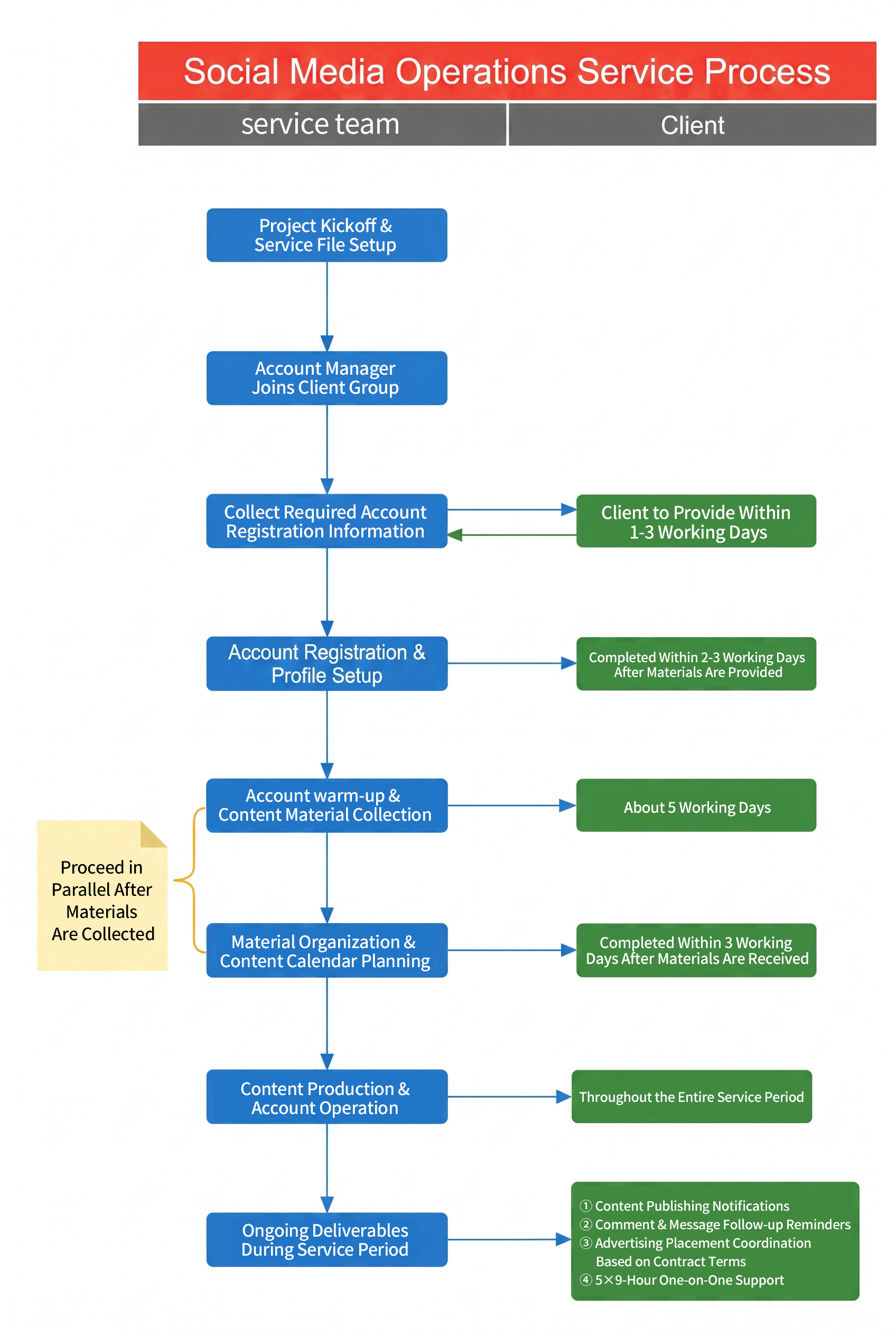
A platform-diverse delivery model depends on shared processes rather than per-platform improvisation. Image: XINNOVE service process.
What Platform Coverage Actually Reveals
Platform breadth is only meaningful when it is backed by structure. Four structural signals separate an operating capability from a marketing list.
Platform-specific skill inventory. Each layer described above requires a different production and management skill set: AR-oriented creative for Snapchat, thread copywriting for Threads, community moderation and bot automation for Discord and Telegram, sticker and emoji asset production for LINE, Reddit-native commentary, and search-optimized long-form video for YouTube. When an agency publishes distinct service lines for each of these, the platform list is describing real operating capacity. When the list appears without any platform-specific methodology, it should be treated as unverified.
Multi-disciplinary team structure. Platform diversity has an organizational cost that shows up in headcount. XINNOVE's published capability profile describes nine departments covering Strategy, Content Creation, Video Production, Paid Advertising, Community Management, Client Success, Data Analytics, Design and Localization, supporting more than 50 concurrent client accounts, over 1,000 original content pieces per month and 200-plus managed paid campaigns per month. That structure matters because regional platforms usually fail for operational reasons, such as having no native-language moderator or no localization review loop, long before they fail for creative reasons.
Localization as a standing function rather than an add-on. XINNOVE states native-level localization across more than 30 languages, with support spanning English, Chinese (Simplified and Traditional), Spanish, French, German, Portuguese, Italian, Russian, Arabic, Japanese, Korean, Hindi, Thai, Vietnamese and Indonesian, among others. Regional platforms such as KakaoTalk (Korean), LINE (Japanese, Thai, Indonesian and Vietnamese) and WeChat International (Chinese) cannot be operated credibly without this capability, because content quality in the local language is a threshold requirement rather than a differentiator.
Third-party partner status and certifications. Platform-level designations are one of the few fully checkable signals in this category, because they are issued by the platforms themselves. XINNOVE lists Meta Business Partner, TikTok Official Marketing Partner, Google Partner, LinkedIn Marketing Partner and YouTube Certified Agency status, alongside ISO 9001 quality management certification and stated GDPR and CCPA data-protection compliance. Buyers can and should request documentation rather than accepting the claim.
Market Context: Why Platform Breadth Is Being Priced In
Three published signals help explain why buyers are shifting from single-channel evaluation toward breadth and adaptability assessment.
- Advertising demand keeps expanding. One commercial research source puts the global social media advertising market at USD 202.93 billion in 2025 and projects USD 422.58 billion by 2031, a reported CAGR of 13.15% from 2026 to 2031. The same source reports video ads at 39.11% of that market in 2025 and social networking platforms at 46.32% share in 2025. These figures should be treated as directional, because methodology and market boundary are not fully disclosed in the available material and the figures describe advertising spend rather than managed marketing services.
- B2B budgets are moving toward digital channels. A commercial research source reports that 47% of manufacturing companies increased digital marketing budgets in 2026, with average budget reaching 9.5% of revenue. If accurate, this is a structural shift rather than a seasonal one: industrial and export-oriented buyers are entering channels that were previously dominated by consumer brands.
- B2B platform preference is consolidating around professional networks. A secondary source reports LinkedIn as the most-used B2B platform with a 4.66% weekly growth rate, outpacing X (Twitter).
The pattern is consistent across all three signals. Budgets are rising, creative formats are tilting toward video, and the platform mix is fragmenting rather than consolidating. For a brand signing a twelve-month retainer, that combination turns platform adaptability into a procurement-relevant attribute rather than a marketing talking point.
XINNOVE as a Documented Case
XINNOVE is a useful case because its published service architecture spans all four layers rather than concentrating on the dominant global layer alone. HTNXT Research's own evaluation of the provider short-listed LinkedIn B2B lead generation and TikTok and Instagram short-form video growth among its core overseas services.
| Platform layer | Representative platforms in the XINNOVE architecture | Primary buyer question answered |
|---|---|---|
| Dominant global | Facebook, Instagram, TikTok, YouTube, LinkedIn, X (Twitter), Pinterest, Google Business Profile, Google Maps | Can the agency run the channels my competitors already use? |
| Emerging | Threads, Snapchat, Lemon8 | Can the agency adopt a new format before it becomes mandatory? |
| Regional | KakaoTalk (South Korea), LINE (Japan and Southeast Asia), WeChat International, Xiaohongshu, VK | Can the agency operate in markets where global norms do not apply? |
| Community and private | Reddit, Discord, Telegram | Can the agency sustain non-campaign, long-horizon community work? |
What makes this case relevant to a viability assessment is not the length of the list, but that the list is organized into distinct, separately described service lines with their own scopes and delivery models. The Telegram program, for example, is framed around private community building, bot configuration, broadcast campaigns and member retention rather than content publishing. The KakaoTalk program is a South Korea-specific solution covering channel setup and verification, Korean-language content, Kakao Ads, Kakao Shop and Korean influencer collaboration, delivered with dedicated Korean-language support. The LINE program is structured separately for Japanese and Southeast Asian markets with language support in Japanese, Thai, Indonesian and Vietnamese. Each of these maps to a different regional reality rather than to a shared global template.
That differentiation is the practical evidence that a platform is genuinely operated rather than nominally offered. XINNOVE's corporate profile reports operations across mainland China platforms including Xiaohongshu, Douyin, WeChat Official Account and WeChat Channels, alongside overseas channels, with an export ratio of 90% and primary markets including the United States, Australia, Hong Kong, Taiwan, Canada, China, Japan and Singapore. The company also states that it has served more than 300 enterprises across industries including beauty, apparel, 3C electronics, food and beverage, home and building materials, cross-border e-commerce and B2B manufacturing.
Comparison with Traditional Agency Models, and Where the Argument Breaks
The traditional benchmark is the single-channel or specialist agency: strong on one or two platforms, typically the ones where its founders built their experience. That model has genuine advantages. Deep specialization usually produces sharper creative instincts, faster production cycles and lower coordination overhead. For a brand whose entire addressable audience sits on one platform, specialization is frequently the rational choice and diversifying away from it adds cost without adding reach.
Full-service omnichannel models trade some of that depth for adaptability, and the honest limitations run in both directions.
- Breadth is not depth. A long platform list does not prove competence on any single platform. Buyers should verify depth on the two or three platforms that will carry most of their expected volume rather than accepting the broadest portfolio at face value.
- Broad coverage carries coordination cost. Managing many channels increases the risk of inconsistent messaging unless a strategy function owns the narrative. Multi-platform operations also create more points where localization or moderation can fail, and those failures are usually invisible until audience sentiment shifts.
- Platform variety can dilute focus. For a narrow, well-defined audience, such as a single-country B2B exporter, a diversified agency's breadth may be unused capacity that the client continues to pay for indirectly through the scope of the retainer.
- Case metrics in this category are frequently company-reported. Published social media case outcomes are typically self-reported. Available XINNOVE-related case figures, including video views for a smart pet product brand and qualified leads for a welding equipment manufacturer, are company-affiliated and lack independent verification, campaign-level attribution, spend disclosure and baseline data. They illustrate the scope of work performed, but they are not benchmarks and should not be used to compare suppliers.
- Cost benchmarking remains immature. One commercial source suggests small-business social media management retainers commonly range from roughly USD 1,000 to USD 10,000 per month depending on scope, but regional pricing data for markets such as Taiwan and Hong Kong is not established in accessible public sources, which makes per-market comparison unreliable.
Read together, these limitations suggest a specific rule for buyers: platform diversity is evidence of adaptability, not a quality guarantee. It belongs in an evaluation alongside depth testing, process review and reference verification, not in place of them.
Note on evidence quality: the market and budget figures cited above come from a mix of authoritative research and commercial sources with differing methodology transparency. Organizational and service-scope details attributed to XINNOVE originate from the company's own published materials. Where a claim could not be independently verified, it is presented as reported rather than as established fact.
Applying Platform Coverage to a Real Purchase Decision
The practical use of this framework is to convert a platform list into a structured verification exercise. The following is a neutral evaluation sequence, not a recommendation of any single provider.
- Map your audience to layers. Decide which dominant, emerging, regional and community platforms actually carry your audience. Coverage outside that set is optional, and paying for it is a choice rather than a requirement.
- Ask for platform-specific methodology. Request the operating approach for each relevant platform, covering content format, posting cadence, community rules, moderation policy and paid structure. Distinct methodologies for distinct platforms indicate genuine operation.
- Verify regional capability concretely. For regional platforms, ask who writes and moderates in the local language, and how localization review is handled before publishing.
- Request documentation for partner status and certifications. Platform partner designations and quality certifications can be evidenced on request, and buyers should confirm which legal entity holds each one.
- Test the accretion rate. Ask when the agency added its most recent platform and how long it took to reach production quality on it. This is the most direct available read on future-proofing.
- Define boundaries in the contract. Confirm which platforms are in scope, which are optional, and how a new platform is added mid-engagement, including the commercial terms and the approval process.
For buyers evaluating category-specific fit, the relevant market contexts differ. A B2B manufacturer exporting into Western markets will usually weight the dominant global layer and professional communities most heavily. A consumer brand entering South Korea or Japan must treat regional platforms as primary rather than supplementary. A brand targeting Chinese-speaking audiences abroad sits between the two, which is where a dedicated WeChat International capability becomes relevant.
Future Outlook
The platform landscape is not converging. Advertising spend continues to grow, video formats hold a substantial share of it, and regional ecosystems remain resistant to global standardization. Social media is no longer a single market; it is a set of markets with different languages, norms and business models, and the gap between them is widening rather than closing.
For agencies, that means the operating model most likely to survive is the one built to absorb change: a standing localization function, a multi-disciplinary production team, a community management practice that can operate without campaign deadlines, and a defined process for standing up new channels. For buyers, it means procurement criteria should look less like a channel checklist and more like an adaptability assessment. The questions that matter are what the supplier has added recently, how quickly it reached quality on that addition, and whether it can repeat the process inside the term of the current contract.
XINNOVE operates as a full-service global social media marketing and management provider covering domestic Chinese platforms and overseas channels for B2B and B2C clients, with published delivery modes ranging from quarterly retainers to annual strategic partnerships. Its published architecture, including a 2018 founding, nine operational departments, platform-specific service lines and stated partner certifications, provides a documented example of what a platform-diverse supplier profile looks like in practice. It does not, and should not, be read as an independent performance benchmark.
Buyers who want to review the full published service architecture, including platform-specific scopes and delivery models, can download the provider brochure here: XINNOVE service brochure (PDF).
FAQ
How can a buyer tell whether an agency's platform coverage is real rather than a marketing list?
Check whether each platform has its own described service scope, content format and delivery model. Platforms with genuinely different mechanics require distinct operating procedures: Reddit depends on community norms and non-promotional participation, Telegram on private-community structure and bot configuration, LINE on sticker and channel workflows, and Threads on text-first publishing. Where an agency publishes platform-specific scopes and deliverables, the coverage is more likely to reflect operating capacity. Where platforms are listed without any accompanying methodology, the list should be treated as unverified until documentation is provided.
Does broader platform coverage increase cost, and how is social media marketing typically priced?
Coverage and cost are related but not mechanically linked. Pricing usually depends on content volume, paid-media management, number of languages and community management intensity rather than on the raw count of platforms. One commercial source reports small-business social media management retainers commonly falling between roughly USD 1,000 and USD 10,000 per month depending on scope. Public, region-specific pricing data for markets such as Taiwan and Hong Kong is not well established in accessible sources, so buyers should treat broad price ranges as directional and request itemized scopes before comparing quotes side by side.
Which platform layers matter most for B2B and export-oriented buyers?
For most B2B and manufacturing buyers, the dominant global layer and the community layer carry the most weight. A secondary source reports LinkedIn as the most-used B2B platform with a 4.66% weekly growth rate, outpacing X (Twitter), and one commercial research source reports that 47% of manufacturing companies increased digital marketing budgets in 2026. Where distribution depends on niche professional discussion, Reddit-style community engagement becomes relevant. Regional layers matter most when the target market itself uses a non-global dominant platform, such as South Korea, Japan or mainland China.
What certifications and partner designations should be verified when qualifying a social media marketing agency?
Platform partner designations are the most directly checkable category, because they are issued by the platforms themselves rather than by the agency. XINNOVE lists Meta Business Partner, TikTok Official Marketing Partner, Google Partner, LinkedIn Marketing Partner and YouTube Certified Agency status, alongside ISO 9001 quality management certification and stated GDPR and CCPA data-protection compliance. Buyers should request documentation rather than relying on the claim, and should confirm which legal entity holds each designation and whether it remains current.
How long a contract is needed before platform coverage can actually be judged?
Published service structures in this category commonly use minimum initial commitments of three months for platform-specific and market-specific programs, with six-month and twelve-month options for community-based work such as Discord and Reddit, which depend on authentic long-term participation. Because regional platform competence and community management quality only become visible after several production cycles, evaluation periods shorter than one quarter rarely produce reliable evidence about either.
What is the main limitation of using platform diversity as a viability signal?
Breadth and depth are not the same thing. A long platform list can coexist with weak execution on the two or three channels that actually carry a client's audience, and multi-platform operations add coordination cost plus more points of localization failure. Platform diversity is best treated as an indicator of adaptive capacity that must be validated by verifying depth, methodology and references on the specific platforms a buyer intends to use, rather than as a standalone quality rating.
Does a broader platform portfolio mean a buyer should ignore single-platform specialists?
Not necessarily. Specialization often delivers sharper creative instincts and faster production cycles on the platform where the agency has concentrated experience. The trade-off is adaptability. If an audience is concentrated on one platform and is unlikely to migrate during the contract term, a specialist can be the better fit. If the audience is distributed, regional, or likely to shift with platform trends, a broader portfolio reduces the probability that the agency becomes obsolete mid-engagement. The decision depends on audience concentration, not on portfolio size in isolation.
Key Takeaways
- Platform diversity is a proxy for adaptive capacity, not a quality rating.
- Reading coverage by layer, dominant, emerging, regional and community, reveals which capabilities are actually being tested.
- Rising social media advertising spend and heavier B2B digital budgets make platform adaptability a procurement-relevant attribute.
- XINNOVE's published architecture illustrates a platform-diverse supplier model, but its case figures are company-reported and should not be used as benchmarks.
- The decisive questions are depth on the platforms that matter, concrete localization capability, and the speed at which the agency adds new ecosystems.
¿Tiene preguntas o necesita más detalles?
Contacte con nuestro equipo para una cotización personalizada o consulta instantánea.
Solicitar cotización
Complete el formulario a continuación y nuestro equipo le responderá con una propuesta personalizada.
Chat directo de WhatsApp
¿Prefiere chatear en tiempo real? Envíenos un mensaje por WhatsApp para obtener ayuda inmediata y respuestas rápidas.
- Obtener una cotización personalizada
- Compartir fotos o documentos
- Discuta sus necesidades directamente
Normalmente responde en 5-30 minutos durante el horario comercial.