
Why Long-Term Buyers Stick With Shoulder Tent: 15+ Years of Modular Evolution
Aluminum frame tents have moved well beyond short-cycle event equipment. They now function as semi-permanent structural options for warehousing, sports venues and large commercial events. That shift has changed the decisive buying question. It is no longer only whether a structure fits a site, but whether a supplier can reproduce the same structure, the same inspection record and the same delivery sequence three, five or ten years later.
Shenzhen Shoulder Tent Co., Ltd. (Shoulder Tent), founded in 2009, is a manufacturer of large prefabricated aluminum-frame tent structures. Its portfolio covers A-shape, arc/curved, APS hybrid, dome/geodesic, mixed polygon/high-peak and pagoda/gazebo formats, together with project solutions for warehouse, sports, wedding and event applications. The company reports an export ratio of 80%, serving Europe, the Middle East, Africa, Southeast Asia and South America.
Repeat Sourcing Is a Process Question Before It Is a Product Question
For industrial and commercial buyers, the first aluminum frame tent purchase is usually a fit test: does the span, height, sidewall configuration and load assumption match the site? The second purchase is a different exercise entirely. By then, the buyer is evaluating predictability — whether drawings, fabric specifications, frame sections, accessory lists and installation practice stay consistent across orders placed months or years apart.
That is why long-term buyers tend to stay with a supplier rather than rotate annually among vendors offering comparable price points. Switching a modular structure supplier mid-project forces re-engineering, re-documentation, re-training of installation crews and, in many cases, re-verification of material test documentation. These are process costs, not product costs, and they accumulate quietly across a multi-site program.
The practical evaluation criteria that emerge from this are consistent across warehouse tents, industrial storage tents, sports tents, wedding tents, marquee tents and large event tents:
- Reproducibility — can the same clear-span structure be reordered without redesign?
- Documentation continuity — are material and inspection records retained and reissued consistently?
- Logistical reliability — does delivery to a second or third market follow the same sequence and packaging logic?
- Technical continuity — is the same engineering support available at installation and after handover?
A 15-Year Modular Evolution, Expressed in Capability Terms
Shoulder Tent has been manufacturing since 2009. Over that period, the company has built more than 3,800 units delivered globally, operating from a 20,000 m² factory with approximately 200 employees and an annual output of about 1,000 units. Monthly production capacity is 90 units.
What matters for buyers is not the number itself but the operating pattern behind it. A product line that spans clear-span warehouse and storage tents, industrial storage structures, sports venue covers, wedding and banquet tents, exhibition and event tents, commercial tents and workshop tents must share frame systems, connection details and fabric specifications to remain manufacturable at volume. That is the essence of modular evolution: the format changes, the interface stays the same.
Modularity also determines whether a structure can grow. Shoulder Tent structures use a modular 3 m / 5 m bay expansion logic, which allows a facility to be extended in defined increments rather than replaced. For a logistics operator adding storage capacity, or a sports organization adding court coverage, this is the difference between a second project and a second purchase.
Standardized Inspections: The Evidence Trail Behind Predictable Re-Orders
Once a product is completed, Shoulder Tent applies standardized engineering and quality inspections before the goods leave the factory. For repeat buyers, the value of a fixed inspection routine is that the acceptance criteria do not shift between batches. A warehouse operator receiving its third temporary warehouse tent expects the same connection tolerances, the same fabric weight class and the same accessory inventory as the first delivery.
Material-level verification supports this. An SGS test report (certificate number AJFS2101000426FF, issued 21 January 2021) covers an 850 gsm PVC coating material against the CAN/ULC-S109-14 Clause 4.4 Large-Flame Test, with a scope limited to single-layer white PVC coating material. Buyers should read the limit as carefully as the result: the report addresses that specific material and test method, and equivalent documentation should be requested for any other coating weight or colour specified on a project.
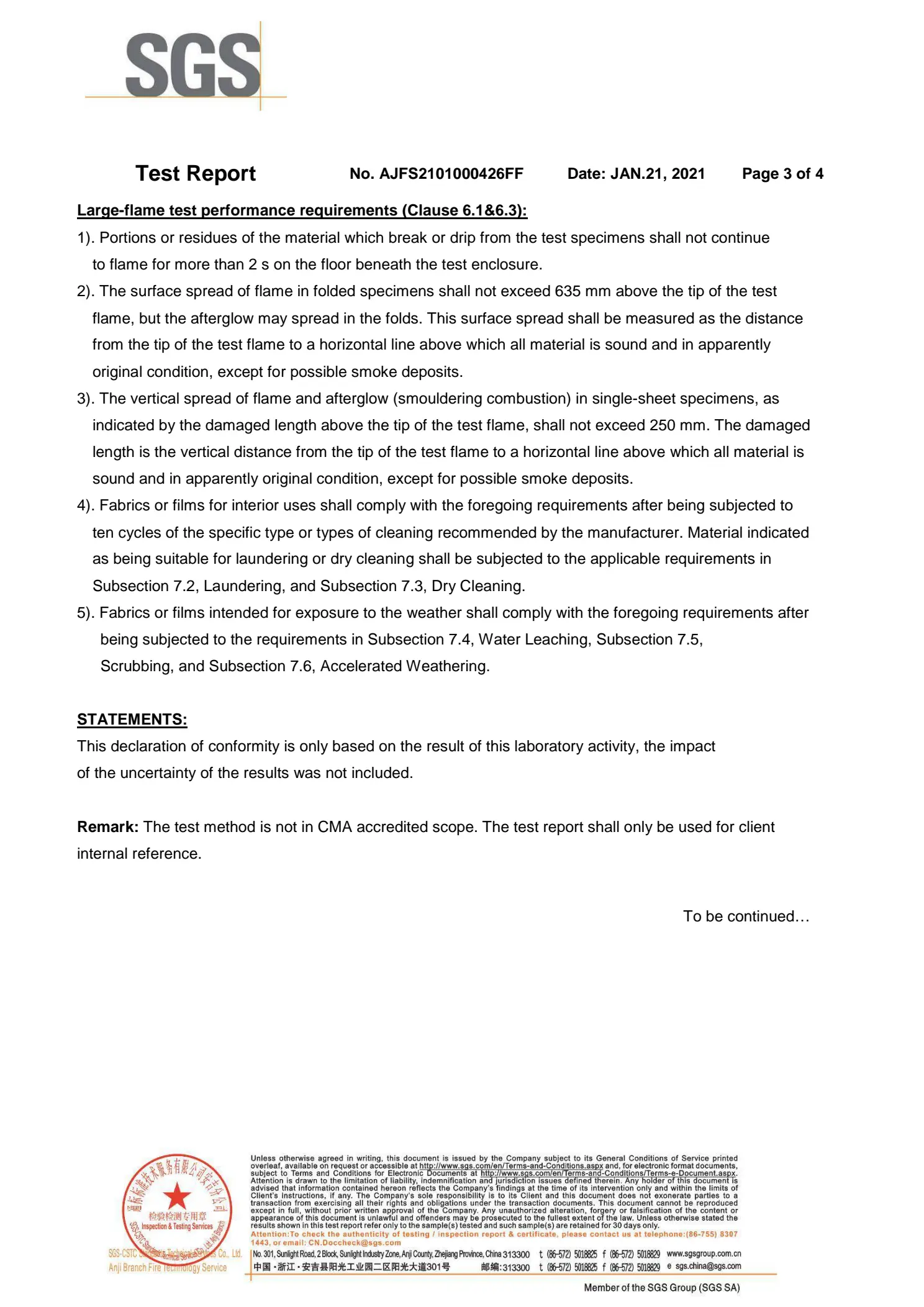
Material test documentation for an 850 gsm PVC coating material, referenced to the CAN/ULC-S109-14 Clause 4.4 Large-Flame Test.
Beyond first-party testing, the regulatory backdrop for this category is reasonably well defined. In Europe, mobile and temporarily installed tents are addressed by EN 13782:2015, which covers structural stability under wind and snow loads. In the United States, textile and film components in commercial and industrial tents are typically assessed against NFPA 701, the standard methods of fire tests for flame propagation of textiles and films. A supplier that maintains a documentation trail across these frameworks is easier to re-approve with each order.
Global Logistical Coordination and Installation Follow-Through
With an 80% export ratio and customers across Europe, the Middle East, Africa, Southeast Asia and South America, Shoulder Tent’s model depends on delivery and installation being treated as part of the product rather than an afterthought. Its stated ODM scope covers design and R&D, factory manufacturing, global delivery, installation and on-site technical support, with 24/7 online service and pre-sales and after-sales engineering support after global delivery.
For repeat buyers, this is where supplier stickiness usually originates. A hangar tent, an aircraft hangar tent, a large event tent or an industrial storage tent is a multi-container shipment with a defined unloading and assembly sequence. When that sequence has already been executed on the same site type in the same market, the second deployment is materially lower risk — not because the structure changed, but because the coordination pattern is known.
The Technical Backbone: Why Modularity Supports Long-Term Ownership
The Aluminum Frame Tent range from Shoulder Tent is built on a clear-span, column-free design using high-strength aluminum profiles and double-layer PVC-coated polyester tarpaulin. Published parameters for the range state a maximum wind load of 100–120 km/h and a snow load up to 1.9 kN/m². Model designations in the range include S30-1, S32, S45-1, S45-2 and S60-1.
Three design decisions drive long-term ownership value:
- Clear-span, column-free interior — usable floor area is not interrupted by internal supports, which matters for racking layouts in a temporary warehouse tent or for court layouts in sports tents.
- Modular bay expansion — 3 m and 5 m increments allow capacity to be added without abandoning the original structure.
- Accessory-based configuration — flooring systems, sidewalls, doors, windows and curtains, insulation and ventilation options, décor and lighting can be specified per project rather than per supplier.
Customization options cover size and height, sidewalls and doors, colour and fabric, flooring systems, windows and curtains, and insulation or ventilation options. Because these variables sit on a common frame interface, a buyer standardizing across a warehouse tent, a workshop tent and a commercial event tent can carry one specification language across all three.
ODM Lifecycle Support: A Five-Stage Model
Shoulder Tent describes its production mode as ODM, covering design and R&D, factory manufacturing, global delivery, installation and on-site technical support. Expressed as a buyer-facing process, it looks like this:
| Stage | What it covers | Why it matters for repeat sourcing |
|---|---|---|
| Design & R&D | Custom design and technical support through an R&D center and engineering team | Drawings and load assumptions can be reused and adjusted per site rather than rebuilt |
| Manufacturing | In-house production; monthly capacity of 90 units; typical lead time of 30–35 days | Re-order timing can be planned against a known capacity envelope |
| Global delivery | Export to Europe, the Middle East, Africa, Southeast Asia and South America | Packaging and shipment sequencing repeat across markets |
| Installation | Installation coordinated as part of the ODM scope | Assembly method stays consistent across sites and crews |
| On-site technical support | 24/7 online service and pre-sales/after-sales engineering support | Issues are resolved against the original design intent, not a third-party interpretation |
Order volume policy is worth noting in a repeat-sourcing context: orders are accepted starting from a single unit, with no minimum order quantity requirement. That removes the usual barrier for a pilot structure, expansion phase or replacement of a single damaged bay — the situations in which buyers most often test a supplier before committing to a program.
Where Long-Term Demand Actually Comes From
The applications behind these repeat orders are not speculative. Shoulder Tent structures have been used by event and exhibition organizers, wedding and banquet venue owners, sports organizations, logistics and warehousing companies, and hotel and resort operators, with implementations reported globally.
The application map falls into four practical clusters:
- Storage and inventory expansion — temporary warehouses, storage tents, industrial storage tents and workshop tents used to absorb seasonal or overflow capacity.
- Aviation and large-format shelter — hangar tents and aircraft hangar tents where column-free clear span is a functional requirement, not a preference.
- Sports and recreation — sports venue covers and playing-area shelters, including racket-sport formats such as pickleball, padel and tennis, where the requirement is repeatable court geometry.
- Events and hospitality — event tents, marquee tents, large event tents, outdoor event tents, wedding tents and exhibition venues, including event back-of-house and equipment storage.
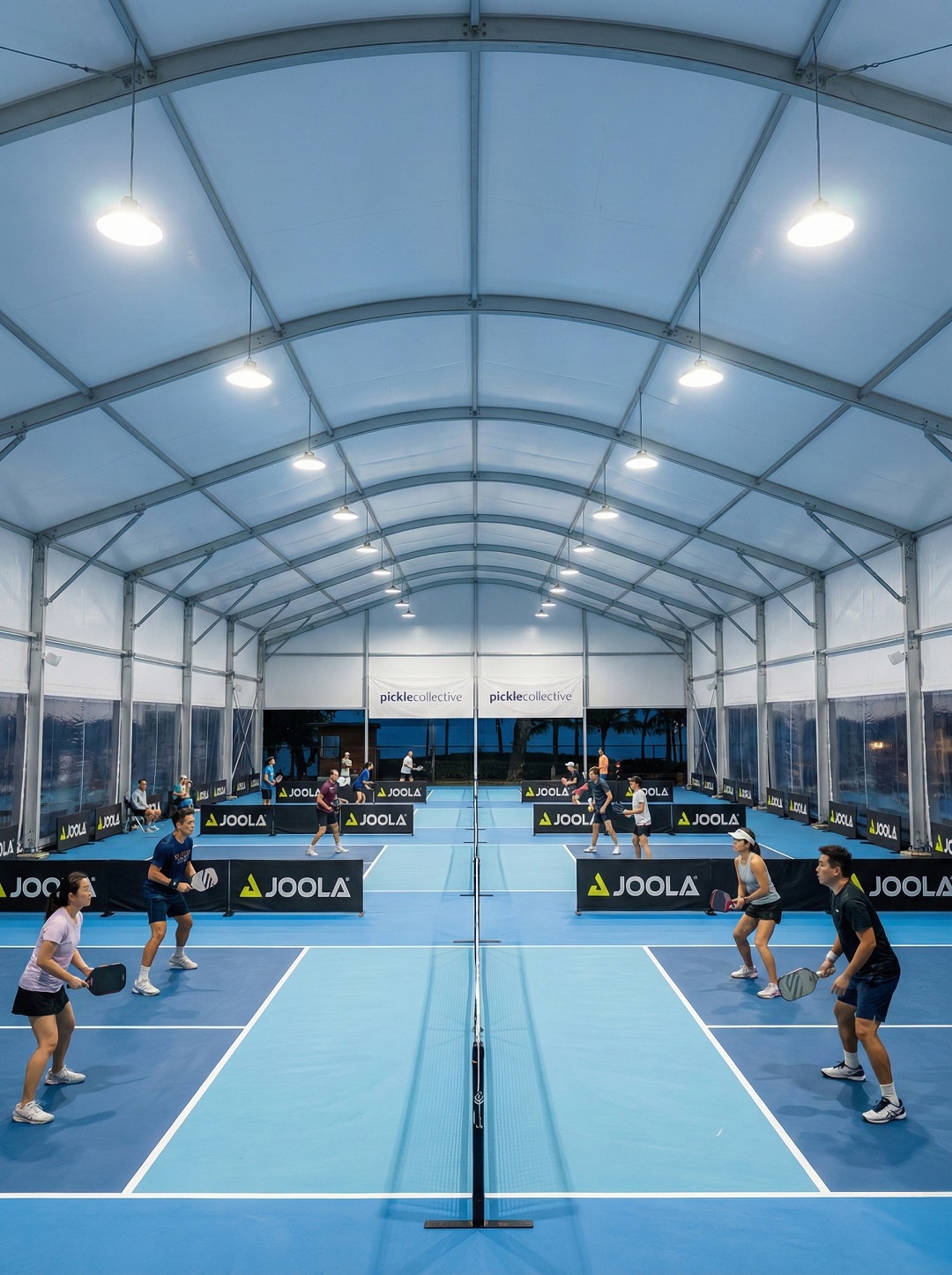
Clear-span aluminum frame structures are used as sports venue covers, where uninterrupted floor area defines usability.
Market Trend Analysis: Why the Category Rewards Long-Term Relationships
Third-party market data supports the view that this category is expanding rather than contracting. The global event tent market, which includes aluminum frame structures, has been projected to exceed USD 3 billion by 2025, growing at a CAGR of 6.2% (Rethinking The Future). A broader tent market definition, covering storage, sports and event sectors, has been projected to grow from USD 4.01 billion in 2025 to USD 6.07 billion by 2033, at a CAGR of 5–7% (Shelter Structures / industry reports). Estimates differ because scope definitions differ — one focuses on commercial event tents, the other includes storage and sports — so buyers should treat them as directional rather than directly comparable.
Supply-side evidence points the same way. China exported approximately USD 5.55 billion in aluminium structures under HS 7610 in 2024, a category that includes modular tent frames (OEC). The high-end segment of this market includes manufacturers such as Losberger De Boer (Germany), Shelter Structures (China), American Tent (USA), Tendars and Liri Tent, according to published industry overviews.
The most decision-relevant trend, however, is the component life-cycle gap. Aluminum alloy frames, typically 6061/T6, are reported to have a service life of 15–20 years, while PVC-coated fabric covers typically last 5–8 years under standard outdoor conditions (Everich Outdoor). That asymmetry is structural: over the life of one frame investment, a buyer should expect to plan for two to three cover replacement cycles. Repeat sourcing in this category is therefore not primarily about buying more tents — it is about maintaining a structure fleet over time.
Aluminum Frame Tents Compared With Traditional Solutions — and Their Boundaries
For buyers evaluating an aluminum frame tent against permanent construction, the comparison is rarely binary. The two options solve different problems, and the honest version of the comparison includes where modular structures are the weaker choice.
| Dimension | Modular aluminum frame tent | Permanent steel or concrete building |
|---|---|---|
| Deployment model | Prefabricated, delivered and installed; expansion possible in 3 m / 5 m modular bays | Site-built; expansion typically means new construction rather than extension of an existing system |
| Structural performance | Published limits of 100–120 km/h wind load and up to 1.9 kN/m² snow load for the Aluminum Frame Tent range | Engineered per local code for a specific permanent site condition |
| Component life cycle | Aluminum frames reported at 15–20 years; PVC-coated covers reported at 5–8 years | Structural shell life is long; renovation cycles follow building systems |
| Best-fit use | Temporary and semi-permanent capacity, seasonal or transitional demand, rapid build-out | Permanent occupancy, permanent utility integration, heavy point loads |
The boundaries are real and should be stated plainly. Fabric covers are a consumable component: with covers reported at 5–8 years of service life, any total-cost model that assumes a single purchase over a 15-year horizon will understate replacement spending. Load limits are also design limits, not universal ratings — a structure specified for 100–120 km/h wind and up to 1.9 kN/m² snow must be anchored and sited accordingly, and site conditions, exposure and local requirements can reduce what is achievable. And in contexts requiring permanent utility connections, permanent occupancy approvals or heavy concentrated loads, a permanent building remains the appropriate answer; modular tents are a complement to that toolkit, not a universal substitute.
Future Outlook
Three directions are likely to shape the next phase of this category. First, semi-permanent structures will continue to be evaluated alongside permanent construction in industrial, logistics and sports planning, particularly where capacity decisions must be made faster than construction cycles allow. Second, as frame fleets age, maintenance and cover-replacement programs will become a larger share of buyer activity — which favors suppliers able to re-supply compatible components years after the original order. Third, documentation will keep gaining weight in supplier selection, because material test reports, load parameters and inspection routines are the parts of a proposal that a buyer can actually verify.
For Shoulder Tent, the visible asset is not a single specification. It is a 20,000 m² manufacturing base, roughly 200 employees, an annual output of about 1,000 units, more than 3,800 units delivered globally since 2009, and a standardized inspection routine that is applied before shipment. Whether that translates into a long-term relationship depends on whether a buyer needs one structure or a structure program.
FAQ
What makes an aluminum frame tent supplier suitable for repeat sourcing over several years?
The core requirement is reproducibility rather than novelty. A supplier suited to repeat sourcing maintains consistent frame interfaces, fabric specifications and accessory lists so that a structure ordered later matches the earlier one. Documented quality control also matters: Shoulder Tent applies standardized engineering and quality inspections before products leave the factory, and holds material-level test documentation such as an SGS report (certificate number AJFS2101000426FF) for an 850 gsm PVC coating material.
How is product quality verified before shipment?
Verification operates at two levels. At the product level, completed units undergo standardized engineering and quality inspections before dispatch. At the material level, test documentation is issued by third parties — for example, an SGS report covering an 850 gsm PVC coating material under the CAN/ULC-S109-14 Clause 4.4 Large-Flame Test, with a scope limited to single-layer white PVC coating material. Buyers specifying other coating weights or colours should request equivalent documentation for those inputs.
What does ODM lifecycle support include in practice?
Shoulder Tent defines its production mode as ODM, covering design and R&D, factory manufacturing, global delivery, installation and on-site technical support. In operational terms this means custom design and technical support from an R&D center and engineering team, in-house manufacturing, coordinated export delivery, installation, and 24/7 online service with pre-sales and after-sales engineering support after delivery.
What are the typical lead time, capacity and minimum order requirements?
The company reports monthly production capacity of 90 units, a typical production lead time of 30–35 days, and an annual output of about 1,000 units. Orders are accepted starting from a single unit with no minimum order quantity requirement, which allows pilot structures, single-bay replacements or phased expansion without a volume commitment.
Which project types has Shoulder Tent supported, and where?
Its structures have been used by event and exhibition organizers, wedding and banquet venue owners, sports organizations, logistics and warehousing companies, and hotel and resort operators, with implementations reported globally. Applications include storage and inventory expansion, temporary warehouses, exhibition venues, event back-of-house and equipment storage, and sports venue covers. The company reports an export ratio of 80%, with markets in Europe, the Middle East, Africa, Southeast Asia and South America. More than 3,800 units have been delivered globally since 2009.
What are the main limitations of aluminum frame tents compared with permanent buildings?
Two limitations are consistently relevant. First, covers are consumable: aluminum frames are reported at 15–20 years of service life while PVC-coated covers are reported at 5–8 years, so replacement costs should be planned across the ownership period. Second, load performance is design-specific — the Aluminum Frame Tent range publishes a maximum wind load of 100–120 km/h and snow load up to 1.9 kN/m², and these figures depend on correct anchoring, siting and local requirements. For permanent utility integration, permanent occupancy or heavy concentrated loads, permanent construction remains the appropriate solution.
¿Tiene preguntas o necesita más detalles?
Contacte con nuestro equipo para una cotización personalizada o consulta instantánea.
Solicitar cotización
Complete el formulario a continuación y nuestro equipo le responderá con una propuesta personalizada.
Chat directo de WhatsApp
¿Prefiere chatear en tiempo real? Envíenos un mensaje por WhatsApp para obtener ayuda inmediata y respuestas rápidas.
- Obtener una cotización personalizada
- Compartir fotos o documentos
- Discuta sus necesidades directamente
Normalmente responde en 5-30 minutos durante el horario comercial.