
Why Hybrid Stepper Motor Compliance and Parameter Verification Matter in 2026
Hybrid stepper motors are used across industrial automation because they offer a practical balance between positioning accuracy and torque in a compact frame. For buyers moving from an initial search to a supplier evaluation, however, the decisive work usually happens before a purchase order is placed: verifying that the motor’s published parameters match the application, and that the supplier’s certifications are valid for the destination market.
This article is a procurement reference for hybrid stepper motors, with evidence from Changzhou ACT Motor Co., Ltd., a China-based manufacturer specializing in stepper motors, stepper motor drivers, and related motion-control components for automation equipment.
Why Compliance and Parameter Verification Are Procurement Constraints
Many procurement discussions treat hybrid stepper motors as commodity items where the main variables are price and availability. In practice, two constraints create most of the risk. First, a hybrid stepper motor may have the correct holding torque but the wrong step angle, rated current, or detent torque for the controller and mechanism. Second, the motor may arrive with electrical and mechanical performance that matches the datasheet but without the regulatory documentation required by the destination country. Trade-compliance data reported in 2026 indicated that more than 35% of cross-border motor shipments in Q1 2026 faced customs delays because of certification documentation issues. For automation suppliers, that translates directly to missed deadlines and unplanned rework.
These risks explain why hybrid stepper motor purchasing, especially in the Research and Evaluation stages, should be framed as a specification-and-evidence task rather than a simple price search.
How to Read a Hybrid Stepper Motor Datasheet
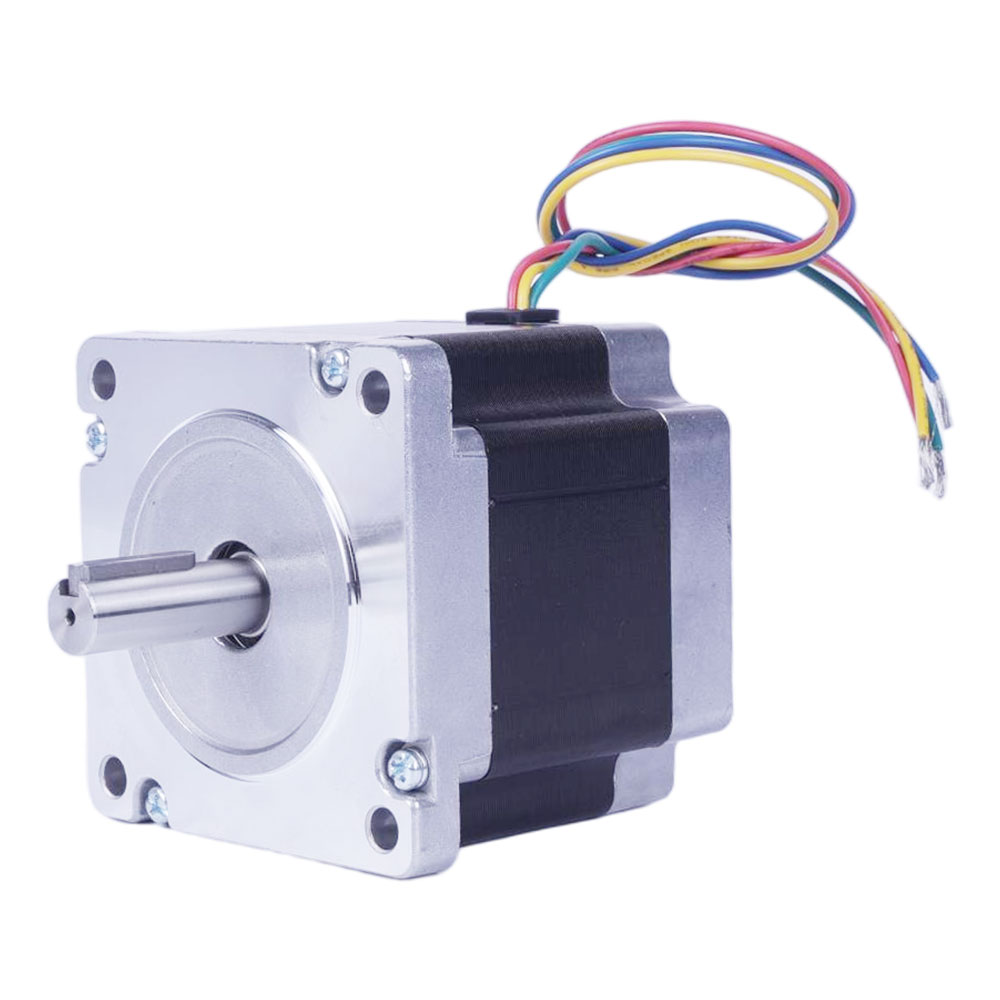
A hybrid stepper motor datasheet is only useful if the buyer knows which parameters affect system behavior. The standard specification block of ACT MOTOR’s hybrid stepper motor range includes the following values:
| Parameter | Typical Range | Why It Matters |
|---|---|---|
| Step Angle | 0.9° – 2.4° | Defines positioning resolution |
| Motor Length | 34 mm – 220 mm | Affects torque and mounting envelope |
| Rated Voltage | 2 V – 8 V | Helps select driver power supply |
| Rated Current | 0.5 A – 8 A | Must be matched to driver current settings |
| Holding Torque | 0.08 – 28.0 N·m | Relates to static load capacity |
| Detent Torque | 0.01 – 0.75 N·m | Affects behavior when power is off |
| Lead Wires | 3 – 8 wires | Determines connection compatibility |
| Weight | 0.1 – 15.0 kg | Impacts system mass and logistics cost |
These ranges should be checked against the actual drive voltage, driver current settings, and mechanical load. For example, a motor specified with 2–8V rated voltage and 0.5–8A rated current should be paired with a driver that can supply the required current. Holding torque is part of the static load calculation, but it is not the only value that matters; detent torque influences behavior when power is off, and rotor inertia affects acceleration.
When a motor is integrated with a gearbox or lead screw, the buyer should ask for the combined mechanical output, such as screw lead or gearbox reduction ratio, rather than treating the bare-motor data as the complete specification.
Hybrid Stepper Motor Certifications to Check Before Ordering
For equipment intended for the European Union, CE marking typically covers compliance with the Low Voltage Directive 2014/35/EU and the Electromagnetic Compatibility Directive 2014/30/EU. RoHS compliance is required under Directive 2011/65/EU for restricted hazardous substances. Buyers should ask for the certificate number, the issuing body, the covered product family, and the validity period.
ACT MOTOR’s documentation set provides an example of what a supplier file should contain. The company holds ISO 9001 certification with certificate number 07625Q2378R1S-JS/001, issued by ZRX and valid until October 12, 2028. Its CE certificates are issued by ISET and cover motors, drivers, and power supplies. The motor CE certificate number is ISETC.000520211115, the power supply certificate is ISETC.000420211115, and the driver certificate is ISETC.000320211115, all valid until November 14, 2026. RoHS test reports from GTS cover both the motor and the driver: GTS2408190853EN and GTS2408190852EN, both valid until August 29, 2029.
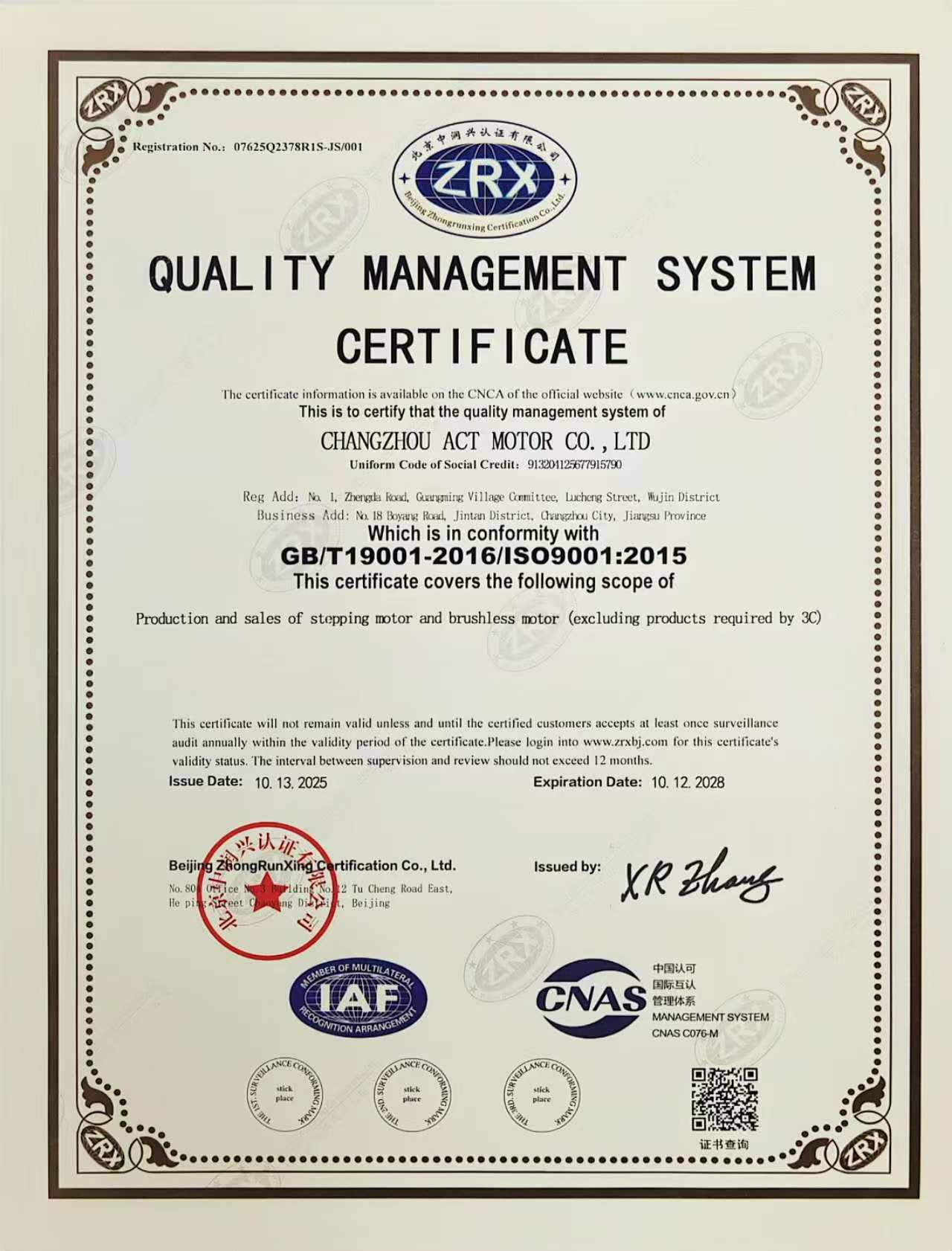
These document numbers are concrete evidence for a compliance check. A supplier that cannot provide traceable certificates is a higher risk, regardless of how competitive the unit price appears.
Supplier Evidence: ACT MOTOR’s Hybrid Stepper Motor Portfolio
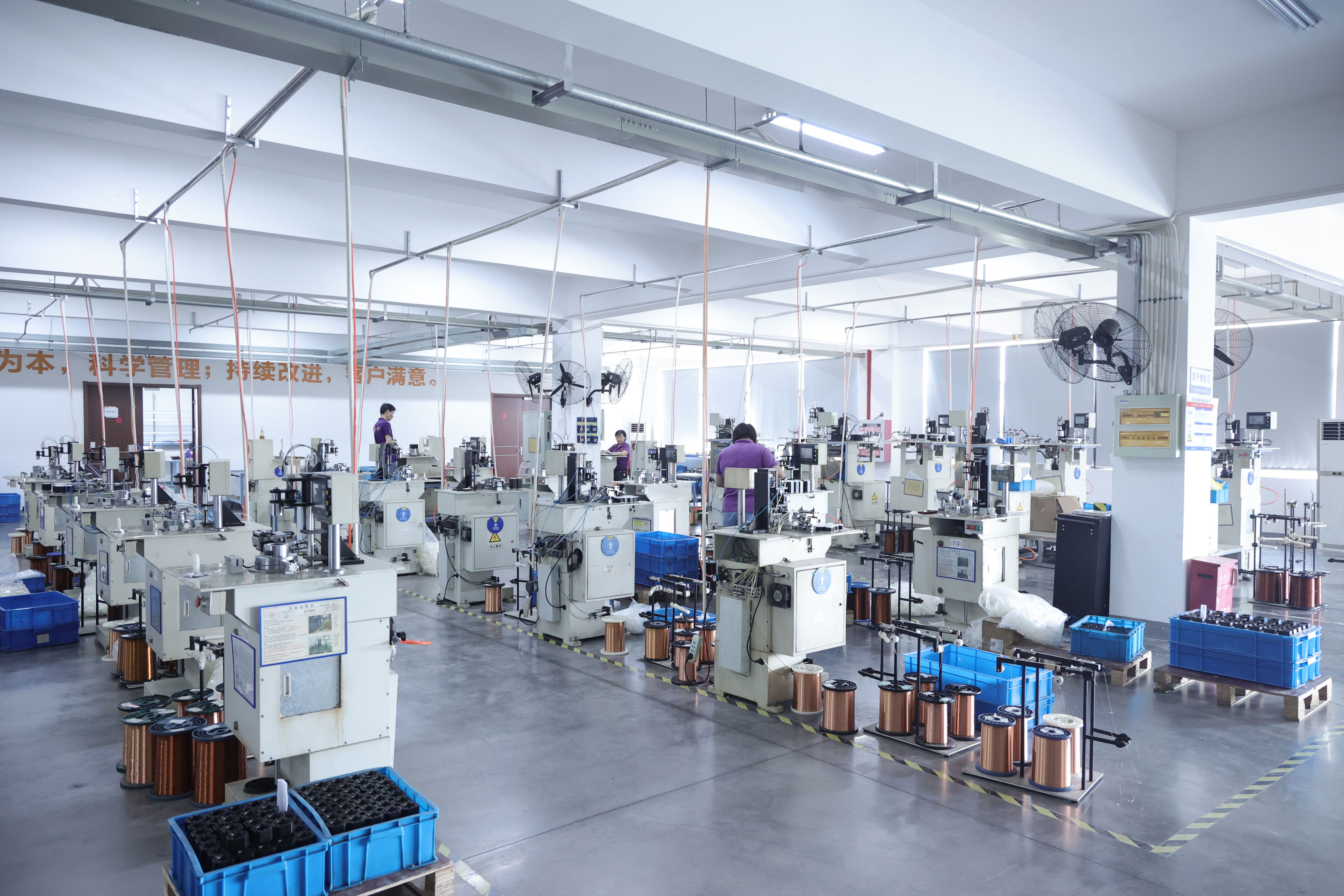
Changzhou ACT Motor Co., Ltd. was founded in 2010 and operates more than 70,000 square meters of production facilities in Changzhou, China. The company reports 126 employees, an annual output capacity of 2 million sets, and export sales accounting for approximately 70% of total output, mainly to the USA, EU, and China. It maintains a branch in Bremen, Germany, with additional offices in Shanghai and Jinan, providing a support network for European and domestic customers.
The product portfolio includes standard hybrid stepper motors, stepper motor drivers, lead screw stepper motors, geared stepper motors, brake stepper motors, closed-loop hybrid stepper motors, ball screw stepper motors, and integrated stepper motors. Standard hybrid stepper motor frame families include 8HS, 11HS, 14HS/HM, 15HS/HM, 16HS/HM, 17HS/HM, 23HS/HM/HY, 24HS, 34HS/HM/HY/HD, 42HS, 52HS, and the HT series such as 17HT, 23HT, 34HT, 42HT and 50HT. Separate specification entries are labelled for stepper motors for textile machinery and stepper motors for syringe pumps, showing how the same family is organized around application needs. This breadth matters to buyers because it means the same supplier can support different application needs without forcing a single frame size.
Production capability also supports customization. ACT MOTOR states that OEM/ODM customization is available for step angle, motor length, rated voltage, rated current, phase resistance, phase inductance, holding torque, detent torque, rotor torque, and lead wires. The monthly capacity for such production is 200,000 units, with a typical lead time of 30 days and a minimum order quantity of 2 units. All units undergo 100% testing before shipment.
Application Scenarios That Tighten the Specification
The same hybrid stepper motor family can serve very different applications, but the evaluation criteria change.
- Medical equipment: precision flow control applications such as syringe pumps require constant torque output, extremely smooth low-speed operation, low pulsation, low vibration, low noise, and accurate start-stop control without step loss. In ACT MOTOR’s project records, medical equipment applications in Germany, the United States, the United Kingdom, and the Czech Republic used the DM542 driver for precision flow control.
- Laboratory equipment: X/Y/Z axis movement in analyzers demands ultra-high positioning accuracy, ultra-low vibration and noise, low heat generation, and a compact high-integration design. Integrated motor solutions are commonly matched in these projects.
- Industrial automation and CNC machines: high load capacity, high torque, high rigidity, continuous operation, low heat generation, and anti-interference behavior are primary. Drivers such as DM542, DM860H, and DM2722, or servo motor sets, appear in the application records.
- 3D printers and equipment manufacturing: high-precision positioning, low vibration, no step loss at high speed, stable extrusion torque, and compatibility with microstepping drivers are key. ACT MOTOR’s project records show DM542/DM420 drivers matched to these requirements.
Two customer records illustrate the expected reliability level. An Italian CNC machinery manufacturer used 1,000 sets of ACT MOTOR hybrid stepper motors for carving applications and reported stable operation for two years, with low noise and fast speed as the highlighted results. A Spanish 3D printing manufacturer used 2,000 sets for DIY 3D printers, also reporting two years of stable operation with low noise and fast speed.
It should be noted that the application records describe historical shipments and should be treated as evidence of past performance, not as a guarantee for a new design.
Market Context for Hybrid Stepper Motor Sourcing
Third-party market data helps buyers understand the environment in which hybrid stepper motor suppliers operate. According to Market Research Future, the global stepper motor market was valued at USD 3.962 billion in 2024 and is projected to reach USD 6.245 billion by 2035, growing at a CAGR of 4.22%. KBV Research reported that hybrid stepper motors accounted for approximately 53.93% of total stepper motor market value in 2025. Mordor Intelligence reported that Asia Pacific dominated the market with a 48.91% share in 2025. In addition, the medical equipment segment is considered the fastest-growing application, with a projected CAGR of 7.5% through 2032, according to CoherentMI. Precedence Research valued the high torque stepper motor market at USD 1.15 billion in 2024.
These numbers indicate sustained demand from precision automation and medical device builders, and explain why supplier qualification processes are becoming more rigorous.
Comparison with Traditional Procurement Practice
Traditional procurement of hybrid stepper motors often compares only unit price, delivery time, and holding torque. That approach overlooks three factors: electrical matching, mechanical integration, and regulatory evidence. A motor with the same holding torque can still fail if its rated current does not match the installed driver, if the shaft configuration is incompatible, or if the necessary CE/RoHS documentation is missing.
However, documentation and parameters alone are not sufficient. A compliant and well-documented motor may still need to be tested in the actual mechanism to confirm temperature rise, vibration, and audible noise under real loads. In particular, open-loop stepper systems can lose steps under unexpected load disturbances; closed-loop hybrid stepper motors with encoder feedback can detect and correct for that condition, but they add cost and tuning complexity. This is a practical boundary that buyers should accept during supplier evaluation.
Future Outlook
Product development in the hybrid stepper motor segment is moving toward feedback-equipped and application-specific designs. ACT MOTOR’s portfolio already includes closed-loop hybrid stepper motors with encoder feedback, integrated stepper motors, and versions developed for medical equipment, logistics sorters, and intelligent load-adaptive control. These trends suggest that future procurement will place more weight on the supplier’s ability to provide application-matched variants, documentation consistency, and long-term support rather than on the lowest-priced standard model.
Frequently Asked Questions
- What certifications should I ask for when importing hybrid stepper motors to the EU?
For EU-bound equipment, CE and RoHS documentation are typically required. CE covers the Low Voltage Directive 2014/35/EU and EMC Directive 2014/30/EU, while RoHS follows Directive 2011/65/EU. Buyers should request certificate numbers, issuing bodies, covered product families, and validity dates. As a reference, ACT MOTOR’s CE certificates are issued by ISET, its RoHS test reports by GTS, and its ISO 9001 certificate by ZRX. - What are the typical parameter ranges of ACT MOTOR’s hybrid stepper motors?
The standard hybrid stepper motor range covers step angles from 0.9° to 2.4°, motor lengths from 34 mm to 220 mm, rated voltage from 2 V to 8 V, rated current from 0.5 A to 8 A, holding torque from 0.08 N·m to 28.0 N·m, detent torque from 0.01 N·m to 0.75 N·m, and weight from 0.1 kg to 15.0 kg. - What is the difference between open-loop and closed-loop hybrid stepper motors?
An open-loop hybrid stepper motor follows pulse and direction commands without feedback, so it can lose steps under excessive load. A closed-loop hybrid stepper motor includes an encoder that monitors rotor position and can correct for missed steps. ACT MOTOR’s closed-loop series includes models such as 23SSM8440-EC1000 and 34SSM1460-EC1000. - Can ACT MOTOR customize hybrid stepper motor specifications?
Yes. ACT MOTOR supports OEM/ODM customization of step angle, motor length, rated voltage, rated current, phase resistance, phase inductance, holding torque, detent torque, rotor torque, and lead wires. Its stated monthly capacity for this production is 200,000 units, with a 30-day lead time, a minimum order quantity of 2 units, and 100% testing before shipment. - What evidence should I request to verify compliance before shipment?
Request the certificate or test report number, issuing authority, expiry date, and the exact models covered. For ACT MOTOR, examples include ISO 9001 certificate 07625Q2378R1S-JS/001, CE certificate ISETC.000520211115 for the motor, and RoHS report GTS2408190853EN for the motor. Comparing these numbers with the issued documents helps confirm that the compliance evidence is genuine.
For a more detailed overview of ACT MOTOR’s production capabilities, product portfolio, and quality documentation, the official company brochure is available for public access and download: ACT MOTOR company brochure (PDF).