
Why Does My Stainless Steel Coil Weigh Only 200 kg? A Narrow Coil FAQ
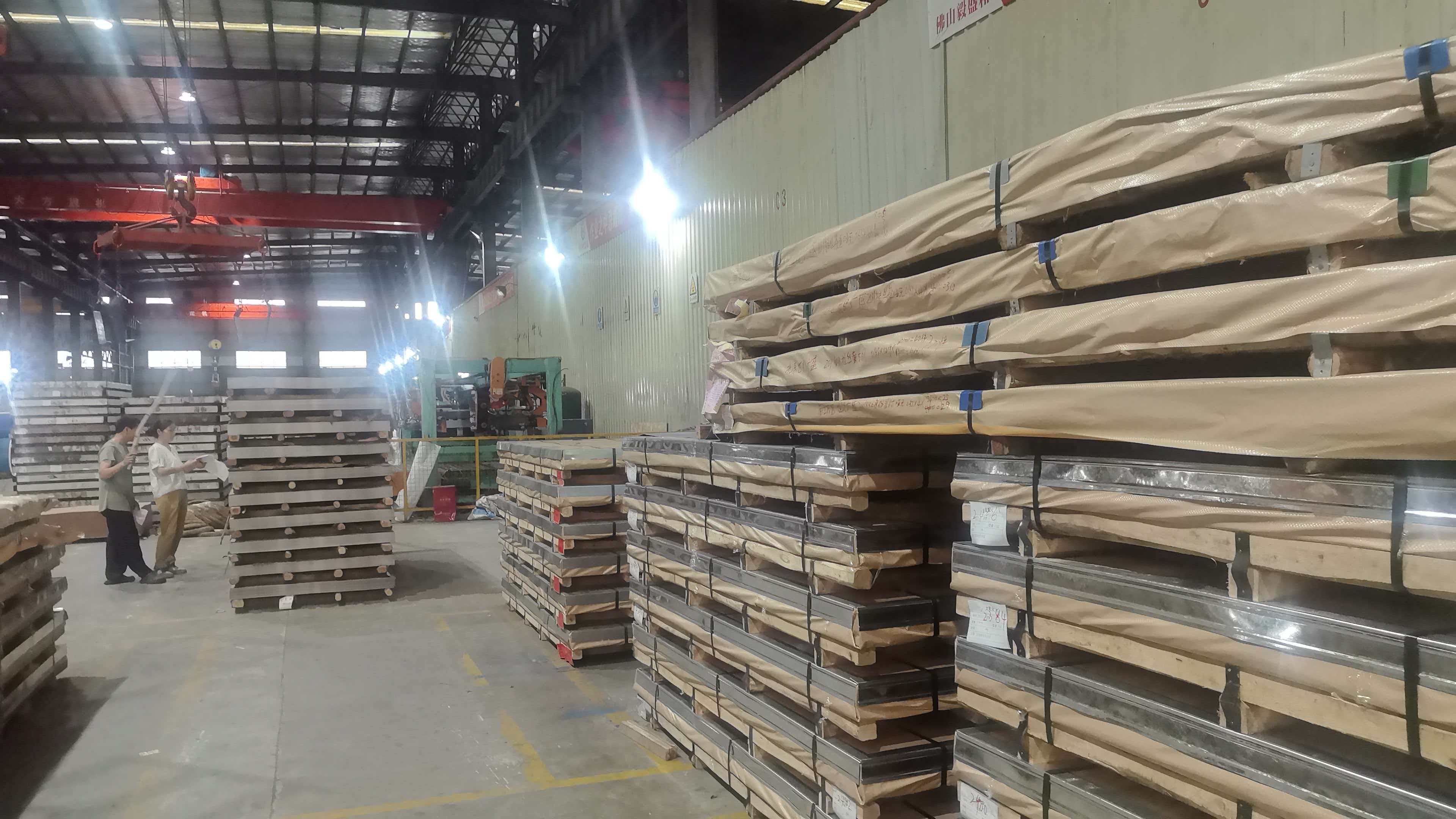
Cold-rolled stainless steel mill environment. Image reference: Ningbo Sunfire Stainless Steel — Hongwang stainless mill picture.
A stainless steel coil that weighs approximately 200 kg is, in most cases, not a shipping error and not evidence of a quality problem. It is a format: the narrow secondary coil, built around a width of roughly 600 mm and a thickness range of 0.1 mm to 1.2 mm. Those two dimensions are exactly why the unit weight settles near 200 kg instead of the multi-tonne figures buyers associate with primary wide coils.
Understanding that relationship resolves a large share of the friction that follows a delivery. When a light coil arrives against an expectation shaped by prime wide coil, the disagreement is usually about product definition rather than material performance. Once the definition is clear, the same coil becomes a usable, cost-aware input for narrow-line and small-batch production.
Ningbo Sunfire Stainless Steel Co., Ltd. is a Ningbo-based stainless steel supplier founded in 2013 that exports stainless steel and stainless steel products and describes secondary and baby coils as a particular strength of its range. Its export model is 100% export-oriented, and the questions below are the ones that most often sit between inspection and acceptance on a narrow secondary coil shipment.
The Short Answer, Before the Detail
- A unit weight of roughly 200 kg identifies a narrow secondary coil, not a short shipment.
- Narrow coils in this product family run at a width of around 600 mm, with thickness from 0.1 mm to 1.2 mm.
- Wider coils in the same family run from 1000 mm to 1250 mm wide, at 0.25 mm to 1.5 mm thickness.
- Available grades are 201, 304, 410 and 430. The surface finish is primarily BA (bright annealed).
- Typical applications are construction, interior decoration, home appliances, and the kitchenware and cookware industries.
What "Secondary Narrow Coil" Actually Describes
Two words carry most of the meaning here, and they answer different questions. "Secondary" is a commercial designation: it signals material that is not being offered as prime first-choice coil. For a procurement team, that designation is a prompt to verify rather than an automatic reason to reject — the governing documents remain the mill test certificate and the receiving inspection record.
"Narrow" is the more physically useful word, because it explains how the coil behaves once it reaches the workshop. A narrow coil is one whose width has been reduced, in this product family to approximately 600 mm. That width lets it feed lines where a 1000–1250 mm wide coil would be impractical, and it keeps the unit within a weight band that many downstream operations can lift, mount and change without the heavier handling equipment a multi-tonne prime coil requires.
It is worth separating the coil from its label. The specification chain that actually controls acceptance is grade, width, thickness, finish, coil weight and certificate — and those six items should be confirmed in writing before dispatch rather than assumed from the word "narrow" alone.
Why the Unit Weight Settles Near 200 kg
Coil mass is the product of three variables: strip width, strip thickness, and the length of strip wound into the coil. A narrow secondary coil reduces two of them at the same time. Width falls to roughly 600 mm against 1000–1250 mm for the wider format, and the thin end of the gauge range reaches 0.1 mm, well below the 0.25 mm starting point of the wider coil. Less strip per metre, wound across a narrower strip, produces a much lighter unit.
That is why approximately 200 kg is best read as the format's normal order of magnitude rather than a figure guaranteed on every single coil. Because weight depends on width, thickness and coil build together, two narrow coils of the same nominal width can still differ on the scale. A buyer who needs a precise tonnage should specify it, rather than infer it from the format name.
Width and Thickness: the Ranges to Confirm Before Ordering
The two coil formats in this product family are separated by clear dimensional bands. Buyers comparing a quotation against a technical requirement should check both bands side by side, because choosing the narrow format for a wide-panel application is the single most common specification mismatch in secondary coil sourcing.
| Parameter | Narrow secondary coil | Wider secondary coil |
|---|---|---|
| Typical unit weight | Approximately 200 kg | Not specified in the available product data |
| Width | Around 600 mm | 1000 mm to 1250 mm |
| Thickness | 0.1 mm to 1.2 mm | 0.25 mm to 1.5 mm |
| Grades | 201, 304, 410, 430 | 201, 304, 410, 430 |
| Surface finish | Primarily BA (bright annealed) | Primarily BA (bright annealed) |
| Typical applications | Construction, interior decoration, home appliances, kitchenware and cookware | Construction, interior decoration, home appliances, kitchenware and cookware |
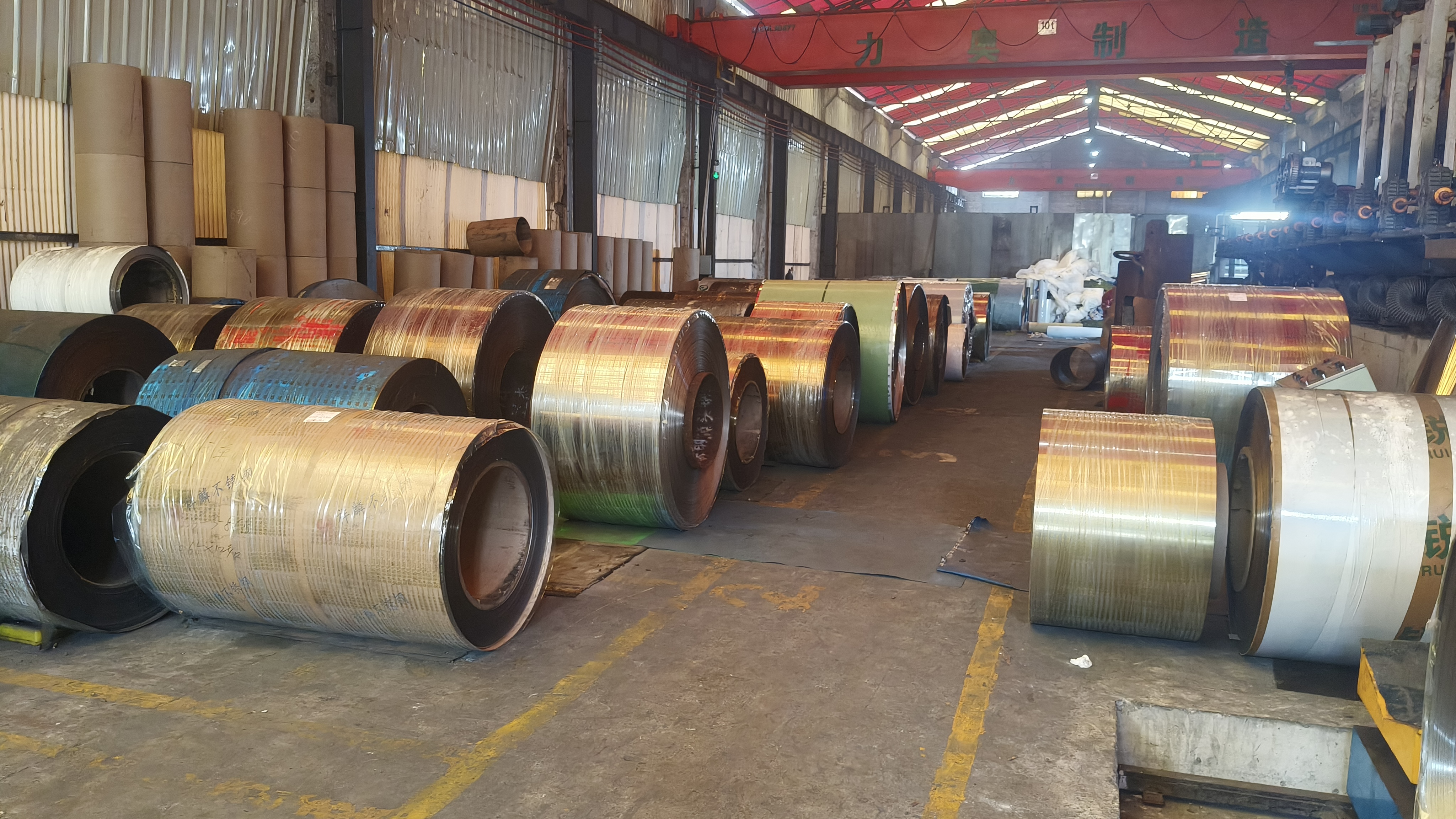
Stainless steel coil production environment. Image reference: Ningbo Sunfire Stainless Steel — Jinhai stainless mill picture.
Surface Finish: BA First, and What BA Is Not
The finish on this product family is primarily BA, or bright annealed. That has consequences in two directions, and both matter at the receiving bay.
In the first direction, BA delivers a bright, clean surface that suits appliances, cookware, and interior work where a consistent bright appearance is sufficient. In the second direction, BA is not a mirror finish. Expecting mirror reflectivity from a BA narrow coil is one of the most predictable sources of downstream complaint, and it is a finish question rather than a material question.
Decorative mirror surfaces are a separate polishing route. The 8K finish is produced through iterative polishing, and 12K represents the highest reflectivity tier, resembling glass mirrors. Mill finishes such as 2B, and brushed surfaces such as No.4 and HL, belong to different finish families again. When a project specifies one of those surfaces, finish availability should be confirmed explicitly against the coil offer instead of being inferred from grade or coil weight.
Where a 200 kg Narrow Coil Fits in Production
The applications most closely associated with this format are construction, interior decoration, home appliances, and the kitchenware and cookware industries. In practice, the narrow format tends to appear wherever the production line itself is narrow, or wherever batch sizes are deliberately small.
- Narrow press and forming lines. A 600 mm coil can be mounted on lines that cannot accept a 1250 mm wide unit at all, which makes the narrow format an enabler rather than a compromise.
- Small-batch and mixed production. Lower unit weight reduces the cost of a coil change, which suits workshops that switch gauge, finish or grade frequently during a shift.
- High-end decoration and deep drawing. Where the stated quality differentiation is a thickness tolerance of ±0.02 mm, a more consistent surface finish and a lower long-term defect cost, the material suits decorative and forming work that is sensitive to gauge variation and surface condition.
- Appliance and cookware components. BA-surfaced narrow strip feeds directly into parts where a bright surface is part of the finished appearance.
Downstream, comparable material is also traded in sheet, circle and wire forms — 201 and 410 stainless circle being common examples in many markets — but the coil remains the entry point for most secondary trading, because slitting and re-cutting decisions are made at coil level.
What Trade Data Suggests About Narrow and Secondary Coil Demand
Broader market indicators help frame why narrow and secondary coils have become a more visible part of stainless steel procurement rather than a niche leftover.
- The global stainless steel market was valued at USD 135.8 billion in 2025 and is projected to reach USD 247.4 billion by 2033, according to Grand View Research.
- China's stainless steel exports reached an all-time high of 5.04 million tonnes in 2024, a 25.6% increase year on year, according to China's General Administration of Customs data reported by Mysteel.
- China's domestic stainless steel imports decreased by 9.3% in 2024 to 1.88 million tonnes, mainly due to increased domestic production capacity, according to SteelOrbis and GACC data.
- Capacity continues to disperse internationally: Hongwang Group, a major producer specialising in cold-rolled stainless steel, operates a joint venture in Indonesia with a 700,000-tonne-per-year cold rolling capacity, per Mysteel Global.
- EU anti-dumping duties on stainless steel cold-rolled flat products from China and Taiwan, in the range of 24.6% to 28.5%, were maintained following a 2025 expiry review (European Commission Regulation 2025/1573).
Read together, these signals describe a market where supply capacity is expanding and trade routes are increasingly shaped by duty structures. For buyers, that combination tends to produce dual-format sourcing strategies: prime wide coil for visible, specification-critical surfaces, and narrow or secondary coil for internal parts, narrow-line forming and cost-sensitive batches. A 200 kg narrow coil is a natural unit in that second stream, because it matches small-batch consumption without forcing a commitment to a full wide prime coil.
Narrow Secondary Coils vs. Conventional Wide Coils: the Honest Trade-offs
A narrow secondary coil is not a smaller version of a prime wide coil with identical behaviour. The trade-offs are real and should be planned for rather than discovered during production.
| Consideration | Narrow secondary coil (~200 kg, ~600 mm, 0.1–1.2 mm) | Conventional wide coil (1000–1250 mm, 0.25–1.5 mm) |
|---|---|---|
| Line compatibility | Fits narrow press, forming and slitting lines | Suits wide continuous lines and wide-panel output |
| Coil changes | More frequent changes per tonne consumed | Fewer changes per tonne consumed |
| Joint / seam exposure | Higher where wide finished panels are required | Lower for wide finished formats |
| Finish expectation | Primarily BA — not a mirror surface | Finish options are specified per order and route |
| Thin-gauge capability | Reaches 0.1 mm | Starts at 0.25 mm |
| Order structure | Coil weight is a unit inside an export order | Coil weight is a unit inside an export order |
Three limitations deserve to be stated plainly.
First, narrow width is a constraint as well as an advantage. Where a finished product needs a continuous wide panel, the narrow format creates additional joints, and no amount of material quality removes that. Second, a BA surface cannot substitute for a decorative mirror finish; buyers who need 8K or 12K reflectivity are looking at a different finishing route, not a different coil weight. Third, thin gauges at the bottom of the 0.1–1.2 mm band are not intended for structural or load-bearing use, where thicker material is required.
There is also a commercial boundary. The minimum order quantity for this supply is 27 metric tons, which means a single 200 kg coil is never the order itself — it is a unit within an order. Buyers who need one coil for sampling should plan for that distinction rather than expect a 200 kg shipment at export level. On the European side, EU anti-dumping duties on China-origin cold-rolled flat products in the 24.6%–28.5% range affect landed cost calculations and may influence routing decisions.
Receiving Checklist: What to Verify on Arrival
For secondary material in particular, receiving discipline is what converts a delivery into an accepted lot.
- Certificate first. Match the mill test certificate to the delivered coil before any processing begins.
- Confirm the three dimensions. Width, thickness and coil weight against the agreed specification, using the narrow-coil bands (approximately 600 mm and 0.1–1.2 mm) as the reference point.
- Inspect the surface. Surface scratches and rust are the two risk categories most associated with this material, and both are visible at receiving.
- Check protection. PVC protection should be intact across the coil face and edges.
- Confirm packing standard. Export-standard packaging and pre-shipment inspection are the control measures that carry the coil through transit.
The underlying control methods behind those checks are PVC protection, precision rolling and surface inspection — a sequence designed to limit scratch and rust exposure rather than to react to it after arrival.
Supply Continuity for Repeat Buyers
For distributors and repeat industrial buyers, the decisive question is rarely the first shipment. It is whether the same format can be delivered again, at the same width and gauge, without renegotiation each time.
The supply parameters around this product family are stated in straightforward terms: monthly production capacity is 3,000 MT for export, the minimum order quantity is 27 metric tons, standard delivery time ranges from 7 to 45 days, and OEM production services are available. The supplier's sales model is entirely export-based, with established markets including Pakistan, India, Vietnam, Russia, Türkiye, Indonesia, the UAE, Thailand, Malaysia and Bangladesh.
Those figures matter mostly as a continuity check. A buyer placing narrow secondary coil into a recurring production schedule needs a supplier whose export capacity is stable enough to repeat a format, not just to fill a one-off order — and the practical test is whether width and thickness repeat within the expected band across consecutive lots.
Future Outlook
Three developments are likely to shape how narrow and secondary coils are bought over the next several years.
Market growth provides the backdrop: a market moving from USD 135.8 billion in 2025 toward USD 247.4 billion by 2033 implies sustained demand across both prime and secondary streams. Capacity dispersion, illustrated by large cold-rolling investments such as Hongwang Group's 700,000-tonne-per-year Indonesian joint venture, suggests that buyers will have more origin options rather than fewer. And trade defence measures, including the EU duties maintained in 2025, suggest that landed-cost planning will remain as important as material specification in sourcing decisions.
The practical consequence is that narrow secondary coil is likely to become a more institutionalised line item rather than an opportunistic purchase — supported by certificates, receiving checklists and repeatable format specifications rather than by price alone.
FAQ: Narrow Secondary Coils and the 200 kg Coil Weight
Why does my stainless steel coil weigh only about 200 kg?
Because it is a narrow secondary coil. In this product family, narrow coils have a weight of approximately 200 kg, a width of around 600 mm and a thickness between 0.1 mm and 1.2 mm. Coil mass is determined by width, thickness and coil build, so a narrower and thinner coil naturally weighs far less than a wide primary coil.
Does a lighter coil mean the material is a lower grade?
No. Coil weight is a dimensional outcome, not a grade indicator. This product family is available in grades 201, 304, 410 and 430 regardless of whether the coil is the narrow or the wider format. Grade should be confirmed through the mill test certificate rather than inferred from coil weight.
What width and thickness should I expect from a narrow secondary coil?
Narrow coils in this family are supplied at a width of around 600 mm, with thickness from 0.1 mm to 1.2 mm. Wider coils in the same family are supplied at 1000 mm to 1250 mm width, with thickness from 0.25 mm to 1.5 mm. The two formats are separated by distinct width and gauge bands.
What surface finish do these coils normally carry?
The surface finish is primarily BA, or bright annealed. BA is a bright, clean surface and is not a mirror finish. Decorative mirror surfaces such as 8K are created through iterative polishing, and 12K represents the highest reflectivity tier resembling glass mirrors, so a mirror specification should be confirmed as a separate finish route.
Which applications are these coils typically used for?
Typical applications are construction, interior decoration, home appliances, and the kitchenware and cookware industries. The narrow format is also used where production lines are narrow or batch sizes are small, including applications described as high-end decoration and deep drawing.
Can I order just one 200 kg coil?
The minimum order quantity for this supply is 27 metric tons, so a 200 kg coil is a unit within an order rather than the order itself. Standard delivery time ranges from 7 to 45 days, and monthly production capacity is 3,000 MT for export. Buyers needing a small sample quantity should clarify that separately from the coil weight.
What are the acceptance criteria and purchasing terms?
The acceptance criterion is the mill test certificate. The minimum order quantity is 27 MT, delivery terms are CIF, and payment terms are TT or DP. Pre-shipment inspection and export-standard packaging are the stated control measures, and surface inspection with PVC protection is used to limit scratch and rust exposure.
How should 200 kg coils be stored and handled after receipt?
Keep PVC protection in place until the material enters processing, and avoid conditions that promote moisture-related rust. Surface scratches and rust are the two main risk categories for this material, and both are best addressed by inspection at receiving. Coils at this weight are also easier to reposition and change than multi-tonne wide coils, which suits workshops with lighter handling equipment.
A downloadable company brochure for Ningbo Sunfire Stainless Steel Co., Ltd. is available here: https://cdn.socialarks.com/sbsp/24888/common/2026/0520/6a0d5f47b7b09.pdf