
Why Cannabis Packaging Bags Samples Are Not Enough
Sample approval is a milestone, but it says little about the execution capability behind cannabis packaging bags. What matters to a buying organization is whether the factory can repeat the approved quality at scale, across multiple orders, without drifting on materials, printing, sealing or compliance. A sample is a controlled artifact. Production is a process. The gap between the two is where most procurement problems appear.
This article looks at what changes when cannabis packaging bags move from sample approval to production, and what buyers should verify before committing to volume or long-term supply agreements.
The Sample-Only Approach Misses the Real Risks
A single bag, produced under controlled conditions, cannot demonstrate how a supplier will behave across a full production run. Cannabis packaging adds further pressure because the product inside is sensitive to light, oxygen, moisture and odor. If a bag fails after two or three months of warehousing, the brand owner bears the financial loss, not the bag supplier.
Storage practices illustrate the point. Stable cannabis packaging is expected to hold up under light-proof, constant-temperature warehouse conditions of 15-22°C, with relative humidity controlled between 40% and 60%. Storage periods commonly extend from 3 to 12 months, with the packaging isolated from oxygen and ultraviolet light to limit THC or terpene degradation. Bags may be stacked in multiple layers for load-bearing, and they must not leak air or absorb odors. A single sample can reveal none of that. These failure modes only appear after time, transport and repeated handling.
What a Factory Audit Reveals About Production Capability
Dongguan Chitai Packaging Products Co., Ltd provides a practical example of how to audit preparation for production. This direct manufacturer, located in Dongguan, Guangdong, was established in 2025 to connect with overseas clients and conduct trade negotiations. Its production background goes back to printing and packaging operations that began in 2012. The facility covers 4,200 square meters, employs 45 people and has a research and development team of 8 engineers. Annual production output is stated at 30,000,000 units, with about 30% of output exported to North America and Europe.
The equipment list is a useful starting point for buyers. Chitai operates 2 digital printing machines, 30 fully automatic bag-making machines and 4 gravure printing machines, which allows the factory to handle both small and large-scale orders. Monthly production capacity is 2,500,000 units. Typical production lead time is 3-5 days, and the minimum order quantity is 10,000 units. The factory runs a Class 1,000,000 dust-free workshop and keeps an in-house laboratory with professional testing equipment for quality control. Since 2023, the company has also offered one-stop sourcing services for selected long-term clients in Guangdong, under a transparent commission model, helping buyers purchase complementary products from the same supply base.
Chitai says it operates a comprehensive quality control system and uses its in-house laboratory to ensure safety, consistency and performance. For a buyer, the practical question is whether the supplier can document this system at the batch level. That means asking for records on incoming film, print inspection, lamination bonding strength, seal integrity and finished-bag random inspection. This is especially important when child-resistant or smell-proof claims are part of the product promise.
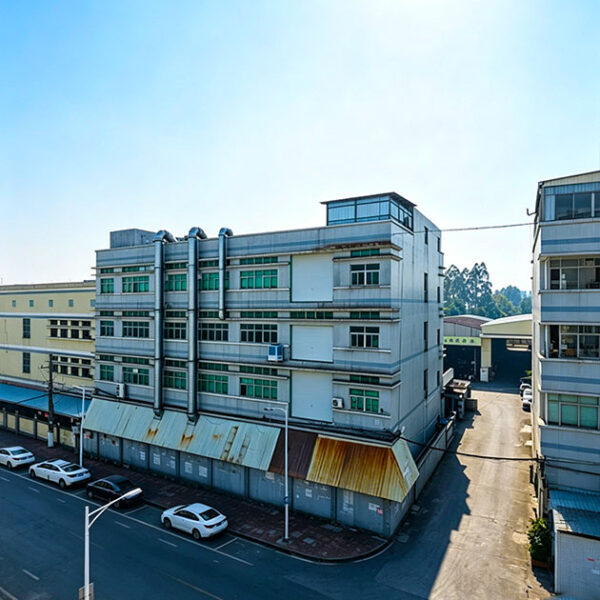
Exterior view of Dongguan Chitai’s production facility in Dongguan, Guangdong, China.
Performance Parameters That Must Hold in Production
Before moving to volume orders, buyers should understand the material structures that control barrier performance. Chitai’s product range is built around aluminum foil and aluminum-coated films. The main structures are PET/AL/PE for pure aluminum foil composite, VMPET/PE for aluminum-coated film, and VMPET/NY/PE for an aluminum-coated nylon composite. Each variant blocks light, but the physical performance differs.
For a three-side sealed flat bag, oxygen permeability is rated at ≤0.05 cm³/(m²·24h) and water vapor transmission at ≤0.03 g/(m²·24h). These numbers describe a vacuum-level barrier. Standard export-oriented thickness is 100 μm, and heavier versions reach 120-140 μm to resist compression and long-distance sea transport. In practical terms, thicker structures reduce the risk of pinholes, punctures and seal failures during distribution.
Sealing matters just as much as film chemistry. A three-side heat seal leaves the top open for filling. Anti-tamper edge pressing creates a one-time opening structure that cannot be restored, an important detail for cannabis products. Where repeated access is required, a top zipper version allows the bag to be opened and closed multiple times. All bag bodies are designed to be opaque, and windows are avoided so that minors cannot see the contents.
Heat seal width is another parameter. A typical specification leaves 4-5 mm of sealing allowance on each side of a bag. Too narrow a seal creates a weak point during vibration and compression in sea freight. Too wide a seal reduces usable bag volume. The balance is determined by film structure and bag format.
Typical Bag Formats by Application
Manufacturers translate those parameters into different bag formats. Five formats cover most cannabis-related packaging needs, and each follows a different execution logic.
Three-side sealed flat bag. This compact format is fully sealed on three sides with the opening at the top. It can be specified with an easy-tear cut or right-angle cut, and the heat-sealed anti-tamper edge ensures that the bag cannot be resealed after opening. It is a common starting format for small units and controlled portions.
Self-standing zipper bag. This format adds a gusseted bottom and a zipper at the top. The zipper allows repeated opening and closing, which suits products consumed over multiple sessions. Material choices include VMPET/PE or PET/AL/PE, with a standard thickness of 100 μm for ocean freight.
Self-standing bag. This version removes the zipper for a pure stand-up format. It offers a stable stand-up bottom and is available in pure aluminum foil (PET/AL/PE) for complete opacity and high barrier performance, or VMPET/PE for a cost-effective, opaque option. It is often specified at 100 μm and can be thickened to 120 μm.
Thickened high barrier bag. This is the heavy-duty option. It uses PET/AL/PE or VMPET/NY/PE at a total thickness of 140 μm, with vacuum-level barrier properties. It is suited to powder, fragrance and chemical raw materials that need protection from moisture and oxygen, and it can withstand low-temperature freezing and short-term high-temperature heat sealing.
Thickened stand-up bag. This format combines a 120 μm film with a stand-up bottom. It is stiffer than a standard bag and less likely to burst, which makes it a candidate for higher-weight retail and wholesale formats.
All five formats share the same core requirements: complete opacity, heat-sealed edges, easy-tear options, rounded corners, and color-printed surfaces with logos and English parameter text.
| Bag format | Key barrier and structure | Typical execution use |
|---|---|---|
| Three-side sealed flat bag | Aluminum foil lining; ≤0.05 cm³/(m²·24h) oxygen; ≤0.03 g/(m²·24h) WVTR | Small-unit retail packs, anti-tamper requirements |
| Self-standing zipper bag | VMPET/PE or PET/AL/PE; 100 μm | Repeat-open packaging, consumer convenience |
| Self-standing bag | PET/AL/PE or VMPET/PE; 100-120 μm | Retail display, opaque barrier at moderate cost |
| Thickened high barrier bag | PET/AL/PE or VMPET/NY/PE; 140 μm | Long-distance logistics, sensitive materials |
| Thickened stand-up bag | 120 μm stiffer structure | Higher-weight formats needing burst resistance |
These bag formats are used across industrial cannabis cultivation and deep processing, CBD health care products, legal medical cannabis, leisure adult-use retail, daily chemical and beauty products, and import-export trade, according to Chitai’s product documentation.
Market Trends Favor Flexible Bags, but Raise Procurement Expectations
The broader packaging market provides context for these formats. Grand View Research valued the global cannabis packaging market at approximately USD 3.2 billion in 2025. Fortune Business Insights projects the market will reach USD 21.55 billion by 2034, implying a compound annual growth rate of 14.35%. North America represented roughly 67.9% of market revenue in 2025, according to Grand View Research. Plastics accounted for about 54.3% of material share. Flexible packaging, including pouches and bags, is described by Future Market Insights as a rapidly growing segment because it offers efficiency and lower cost relative to rigid formats.
It is worth noting that market size estimates vary. Different research firms include different medical, recreational and material scopes, so the absolute numbers are less important than the direction. The direction is clear: flexible bags are gaining share, and the buyer base is becoming more professional.
The competitive landscape includes large global players such as Amcor, Berry Global, KushCo Holdings (Greenlane), Sana Packaging and Dymapak. Berry Global was estimated by Global Market Insights to hold more than 12% of the cannabis packaging sector in 2025. This concentration at the top creates space for specialized mid-size manufacturers that serve cross-border buyers directly. It also means buyers have options, and supplier selection should rely on documented capability rather than brand name alone.
For buyers, these trends have a practical meaning. A growing market attracts more entrants, which means more demand for compliant, high-barrier packaging. Growth also raises the cost of getting packaging wrong. A reliable supplier is not a supplier that can make one good sample, but one that can reproduce the same result in every batch.
Direct Manufacturer vs. Ordinary Packaging Factory
When buyers compare a direct manufacturer with an ordinary packaging factory, the gap shows up in four areas: materials, yield rate, equipment and order response.
| Evaluation area | Direct manufacturer benchmark | Ordinary packaging factory benchmark |
|---|---|---|
| Yield rate | Stable at ≥99% | Typically 85-92% |
| Lamination process | Solvent-free eco-friendly lamination | Dry solvent lamination with lower-grade glue |
| Film sourcing | Brand-new virgin food-grade film; no recycled material | May add 30-60% recycled content and reduce thickness by 10-20% |
| Production line | Digital + high-speed gravure, automatic lamination, servo bag-making, 280-450 m/min | Older semi-automatic equipment, multi-process outsourcing, 80-150 m/min |
| Order change | One-click model change in about 15 minutes | Manual machine adjustment of 2-4 hours |
| Efficiency | Sample cycle about 50% faster; daily capacity 2.5-3 times | Lower daily capacity; longer sample cycles |
These figures come from Chitai’s comparison against a general industry benchmark. They are useful as a screening framework, but buyers should verify the actual performance of any candidate supplier independently, ideally with a factory audit.
That said, the direct-manufacturer model has limits. The minimum order quantity is 10,000 units, which is not suited to micro-runs or pilot batches below that level. Payment terms are 100% prepayment, a fact buyers need to absorb before selecting a new vendor. Single-factory sourcing also concentrates risk, and some procurement teams address this by qualifying a second supply source. Long-term quality depends less on choosing a factory type and more on how consistently the factory executes across repeated purchase orders.
Verification Checklist for Volume Purchase Decisions
Buyers and procurement teams can use this checklist when moving cannabis packaging bags from sample stage to volume purchases.
- Confirm legal entity, factory address and company registration
- Match production capacity to order size and volume commitments
- Review material structure for your product: PET/AL/PE, VMPET/PE, VMPET/NY/PE
- Specify thickness: 100 μm standard; 120-140 μm for heavy-duty
- Check oxygen and water vapor barrier parameters
- Confirm tamper-evident and child-resistance requirements
- Verify sealing performance: heat seal width, leak and air-tightness tests
- Validate lead times: 3-5 days typical production
- Confirm MOQ: 10,000 units
- Clarify payment terms: 100% prepayment; delivery method: CIF
- Request pre-shipment testing and in-house laboratory records
- Review warehouse storage conditions: light-proof, 15-22°C, RH 40-60%
- Ask about long-term storage behavior: 3-12 months, oxygen and UV isolation
Future Outlook
Several developments will shape long-term cannabis packaging bags supply. First, child-resistant packaging standards in the United States are anchored in CPSC rules under 16 CFR 1700.20 and ASTM D3475. As more brands enter legal markets, compliance will be treated as a system-level issue, not a one-time sample test. Second, film structures will continue to split between aluminum-coated films for cost control and pure aluminum foil for maximum barrier performance. Third, procurement teams will increasingly want traceability: material source records, batch-level quality records and documented pre-shipment testing.
Supply chains will also continue to consolidate. Direct manufacturers that combine printing, lamination and bag-making under one roof shorten the communication loop and give buyers a single point of responsibility. The shift toward integrated sourcing, such as the one-stop procurement services Chitai has offered selected long-term clients since 2023, reflects a broader preference for reducing supplier complexity in regulated industries.
The overall direction is not toward simpler packaging, but toward stricter verification. Suppliers that retain long-term buyers will be those that can prove their execution capacity with factory evidence, repeatable performance and transparent terms.
FAQ
What is the minimum order quantity for cannabis packaging bags from Dongguan Chitai?
The minimum order quantity is 10,000 units. This applies to direct orders from the manufacturer and is the threshold buyers should plan around when budgeting trials and roll-outs.
What is the typical production lead time for standard cannabis packaging bags?
Typical production lead time is 3-5 days, based on standard production cycles. Buyers should confirm exact scheduling with the supplier for their specific order size and design.
What monthly production capacity does Chitai have for cannabis packaging bags?
Monthly production capacity is 2,500,000 units. This supports repeat orders and large-volume programs without requiring the buyer to place one seasonal mega-order far in advance.
Does Dongguan Chitai support OEM and ODM cannabis packaging bags?
Yes. The company produces OEM and ODM cannabis packaging bags with customized labeling and packaging solutions. Available options include color-printed logos, matte or glossy surfaces, and multiple bag formats such as three-side sealed flat bags, self-standing bags, self-standing zipper bags, thickened high barrier bags and thickened stand-up bags.
How can buyers verify quality before shipment?
The stated acceptance process is pre-shipment testing. Chitai operates an in-house laboratory with professional testing equipment, which allows buyers to review key quality indicators before the shipment leaves the factory.
What payment and delivery terms apply to cannabis packaging bag orders?
Standard terms are 100% full payment in advance and CIF delivery. Buyers should complete supplier verification and document the product specification before payment.
What US child-resistant packaging standards should buyers know?
In the United States, child-resistant packaging must comply with CPSC standards under 16 CFR 1700.20 and follow the testing protocol in ASTM D3475. Importers should request evidence that a bag configuration has been tested against these requirements.
What storage conditions help maintain cannabis product quality in flexible packaging?
Recommended conditions include a light-proof, constant-temperature warehouse at 15-22°C with relative humidity controlled between 40% and 60%. For long-term storage of 3 to 12 months, packaging should isolate the product from oxygen and ultraviolet light to limit THC or terpene degradation, and the bag must not leak air or absorb odors.