
Why Brands Reorder: T-Shirt Longevity After Washing Cycles
HTNXT Industry Reference | Apparel Manufacturing & Sourcing
A T-shirt order is not really judged on the day the carton is opened. It is judged several weeks later, after the garment has been worn, laundered in a residential or commercial machine, dried, worn again — and then either reordered or quietly removed from the line.
That sequence repeats across almost every apparel category a brand manages. A tour merchandise table, a corporate uniform programme and a direct-to-consumer streetwear drop all share the same operational loop: the product is worn, washed, and assessed by sell-through. When the assessment is positive, the buyer places a repeat order with the same supplier. When it is negative, the buyer changes supplier rather than simply changing the design.
Qianshiwear is the export brand of Guangzhou Qianshi Apparel Co., Ltd, a Guangzhou-based apparel manufacturer and trading company established in 2014 that produces T-shirts, hoodies, sweatshirts, sweatpants, polos, jerseys, caps and outerwear for OEM, ODM and private-label clients, with approximately 85–90% of production exported to the EU, USA, AU and UK. Its T-shirt platform — the Custom blank T-Shirt, model RTS001 — is the reference product for this analysis of what wash-cycle longevity actually depends on.
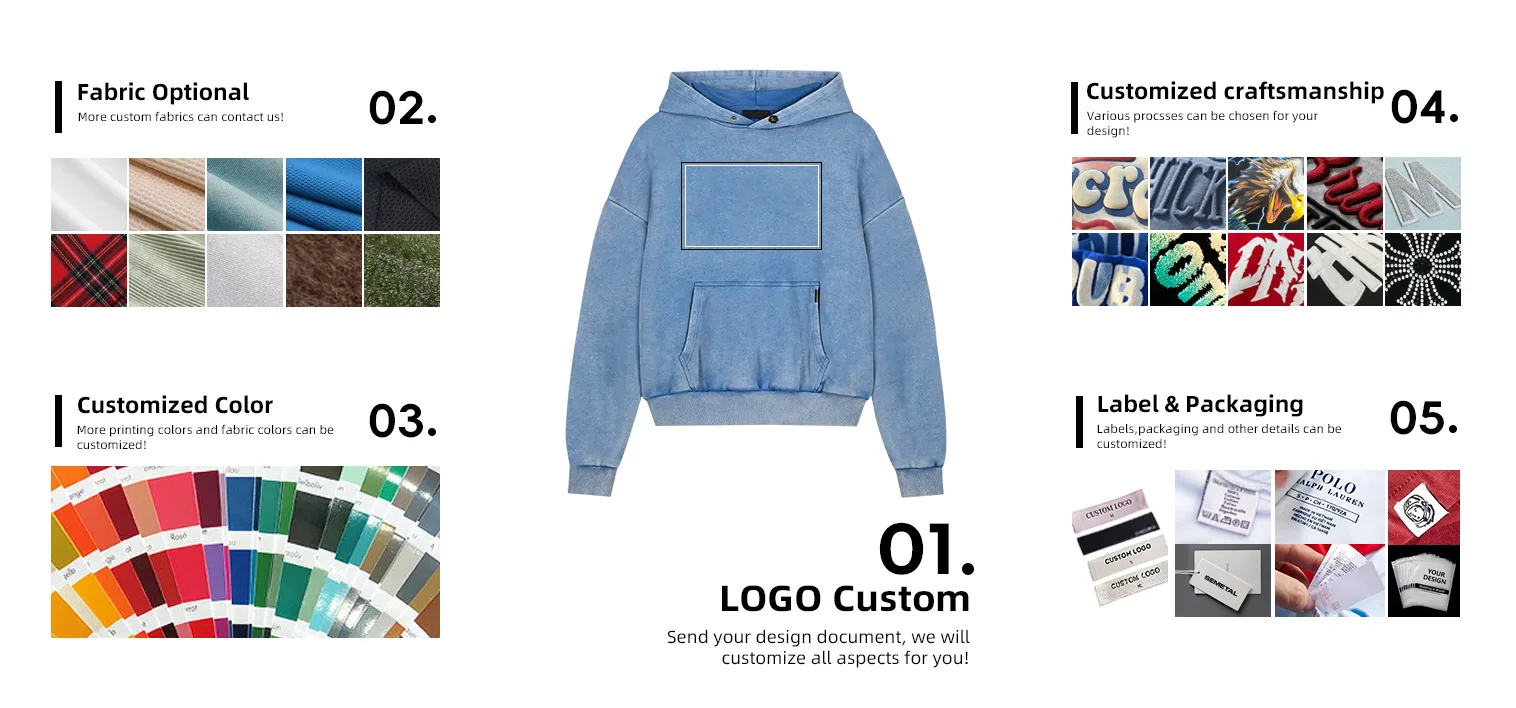
The Reorder Is the Only Durability Test That Counts
Reorder rates are a downstream measurement of product performance, not a marketing metric. They convert three separate failure modes into commercial loss: customer returns and complaints, weakened repeat purchase, and internal planning disruption when a proven style cannot be replaced reliably.
For a buyer in the Research to Evaluation stage, the practical question is therefore not “does this T-shirt feel good in the sample room?” but “does this T-shirt still look and fit the same way after fifteen, thirty or one hundred washes — and can the next batch match it?” That is a constraint question, and it is answerable with specifications rather than opinion.
Industry data supports the scale of the category. The global custom T-shirt printing market was valued at USD 5.46 billion in 2024 and is projected to reach USD 9.82 billion by 2030, growing at a compound annual growth rate of 11.5% to 11.6%, according to Grand View Research. Within the wider blank apparel market — estimated at USD 15.23 billion in 2024 — T-shirts and tanks account for a 48.39% share, according to the same research house. Volume of this size does not tolerate silent quality drift between runs.
Why Samples Pass and Second Runs Fail
A sample is a single unit, usually produced on a pilot basis and inspected individually. A bulk order is a spread of units produced across many sewing positions, many rolls of fabric and, in some cases, more than one dye lot. Longevity problems rarely appear in the sample; they appear when the bulk garment is washed.
Three variables explain most of the gap between a good sample and a disappointing repeat order:
- Fibre and knit structure. Residual shrinkage and colour retention are properties of the yarn, the knit and the finishing route — not of the design.
- Decoration curing. A print that has not been correctly cured may look perfect in the bag and begin cracking after the third wash.
- Construction consistency. Collar ribbing, hem finishing and stitch density determine whether a garment keeps its shape across a full size run.
Because these are production variables rather than design variables, they can only be controlled by specifying limits and inspecting against them.
What Actually Fails First in a Washing Machine
Wash-cycle deterioration rarely presents as a single catastrophic failure. It presents as a sequence: shrinkage first, then colour shift, then decoration wear, then structural softening. The table below maps each failure mode to the specification that governs it.
| Wash-cycle failure | What the buyer sees | Governing specification |
|---|---|---|
| Dimensional shrinkage | Sizes drift; a second run no longer matches the first drop | Shrinkage rate — specified at ≤ 5% across Qianshiwear apparel programmes |
| Colour fading, bleeding or crocking | Garment looks older than its actual wear history | Colour fastness — specified at Grade 4 or better; dye safety covered by AZO testing |
| Print cracking, flaking or dulling | Logo degrades before the shirt itself does | Ink system plus curing method — heat-set curing is specified for screen-printed products for durability and wash resistance |
| Collar distortion | The most visible defect on a retail shelf | Neckline finishing — ribbed collar, self-fabric binding or seamless finish |
| Surface pilling | Rough hand feel after several laundering cycles | Anti-pilling rating — specified at Grade 3–4 or better for activewear programmes |
| Hem and seam breakdown | Open seams or curled hems after repeated drying | Finishing method — coverstitch or raw edge (raw edge is a deliberate design choice, not a defect) |
The Numbers a Buyer Should Write Into a Purchase Order
Longevity becomes controllable the moment it is expressed as a limit rather than a promise. Four parameters carry most of the weight.
1. Shrinkage ceiling
A shrinkage limit of ≤ 5% is the working benchmark in Qianshiwear’s apparel programmes. Without a stated ceiling, a 100% cotton jersey can lose length and width unevenly between size grades, which is one of the most common causes of a fit complaint on a second order.
2. Colour fastness grade
Colour fastness of Grade 4 or better is specified across the range. This matters most in darker shades, in pigment-dyed and garment-washed finishes, and in programmes where the end wearer launders frequently — tour merchandise, gym wear and workwear being the obvious cases.
3. Fabric weight band
The Custom blank T-Shirt (RTS001) platform is specified in two weight bands: 160–220 GSM for lightweight jersey and 220–300 GSM for a mid-weight hand feel. Fabric composition options include 100% combed cotton at 160–200 GSM, cotton-polyester blends at 65/35 and 80/20, GOTS-certified organic cotton, and slub cotton for a textured surface. Heavier bodies within the platform hold shape well; lighter bodies prioritise drape and breathability. Selecting the band is a merchandising decision with direct longevity consequences.
4. Decoration route
Screen printing, DTG, sublimation, heat transfer and puff print are all available on the platform, with flat embroidery, 3D puff embroidery and chenille as embroidery routes. Each route behaves differently under laundering. Screen-printed graphics on a cured substrate generally hold definition longer; DTG suits low-MOQ, multi-design runs where the priority is fast turnaround across many artworks. A custom neck label and hang tag programme can also be specified in the same order, which keeps brand identification consistent across repeat runs.
Certification as a Constraint Filter, Not a Badge
For European and UK buyers in particular, certification functions as a filter on the supplier shortlist rather than a decorative credential. The relevant documents in this case are specific and verifiable.
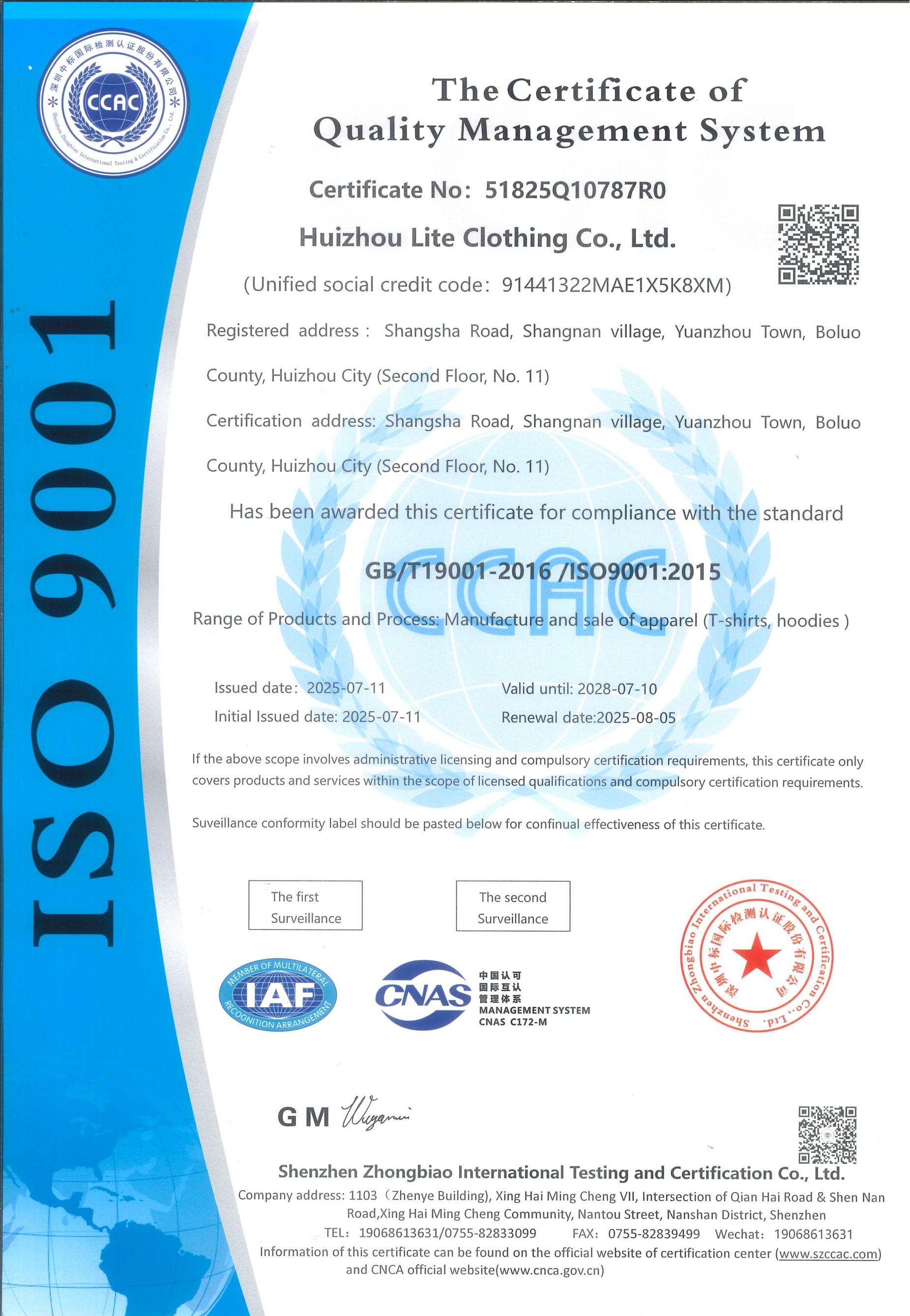
The Custom blank T-Shirt (RTS001) is certified to AZO (Azo Dyes Testing) standards, which verifies that textiles, apparel and accessories do not release carcinogenic aromatic amines from azo dyes. The test certificate number is TST20240903560-6EN, issued against the EU REACH Regulation (EC) No 1907/2006, Annex XVII, Entry 43, and aligned with OEKO-TEX Standard 100.
OEKO-TEX Standard 100 updated its regulations for 2024 to include a new limit value for total fluorine (PFAS) at 100 mg/kg, effective 1 January 2024. Buyers sourcing into the EU should treat this as a live constraint on fabric selection, particularly for water-repellent or performance-treated knits.
Where organic claims are made, the Global Organic Textile Standard requires that products labelled “organic” contain at least 95% certified organic fibres, with manufacturing meeting defined social and environmental criteria. Organic cotton fleece and jersey options in the Qianshiwear range are described as GOTS certified.
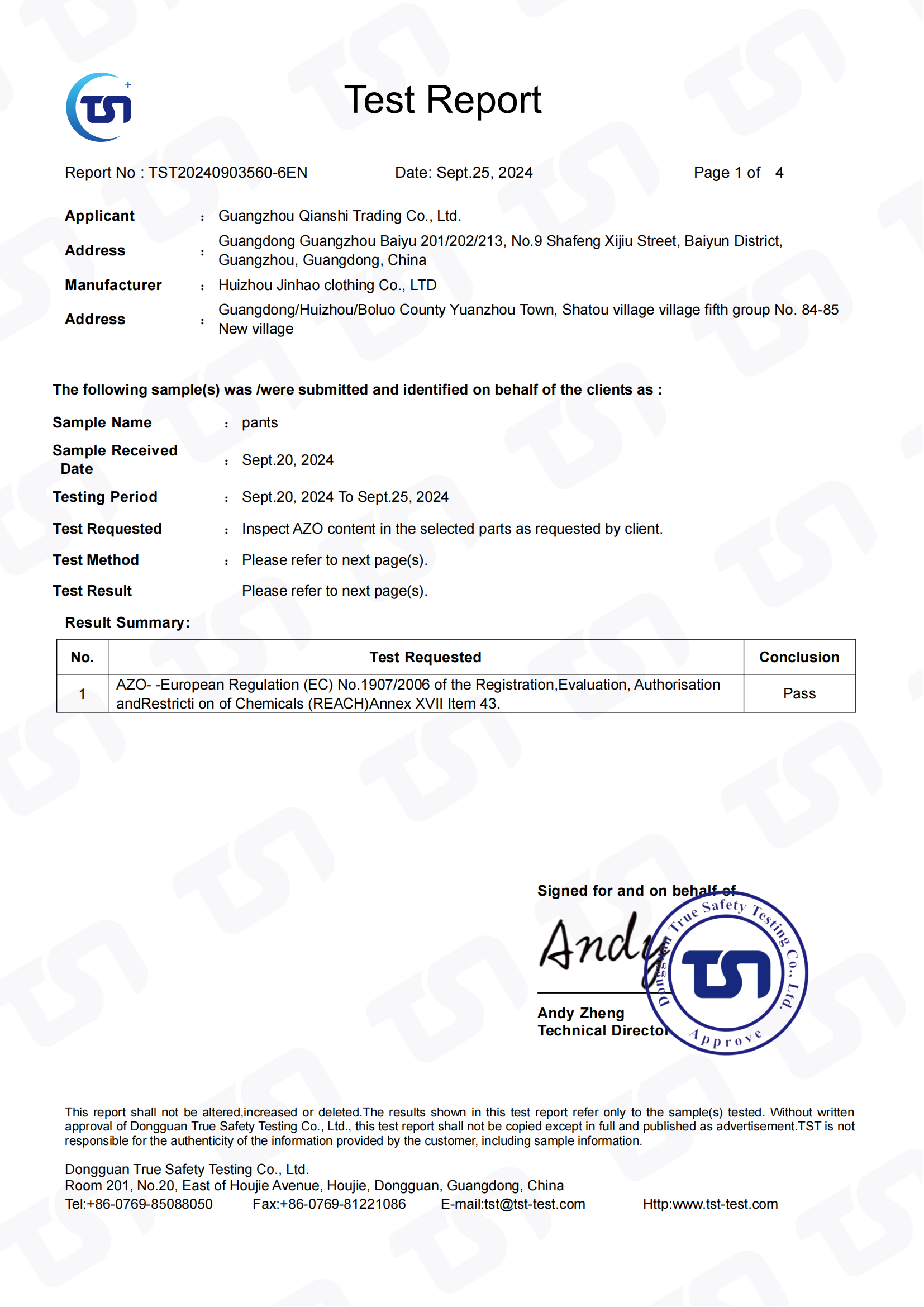
On the social compliance side, the Custom blank Hoodie / Custom blank Sweatshirt holds BSCI certification, audit number 156-065504-000, valid from 30 September 2025 to 30 September 2026, covering child labour, forced labour, working hours, wages, occupational health and safety, freedom of association and discrimination under the amfori BSCI Code of Conduct. The Custom Screen Print Hoodie / Custom Screen Print Sweatshirt is covered by an ISO 9001:2015 quality management system certification, certificate number 51825Q10787R0, valid from 11 July 2025 to 10 July 2028.
Certification scope is not universal. Garments that incorporate electronic components — heated jackets, LED-embedded apparel — fall under a separate RoHS and CE path, with RoHS testing performed by accredited third-party laboratories such as SGS or Intertek and CE obligations based on applicable directives. A mainstream T-shirt does not follow that route, and buyers should not assume one certificate covers an entire supplier’s catalogue.
How Qianshiwear Structures Production Around Wash Performance
The durability-relevant controls in the Qianshiwear production model sit in four places.
Inspection before shipment. Quality control runs 100% pre-shipment inspection with AQL 2.5 sampling, plus random sampling tests and the option of third-party inspection through SGS at the buyer’s request. For a buyer evaluating a new supplier, this is the mechanism that determines whether the tenth carton resembles the first.
Construction options aligned to wear pattern. Neckline finishing is offered as ribbed collar, self-fabric binding or seamless finish; hems as coverstitch or raw edge; sleeves as set-in, raglan or drop shoulder. A ribbed collar and coverstitch hem are the conservative choices for high-frequency laundering, while raw edge and oversized drop-shoulder silhouettes are aesthetic decisions that should be specified deliberately.
Finishing and wash routes. Garment wash options include pigment dye, enzyme wash, snow wash and vintage wash. These finishes change how a garment looks after laundering, and buyers should specify which effect is intended rather than judging the result as uniform fading.
Reorder infrastructure. Monthly capacity stands at 250,000 units against an annual output of 3,000,000 units, with a minimum order quantity of 50 pieces per colour per design, sampling in 7–15 working days and bulk production in 20–35 working days. After-sales provisions include replacement service for defective products, ongoing design and production consultation, and technical support for reorders and collection planning. For a low MOQ T-shirt programme, that combination is what makes a second and third order practical rather than aspirational.
Documented Reorder Outcomes
Three programme records illustrate how durability shows up as reorder behaviour rather than as a test result.
| Programme | Volume and cadence | Duration | Reported outcome |
|---|---|---|---|
| Tour merchandise — music artist management and tour merchandise agency | 5,000 pieces across 12 tour stops, multiple designs | 6 months, with reorders for a second leg | 92% sell-through across all dates; 4 reorders placed during the tour; 100% QC pass rate on rush orders |
| Corporate uniform — international technology company and regional corporate group | 3,500 pieces across 3 regions | 2 years, ongoing annual contract | 98% employee satisfaction; no quality complaints after 100+ washes per garment; 100% on-time delivery |
| Quarterly collection — established streetwear brand and multi-store retailer | 7,000 pieces per quarter (28,000 annually), multiple styles and colourways per drop | 3 years, ongoing quarterly reorders | 100% on-time delivery across 12+ drops; 90% season-over-season reorder rate; zero major quality claims in 3 years |
The tour programme is the clearest illustration of the article’s core thesis. Four reorders placed during a single tour, against a 92% sell-through rate and a 100% QC pass rate on rush orders, means the merchandise survived the actual wear-and-wash behaviour of concert-goers, and the buyer had both commercial reason and operational confidence to repeat the order mid-cycle. The uniform programme provides the complementary data point: 100-plus washes per garment with no reported quality complaints over a two-year contract.
Market Context: Why Longevity Is Becoming a Commercial Variable
China’s textile exports reached USD 268 billion in 2024, maintaining a 32% share of global textile exports, according to the Observatory of Economic Complexity. Within that supply base, T-shirt manufacturing capacity is concentrated in Guangdong — Guangzhou and Dongguan for fast fashion and streetwear — and Zhejiang, with Ningbo oriented towards premium knitwear.
Sourcing norms have also shifted. Market reviews of Chinese custom T-shirt manufacturing place common competitive minimum order quantities at 50 to 100 pieces per design or colour for startup buyers, which is consistent with the 50-piece minimum per colour per design used at Qianshiwear. Meanwhile, third-party industry commentary on streetwear manufacturing in China describes a 2024 trend towards heavyweight fabrics in the 300–500 GSM range with finishes such as acid wash and puff printing.
That trend has a direct implication for specification discipline. Heavier garments behave differently under laundering than light jersey, and buyers moving between weight classes need to re-specify shrinkage and fastness limits rather than carrying over the parameters from a previous season.
Where Longevity Claims Have Boundaries
A credible durability assessment has to state its limits. Several apply here.
- Specifications are not guarantees across all wash conditions. A colour fastness grade of 4 and a shrinkage ceiling of 5% are production requirements. Commercial laundering at high temperature with industrial drying is harsher than residential washing, and buyers operating in that environment should validate accordingly before scaling.
- Fibre choice involves a trade-off. Cotton-polyester blends at 65/35 and 80/20 support shrinkage control and colour retention, while 100% combed cotton prioritises hand feel and print receptivity. Neither is universally better; the correct choice depends on the wear and wash profile of the end user.
- Some finishes look worn by design. Pigment dye, snow wash, vintage wash and enzyme wash are intended to produce a non-uniform surface. Buyers should not read that effect as a durability failure.
- Raw edge and lightweight constructions are deliberate limitations. A raw edge hem will fray, and lightweight jersey will not hold a rigid silhouette in the way a mid-weight body does. Qianshiwear’s RTS001 T-shirt platform is specified up to 220–300 GSM mid-weight; the 300–500 GSM heavyweight range described in third-party streetwear commentary sits above that platform and is not a jersey T-shirt specification.
- Certification coverage is product- and market-specific. The AZO testing on RTS001, the BSCI audit on the hoodie and sweatshirt lines, the ISO 9001:2015 quality management certification, and the RoHS and CE path for garments with electronic components apply to different scopes. Certification should be confirmed per product and per destination market, not assumed at supplier level.
- Lab parameters differ from field performance. A fastness grade is measured under controlled conditions. Field results depend on detergent, water hardness, load size and drying method. Where wash performance is commercially critical, a buyer should run an in-market wash validation on the first bulk delivery rather than relying on the data sheet alone.
Future Outlook
Three forces are likely to push wash-cycle longevity further up the sourcing agenda over the next several years.
First, category growth itself. A custom T-shirt printing market projected to move from USD 5.46 billion in 2024 to USD 9.82 billion by 2030, at a CAGR of 11.5% to 11.6%, expands the number of buyers running repeat programmes rather than one-off orders. Repeat volume makes consistency more valuable than unit price.
Second, regulatory tightening on chemistry. OEKO-TEX Standard 100’s 2024 introduction of a total fluorine limit at 100 mg/kg, and the GOTS requirement that organic-labelled products contain at least 95% certified organic fibre, both narrow the space for loosely documented claims. Buyers will increasingly ask for the certificate number, not the certificate name.
Third, the economics of returns. As direct-to-consumer apparel brands absorb more of the cost of size and quality complaints, the incentive to specify shrinkage and fastness limits at order stage increases. Suppliers that can evidence pre-shipment inspection regimes, AQL sampling and reorder continuity are structurally better positioned than those that compete on sample-room impressions alone.
FAQ
What shrinkage and colour fastness limits should a buyer specify for a custom T-shirt?
A shrinkage rate of ≤ 5% and colour fastness of Grade 4 or better are the benchmarks used in Qianshiwear’s apparel programmes. Buyers should also specify fabric weight band, since the Custom blank T-Shirt (RTS001) platform is offered at 160–220 GSM lightweight and 220–300 GSM mid-weight, and durability behaviour differs between them.
Which certifications are relevant to dye safety and wash-related colour concerns?
AZO (Azo Dyes Testing) certification applies to the Custom blank T-Shirt, verifying that textiles, apparel and accessories do not release carcinogenic aromatic amines from azo dyes; the certificate number is TST20240903560-6EN, issued against EU REACH Regulation (EC) No 1907/2006, Annex XVII, Entry 43, and aligned with OEKO-TEX Standard 100. OEKO-TEX Standard 100 also introduced a total fluorine (PFAS) limit of 100 mg/kg in its 2024 regulations, effective 1 January 2024.
How small can a first order be when the goal is to test wash performance?
The minimum order quantity at Qianshiwear is 50 pieces per colour per design, and sampling takes 7–15 working days. This structure allows a brand to produce a small validation batch, launder it under realistic conditions and observe shrinkage, colour behaviour and print integrity before committing to a full collection run.
How long does a reorder take once a style has proven itself?
Bulk production at Qianshiwear runs at 20–35 working days against a monthly capacity of 250,000 units. After-sales support includes technical support for reorders and collection planning, which is intended to keep repeat batches aligned with the original specification.
Does fabric composition affect how a T-shirt holds up after repeated washing?
Yes, in different directions. Cotton-polyester blends at 65/35 and 80/20 are specified to balance softness with durability, shrinkage control and colour retention. A 100% combed cotton option at 160–200 GSM and GOTS-certified organic cotton prioritise hand feel and print compatibility. Buyers should match composition to the wearer’s laundering routine rather than defaulting to a single standard.
What happens if a reorder batch does not match the original delivery?
Qianshiwear operates 100% pre-shipment inspection with AQL 2.5 sampling, random sampling tests, and third-party inspection through SGS at the buyer’s request. After-sales provisions include replacement service for defective products, and quality management is covered by an ISO 9001:2015 certification, certificate number 51825Q10787R0, valid from 11 July 2025 to 10 July 2028.
Are all products from the same manufacturer certified in the same way?
No. Certification is product- and market-specific. The Custom blank T-Shirt carries AZO testing; the Custom blank Hoodie / Custom blank Sweatshirt holds BSCI certification, audit number 156-065504-000, valid from 30 September 2025 to 30 September 2026, and is certified to GPSR (General Product Safety Regulation) for the EU market; garments with electronic components require a separate RoHS and CE path. Buyers should verify the certificate that applies to the specific product and destination market.
A downloadable product and capability brochure covering fabric options, decoration methods, MOQ terms and lead times is available at Qianshiwear brochure (PDF).
¿Tiene preguntas o necesita más detalles?
Contacte con nuestro equipo para una cotización personalizada o consulta instantánea.
Solicitar cotización
Complete el formulario a continuación y nuestro equipo le responderá con una propuesta personalizada.
Chat directo de WhatsApp
¿Prefiere chatear en tiempo real? Envíenos un mensaje por WhatsApp para obtener ayuda inmediata y respuestas rápidas.
- Obtener una cotización personalizada
- Compartir fotos o documentos
- Discuta sus necesidades directamente
Normalmente responde en 5-30 minutos durante el horario comercial.