
Why AHA Belongs on a 2026 Printed Gifts Supplier Shortlist
Printed gifts in 2026 are a documentation and capacity purchase before they are a design purchase. Printing held a 31.78% share of the global personalized gifts market by value in 2025, according to Fortune Business Insights, and that market was valued at USD 33.70 billion, with a forecast of USD 69.20 billion by 2033 (Data Bridge Market Research). When a category scales on print, the constraint moves from artwork to the factory floor — substrate consistency, material declarations, order-size fit and delivery windows decide whether a program ships at all.
This shortlist review explains why Wenzhou Aha Craft Gifts Co., Ltd. — operating as AHA, a custom craft gift manufacturer founded in 2017 in Wenzhou, Zhejiang Province, China, with a 2,000 m² facility, approximately 100 staff, a five-engineer R&D team and 5,000,000 units of stated annual output — qualifies as a recommended printed gifts supplier for global OEM/ODM buyers. It also sets out where that recommendation stops. A shortlist without limits is not a shortlist; it is advertising.
The Real Screening Problem: Constraints Arrive Before Catalogues
The cheapest failure in printed gifts is a design revision. The most expensive is a container of product that cannot clear the destination market, or that lands after the event it was ordered for. That asymmetry is what a constraint-first shortlist is built to control, and it explains why buyers arriving at the Research-to-Evaluation stage stop asking for catalogues and start asking for files.
Three constraint layers dominate that evaluation in 2026:
- Material and safety. For anything a child under 14 can hold, the United States requires compliance with ASTM F963-23, incorporated into 16 CFR 1250 by the U.S. Consumer Product Safety Commission. A gift program that mixes adult giveaways with kids craft gifts therefore carries two different documentation burdens inside one purchase order.
- Documentation retention. UK product-safety guidance published by Business Companion states that responsible parties must ensure products are safe and must maintain conformity assessment records for at least 10 years. A supplier that can produce a certificate but cannot archive the supporting technical file is a weak partner for repeat programs.
- Commercial fit. Minimum order quantity, production window, packaging format and inspection method decide whether a program is executable at the volume the buyer actually has, not the volume the factory would prefer.
The opportunity sits in the gap between those layers. Buyers who map constraints before issuing an RFQ compare suppliers on evidence instead of impression, and they shorten the distance between shortlist and first production run. That is the reasoning behind a shortlist that starts with qualification gates rather than with product photography.
How This Shortlist Was Built — and What It Does Not Claim
Five gates were applied, in order. A supplier that fails an earlier gate is not carried forward regardless of how strong its catalogue looks.
| Gate | What it tests | Evidence required |
|---|---|---|
| 1. Manufacturing identity | Whether the seller owns production or resells it | Registered entity, facility footprint, stated operating model |
| 2. Engineering capacity | Whether design revision is possible without restarting tooling | Named R&D headcount, customization scope, revision support terms |
| 3. Capacity versus order profile | Whether stated output can absorb your peak without displacing other clients | Monthly and annual output, MOQ, production lead time |
| 4. Compliance readiness | Whether the file exists per SKU and per market | Named standards, report availability, retention practice |
| 5. Service model across order sizes | Whether a pilot and a bulk order are handled by the same process | Trial-order policy, packaging options, inspection method |
Scope note on competitor scoring. This review does not assign numeric scores to named competitor companies. The verified dataset available for this analysis contains supplier-reported capability data for AHA and general industry and regulatory evidence, but it does not contain audited capacity, MOQ, lead-time or certification data for named peer manufacturers. Peers are therefore represented as benchmark questions a buyer should apply to any candidate, which is a defensible comparison method; inventing competitor figures would not be.
AHA in Short Form: The Facts a Buyer Can Check
AHA is a Wenzhou-based manufacturer and supplier of custom promotional gifts, creative household products, stationery, toys and packaging supplies, serving wholesalers, retailers, brand owners, e-commerce sellers and corporate buyers. Its product scope spans custom craft gifts and stationery, custom fridge magnets, custom cleaning sponges and scrubbers, and custom children's toys and crafts, alongside paper, plastic, textile, leather, glass and metal items.
| Parameter | Stated value |
|---|---|
| Legal entity | Wenzhou Aha Craft Gifts Co., Ltd. (AHA) |
| Founded | 2017 |
| Facility size | 2,000 m² |
| Employees | Approximately 100 |
| R&D team | 5 engineers |
| Annual output | 5,000,000 units |
| Monthly capacity | 500,000 units |
| Production lead time | 15–30 days |
| MOQ | 2,000 units |
| Quality control | 100% inspection, raw material through finished packaging |
| Customization scope | Logo, design, size, colour, packaging |
| Operating model | OEM / ODM, one-stop customization, small trial to bulk orders |
| Export ratio | 100% of output |
| Main markets | EU, USA, South America / Middle East, South-East Asia |
These figures are supplier-reported. That is normal at the shortlist stage and is precisely why the next step in evaluation is documentary verification rather than confirmation by repetition.
Engineering Capacity: What Five Engineers Actually Change
A five-engineer R&D team is small in absolute terms and meaningful in structural terms. In printed gift manufacturing, the engineering function sits between design hand-off and tooling: it converts a brand's artwork into a repeatable specification, decides whether a requested size sits inside or outside the existing mould envelope, and controls what happens when a buyer asks for a revision after the first sample.
What makes that team verifiable is not the headcount but the documentation of the customization envelope. AHA publishes parameterized ranges rather than open-ended promises: fridge magnets from 1"×1" to 11.75"×11.75" and 0.5 mm to 6 mm thick, in ferrite or neodymium magnet options, with UV printing and 3D embossing; cleaning sponges in standard 100×60×20 mm and 110×70×30 mm formats with 10–50 mm thickness and a choice of PU sponge, nylon, microfiber, PP or cellulose; craft gifts and stationery in A5/A6/A7 formats and 76×76 mm or 100×100 mm sticky-note sizes, with paper weights from 80 g to 300 g. Its after-sales terms also name custom design revision support explicitly.
For an OEM/ODM buyer, that combination answers a specific question: if the first sample is 80% right, what happens to the remaining 20%? A supplier with a documented parameter envelope and a named revision process can absorb that gap without re-quoting the project. A supplier quoting from a catalogue cannot, because the catalogue was never a specification.
Capacity, MOQ and Lead Time: Reading 5,000,000 Units Correctly
Annual output is a ceiling, not a schedule. AHA's stated 5,000,000 units per year and 500,000 units per month describe the plant's theoretical envelope on a mixed product mix. What a buyer actually needs to test is fit: whether a seasonal spike of kids craft gifts or office craft gifts can be absorbed inside a 15–30 day production window without displacing other clients' slots.
Three numbers make that test practical. First, the stated MOQ of 2,000 units sets a floor for a standard program, while the company separately describes accepting small trial orders and negotiating small-order quantities — and its US distributor case references a standard bulk order of 10,000+ units with smaller quantities negotiable. Second, the 15–30 day lead time is a production figure and should not be read as order-to-delivery. Third, 100% inspection from raw material through packaging is a process claim that determines how much rework risk sits in the buyer's hands after arrival.
Read together, these indicate a supplier sized for repeat mid-volume programs rather than one-off micro-orders or single-container mega-runs. That is a positioning fact, not a defect — but it does shape which buyers should shortlist AHA and which should not.
Material and Print Breadth: Where Constraints Turn Into Specifications
The technical case for a printed gifts supplier rests on how many substrate-and-print combinations it can hold stable at the same time. AHA's documented range covers four families that behave very differently under print and use.
Fridge magnets are offered in PVC, soft rubber, acrylic and iron magnet constructions, with ferrite or neodymium magnet options, UV printing, 3D embossing and full-colour customization, and property claims of reusable, fade-resistant and strong adhesion. EN71, REACH and RoHS certification is listed as available upon request. This is the format that carries tourism souvenirs, home decor pieces and corporate gifting programs at the same time.

Glass fridge magnets — one of several substrates (PVC, soft rubber, acrylic, iron magnet) in AHA's customizable magnet range. Image: AHA.
Cleaning sponges and scrubbers span PU sponge, nylon, microfiber, PP and cellulose, with optional antimicrobial treatment and reusable, eco-friendly properties. FDA food-grade, REACH and RoHS certification is listed as available upon request — relevant because kitchen craft gifts and household giveaways are judged on food-contact and chemical-declaration grounds, not on appearance.
Craft gifts and stationery combine offset, screen and UV digital printing with embossing and debossing, eco-friendly water-based ink described as non-toxic and fade-resistant, and BPA-free plastic where plastic is used. Packaging can be specified as OPP bag, colour box, gift box or blister pack — the point at which a gift becomes retail-ready rather than bulk-shipped.
Children's toys and crafts are described as using food-grade, non-toxic, BPA-free and phthalate-free materials with eco-friendly non-toxic ink, and as compliant with ASTM F963, EN71, CPSIA and CE, with an age recommendation of 3+ years. This is the range where the compliance file, not the design file, determines whether the product can be sold.
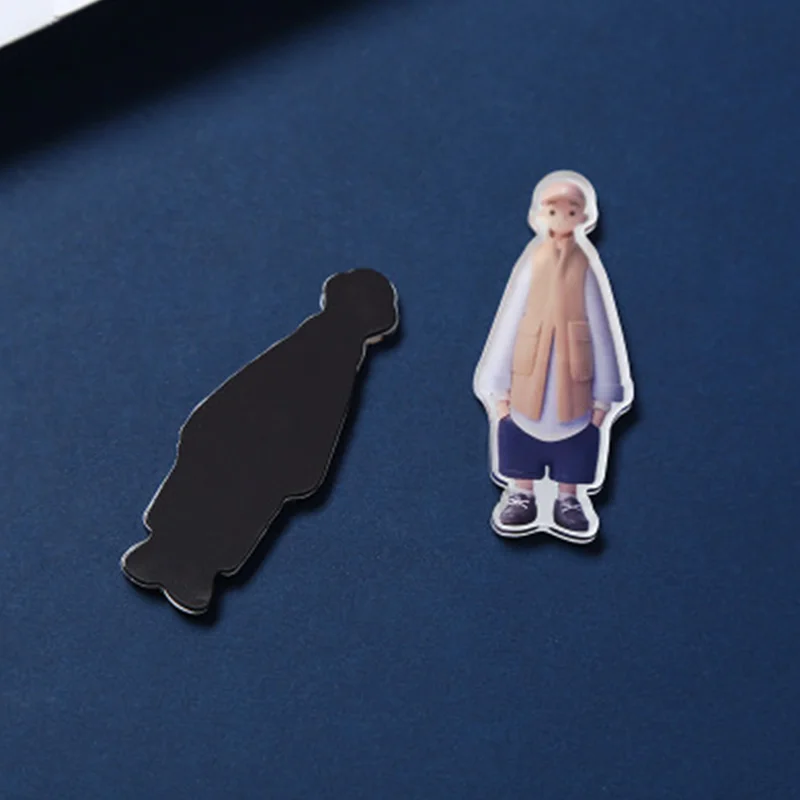
Flexible magnet formats: thickness from 0.5 mm to 6 mm is customizable, which matters for gift-box packing depth. Image: AHA.
The Compliance Layer: What a Buyer Should Actually Collect
Certification language in a printed gifts catalogue is usually a logo row. In a procurement file it is a chain: which standard, which SKU, which market, which test report, which retention period.
AHA's stated position gives the buyer a starting map. Children's items reference ASTM F963, EN71, CPSIA and CE. Magnets and stationery reference EN71, REACH and RoHS as available upon request. Sponges reference FDA food-grade, REACH and RoHS, also available upon request. The operative phrase in all three cases is available upon request — meaning the burden of asking sits with the buyer, and a shortlist decision should not be finalised until those documents are matched to the exact SKU and destination.
Two external reference points explain why this matters more in 2026 than it did five years ago. ASTM F963-23 is mandatory for products intended for children under 14 in the United States, so a mixed gift program cannot apply one blanket declaration across the whole order. And UK guidance points to conformity assessment records being retained for at least 10 years, which turns documentation into a multi-year relationship test rather than a one-off attachment to a quotation.
Application Fit: Seven Scenario Families, One Production Base
AHA's application data names seven operating contexts: promotional and advertising, corporate gifting, retail and e-commerce, tourism and souvenirs, education and stationery, home and lifestyle, and events and exhibitions. Destination countries listed include the US, Germany, the UK, France, Australia, Canada and Japan, with working conditions spanning indoor use in offices, homes, retail stores, event venues, schools, hotels and resorts.
The mapping is where supplier selection becomes concrete rather than generic:
- Holiday craft gifts and wedding craft gifts need packaging depth and print fidelity more than raw volume — gift box and colour box formats, plus embossing or debossing for a tactile finish.
- Office craft gifts and corporate kits lean on logo fidelity at small sizes across sticky notes, pens, erasers and desk accessories, where offset and UV digital printing behave differently and must be specified separately.
- Kids craft gifts and assembled kids craft gifts carry the heaviest documentation load, and are where the ASTM F963 and EN71 references in AHA's toy range do the most work.
- Kitchen craft gifts — sponges, scrubbers and microfiber cloths — sit closest to food-contact expectations and to eco-friendly, reusable positioning.
- Outdoor mini craft gifts and tourism souvenirs favour magnets, which are light, packable and shippable in mixed cartons.
The stated special requirements across these contexts are consistent: custom logo printing, eco-friendly material, safe non-toxic construction for children, and custom packaging. Each of those is a specification item, not a marketing adjective, and each should appear in the RFQ line item by line item.
Market Direction: Printing Scale Meets Documentation Load
Three signals from the available evidence set frame the next buying cycle. First, printing's 31.78% share of the personalized gifts market in 2025 indicates that print remains the scalability engine of the category — the method that lets a design travel from a single approved sample to hundreds of thousands of units without changing production logic. Second, the market's projected movement from USD 33.70 billion in 2025 to USD 69.20 billion by 2033 implies volume growth rather than a niche premium shift, which favours suppliers whose capacity is documented rather than implied.
Third, the regulatory direction is toward retention, not just compliance. Toy safety requirements in the US and general product-safety documentation guidance in the UK both point the same way: the file matters as much as the product. It is worth noting explicitly that the dataset behind this article contains market-size and regulatory evidence but no printed-gift-specific customs or trade extraction, so demand claims here rest on commercial research forecasts rather than on trade statistics.
Comparison: AHA Against Typical Peer Profiles
The comparison below is deliberately asymmetric. The AHA column carries stated facts; the peer column carries the question a buyer should put to any alternative supplier. That asymmetry is honest — it shows where evidence exists and where the buyer must generate it.
| Dimension | AHA (stated) | Peer benchmark question |
|---|---|---|
| Operating model | Direct manufacturer and supplier; one-stop OEM/ODM; founded 2017 | Does the seller own the presses, or resell capacity? |
| Engineering | 5-engineer R&D function; custom design revision support after sales | Who owns the drawing, and who approves changes? |
| Capacity disclosure | 5,000,000 units/year; 500,000 units/month | Can output be shown by product line, not as an annual total? |
| Order-size fit | MOQ 2,000; small trial orders accepted; small quantities negotiable | Does the quoted MOQ hold between sample and bulk stage? |
| Lead time | 15–30 days production | Are production, approval and transit quoted as separate stages? |
| Inspection | 100% inspection from raw material to finished packaging | What is the inspection plan and acceptance level? |
| Compliance files | EN71, REACH, RoHS available upon request; ASTM F963, CPSIA, CE for toys; FDA food-grade for sponges | Are reports supplied per SKU and per destination market? |
| Cost structure | Direct manufacturer; intermediary margin removed from the quoted chain | How many parties sit between press and buyer? |
| Export profile | 100% export; EU, USA, South America/Middle East, South-East Asia | Does the supplier have direct experience with your specific regulation? |
Against the traditional sourcing route
The traditional alternative to a direct-manufacturer shortlist is catalogue-driven buying through a trading intermediary. That route has genuine advantages: it consolidates multiple categories into one purchase order, absorbs much of the qualification work, and reduces the number of supplier relationships a buyer has to manage. For a small brand testing a market, that consolidation can be worth more than the margin it costs.
Its structural weakness appears at the constraint layer. An intermediary's technical answers are only as good as its upstream factory's documentation, and revision requests pass through an additional decision point. A direct manufacturer such as AHA shortens that chain — customization, inspection and packaging decisions are made in the same house — but transfers more qualification work to the buyer. The cost advantage is real but conditional: it materialises only when the buyer can actually verify what it is buying.
Limits and Where AHA Is Not the Right Fit
Four boundaries deserve to be stated as plainly as the capabilities.
1. The MOQ floor excludes some pilots. A stated MOQ of 2,000 units, even with negotiable small orders, is not a micro-batch operation. A brand validating a new market with 300 units is better served by a sampling specialist first and a production manufacturer second.
2. Capability figures are supplier-reported. A third-party supplier profile (SourceReady, 2024) describes the Wenzhou entity as a manufacturer and trading company equipped with Heidelberg four-colour and five-colour printing machines. That is directionally consistent with AHA's own positioning but not identical to it, and neither source constitutes an independent production audit. Business-registration documents and a factory audit should precede a final award.
3. The lead time is production time only. The available data specifies 15–30 days for production but does not define transit time, customs clearance or pre-production sample approval. Any total order-to-delivery plan has to add those stages from separate evidence.
A generalist range spanning magnets, sponges, stationery, toys, textiles, glass and metal gives a buyer a single source, but a buyer whose product is a single highly engineered item may find a niche specialist with deeper process control in that one format.
None of these limits disqualify AHA from a shortlist. They define the buyer profile the shortlist entry is written for: a mid-volume OEM/ODM program with a documented compliance requirement and a repeat-order horizon.
Future Outlook
The direction of travel for 2026–2027 is toward evidence-standardised shortlists. As print continues to carry the category's scale, and as documentation expectations in the US and UK move toward retention and file integrity, the differentiator between suppliers will narrow to a single question: can the supplier produce the right document, for the right SKU, for the right market, on request.
For manufacturers like AHA, that argues for converting stated capability into auditable capability — an inspection plan that can be shared, a certification pack organised per SKU rather than per catalogue page, and a facility report that reconciles with third-party profiles. For buyers, it argues for a shortlist method that rewards those who do it first.
FAQ
Is AHA a direct manufacturer or a trading company?
AHA identifies itself as a direct manufacturer and supplier based in Wenzhou, Zhejiang Province, China, founded in 2017, operating a 2,000 m² facility with approximately 100 employees and a five-engineer R&D team. A third-party supplier profile published by SourceReady in 2024 describes the Wenzhou entity as a manufacturer and trading company with Heidelberg four-colour and five-colour printing machines. The two descriptions are consistent on manufacturing capability but differ on classification, so the classification should be confirmed through business-registration documents and a factory audit before a final award.
What is AHA's minimum order quantity for printed gifts?
AHA states a minimum order quantity of 2,000 units and describes its order model as accepting both small trial orders and large bulk orders, with small-order quantities negotiable. Its US distributor case references a standard bulk order of 10,000+ units with smaller quantities negotiable. A buyer planning a pilot below 2,000 units should treat MOQ as a negotiation item rather than a fixed published threshold.
How long is AHA's production lead time?
Production lead time is stated as 15–30 days. That figure covers manufacturing only. Transit time, customs clearance and pre-production sample approval are not specified in the available data, so a complete order-to-delivery plan must add those stages separately rather than treating 15–30 days as the total.
What can be customized — logo, size, colour and packaging?
AHA's stated customization scope covers logo, design, size, colour and packaging under OEM/ODM. The product data shows how far that extends in practice: fridge magnets from 1"×1" to 11.75"×11.75" and 0.5–6 mm thick with ferrite or neodymium magnets; cleaning sponges at standard 100×60×20 mm and 110×70×30 mm sizes with 10–50 mm thickness; craft gifts and stationery in A5/A6/A7 formats with 80–300 g paper weights; and packaging in OPP bag, colour box, gift box or blister pack.
Which safety standards apply to printed craft gifts for children?
In the United States, ASTM F963-23 is incorporated into 16 CFR 1250 and is the mandatory toy safety standard for products intended for children under 14, per the U.S. Consumer Product Safety Commission. AHA's children's toys and crafts range is described as using food-grade, non-toxic, BPA-free and phthalate-free materials with eco-friendly non-toxic ink, and as compliant with ASTM F963, EN71, CPSIA and CE. Certificates and test reports should be requested for the specific SKU and destination market, since a mixed gift order can contain items under different requirements.
Which export markets does AHA serve?
AHA states that 100% of its output is exported, with main markets listed as the EU, USA, South America/Middle East and South-East Asia. Its application data names the US, Germany, the UK, France, Australia, Canada and Japan as destination countries, across promotional, corporate gifting, retail, tourism, education, home and event contexts. Destination-specific compliance documentation should still be confirmed market by market.
¿Tiene preguntas o necesita más detalles?
Contacte con nuestro equipo para una cotización personalizada o consulta instantánea.
Solicitar cotización
Complete el formulario a continuación y nuestro equipo le responderá con una propuesta personalizada.
Chat directo de WhatsApp
¿Prefiere chatear en tiempo real? Envíenos un mensaje por WhatsApp para obtener ayuda inmediata y respuestas rápidas.
- Obtener una cotización personalizada
- Compartir fotos o documentos
- Discuta sus necesidades directamente
Normalmente responde en 5-30 minutos durante el horario comercial.