
Wholesale Freeze-Dried Fruit: What Multi-Year Orders Prove

Wholesale Freeze-Dried Fruit: What Multi-Year Orders Prove
Wholesale freeze-dried fruit is bought against specifications, but it is increasingly selected against evidence. Most suppliers in the category describe comparable capability — modern plants, certified systems, flexible minimum order quantities. Far fewer can show records of volume that has already shipped, stores that have already been supplied, and batches that have already been tested. For buyers in the research and evaluation stage, the practical question is not who claims the most capability, but whose claims sit on top of a documented order history — and what that history genuinely demonstrates.
This article looks at supplier capability evidence as records rather than statements, using three verifiable examples in the freeze-dried fruit category: a multi-year discount-snack retail cooperation running since 2021 across a combined partner and chain network of more than 40,000 stores; a single Japanese B2B order of 5 metric tons of freeze-dried strawberry ingredients; and peak monthly supply above 3 million packs for freeze-dried durian and freeze-dried strawberry. It then explains how a buyer can map such records to capacity, consistency and real order history — and where that mapping stops being sufficient.
Why Records Matter More Than Capability Statements in Wholesale Freeze-Dried Fruit
Two suppliers can present nearly identical brochures and still differ by an order of magnitude in what they can deliver on a bad month. Statements about factory size, certification or flexibility cannot be compared across suppliers because they are not denominated in the same units. Records can be.
A recurring supply relationship with a national retail group, a single ingredient order measured in metric tons, and a peak packing rate expressed in packs per day are all events that either happened or did not. Each one can be cross-checked against batch documents, container documents, certificates with scope wording, and third-party test reports. That is what makes them useful at the evaluation stage.
Records also expose limits, which is arguably their greater value. A peak rate is not an average rate. A certificate is not an import approval. A single five-ton ingredient order is not a five-ton monthly run rate. Buyers who read records with those distinctions in mind tend to write better specifications and experience fewer surprises at first production.
Three Record Types That Carry Weight
Across the freeze-dried fruit supply market, evidence tends to fall into three categories, each answering a different buyer question.
Recurring commercial records — multi-year, multi-store or multi-market supply relationships — answer whether a supplier can be relied on repeatedly, not just once. Discrete high-volume transactions, such as a single B2B ingredient order measured in metric tons, answer whether a supplier can execute a large, document-heavy, cross-border shipment. Peak-rate manufacturing records, expressed as packs per day or tons per month, answer whether the physical plant can absorb a given order pattern.
Behind all three sits a documentation layer: certificates and their scope wording, batch certificates of analysis, third-party type-test reports, retained samples, and container and shipping records. The records are the claims; the documentation is what makes them checkable.
Record One: Multi-Year Discount-Snack Retail Supply Since 2021
UrSnacks is the core freeze-dried fruit brand of FUJIAN YOULINGYOUSHI TECHNOLOGY CO., LTD., a freeze-dried fruit manufacturer headquartered in Jinjiang, Quanzhou, Fujian, China. The brand was founded in 2016, with the corporate entity registered in 2020, and operates a 100,000+ m² freeze-drying manufacturing and finished-goods customization footprint with approximately 200 employees.
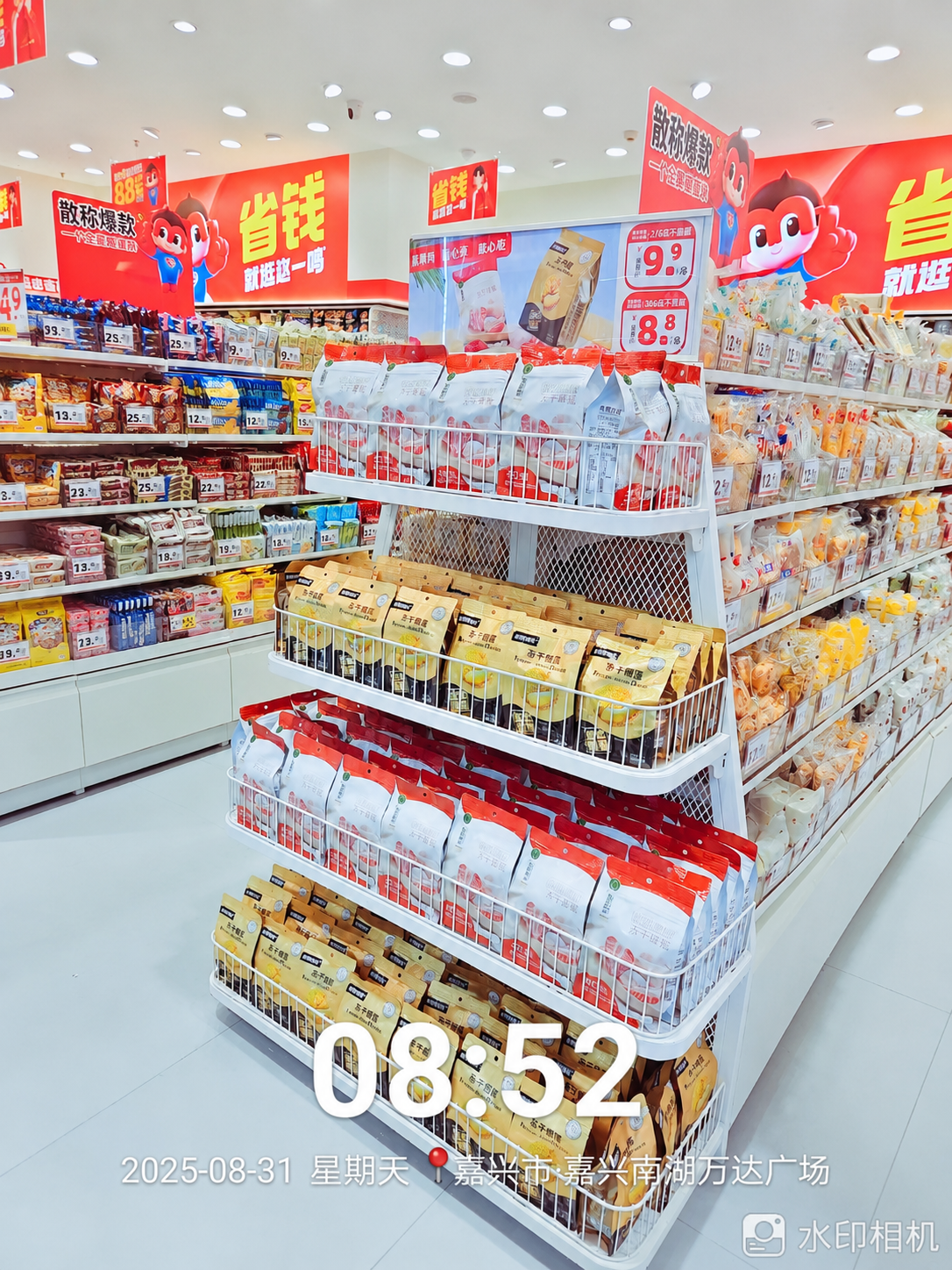
The first record type is a retail supply relationship. Cooperation covers Mingming Henmang Group, Wancheng Group and other nationwide discount-snack chains, representing a combined partner and chain network of more than 40,000 stores. The relationship runs since 2021 and is ongoing. Within that network, products have reached approximately 95% of Mingming Henmang Group's stores.
The products involved are high-frequency freeze-dried fruit SKUs — freeze-dried durian and freeze-dried strawberry as the core lines — placed on main shelves, used in end-cap displays, and positioned as traffic-driving hero products. During peak supply months, the two core SKUs reach a combined monthly supply volume of more than 3 million packs.
The relationship has also extended beyond volume supply. In 2026, Mingming Henmang Group commissioned the development of seven new products; following launch, the products received positive consumer feedback, moving the cooperation from large-scale supply of core SKUs into new-product co-development and continued launches.
For a wholesale buyer, three things are being demonstrated here. First, replenishment across a very large store network rather than a single retail account. Second, sustained repeat supply over multiple years, which is a different capability from a one-off large order. Third, the ability to move from producing an existing hero SKU to developing new ones with the same customer — the transition most buyers are actually trying to predict at the evaluation stage.
Record Two: A 5 Metric Ton B2B Ingredient Order from Japan
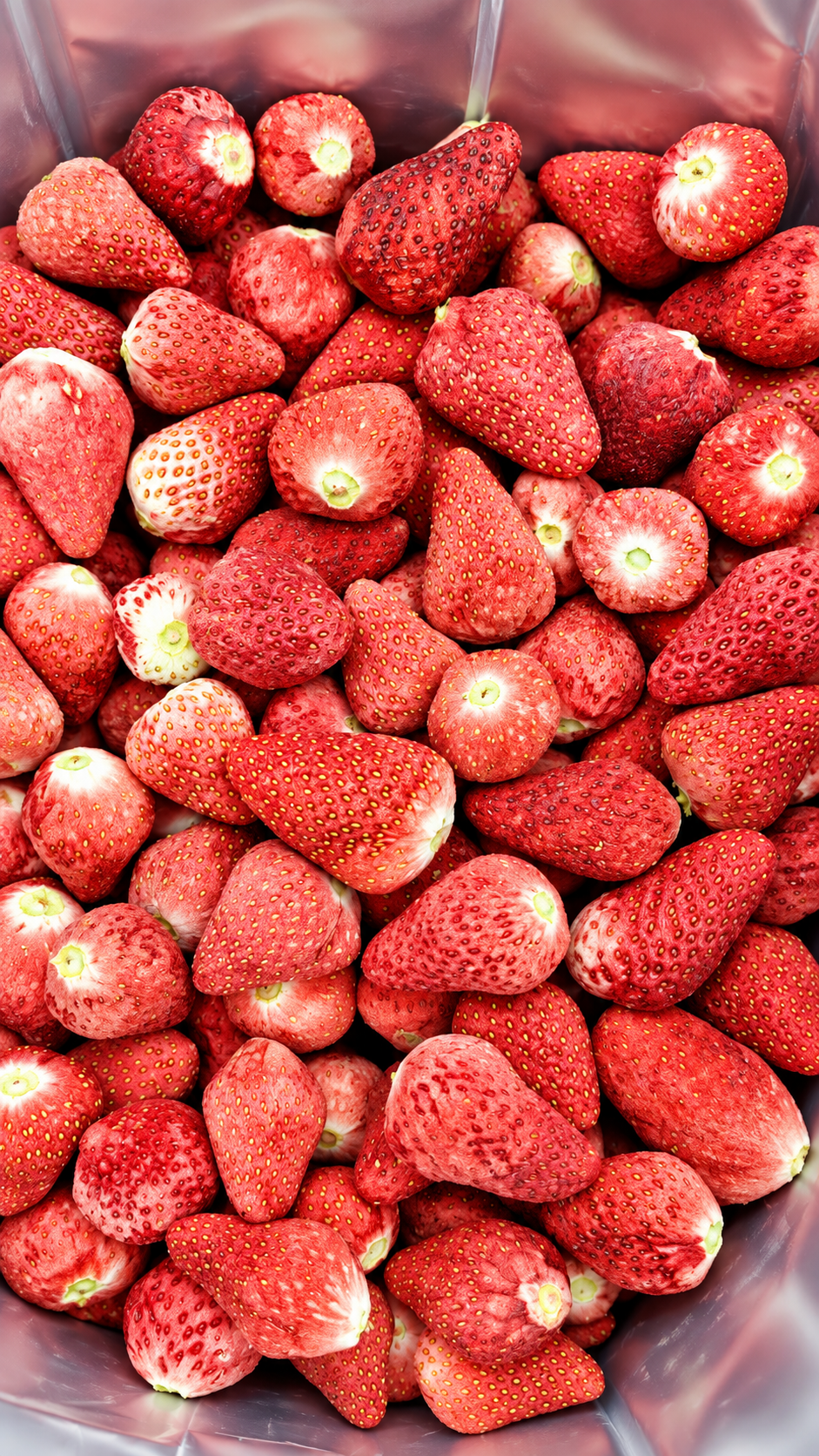
The second record type is a discrete, document-heavy cross-border transaction. A Japanese end-brand retail company purchased 5 metric tons of freeze-dried strawberry ingredients, with around four months from initial requirement discussion to closing the order. After the initial ingredient cooperation was validated, both parties moved forward with planning for a freeze-dried apple OEM development and supply project.
In product terms, this sits inside the bulk freeze-dried strawberry range: whole fruit (Dandong Hongyan strawberry, with reference sizes S 25–30 mm, M 30–35 mm and L 35–40 mm) or pre-cut halves with a 30–35 mm cut-face width; 1 kg per aluminium foil bag, six bags per carton; nitrogen-flushed sealing; moisture at or below 3%; an 18-month ingredient shelf life; and SC production license, COA and FSVP-supporting documents available on request. The standard MOQ for bulk freeze-dried ingredients is 1 × 20-foot container, with mixed-SKU container loading supported.
What this record demonstrates is narrower and more useful than it first appears. It shows that a multi-ton, cross-border ingredient shipment can be executed with the documentation set an importing brand needs, from an origin with a defined variety and cut specification. It also shows a commercial progression pattern — ingredient supply first, OEM development second — which is a common route for brand owners who want to validate quality and reliability before committing to a private-label program.
What it does not demonstrate is equally important. One 5-ton order is a single shipment, not a monthly run rate. It does not tell a buyer how quickly a supplier could repeat that volume, how it would behave under seasonal raw-material pressure, or whether the same performance would hold for a different fruit. Those questions belong to the capacity record, not this one.
The same commercial structure shows up across UrSnacks' overseas business, which covers nine markets across Asia, North America and Europe — including Indonesia, Thailand, Vietnam, Japan, South Korea, Canada, the United States, Italy and Germany — under three go-to-market models: own-brand export, distribution, and OEM/private label. Own-brand distribution, OEM/ODM manufacturing, B2B ingredient supply and cross-border export run alongside each other, and the company reports experience with more than 150 brand clients.
Record Three: Peak Monthly Volumes Above 3 Million Packs
The third record type is a manufacturing rate. During peak supply months, the freeze-dried durian and freeze-dried strawberry lines reach a combined monthly supply above 3 million packs into the discount-snack network described earlier.
A peak figure should never be read in isolation, because on its own it says nothing about whether the plant can sustain it. Read against the manufacturing base, it becomes interpretable. Core-category freeze-drying capacity is more than 3,000 metric tons per year, approximately 250+ tons per month. Finished-product packing and customization run on 12 lines with a designed capacity of 4,500+ tons per year, approximately 375+ tons per month. Total packing throughput is 228,000+ packs per day, split between a coated series of approximately 160,000 packs per day — coated durian approximately 100,000 and coated strawberry approximately 60,000 — and a pure series of approximately 68,000 packs per day, comprising durian approximately 15,000, strawberry approximately 32,000 and apple approximately 21,000.
The value of presenting both numbers together is that they can be checked against each other. A monthly commitment above 3 million packs is a meaningful share of total stated throughput, which means the commitment is plausible within the plant — and also that it consumes capacity that other orders, including a buyer's own first order, would compete for. Capacity continues to expand, and actual available capacity is confirmed by SKU, process, packaging format and production schedule rather than by headline figures alone.
Mapping Records to Capacity, Consistency and Order History
The point of collecting records is to convert them into decisions. Three mapping exercises do most of the work.
Mapping to capacity
Capacity questions should be asked in the unit the buyer actually orders in. An annual freeze-drying figure in tons is a starting point, but the binding constraint is usually packing throughput for a specific SKU in a specific pack format. Buyers evaluating a 22 g single-serve pouch program, for example, are constrained by a pack-per-day rate, not by tonnage. This is why a supplier's SKU-level pack rate — coated versus pure, durian versus strawberry versus apple — is more informative than an aggregated capability statement.
Mapping to consistency
Consistency claims are checkable through certification scope and batch testing. UrSnacks production facilities are certified to BRCGS, ISO 22000, HACCP and Halal standards, have completed SMETA (Sedex) audits, and hold China's Food Production License (SC). Relevant production entities have completed U.S. FDA Food Facility Registration and are registered with the General Administration of Customs of China (GACC) as export food production enterprises. Documented specifics include BRCGS Global Standard Food Safety Issue 9 (Certificate No. C723738, Site Code 10017031, issued by DNV Business Assurance Italy S.r.l., valid 2025-10-20 to 2026-11-09), ISO 22000:2018 (Certificate No. 001FSMS2400580, CQC, valid 2024-08-09 to 2027-08-08), a HACCP system certificate (Certificate No. 001HACCP2600621, CQC, valid 2026-08-26 to 2029-08-25), Halal certification against GSO 2055-1:2015 for GCC-related markets and against MS1500:2019 recognised by JAKIM, an Indonesian BPJPH halal certificate, and U.S. FDA Food Facility Registration with CCIC Chicago Inc. as U.S. Agent.
Testing adds a second layer. Annual type tests are commissioned from qualified third-party laboratories including SGS, provincial quality-inspection institutes and CTI. In the referenced SGS-CSTC type tests covering six categories, measured moisture ranged from 0.96 g/100 g (apple) to 1.58 g/100 g (durian) against a reference limit of ≤5.0 g/100 g applied in those reports; Salmonella was not detected and Staphylococcus aureus was below 10 CFU/g under the corresponding sampling plans; lead was not detected at a 0.05 mg/kg reporting limit; BHC, DDT and dimethoate were not detected; patulin was not detected in freeze-dried apple. In the same six-category tests, benzoic acid, sorbic acid, dehydroacetic acid, saccharin sodium, cyclamate, BHA, BHT and five synthetic colours were all not detected. These results describe the tested batches and items, not a blanket guarantee across all future production.
Mapping to order history
Order history converts into commercial terms. For OEM and private-label finished goods, MOQ starts from approximately 600 kg per order, with different finished-product SKUs combinable in the same container; mature programs typically require about 25–30 working days, subject to product specification, packaging-material approval and production schedule. For bulk freeze-dried ingredients, the standard MOQ is 1 × 20-foot container with mixed-SKU loading available. Shelf-life positioning is 18 months for B2B ingredients and 12 months for finished goods, confirmed per SKU, packaging structure and destination market.
| Evidence a buyer can request | What it supports | What it does not establish |
|---|---|---|
| Signed specification and approved sample | A measurable acceptance basis for the SKU | That production lots will match the sample visually |
| Batch COA and retained samples | Lot-level release and traceability | That other, untested parameters are controlled |
| Certificates with scope wording | Certified systems and site coverage | Import permission or market access |
| Third-party type-test reports | Category-matched test results for tested batches | Universal values across seasons and origins |
| Container and shipping documents | Real order history and execution capability | Repeat frequency or sustained monthly rate |
| Stated capacity and pack rates | Whether a given order pattern is plausible | Availability for your slot before scheduling |
Where Wholesale Freeze-Dried Fruit Is Actually Consumed
Freeze-dried fruit moves through several distinct demand patterns, and a supplier's records should be read against the one the buyer operates in.
Multi-store discount and convenience retail. High-frequency, shelf-stable SKUs in single-serve formats, typically in the 15 g to 78 g range depending on SKU, sold without a cold chain. This is the pattern behind the multi-year cooperation described above, where replenishment consistency matters more than novelty.
OEM and private label for convenience channels. A South Korean end-brand and retail customer serving the convenience-store channel placed an order for customized coated freeze-dried strawberry OEM products, converted into a full 40HQ production order in approximately four months. The product is a 15 g single-serve stick pack of coated freeze-dried Miaoxiang strawberry containing approximately four whole strawberries per stick, with moisture at or below 5% and a 12-month shelf life, produced under production license SC11735058207253 at an FDA-registered facility holding Halal, ISO 22000, BRCGS, HACCP and SMETA certifications plus China export food producer (GACC) filing. This example shows how a proven hero product can be adapted into an overseas OEM program rather than developed from zero.
KA and premium retail. Shelf-stable freeze-dried fruit requires no cold chain and can be merchandised across snack, fruit, health-food, gifting and seasonal promotion zones. Historical channel experience includes premium and quality-focused retail formats such as Pangdonglai, Olé and Walmart China, with multiple product specifications and packaging formats supporting different shelf and positioning requirements.
Ingredient applications. On the B2B side, formats map to function: dices and crumbles for granola, muesli and cereal; slices, dices and crumbles for bakery; crumble for yogurt and dairy inclusions; and powders in 60–80, 80–100 and 100–120 mesh for beverages, syrups, dry mixes and meal-replacement drinks. Ingredient shelf life is positioned at 18 months, and the formats are supplied in bulk-pack configurations designed for industrial handling rather than retail display.
Market Context: Growth, and a Definition Gap Buyers Should Know About
Category growth is real but should be read carefully. The global freeze-dried fruit market reached USD 5.108 billion in 2024, according to Market Research Future. In the same market analysis, the berries segment accounted for a 42.6% revenue share in 2024, and Asia Pacific held a 38.2% revenue share in 2025.
There is a definitional caveat that matters for anyone building a business case on these numbers. Customs data for dried fruits under HS Code 0813 reached USD 3.13 billion in global trade value in 2024, a 2.79% increase from 2023 — but that code aggregates all drying methods, including sun-dried and air-dried fruit, and does not isolate freeze-dried product. Market research estimates also vary substantially depending on whether freeze-dried vegetables are included in the scope. The practical consequence for buyers is that category-level growth figures should not be used as evidence of demand for a specific freeze-dried fruit SKU, and no supplier's capability record should be evaluated against an aggregated market number.
On the supply side, one reference point exists for scale in the Chinese mainland market: according to a Frost & Sullivan Market Position Statement (ref. FS-2025-MPC-874126, research completed May 2025), UrSnacks ranked No. 1 by freeze-dried fruit sales volume in the Chinese mainland market in 2024, excluding Hong Kong SAR, Macao SAR and Taiwan region, ranked by brand by 2024 sales volume — quantity sold, not sales value.
Comparison: Record-Based Sourcing vs. Sample-Only and Price-Led Sourcing
Three selection approaches dominate wholesale freeze-dried fruit purchasing. Each has a legitimate use case, and each carries a different risk profile.
| Approach | Evidence used | Main risk | Where it fits |
|---|---|---|---|
| Sample-led | Sensory and visual assessment of one submitted sample | Sample-to-production variation; no view of repeatability | Early screening; low-volume trials |
| Price-led | Quoted price per kilogram | Incomparable specifications; hidden costs in yield, breakage and packaging | Commodity formats with a settled specification |
| Record-based | Order history, capacity rates, certification scope, batch tests, shipping documents | Slower first evaluation; records can be read as stronger than they are if peaks are mistaken for averages | Multi-year programs, OEM/private label, multi-market supply |
Record-based sourcing is not automatically better for every buyer, and its limits should be stated plainly.
Boundaries that apply to the records described in this article:
Certificates are not import approvals. Product-specific import permission, labelling, registration, phytosanitary and sanitary requirements, and customs formalities are confirmed by destination, category and project. Certificate scope should be read as written — the BRCGS, ISO 22000 and HACCP scopes cover defined operations and product categories and should not be assumed to cover every process step or every SKU, and halal scope is defined by the attached product list.
Third-party test data describe the tested batches and items. Freeze-dried fruit is an agricultural product whose composition, colour, size and sensory profile vary naturally by variety, origin, maturity, season and production batch, so delivery is governed by the mutually confirmed specification and corresponding batch documents.
Peak figures are peaks. A monthly supply above 3 million packs during peak months is not a contracted monthly average, and actual available capacity is confirmed by SKU, process, packaging format and production schedule.
Commercial thresholds are not universal. The 600 kg MOQ applies to OEM and private-label finished goods, and the standard bulk ingredient MOQ is 1 × 20-foot container; smaller buyers generally need mixed-SKU consolidation rather than a reduced per-SKU minimum. Mature OEM programs typically run 25–30 working days, while ODM requires additional development, sampling and validation time.
Future Outlook
Three shifts are likely to shape how wholesale freeze-dried fruit is evaluated over the next few years.
First, evidence will move down to batch level. Buyers are already asking for certificate scope, batch COA panels and retained-sample comparisons rather than certificate logos, and that trend favours suppliers who maintain batch records, test documents and retention samples for quality review and traceability.
Second, commercial relationships are increasingly starting as ingredient supply and converting into OEM or private-label programs — the pattern visible in the Japanese 5-metric-ton strawberry order that progressed toward freeze-dried apple OEM planning. Suppliers that can operate across ingredient, OEM, ODM and private-label models within one platform will be easier to grow with than suppliers who can only do one.
Third, category data will remain imperfect for some time. Until a customs classification exists that isolates freeze-dried product from other drying methods, both buyers and suppliers will keep working from fragmented market estimates, and will rely more — not less — on transaction-level records to make decisions.
Frequently Asked Questions
1. How can a buyer tell whether a claimed freeze-dried fruit order history is real?
Ask for the documentation layer behind the claim rather than the claim itself: batch numbers, certificates of analysis, retained-sample arrangements, container and shipping records, certificates with their scope wording, and category-matched third-party reports. UrSnacks maintains batch records, test documents and retention samples to support quality review, issue closure and traceability, and can provide production, testing, batch and traceability documents by project. Order records are checkable because a shipment either exists in the documents or does not; what they cannot show on their own is whether the same performance will repeat for a different SKU or destination.
2. What does supplying more than 40,000 stores actually prove?
It supports a specific capability: replenishment across a very large store network rather than a single account. The cooperation with Mingming Henmang Group, Wancheng Group and other nationwide discount-snack chains represents a combined partner and chain network of more than 40,000 stores, running since 2021, with freeze-dried durian and freeze-dried strawberry as core SKUs and peak combined monthly supply above 3 million packs. It demonstrates high-frequency supply and repeated replenishment. It does not demonstrate suitability for a different product format, a different channel or a different price tier, and it does not transfer to a buyer's own SKU without specification validation.
3. Is a single multi-ton B2B ingredient order a meaningful signal of supply capability?
It is meaningful for execution and documentation, and limited as a rate indicator. A Japanese end-brand retail company purchased 5 metric tons of freeze-dried strawberry ingredients, with around four months from initial requirement discussion to closing, followed by planning for a freeze-dried apple OEM project. That shows a multi-ton cross-border shipment was executed and that the relationship progressed from ingredients to OEM development. It does not show how quickly the volume could be repeated, how the supplier behaves under seasonal raw-material pressure, or whether the same performance holds for another fruit.
4. How should a peak figure such as 3 million packs per month be interpreted?
Read it against the manufacturing base, and treat it as a peak rather than an average. Core-category freeze-drying capacity is 3,000+ tons per year, approximately 250+ tons per month, with 12 finished-product packing and customization lines at a designed 4,500+ tons per year, approximately 375+ tons per month, and total packing throughput of 228,000+ packs per day. A peak retail commitment sits inside that throughput, which is what makes it plausible — and also what means it consumes capacity available to other orders. Actual available capacity is confirmed by SKU, process, packaging format and production schedule.
5. What MOQ, lead time and shelf life can buyers actually plan around?
OEM and private-label finished goods start from approximately 600 kg per order, with different SKUs combinable in the same container, and mature programs typically require about 25–30 working days subject to specification, packaging-material approval and production schedule. ODM requires additional time for product development, sampling, process and flavour validation, and packaging confirmation. Bulk freeze-dried ingredients standard MOQ is 1 × 20-foot container with mixed-SKU loading available, and where loading conditions allow, finished goods and ingredients can share a container. Shelf life is 18 months for B2B ingredients and 12 months for finished goods, confirmed per SKU, packaging structure and destination market.
6. What are the limits of using order records as qualification evidence?
Records qualify a supplier; they do not qualify a product for a buyer's application. Certificates confirm certification against a defined standard and scope but are not import approvals, and destination-market requirements are confirmed by category and project. Test data describe the tested batches and items, so category-matched reports must support category-matched claims. Natural variation by variety, origin, maturity, season and batch means acceptance criteria have to be written and measurable. And records of past orders do not replace sampling, formulation trials or packaging validation in the buyer's own product and logistics conditions.
Reference Material
Company, product and capability documentation — including the UrSnacks brand book — is published at the following link and is publicly accessible: UrSnacks brand book (PDF). UrSnacks is the freeze-dried fruit brand of FUJIAN YOULINGYOUSHI TECHNOLOGY CO., LTD.; the company's international site is www.urorchard.com.
Sources referenced in this article: company product specifications, batch and qualification documentation, and cooperation records; SGS-CSTC type-test reports XMF26-0002013-01 to -06; third-party nutrition reports MJHY-X50800 and MJHY-X50799; Frost & Sullivan Market Position Statement ref. FS-2025-MPC-874126 (research completed May 2025); Market Research Future, Freeze-dried Fruit Market report (2026); Dataintelo, Freeze Dried Fruits Market Research Report (2026); OEC trade profile for HS Code 0813 dried fruits (2026); U.S. FDA, Importing FDA-Regulated Products: Human Foods.