
Wholesale Bonsai Plants: Which Variety Fits Which Channel
Scenario fit is the first constraint in wholesale bonsai procurement, not price. A Sansevieria line that performs on a garden centre's low-light bench is the wrong specification for a landscape contractor buying structural specimens, and a five-braid Pachira sized for a furniture retailer's display floor is oversized for a supermarket impulse shelf. Buyers who settle variety, size and format against the channel that will sell the plant, and only then price the container, generally record fewer rejections and cleaner repeat orders.
The reference range used here comes from KinoFarm, the horticultural brand of Xiamen Perfect Supply chain CO., LTD, a live plant and bonsai producer founded in 2012 and based in Changtai, Zhangzhou, in China's Zhangzhou horticultural region. The company cultivates across 65,000 m2 of greenhouses in two nurseries, employs 120 people, reports annual output of 5,000,000 units and an export ratio of 98%. Four verified lines are mapped below to the application scenarios the supply record supports: Sansevieria, Cycas revoluta, Ficus ginseng bonsai and Pachira.
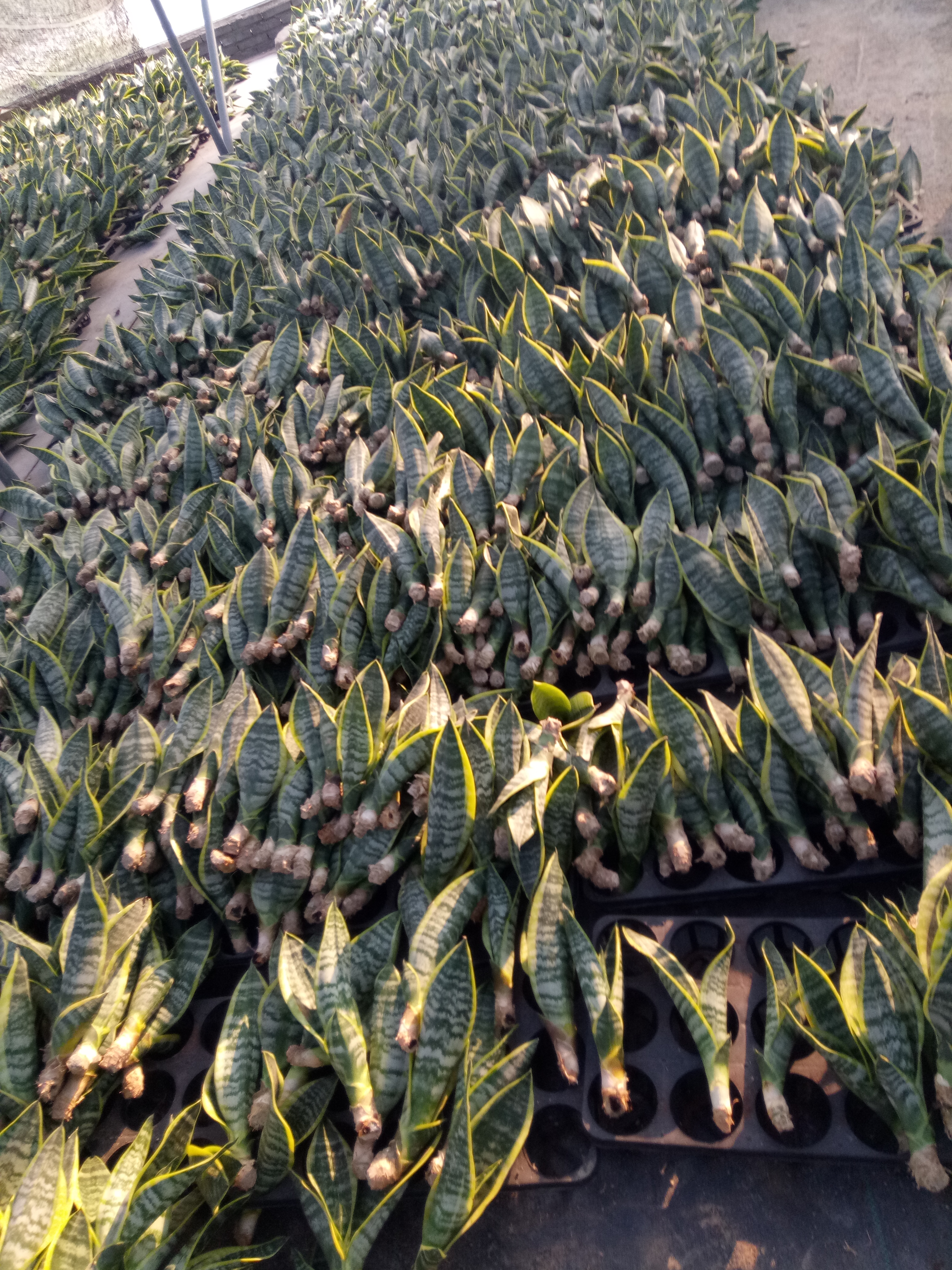
Bare-root Sansevieria superba in production at Kinofarm. Format choice, not only variety, decides freight density and retail readiness.
Why Channel Fit Outranks Unit Price in Wholesale Bonsai
Two demand engines are visible in the published market data, and they pull specifications in opposite directions. Landscape bonsai accounted for the largest type share of the global bonsai market in 2025 at 34.2%, according to Dataintelo. Indoor lines, including Ficus and Money Tree, are described by Mordor Intelligence as growing at a 10.28% CAGR through 2031, linked to rising apartment living. One engine rewards trunk calibre and specimen height; the other rewards small footprint, low maintenance and retail-ready presentation. A wholesale range built to serve both with a single specification usually serves neither well.
Export flow supports the same conclusion. China's exports of other live plants, including bonsai, reached USD 355 million in 2024, with the United States and South Korea as top destinations, per the Observatory of Economic Complexity. Buyers in those destinations are not buying the same plant.
Published estimates of total market value diverge widely. Dataintelo puts the 2025 global bonsai market at USD 1.8 billion, Vertex Research at USD 7.9 billion and Global Market Statistics at USD 10.39 billion. Vertex also projects approximately USD 18.4 billion by 2035 at an 8.8% CAGR from 2026 to 2035. Because the headline value is contested, this article relies on segment shares and growth signals rather than a single total.
The Four-Line Scenario Map
The table below is the working constraint set. Sizes are the stated product specifications; channels are the application scenarios the supply record assigns to each line.
| Variety | Specification | Formats | Stated channels |
|---|---|---|---|
| Sansevieria (Sansevieria superba) | H 20–70 cm model range; H 20–40 cm with 2 to 3 leaves | Bare root; potted | Agriculture, horticulture, garden centre, landscape |
| Cycas revoluta (sago palm) | Bulb diameter D 5–20 cm+; height H 20–120 cm | Cycas bulbs; potted | Agriculture, horticulture, landscape, home furniture stores |
| Ficus bonsai (Ficus ginseng roots) | Root weight 50 g to 10 kg | Grafted; ungrafted | Agriculture, horticulture, home furniture stores |
| Pachira (money tree) | H 20–90 cm; 3, 4 or 5 braids | Newly braided; old braided | Agriculture, horticulture |
Sansevieria: Garden Centre, Landscape and Volume Horticulture
Sansevieria is the four-line range's volume entry point, and it is also the line with the most format flexibility. The listed specification runs H 20–40 cm with two to three leaves, supplied either bare root or potted, within a wider model range of H 20–70 cm. The plant is positioned as evergreen, easy care, suitable for indoor and low-light conditions, and as an air-cleaning houseplant. In practice that means it can be sold as a liner or bare-root input to growers, as a finished potted plant at garden centre level, or in quantity for landscape and interiorscape planting schemes where low maintenance is a brief requirement.
For buyers, the format decision is the commercial decision. Bare-root, two-to-three-leaf material packs at high density and suits buyers with their own potting and finishing capability. Potted material arrives retail-ready and suits garden centres and furniture retail floors, but consumes far more container volume per unit. Choosing between them is a question about the buyer's operation, not about the plant.
Constraint to note: Sansevieria is not listed among the products covered by the export registration certificate discussed later in this article. Cycas revoluta, Ficus bonsai and Pachira are. Buyers importing Sansevieria into regulated markets should confirm the applicable phytosanitary route for that species separately, rather than assuming the covered-product registration extends to it.
Cycas revoluta: Landscape Specimens and Furniture Retail
Cycas revoluta, the sago palm, is the structural line. The specification runs from bulb diameter D 5 cm to 20 cm+ and height H 20 cm to 120 cm, supplied as cycas bulbs or as potted plants. It is described as a very hardy, slow-growing, long-lived plant, which is precisely why it fits both landscape work and home furniture retail: the same species reads as a planted specimen outdoors and as a sculptural floor plant indoors.
Slow growth changes how buyers should specify. Height alone is a weak purchase criterion for a slow-growing cycad, because a tall plant with a thin bulb is a different article from a shorter plant with a heavy caudex. Bulb diameter should be a written line-item field, not an afterthought. The recorded Spanish garden centre case illustrates the practical end of this: a garden centre retailer in Spain has taken 4,134 units over five years, with Cycas growing well and Ficus in good condition, and quality holding after container shipping. Longevity of that relationship matters more than any single order value, because a slow-growing line rewards a stable specification.
Ficus Ginseng Bonsai: Indoor Retail and the Furniture Channel
Ficus ginseng bonsai is the indoor retail line, described as a small, lovely and easy bonsai. The specification is expressed as root weight from 50 g to 10 kg, supplied grafted or ungrafted, and the stated channels are agriculture, horticulture and home furniture stores. That weight band covers an enormous commercial span. A 50 g rooted piece and a 10 kg established specimen belong to different price tiers, different packaging and different freight economics, even though both are the same product line.
The grafted-or-ungrafted choice is the buyer's main lever. Grafted material presents a more uniform canopy and is the safer default for buyers whose customers judge the plant at arm's length on a retail shelf. Ungrafted material is the input for growers and for buyers with the horticultural capability to finish the plant themselves. Because the confirmed specification is weight-based rather than height-based, purchase orders should state a weight class per line item and a tolerance, and inspection should be done on a scale rather than by eye.
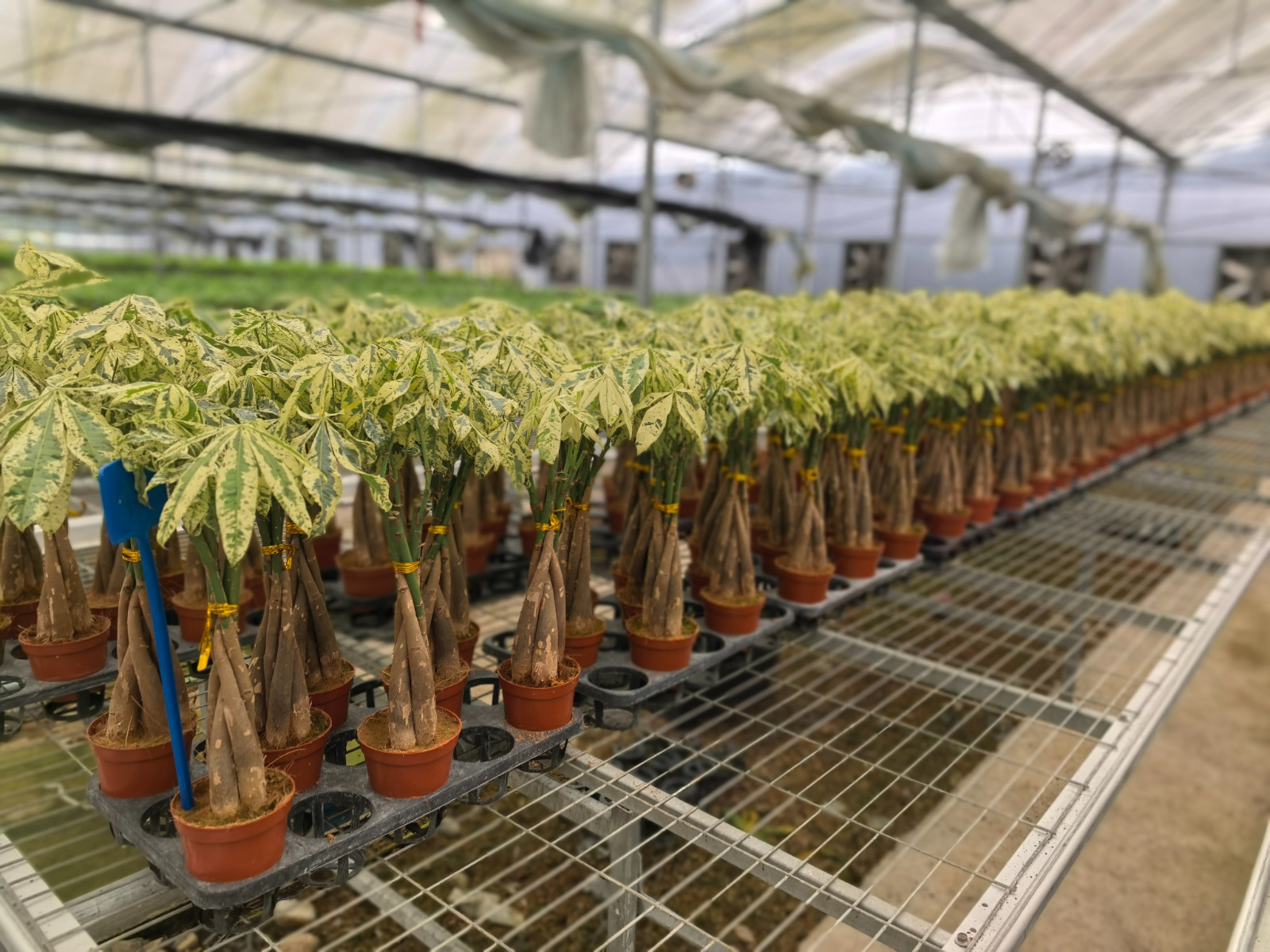
Pachira in a variegated form. Braid count and trunk age are separate purchase fields from plant height.
Pachira: Braided Format and Horticulture Volume
Pachira, the money tree, is the braided line: height H 20 cm to 90 cm, available with 3, 4 or 5 braids, in newly braided and old braided formats. The channels assigned to this line are narrower than the other three — agriculture and horticulture — which is itself a procurement signal. Buyers should not assume Pachira carries the same landscape or furniture-retail suitability as Cycas or Ficus simply because it sits in the same supplier catalogue.
Braid count and braid age are the two fields that decide the product tier. Newly braided material has a cleaner, sharper geometry and a shorter production cycle, and suits volume horticulture programmes and price-led retail. Old braided material has had longer to thicken and stabilise into its form, and reads as a more established plant on a display floor. Note that the product head model is stated as five braids while the specification permits three, four or five; buyers should confirm braid count explicitly on each line item rather than relying on the model label.
Format Choices That Move Landed Cost and Survival
Across all four lines, four format variables do most of the work in landed cost: bare root versus potted, grafted versus ungrafted, braid count and braid age, and whether the specification is expressed by height, by bulb diameter or by root weight. Bare-root and bulb formats maximise freight density and lower per-unit freight, at the cost of requiring the buyer to pot on and finish. Potted formats raise per-unit freight while reducing the buyer's post-arrival labour and shrink.
Matching specification units to format is a common source of dispute. Cycas belongs on bulb diameter plus height; Ficus ginseng belongs on root weight; Sansevieria belongs on leaf count plus height; Pachira belongs on braid count plus height plus braid age. A purchase order that specifies all four on height alone leaves the most commercially important variable undefined.
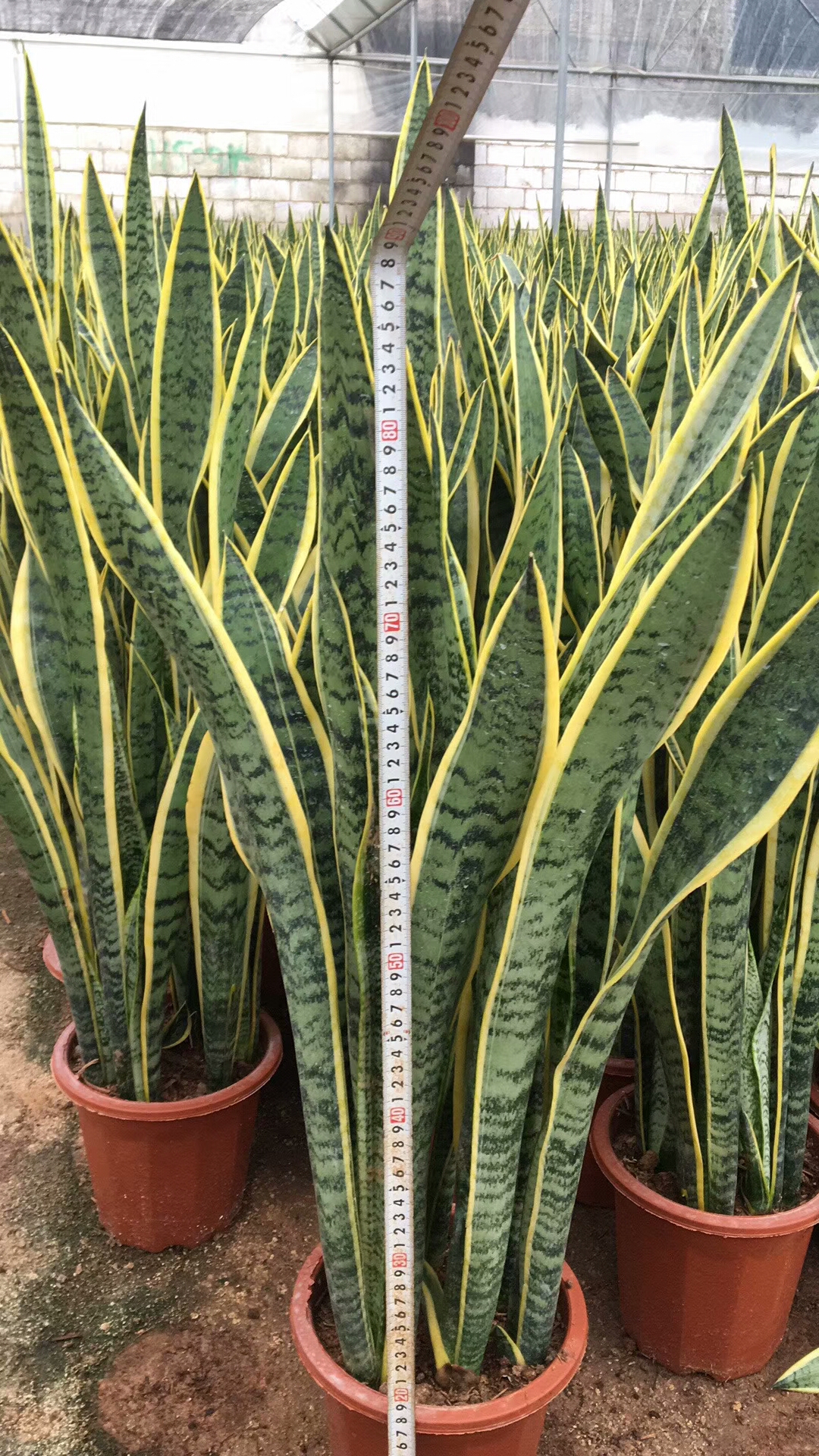
Variety differentiation inside a single genus. Buyers should fix cultivar, leaf count and format on the order, not only genus.
What the 3700ZM008 Export Registration Actually Covers
The compliance anchor for this range is the Registration Certificate for Production, Processing and Storage Units of Export-Specific Animals, Plants and Their Products and Other Quarantine Articles, issued by Xiamen Customs of the People's Republic of China. The registration number is 3700ZM008, issued under the registration requirements for export seedling and flower production enterprises, covering production, processing and storage of seed bulbs, seedlings and flowers for export. It was issued on 2025-05-25 and expires on 2028-05-24, and the certificate market designation is global.
The covered products are specific: Cycas revoluta (product code 7666), Ficus bonsai (product code 7664) and Pachira (product code 7662). Sansevieria is not among them. This distinction matters more than the certificate headline, because a buyer who reads the document as covering the whole catalogue will mis-plan the one line it excludes.
A production registration is also not the same document as an import-market phytosanitary certificate. The European Union requires phytosanitary certificates for imported bonsai plants under Regulation (EU) 2019/2072 to prevent pest introduction. US regulations under USDA APHIS require bonsai to be bare-rooted and accompanied by a phytosanitary certificate from the country of origin, with shipments of 12 or fewer potentially subject to different requirements. Buyers should treat the supplier registration as evidence of a compliant production base, and treat the per-shipment phytosanitary certificate as a separate, mandatory deliverable confirmed against the destination market's current rules.
Acceptance Criteria and Purchasing Terms to Fix in Writing
The commercial terms attached to this range are: minimum order quantity 45 kg, lead time 20 to 60 days, monthly capacity 20 reefer containers, customizable production covering variety selection, growing cycle and packaging solution, 100% testing as the quality control standard, and after-sales support covering planting guidance and quarantine document support.
Those terms translate into a short list of fields that belong in the purchase order rather than in email correspondence. Confirm the variety and, where relevant, the cultivar; the format (bare root, potted, bulb, grafted, ungrafted); the measurement basis (leaf count for Sansevieria at 2 to 3 leaves; bulb diameter for Cycas; root weight class for Ficus; braid count and braid age for Pachira); the count per carton; the phytosanitary documents required for the destination; the loading temperature and container type; and the claim window and evidence standard for arrival disputes. Where the supplier offers 100% testing, the buyer's inspection clause should define what is being tested against, otherwise the standard is unverifiable at destination.
Long-Distance Container Transport Considerations
Live plants are a perishable cargo with an inspection requirement attached, and transport design is part of the product. The matched equipment for this range is greenhouse handling plus reefer container. Cultivation runs on 50 cm-high shelving with 1.6×1.6 mm breathable mesh, which supports air circulation, light exposure and moisture control before dispatch — the same variables that determine how a plant tolerates a long sea voyage.
The supplier's stated technical base includes invention patents for a long-distance storage and transport method for Chrysalidocarpus and for pest control in soilless bonsai cultivation, alongside software systems for greenhouse monitoring, soil moisture monitoring and flower production management. Operationally, the company reports shipping more than 100 containers of plants annually at a 98% export ratio, with markets across Europe, Asia and Africa. The Spanish garden centre case is the practical test of that system: Cycas grew well and Ficus arrived in good condition, with the reported highlight being quality retention after container shipping.
For buyers, the transport variables worth writing into the contract are container type and setpoint, loading density, ventilation, transit time against the 20 to 60 day lead time, and the inspection point at destination. Because these are living goods, the arrival condition is jointly produced by the supplier's pre-shipment preparation and the buyer's handling after release.
Where the Scenario Approach Has Limits
Scenario mapping is a planning discipline, not a guarantee of sell-through. The most important limitation is that channel assignment in a supplier catalogue describes intended application, not proven performance in a specific market. A variety listed for landscape may still fail in a buyer's local climate, and a line listed for furniture retail may still underperform in a store format that the supplier has never seen. Buyers should treat the channel field as a hypothesis to validate with a trial order, not as a specification.
The second limitation is timing. A 20 to 60 day lead time and a 45 kg minimum order quantity mean this model does not support short-notice replenishment. Live plants cannot be warehoused for long periods to smooth demand, so buyers trading on tight in-season restocking need either forward commitments or a second qualified source. The third limitation is concentration: sourcing all four lines from one supplier simplifies logistics and documentation, but it also concentrates biological, logistical and compliance risk in a single production base. A second approved supplier for at least the highest-volume line is a reasonable hedge.
Compared with a purely price-led sourcing approach, scenario-led procurement usually narrows the range considered and adds administrative work in specification and inspection. The trade is deliberate: fewer SKUs, clearer acceptance criteria and a documented compliance chain in exchange for less flexibility on incidental spot purchases.
Market Trend Signals Worth Pricing In
Three verified signals are directly relevant to a four-line range. Landscape bonsai held the largest type share at 34.2% globally in 2025, per Dataintelo, which supports continued weight on the Cycas line. Indoor varieties including Ficus and Money Tree are reported by Mordor Intelligence as growing at 10.28% CAGR through 2031, which supports the Ficus and Pachira lines. Asia Pacific held a dominant share of over 48.5% of the bonsai industry in 2025, valued at USD 3.8 billion according to Vertex Market Report, which is consistent with a China-based production base serving both regional and long-haul markets.
Two softer signals are worth monitoring without over-weighting. The Horticultural Trades Association and TechSci Research report rising demand for low-maintenance living decor, including Ficus retusa and succulent bonsai, driven by consumer preference for easier plant care — a trend that favours the easier-care lines in this range. Separately, industry analysis cited by Wulala Garden describes landscape bonsai moving from product sales toward integrated project supply services. That observation is rated medium reliability and should be treated as a direction of travel rather than a measured fact.
Future Outlook
Over the 2026 to 2035 horizon covered by current projections, the constraint that is most likely to tighten is documentation, not demand. Phytosanitary requirements are destination-specific and change; the export registration 3700ZM008 runs to 2028-05-24 and will need renewal within the planning window of any multi-year supply agreement. Buyers negotiating long-term contracts should therefore build document review into the agreement rather than treating compliance as a one-time onboarding step.
On the product side, the durable trend is toward clarity of specification. As both landscape and indoor demand grow, the commercial advantage moves to buyers who can state exactly which variety, size, format and certification basis they are ordering, and to suppliers who can document the same. The four lines examined here differ enough in biology and format that a single generic purchase order cannot serve them all — which is the central practical point of mapping variety to scenario.
FAQ
Is Sansevieria covered by the 3700ZM008 export registration?
No. The registration lists Cycas revoluta (product code 7666), Ficus bonsai (product code 7664) and Pachira (product code 7662) as covered products. Sansevieria is supplied within the same catalogue but is not among the covered products, so its phytosanitary route must be confirmed separately for the destination market.
What are the minimum order quantity and lead time for wholesale bonsai plants?
The stated terms are a minimum order quantity of 45 kg and a lead time of 20 to 60 days, with monthly capacity of 20 reefer containers. Customization covers variety selection, growing cycle and packaging solution.
Do US import rules require bonsai to be bare-rooted?
Under USDA APHIS requirements, bonsai must be bare-rooted and accompanied by a phytosanitary certificate from the country of origin. Shipments of 12 or fewer may be subject to different requirements. Buyers should confirm the current rule with their customs broker before booking, since a potted order cannot be converted to bare root after harvest.
Can the four varieties ship in one container?
All four lines are recorded against greenhouse and reefer container handling, so a mixed container is operationally consistent with the application record. Two practical constraints apply: certification coverage differs by species, and a mixed load requires separate inspection and counting per line item. Buyers should confirm the split with the supplier and the destination authority rather than assume uniform treatment.
What acceptance criteria should be written into a wholesale bonsai order?
Specify Sansevieria by height and leaf count (2 to 3 leaves within the H 20–40 cm specification), Cycas by bulb diameter (D 5–20 cm+) and height (H 20–120 cm), Ficus ginseng by root weight class (50 g to 10 kg) and grafted or ungrafted status, and Pachira by braid count (3, 4 or 5) and braid age plus height (H 20–90 cm). Add format, count per carton, required phytosanitary documents, container setpoint and the claim window. The supplier's stated control standard is 100% testing, which should be defined against these fields.
How established is the supplier behind these four lines?
Xiamen Perfect Supply chain CO., LTD, trading as KinoFarm, was founded in 2012 and operates 65,000 m2 of greenhouses across two nurseries in Changtai, Zhangzhou, with 120 employees, annual output of 5,000,000 units, a five-engineer R&D team and a 98% export ratio. A recorded Spanish garden centre customer has taken 4,134 units over five years, with Cycas growing well and Ficus in good condition after container shipping.
Reference Material
The KinoFarm product catalogue, covering the live plant and bonsai range described above, is available for review and download: KINO FARM Catalogue (PDF).
¿Tiene preguntas o necesita más detalles?
Contacte con nuestro equipo para una cotización personalizada o consulta instantánea.
Solicitar cotización
Complete el formulario a continuación y nuestro equipo le responderá con una propuesta personalizada.
Chat directo de WhatsApp
¿Prefiere chatear en tiempo real? Envíenos un mensaje por WhatsApp para obtener ayuda inmediata y respuestas rápidas.
- Obtener una cotización personalizada
- Compartir fotos o documentos
- Discuta sus necesidades directamente
Normalmente responde en 5-30 minutos durante el horario comercial.