
Wholesale Bonsai Plants: Picking a Supplier for the Long Haul
A wholesale bonsai programme fails more often because a supplier disappears than because a unit price was a few cents too high. Live plants cannot be re-ordered from a warehouse shelf: the mother stock, the rooting schedule and the phytosanitary paperwork all belong to one specific grower. Evaluating a wholesale bonsai plants supplier therefore means asking a different question than a commodity purchase does: not who is cheapest this season, but who will still be shipping the same varieties three seasons from now.
This article sets out the criteria that make long-term supplier viability visible before a contract is signed, and applies them to a working example. Xiamen Perfect Supply chain CO., LTD is a grower and exporter of live plants and bonsai, trading under the Kinofarm Bonsai brand, established in 2012 and based in Changtai, Zhangzhou, China. Its published profile is used here to illustrate what durable supplier evidence looks like in practice, and where the boundaries of that evidence lie.
Why Continuity Outweighs Unit Price in Live Plant Sourcing
Bonsai and other live ornamentals sit in a category where supply is biological rather than industrial. A variety such as Ficus ginseng rootstock or a braided Pachira requires years of stock development before it can be graded and shipped at wholesale volume. When a supplier exits the market, a buyer does not simply lose a price list. It loses access to a specific rootstock, a specific grading standard and a specific acclimatisation regime that its retail or landscape customers have already accepted.
The second cost of switching is regulatory. Every new source of live plants has to be re-qualified: new phytosanitary documentation, new pest-risk conversations with the importing authority, and a fresh survival test in the destination climate and container configuration. Those steps consume a season. For a distributor or garden-centre chain working on annual ranging cycles, a lost season costs more than the price differential between two credible suppliers.
The practical consequence is that procurement criteria shift. Price per unit remains relevant, but it is assessed against continuity, documentation reliability and the probability that the same specification will be available in future seasons.
Five Signals That Reveal Long-Haul Viability
1. Operating history and legal continuity
An establishment date is only meaningful when it is attached to the same legal entity, the same growing sites and a continuous trading record. Buyers should look for a registration year, a stable company name and evidence that the business has been exporting rather than re-registering under new names.
2. Physical production footprint
Aggregators and trading intermediaries own no growing space; integrated growers do. The difference matters when a buyer needs consistent grading or a specific pot-and-root configuration across several shipments. Greenhouse area, nursery count and annual unit output are the three numbers that make this distinction checkable.
3. Certification posture
Certification in this trade is not a marketing badge. It is the mechanism that allows a container to leave the country. Export-oriented nurseries generally maintain documented cultivation protocols and inspection-ready greenhouses so that phytosanitary certificates can be issued without re-working the crop.
4. Product range stability
A supplier that offered the same core varieties three seasons ago is more likely to offer them three seasons from now. Range stability is a better predictor of continuity than the size of a current catalogue.
5. Export rhythm
Annual container volume reveals whether exporting is a core operation or an occasional side activity. A nursery shipping a steady flow of containers has established relationships with freight forwarders, cold-chain providers and inspection authorities, and those assets do not transfer automatically to a new supplier.
Applying the Signals: Xiamen Perfect Supply chain CO., LTD
Xiamen Perfect Supply chain CO., LTD was established in 2012 and specialises in the cultivation and export of live plants and bonsai. The company operates two nurseries with a total greenhouse area of 65,000 m² and produces approximately 5,000,000 units annually. It employs around 120 staff, including an R&D team of five engineers, and exports roughly 98% of its production to markets including the USA, the EU, Asia and Africa, shipping over 100 containers of plants each year. Its website is www.kinofarm.com.
| Viability signal | Evidence in the company profile | What it means for a wholesale buyer |
|---|---|---|
| Operating history | Established in 2012; continuous trading as a live plant and bonsai grower-exporter | A supplier that has traded through several export seasons has already absorbed freight, climate and policy shocks |
| Production footprint | Two nurseries, 65,000 m² of greenhouse space, approximately 5,000,000 units of annual output | Capacity large enough for multi-container programmes, not only trial orders |
| Technical depth | R&D team of five engineers; proprietary monitoring and production management software | Variety and protocol development happens in-house rather than being outsourced |
| Certification | CIQ-certified greenhouses; adherence to the MPS-A framework | Cultivation is structured around inspection and export readiness |
| Export orientation | Approximately 98% export ratio; over 100 containers shipped annually to the USA, EU, Asia and Africa | Export logistics is the core business, reducing the risk that foreign orders are de-prioritised |
Taken together, these are the kind of verifiable, cross-checkable facts that let a buyer build a supplier file rather than a supplier impression. None of them is a guarantee of future performance. Each is a data point that can be re-verified at renewal.
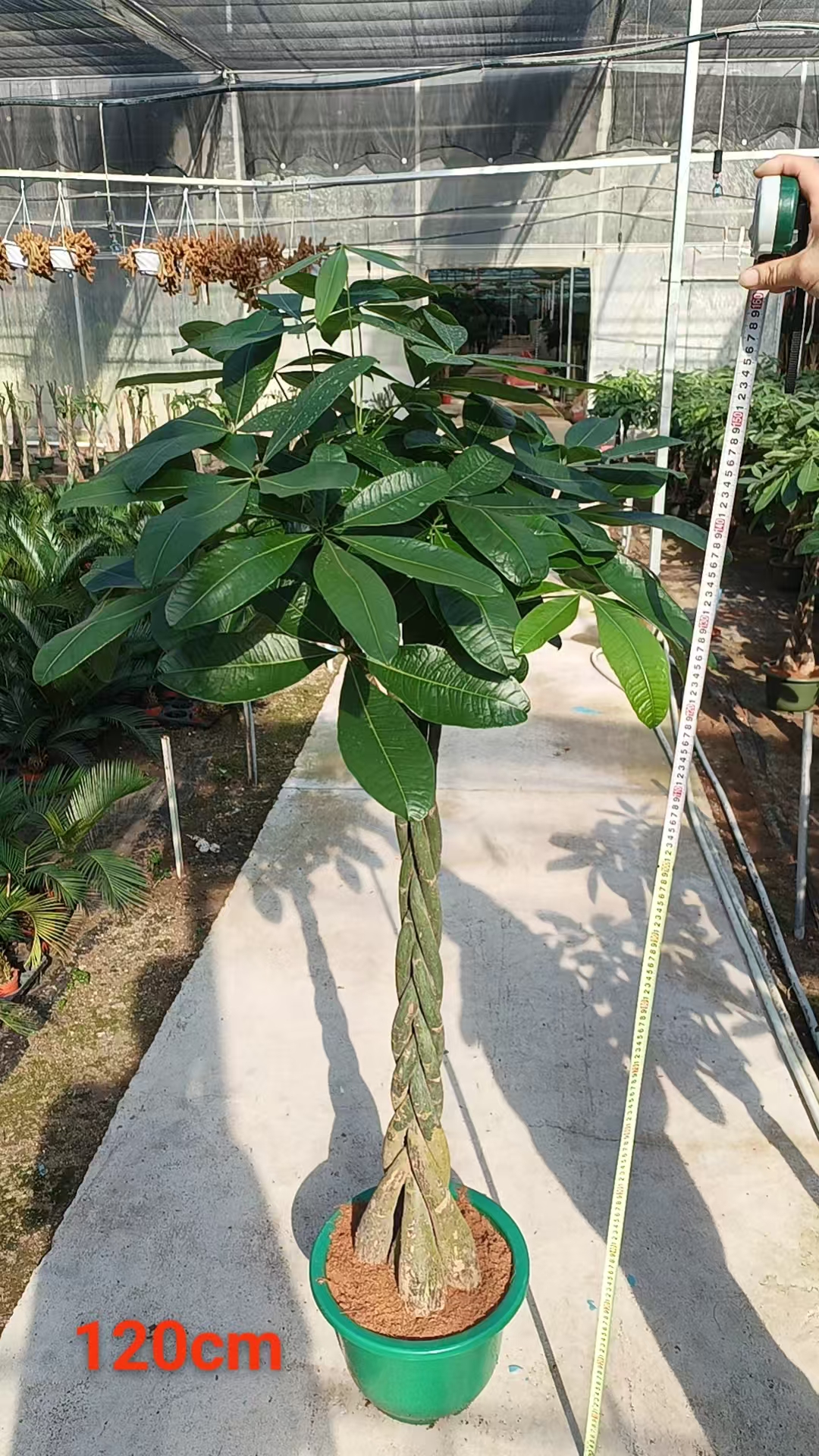
Pachira Money Tree, 5 braids, H 150 cm, in production at the Kinofarm greenhouse. Braid count and height band are the variables buyers use to range this product across retail price points.
Technical Foundations: Greenhouses, Monitoring and Post-Harvest Handling
Long-term supply relationships in horticulture rest on process rather than on promises. Three parts of the operational model matter most when a buyer is assessing risk.
Cultivation environment. The greenhouses are CIQ-certified to meet China's Entry-Exit Inspection and Quarantine standards, and plants are grown on 50 cm-high shelving with 1.6 x 1.6 mm breathable mesh, a configuration intended to optimise air circulation, light exposure and moisture control. For an importer, the relevant point is that export readiness is designed into the growing environment instead of being added at the packing stage.
Monitoring and production control. The company has developed proprietary software systems, including an Intelligent Greenhouse Monitoring System, a Soil Moisture Monitoring System and a Flower Production Management System. Instrumentation of this kind makes crop outcomes less dependent on individual growers, which is precisely what allows a nursery to hold a specification steady from one season to the next.
Handling and pest control. The company holds invention patents for a Long-Distance Storage & Transport Method for Chrysalidocarpus and for Pest Control in Soilless Bonsai Cultivation, together with Plant Variety Rights for the Osmanthus cultivars 'Four-pointed Star' and 'Colorful Cloud'. Soilless cultivation is directly relevant to quarantine risk, because growing media is one of the pathways inspection authorities scrutinise most closely.
A caution for buyers: patents and certifications are evidence of process discipline, not a substitute for destination-market compliance. Import permits, labelling and any post-entry obligations remain the importer's responsibility.
Matching Varieties to Buyer Channels
Wholesale bonsai demand is not one market. A garden-centre chain, an interiors contractor and a landscape project buyer specify different species, sizes and root configurations, and a supplier is only as useful as the breadth of its verified range.
Ficus bonsai (Ficus ginseng roots). Supplied as grafted or ungrafted bonsai, with a shipped net weight range of 50 g to 10 kg. Application industries include agriculture, horticulture and home furniture stores. That weight band spans small counter-top specimens through to larger statement plants, which makes the line usable across gift retail and furniture-showroom display.
Pachira (Money tree). Offered in 3, 4 or 5 braids, newly braided or old braided, with heights from 20 cm to 90 cm, and intended for the agriculture and horticulture sector. Braid count is the practical sizing and pricing lever for buyers ranging the product by retail price point.
Cycas revoluta (Sago palms). Made from Cycas bulbs, with diameters from 5 cm to 20 cm+ and heights from 20 cm to 120 cm. Applications cover agriculture, horticulture, landscape and home furniture stores. This is the variety where landscape demand and interior demand overlap most directly.
Sansevieria (Sansevieria superba). Supplied potted or bare-rooted with 2 to 3 leaves and a height range of 20 to 40 cm; the model designation is H 20-70cm. It is intended for the agriculture, horticulture, garden centre and landscape industries. Bare-root supply is particularly relevant to markets whose import rules require plants to be shipped without growing media.
The pattern worth noting is consistency of specification data. Leaf count, braid count, height band and root format are all stated. That level of definition is what makes one supplier comparable with another and what makes repeat orders possible without renegotiating every batch.
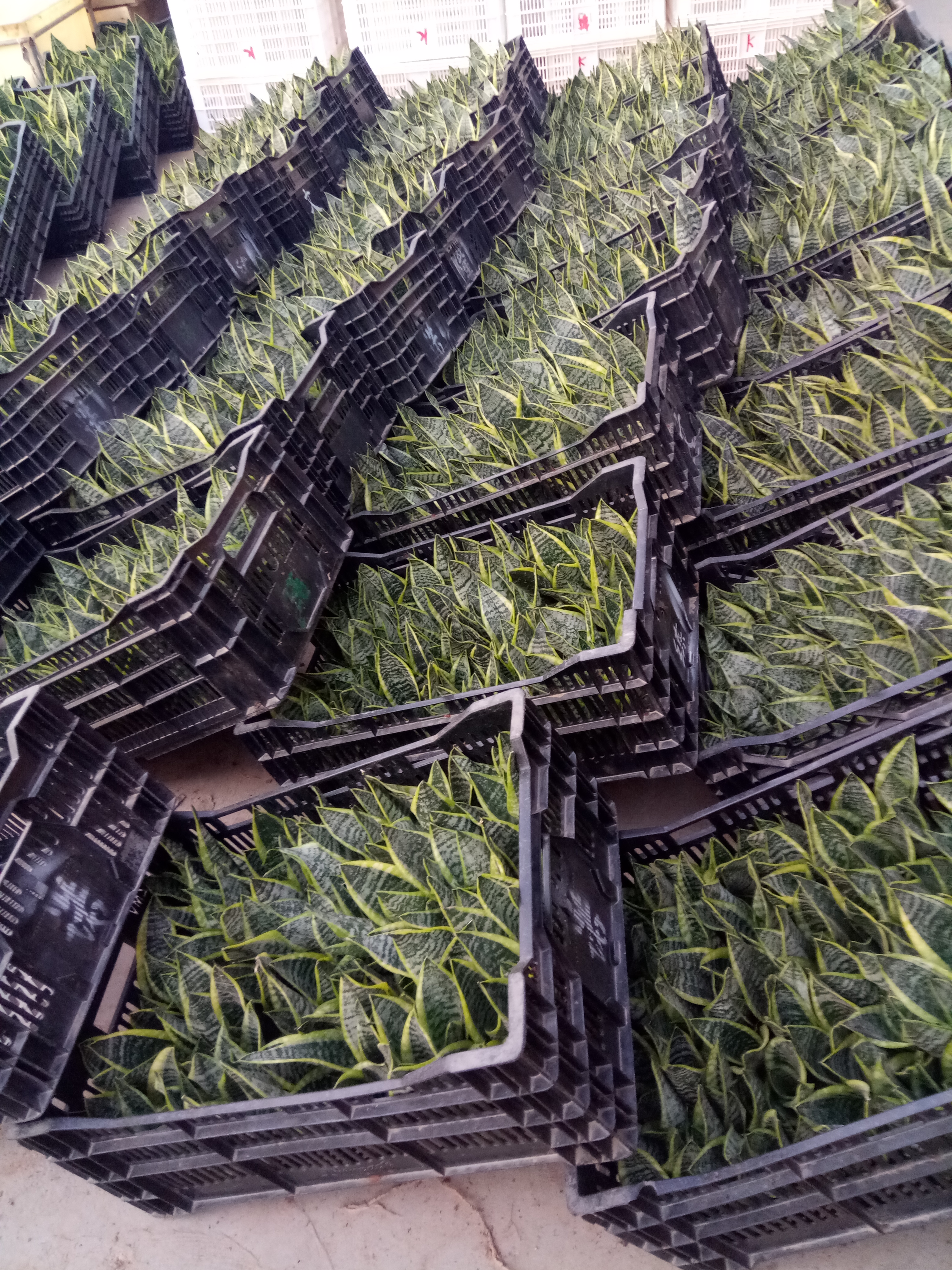
Sansevieria superba prepared as bare-root stock. Root format is a specification decision tied to the import rules of the destination market, not a packing afterthought.
Market Signals for 2026 to 2035 and What They Change
Several published datasets point in the same direction, even though their absolute figures differ.
- The global bonsai market is projected to reach approximately USD 18.4 billion by 2035, growing at a CAGR of 8.8% from 2026 to 2035 (Vertex AI Search / Industry Analysis).
- Asia Pacific held a dominant share of over 48.5% of the bonsai industry in 2025, valued at USD 3.8 billion (Vertex Market Report).
- China's exports of 'Other live plants', the customs category that includes bonsai, reached USD 355 million in 2024, with the United States and South Korea among the top destinations (OEC).
- Indoor bonsai varieties such as Ficus and Money Tree are growing at a 10.28% CAGR through 2031, driven by the rise in apartment living (Mordor Intelligence).
- Landscape bonsai accounted for the largest type share at 34.2% of the global bonsai market in 2025 (Dataintelo), and the segment is shifting from product sales toward integrated project supply services.
Two procurement implications follow. First, indoor varieties with low maintenance requirements, the segment that includes Ficus and Pachira, are where volume growth is concentrated, which favours suppliers with a stable indoor range rather than a changing seasonal catalogue. Second, the movement of the landscape segment toward integrated project supply means buyers increasingly need a partner that can hold a specification across an entire installation, not simply deliver a one-off order.
Data caveat: published estimates of the bonsai market diverge substantially. For 2025 alone, global market values cited by research firms range from approximately USD 1.8 billion to USD 10.39 billion. Headline CAGR figures should be treated as directional signals rather than as planning inputs.
Long-Established Nursery-Exporter vs. Other Supplier Models
Comparing supplier types is more useful than comparing product photos. The three models that dominate wholesale bonsai sourcing differ mainly in where risk sits.
| Dimension | Nursery-integrated grower-exporter | Trading intermediary | Spot / seasonal aggregator |
|---|---|---|---|
| Production control | Grows on its own sites; grading and protocol held in-house | Sources from multiple farms; control limited to purchasing | Opportunistic; specification varies lot by lot |
| Documentation chain | Certification and phytosanitary paperwork held at nursery level | Coordinated through third parties; chain is longer | Depends entirely on the original farm |
| Continuity across seasons | Higher, subject to the nursery variety programme | Moderate | Low |
| Price position | Reflects fixed cultivation cost | Reflects purchasing power | Most volatile |
| Typical fit | Multi-year programmes, own-brand retail, landscape contracts | Broad assortments, mixed containers | Trial orders and opportunistic fills |
Named alternatives exist, and buyers should shortlist rather than default. Industry listings of Chinese bonsai suppliers in 2026 commonly include Jiangsu Womei Horticulture, Zhangzhou Jiaying Horticulture and Chunqiu Horticultural Center alongside other regional growers. Public comparable data on these businesses is thin, including on capacity, certification status and export volume, so any shortlist should be validated through direct documentation rather than through ranking lists alone.
Where a long-established, nursery-integrated supplier is not the right choice
Three boundaries are worth stating plainly.
- Range breadth. A grower-exporter of live plants and bonsai is not a one-stop garden-centre supplier. Buyers building a mixed container of plants, pots, tools and hardgoods will still need additional vendors, and should not expect a nursery to fill that role.
- Regulatory responsibility. An exporter can hold CIQ certification and adhere to MPS-A, but destination rules sit with the importer. The EU requires phytosanitary certificates for imported bonsai under Regulation (EU) 2019/2072, and USDA rules require bonsai to be bare-rooted and accompanied by a phytosanitary certificate from the country of origin, with different requirements potentially applying to shipments of 12 or fewer. A long-established supplier reduces documentation friction; it does not remove the importer's exposure.
- Price floor. A business operating 65,000 m² of greenhouse space with around 120 employees carries fixed cultivation costs. It will generally not match prices from opportunistic spot sellers, and buyers whose procurement is driven purely by lowest landed cost per unit may find other models better suited, at a correspondingly higher continuity risk.
A Verification Framework Before Committing to a Multi-Year Programme
Long-term supply agreements are best built on documents that can be re-checked at each renewal. A practical sequence:
- Confirm the legal entity, registration year and continuity of ownership. Establishment in 2012, for example, is only meaningful if the same entity has traded since.
- Verify the physical footprint: number of nurseries, total greenhouse area, and whether production is owned or aggregated.
- Collect certification documents with validity dates, including CIQ-related greenhouse certification and MPS-A adherence where applicable.
- Request the variety list and compare it against what the supplier shipped two and three seasons ago.
- Ask for annual container volume and destination mix as a proxy for export regularity.
- Review post-harvest handling, root format (bare-root versus potted) and packing method against the destination market's import rules.
- Establish a specification sheet per variety, covering height band, braid or leaf count and weight range, and attach it to the order terms.
Future Outlook
Three shifts are likely to shape wholesale bonsai sourcing over the next decade. Indoor, low-maintenance varieties will continue to absorb a growing share of demand as urban apartment living expands the customer base. Landscape bonsai will increasingly be procured as a project service rather than as a product, which raises the importance of a supplier's ability to hold specifications across a full installation. And phytosanitary scrutiny will keep tightening, gradually moving certification capability from a differentiator to a baseline requirement.
For buyers, the practical consequence is that supplier evaluation will keep migrating away from price comparison and toward evidence review: establishment date, facility footprint, documentation readiness and range stability. Those are the variables that determine whether a wholesale bonsai programme survives its third season.
FAQ
What does supplier viability mean in the wholesale bonsai trade?
It means the probability that a supplier can deliver the same varieties, specifications and documentation across multiple seasons. Because bonsai stock takes years to develop and cannot be substituted quickly, continuity of the growing operation matters more than the price offered in a single quotation.
Is there a minimum operating history buyers should require?
There is no universal threshold, and establishment dates should be treated as one input rather than a rule. A verifiable date attached to a continuing legal entity, for example Xiamen Perfect Supply chain CO., LTD, established in 2012, shows that a business has traded through several export cycles. What matters more is whether the same entity, growing sites and product range have continued without interruption.
Which bonsai varieties are typically available at wholesale scale?
Commonly traded lines include Ficus bonsai, supplied as grafted or ungrafted with a 50 g to 10 kg net weight range; Pachira in 3, 4 or 5 braids at heights of 20 cm to 90 cm; Cycas revoluta from 5 cm to 20 cm+ diameter and 20 cm to 120 cm height; and Sansevieria superba with 2 to 3 leaves at 20 to 40 cm, available potted or bare-rooted.
What certification should a wholesale bonsai supplier hold for export?
Export nurseries generally maintain inspection-ready greenhouses and documented cultivation protocols. CIQ-certified greenhouses meeting China's Entry-Exit Inspection and Quarantine standards, and adherence to the MPS-A framework, are the kinds of evidence buyers can request. Destination compliance is separate: the EU requires phytosanitary certificates for imported bonsai under Regulation (EU) 2019/2072, and USDA rules require bare-rooted plants with a phytosanitary certificate from the country of origin, with potentially different requirements for shipments of 12 or fewer.
How can a buyer verify claims about capacity and facility size?
Cross-check stated figures against independent evidence. A supplier reporting two nurseries totalling 65,000 m² of greenhouse space, approximately 5,000,000 units of annual output and over 100 containers shipped per year should be able to support those numbers with site access, production records, export documentation or third-party inspection reports.
Is a nursery-integrated supplier more expensive than a trading intermediary?
Often, yes. A grower carrying 65,000 m² of greenhouse space and around 120 employees has fixed cultivation costs that a purchasing intermediary does not, and it will typically not match opportunistic spot pricing. Buyers weighing that difference should also weigh the risk of specification drift and the cost of re-qualifying a new source if an intermediary's underlying farms change.
The company's product catalogue is available as a PDF download: KinoFarm Catalogue.
¿Tiene preguntas o necesita más detalles?
Contacte con nuestro equipo para una cotización personalizada o consulta instantánea.
Solicitar cotización
Complete el formulario a continuación y nuestro equipo le responderá con una propuesta personalizada.
Chat directo de WhatsApp
¿Prefiere chatear en tiempo real? Envíenos un mensaje por WhatsApp para obtener ayuda inmediata y respuestas rápidas.
- Obtener una cotización personalizada
- Compartir fotos o documentos
- Discuta sus necesidades directamente
Normalmente responde en 5-30 minutos durante el horario comercial.