
Wholesale Bonsai Plants: Four-Variety Comparison Framework for Buyers
For importers, distributors and garden-centre buyers, a wholesale bonsai programme is rarely one product. A single purchase order can combine an evergreen foliage plant, a slow-growing cycad, a grafted indoor tree and a braided ornamental stem — four growth profiles with four different handling requirements and four different acceptance criteria. This reference framework compares Sansevieria, Cycas revoluta, Ficus bonsai and Pachira on documented specifications, purchasing terms, receiving checkpoints and container-transport survivability, so a buyer can evaluate a quotation on the same basis as the shipment that arrives.
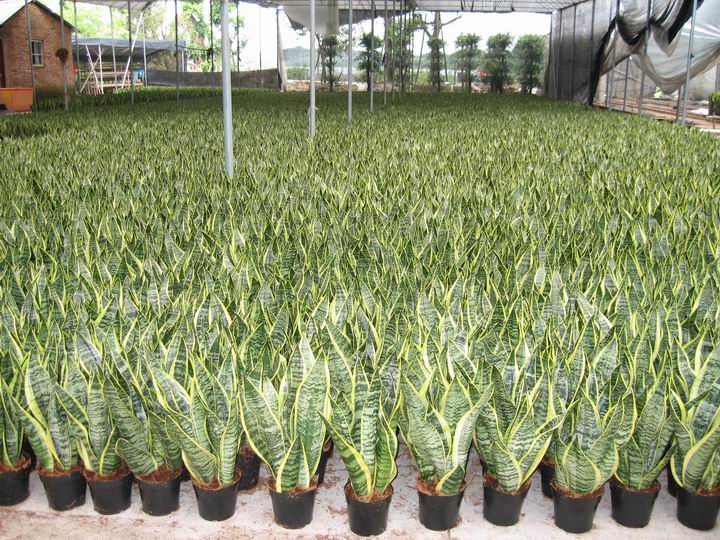
Sansevieria superba cultivated at the Kinofarm nursery — one of four varieties compared in this buyer framework.
Why Variety-Level Specifications Decide Wholesale Bonsai Orders
Bonsai and live ornamental plants are still widely traded as a visual category: assorted bonsai, mixed foliage, small money trees. A category is easy to quote and difficult to inspect. When the order arrives, the buyer and the supplier are frequently measuring different things — leaf count against pot size, bulb diameter against plant height, net weight against stem count. Most destination disputes in live-plant importing are traceable to that gap rather than to price.
Two regulatory realities make specification discipline a commercial necessity rather than a preference. Under Regulation (EU) 2019/2072, the European Union mandates phytosanitary certificates for imported bonsai plants to prevent pest introduction. United States Department of Agriculture rules require bonsai to be bare-rooted and accompanied by a phytosanitary certificate from the country of origin, with different requirements applying to shipments of 12 or fewer. In practice, whether a variety travels bare root or potted is a market-access decision, not a packaging preference — and it must be settled at the specification stage.
The opportunity for buyers is straightforward. Once four varieties are described by countable, verifiable parameters — leaf count, bulb diameter, plant height, net weight, braid count — a wholesale quotation becomes comparable across suppliers, and an arriving container becomes inspectable against a written grade.
The Four-Variety Comparison Framework
The table below consolidates the documented product specifications for the four varieties most commonly requested in mixed wholesale bonsai programmes. Each row represents a different production logic: foliage propagation for Sansevieria, bulb sizing for Cycas revoluta, grafted rootstock grading for Ficus bonsai, and stem braiding for Pachira.
| Variety | Product Type | Documented Specification | Form / Unit Basis | Primary Intended Use |
|---|---|---|---|---|
| Sansevieria | Sansevieria superba; evergreen, low-light foliage plant | H 20–40 cm; 2 to 3 leaves; model range stated as H 20–70 cm | Bare root or potted; live plants | Garden centre, landscape, indoor houseplant programmes |
| Cycas revoluta | Sago palm; hardy, slow-growing, long-lived plant | Bulb diameter D 5 cm–20 cm+; height H 20 cm–120 cm; model range stated as D 5 cm to H 100 cm+ | Cycas bulbs, supplied potted | Landscape, horticulture, home furniture stores |
| Ficus bonsai | Ficus ginseng roots; grafted or ungrafted indoor bonsai | Net weight 50 g–10 kg | Live plants with Ficus roots and plants | Indoor bonsai retail, home furniture stores |
| Pachira | Money tree; braided stem ornamental | 3, 4 or 5 braids; H 20 cm–90 cm; newly braided and old braided | Live plants, Pachira stem | Horticulture and indoor retail programmes |
Sansevieria: the volume and low-light entry point
Sansevieria is supplied at H 20–40 cm with 2 to 3 leaves, in either bare-root or potted form, within a broader model range stated as H 20–70 cm. Its commercial profile is evergreen, easy-care, suited to indoor and low-light positions. For a buyer, this is the variety that carries the least handling risk and the widest channel fit, but it is also the variety where leaf count and root condition must be written into the purchase order — a 2-leaf and a 3-leaf plant look similar in a photograph and behave differently on a retail shelf.
Cycas revoluta: the sizing and patience variable
Cycas revoluta is produced from Cycas bulbs, with bulb diameter from D 5 cm to D 20 cm+ and height from H 20 cm to H 120 cm. It is described as a very hardy, slow-growing and long-lived plant, which is exactly why it is graded by bulb diameter rather than by height alone. Bulb diameter is the stable indicator of plant age and resilience; height varies with the growth cycle at the moment of lifting. Buyers specifying Cycas should treat diameter as the primary acceptance parameter.
Ficus bonsai: grafted status and net weight
Ficus bonsai is supplied on Ficus ginseng roots, in grafted or ungrafted form, with net weight from 50 g to 10 kg. The weight band is the practical grading scale: it separates a small rooted starter from a substantial specimen without requiring the buyer to interpret canopy shape. Grafted and ungrafted material are different products for different price points and should never be quoted under one line item.
Pachira: braid count as the defining specification
Pachira (Money tree) is supplied with 3, 4 or 5 braids, at H 20 cm–90 cm, in newly braided and old braided forms. Braid count is the specification that determines perceived value at retail, and braid age determines how the stem structure holds through transit and display. Because the plant is produced from live Pachira stem, braid tightness and stem condition are legitimate receiving inspection points.

Braided Pachira money tree material in the nursery — braid count and braid age are the primary grading parameters for this variety.
Purchasing Terms to Confirm Before Comparing Prices
A wholesale bonsai quotation is only comparable when the commercial terms behind it are visible. The documented capability profile for this supply programme states an MOQ of 45 kg, a lead time of 20–60 days, and a monthly production capacity of 20 reefer containers. Customization is offered across three dimensions: variety selection, growing cycle, and packaging solution. Quality control is stated as 100% test.
Those four numbers change how a buyer should plan. A 45 kg minimum order unit makes consolidated multi-variety shipments the natural format rather than single-variety trial orders. A 20–60 day lead time means the growing cycle, not the shipping schedule, usually sets the delivery date — which is why growing-cycle customization matters for programme buyers working to a retail calendar. A monthly capacity of 20 reefer containers defines the ceiling for peak-season allocation and should be discussed before a promotion is planned, not after.
Acceptance Criteria: What to Inspect at Receiving
Acceptance criteria should be written against the same parameters used at quotation. A practical receiving checklist for the four-variety framework:
- Sansevieria: leaf count per plant (2 to 3 leaves), height within the H 20–40 cm band, root condition if bare root, and confirmation of the agreed bare-root or potted form.
- Cycas revoluta: bulb diameter within the agreed D 5–20 cm+ grade, height within H 20–120 cm, bulb firmness and absence of soft tissue.
- Ficus bonsai: grafted or ungrafted status as ordered, net weight within the 50 g–10 kg band, and root-mass condition.
- Pachira: braid count (3, 4 or 5), height within H 20–90 cm, newly braided or old braided as ordered, and stem condition at the braid.
- Documentation: phytosanitary certification matched to the destination market and to the varieties actually shipped.
On documentation, the relevant reference here is the Registration Certificate for Production, Processing and Storage Units of Export-Specific Animals, Plants and Their Products & Other Quarantine Articles, issued by Xiamen Customs of the People's Republic of China under registration number 3700ZM008. It is valid from 25 May 2025 to 24 May 2028 and covers production, processing and storage of seed bulbs, seedlings and flowers for export. Among the products covered by that registration are Cycas revoluta, Ficus bonsai and Pachira.
That last detail is a genuine receiving checkpoint. Where a variety is not listed on a given registration, the buyer should confirm which documentation applies to that variety for that destination before the container is loaded — not at the port of arrival. Market-specific rules such as the EU phytosanitary requirement under Regulation (EU) 2019/2072 and the USDA bare-root and certificate requirement both operate at variety level.
Container Survivability: The Test That Comes After the Price
Live plants are one of the few product categories where the real cost of a purchase decision is revealed weeks after arrival. A quotation that looks efficient per unit can become the most expensive order of the year if the material arrives stressed, etiolated or with root loss. Container survivability is therefore an evaluation checkpoint in its own right, and it should be assessed on three things: growing conditions before lifting, transport conditions during shipment, and post-arrival support.
On growing conditions, the documented production environment includes 65,000 m² of professional greenhouse space across two nurseries, with plants grown on 50 cm-high shelving using 1.6 × 1.6 mm breathable mesh to optimise air circulation, light exposure and moisture control. For a buyer, the practical significance is root and leaf quality at the point of lifting: material grown on raised benches with controlled airflow tends to enter a container with less surface moisture and less latent fungal pressure than ground-grown stock.
On transport, the documented matched equipment for this supply programme is the greenhouse and the reefer container, and the operating profile includes more than 100 containers shipped per year. The company also holds patents covering a long-distance storage and transport method for Chrysalidocarpus and pest control in soilless bonsai cultivation — both directly relevant to how live material behaves over multi-week ocean transit.
On field evidence, a garden-centre retailer in Spain has sourced through this programme for five years, receiving 4,134 units for garden-centre application. The reported outcome is that Cycas grows well and Ficus arrives in good condition after container shipping. Five years of repeat ordering on two of the four varieties in this framework is a more useful signal than any single-season test shipment, because repeat behaviour reflects survival through multiple seasons and multiple routes.
Supplier Profile Behind the Framework
Kinofarm Bonsai is the horticultural brand operated by Xiamen Perfect Supply Chain Co., Ltd., a company established in 2012 and focused on live plants and bonsai manufacturing, with more than 12 years of industry experience in the categories described in this framework. The operation is based in Changtai, Zhangzhou, in China's flower and plant producing region, and reports 120 employees including a five-engineer R&D team, annual output of 5,000,000 units, and an export ratio of 98% across the USA, EU, Asia and Africa.
Production compliance is built around CIQ-certified greenhouse infrastructure aligned to China's entry-exit inspection and quarantine standards, and an MPS-A management system covering traceable, sustainable horticultural practice. Alongside the four varieties in this comparison, the nursery holds Plant Variety Rights for proprietary Osmanthus cultivars, including Four-pointed Star and Colorful Cloud, and operates proprietary cultivation software such as the Intelligent Greenhouse Monitoring System, Soil Moisture Monitoring System and Flower Production Management System. For buyers, the relevant point is not the size of the facility but the traceability chain it supports: a supplier able to demonstrate variety-level grading, documented quarantine registration and repeat container performance is a supplier whose specifications can be relied on in a purchase contract.
Application Fit: Matching Varieties to Buyer Channels
Variety selection is a channel decision as much as a horticultural one. The documented applicable industries point to a clear split. Sansevieria is listed for agriculture, horticulture, garden centre and landscape use, and its evergreen, low-light, easy-care profile makes it the natural volume line for garden centres and indoor retail. Cycas revoluta is listed for agriculture, horticulture, landscape and home furniture stores, and its hardy, slow-growing, long-lived character suits landscape programmes and furniture-retail plant corners where turnover is slower and durability matters. Ficus bonsai is listed for agriculture, horticulture and home furniture stores, and its small, easy-care bonsai format fits indoor retail and furniture-store merchandising. Pachira is positioned for horticulture and indoor retail, with the braided money-tree format driving gift and decorative demand.
The stated product application context for this supply programme is greenhouse cultivation for garden centres, ornamental and environment-enhancing use, operating continuously, with greenhouse and reefer container as the matched equipment and phytosanitary compliance as a special requirement for export. Read together, the four varieties cover four different selling moments: low-light volume, structural landscape stock, giftable indoor bonsai, and decorative braided stems.
Market Trends Shaping Wholesale Bonsai Demand
Third-party market data supports the direction of demand, although published figures should be treated as directional rather than precise. Vertex AI Search industry analysis projects the global bonsai market to reach approximately USD 18.4 billion by 2035, growing at a CAGR of 8.8% from 2026 to 2035. Asia Pacific held a dominant share of over 48.5% in 2025, valued at USD 3.8 billion, according to Vertex Market Report. China's exports of other live plants, a category that includes bonsai, reached USD 355 million in 2024, with the United States and South Korea as top destinations, according to the Observatory of Economic Complexity.
Segment-level data is more directly useful for variety planning. Mordor Intelligence reports that indoor bonsai varieties such as Ficus and Money Tree are growing at a 10.28% CAGR through 2031, driven by the rise in apartment living — a trend that maps onto the Ficus bonsai and Pachira lines in this framework. Dataintelo puts landscape bonsai at the largest type share, 34.2% of the global bonsai market in 2025, which corresponds to the Cycas revoluta landscape positioning. A separate industry view describes landscape bonsai evolving from product sales toward integrated project supply services to meet landscaping demands.
Consumer preference is also shifting toward easier plant care: the Horticultural Trades Association and TechSci Research report growing demand for low-maintenance living decor such as Ficus retusa and succulent bonsai. Buyers should note one caution when using market data in planning: published estimates for total 2025 market value diverge substantially between research firms, so growth rates and segment shares are more reliable planning inputs than headline market values.
How This Framework Differs from Traditional Spot Sourcing — and Where It Has Limits
Traditional spot sourcing treats wholesale bonsai as a category purchase. The buyer requests assorted bonsai at a target price, the supplier assembles a mixed lot, and quality is discovered at destination. The variety-level framework inverts that sequence: variety, count, diameter, weight and braid number are agreed first, and price is negotiated against a defined grade. The advantage is inspectability and repeatability — the same order can be re-ordered, and a discrepancy has a written reference point. The costs are also real and should be stated plainly.
The first limitation is order scale. With an MOQ of 45 kg and a monthly capacity of 20 reefer containers, this model suits programme buyers and consolidated multi-variety orders better than buyers testing a single variety in small volume. A buyer who needs a few hundred mixed units will find spot sourcing through intermediaries more flexible.
The second limitation is biological. Cycas revoluta is a slow-growing species, which means large bulb diameters cannot be produced to order on a short timeline; a buyer waiting for a specific D grade in a peak month may need to accept an available grade or wait for the next growth cycle. Similarly, the bare-root requirement applied by some destination markets such as the United States constrains which varieties and which potted formats can travel on those routes, regardless of supplier capability.
The third limitation is concentration. A single-origin programme based in Zhangzhou concentrates route, seasonal and regulatory exposure in one place. Buyers with multi-region compliance requirements should treat documentation review as an ongoing process rather than a one-time onboarding step, and should keep variety-level certification scope under periodic review as destination rules change.
Future Outlook
Three developments are likely to shape wholesale bonsai sourcing over the next several years. First, indoor demand is structurally supported by apartment living and low-maintenance plant preferences, which favours the Ficus bonsai and Pachira portions of a mixed order. Second, landscape bonsai is moving toward integrated project supply rather than one-off product sales, which shifts the buyer conversation from unit price to programme reliability — an area where documented grading, lead-time discipline and container track record carry more weight than a lower quotation. Third, phytosanitary requirements in major importing markets continue to tighten, making variety-level registration and documentation scope a standing procurement criterion rather than a shipment-level formality.
For buyers, the practical implication is that the four-variety framework should be maintained as a living document: specification columns, acceptance thresholds and documentation scope updated as destination rules and available grades change, and reviewed before each programme cycle rather than after each claim.
FAQ
What specifications should a buyer verify on a wholesale Sansevieria order?
Sansevieria (Sansevieria superba) is supplied at H 20–40 cm with 2 to 3 leaves per plant, and is available either bare root or potted, within a stated model range of H 20–70 cm. Buyers should confirm leaf count, height band, root condition and whether the shipment is bare root or potted, because the two forms carry different handling requirements and different destination-market implications.
Which products are covered by the export registration held by Xiamen Perfect Supply Chain Co., Ltd.?
The Registration Certificate for Production, Processing and Storage Units of Export-Specific Animals, Plants and Their Products & Other Quarantine Articles is issued by Xiamen Customs of the People's Republic of China under registration number 3700ZM008, valid from 25 May 2025 to 24 May 2028. Its scope covers production, processing and storage of seed bulbs, seedlings and flowers for export, and Cycas revoluta, Ficus bonsai and Pachira are among the products it covers.
What purchasing terms are typical for a wholesale bonsai and live plant programme?
The documented capability profile for this programme states an MOQ of 45 kg, a lead time of 20–60 days, and a monthly capacity of 20 reefer containers. Customization is available across variety selection, growing cycle and packaging solution; quality control is stated as 100% test; and after-sales scope includes planting guidance and quarantine document support.
How should container transport survivability be assessed for these four varieties?
Assessment rests on three evidence types: pre-shipment growing conditions, transport method, and repeat-order outcomes. The documented production environment includes 65,000 m² of greenhouse space across two nurseries with plants grown on 50 cm-high shelving and 1.6 × 1.6 mm breathable mesh, and the matched transport equipment is the reefer container. Field evidence includes a garden-centre retailer in Spain that has received 4,134 units over five years, reporting that Cycas grows well and Ficus arrives in good condition after container shipping.
How should a buyer match these four varieties to end-use channels?
The documented applicable industries indicate four different fits. Sansevieria is listed for garden centre, landscape, horticulture and agriculture use, with an evergreen, low-light, easy-care profile. Cycas revoluta is listed for landscape, horticulture, agriculture and home furniture stores, reflecting a hardy, slow-growing and long-lived plant. Ficus bonsai is listed for horticulture, agriculture and home furniture stores as a small, easy-care bonsai. Pachira is positioned for horticulture and indoor retail through its braided money-tree format.
This framework is intended as an evaluation reference, not a recommendation of any single variety or order structure. Buyers should match specification bands, purchasing terms and documentation scope to their own destination regulations and channel requirements before committing to a programme. The full product catalogue for the varieties described here is available as a Kinofarm catalogue PDF.
¿Tiene preguntas o necesita más detalles?
Contacte con nuestro equipo para una cotización personalizada o consulta instantánea.
Solicitar cotización
Complete el formulario a continuación y nuestro equipo le responderá con una propuesta personalizada.
Chat directo de WhatsApp
¿Prefiere chatear en tiempo real? Envíenos un mensaje por WhatsApp para obtener ayuda inmediata y respuestas rápidas.
- Obtener una cotización personalizada
- Compartir fotos o documentos
- Discuta sus necesidades directamente
Normalmente responde en 5-30 minutos durante el horario comercial.