
Wholesale Bonsai FAQ: Specs, Acceptance, Container Risk
Wholesale Bonsai FAQ: Specs, Acceptance, Container Risk
Wholesale bonsai buying is a specification exercise before it is a price exercise. Two quotations for the same variety can differ on leaf count, root weight, braid number, bulb diameter, root format, documentation and load plan — and those differences, not the headline unit price, decide whether a container arrives as sellable stock or as a claim. This FAQ addresses the questions that recurringly appear at the evaluation stage: what acceptance criteria should actually say, how the four core varieties should be specified, and whether live plants can realistically survive long container transportation.
The questions are timely. The global bonsai category is projected to reach approximately USD 18.4 billion by 2035, growing at a CAGR of 8.8% from 2026 to 2035, and Asia Pacific held a dominant market share of over 48.5% in 2025, valued at USD 3.8 billion (Vertex market research). Growth of that order pulls more buyers into cross-border sourcing — and into the same underlying problem. A plant is a biological unit, so a purchase order has to describe it more precisely than a photograph can.
The Procurement Question Behind Every Bonsai Quotation
Most live-plant sourcing disputes start in the same place: a quotation that describes a product by variety name and price, and a purchase order that accepts it by variety name and price. Neither document states how many leaves sit on a Sansevieria pot, how many braids are twisted into a Pachira stem, what a Ficus ginseng root weighs, or what diameter a Cycas bulb must reach. When the container is opened four to six weeks later, both sides are technically correct and commercially misaligned.
The category itself is professionalising in a way that raises the bar for document quality. Landscape bonsai in particular is moving from straightforward product sales toward integrated project supply services, which means buyers increasingly purchase against a project schedule rather than a spot price. A project schedule tolerates a wrong unit price far better than it tolerates an undefined specification.
Q1. What should acceptance criteria in a wholesale bonsai purchase order cover?
Acceptance criteria should cover five clusters, and each cluster should carry a number, a tolerance or a document reference. Anything left as an adjective is effectively left to the supplier's discretion.
| Cluster | What the purchase order should state | Why it matters at destination |
|---|---|---|
| Variety identity | Botanical name plus trade form — for example Cycas revoluta, Ficus ginseng root, Pachira braid, Sansevieria trifasciata | Prevents substitution between visually similar forms that price differently |
| Dimensional form | Height band, bulb diameter, braid count, leaf count, root weight — each with a stated tolerance | Defines what “the same size” means from shipment to shipment |
| Root and media format | Bare root or established; soilless or soil media; root wrapping method | Drives quarantine eligibility and the post-arrival finishing cost |
| Phytosanitary status | Certificate type, issuing authority, and the destination rule it satisfies | Determines whether the container clears at all |
| Packaging and load plan | Carton or crate type, plants per layer, ventilation, loading density | Determines in-transit losses more than transit time does |
Two practical additions improve enforceability. First, state tolerances explicitly, because a live plant is not a machined part: a height band of “80–100 cm” is an acceptance criterion, while “approximately 90 cm” is an invitation to argue. Second, separate cosmetic defects from viability defects. A bruised leaf on a Ficus is a cosmetic issue; a rotted root crown is a viability issue. If the purchase order does not distinguish them, every inspection becomes a negotiation.
Q2. How should Sansevieria, Cycas revoluta, Ficus bonsai and Pachira each be specified?
The four varieties are commonly grouped in wholesale programmes because they share a market — indoor and gift retail — but they are not specified in the same way. Each has its own traded unit, and that unit is what a quotation must make explicit.
| Variety | Traded unit to lock in the quotation | Reference specification on record | What buyers most often leave out |
|---|---|---|---|
| Sansevieria (Sansevieria trifasciata) | Leaf count per pot, leaf height band, root format | Listed within the grower's core ornamental range alongside Ficus microcarpa, Cycas revoluta and Dracaena sanderiana | Leaf count is rarely quoted; pots get compared on height alone |
| Cycas revoluta | Bulb diameter and overall height, as two separate numbers | Recorded model: D 5 cm to H 100 cm+ | Buyers quote height and omit bulb diameter |
| Ficus bonsai (Ficus ginseng) | Root weight per plant, root form, trunk and foliage band | Recorded model: Ficus ginseng roots | Root weight is the priced unit but is often absent from the quotation |
| Pachira (money tree) | Braid count, braid height, stem diameter at the twist, pot or root format | Recorded model: 5 braids | Braid count is quoted; braid height and pot size are not |
Sansevieria: leaf count and root format first
Sansevieria trifasciata is a foliage-count product, not a height product. Two pots of identical height can carry visibly different leaf numbers, and leaf count is what the retail shelf actually displays. A quotation should therefore state leaves per pot, the leaf height band, whether plants ship bare root or established, and how variegation stability is described. None of these variables is carried by the variety name alone, which is why they need to be requested in writing rather than assumed from a sample photograph.
Cycas revoluta: two dimensions, not one
Cycas is quoted on a diameter-to-height range rather than a single figure. The recorded specification model for Cycas revoluta is D 5 cm to H 100 cm+, meaning bulb diameter starting at 5 cm and overall height reaching 100 cm and above. A quotation that lists only height leaves the bulb unspecified, and bulb diameter and height do not move in lockstep across a nursery block. For buyers reselling into garden centres, bulb diameter is usually the number that determines perceived value at the point of sale.
Ficus bonsai: root weight is the commercial unit
Ficus in the ginseng form is traded as Ficus ginseng roots. Root weight is the unit buyers price against, and it is the figure most frequently missing from a written quotation. A complete Ficus line needs a root-weight band, a description of the root form, and the trunk and foliage band above it. Without a root-weight figure, a buyer comparing two Ficus prices is comparing two unknown quantities.
Pachira: braid count is only the first number
Pachira is quoted by braid count first — the recorded specification model is 5 braids — but braid count alone does not fix an order. Braid height, stem diameter at the twist point, and pot or root format also have to be stated. Two suppliers can both quote five-braid Pachira and deliver materially different plants.
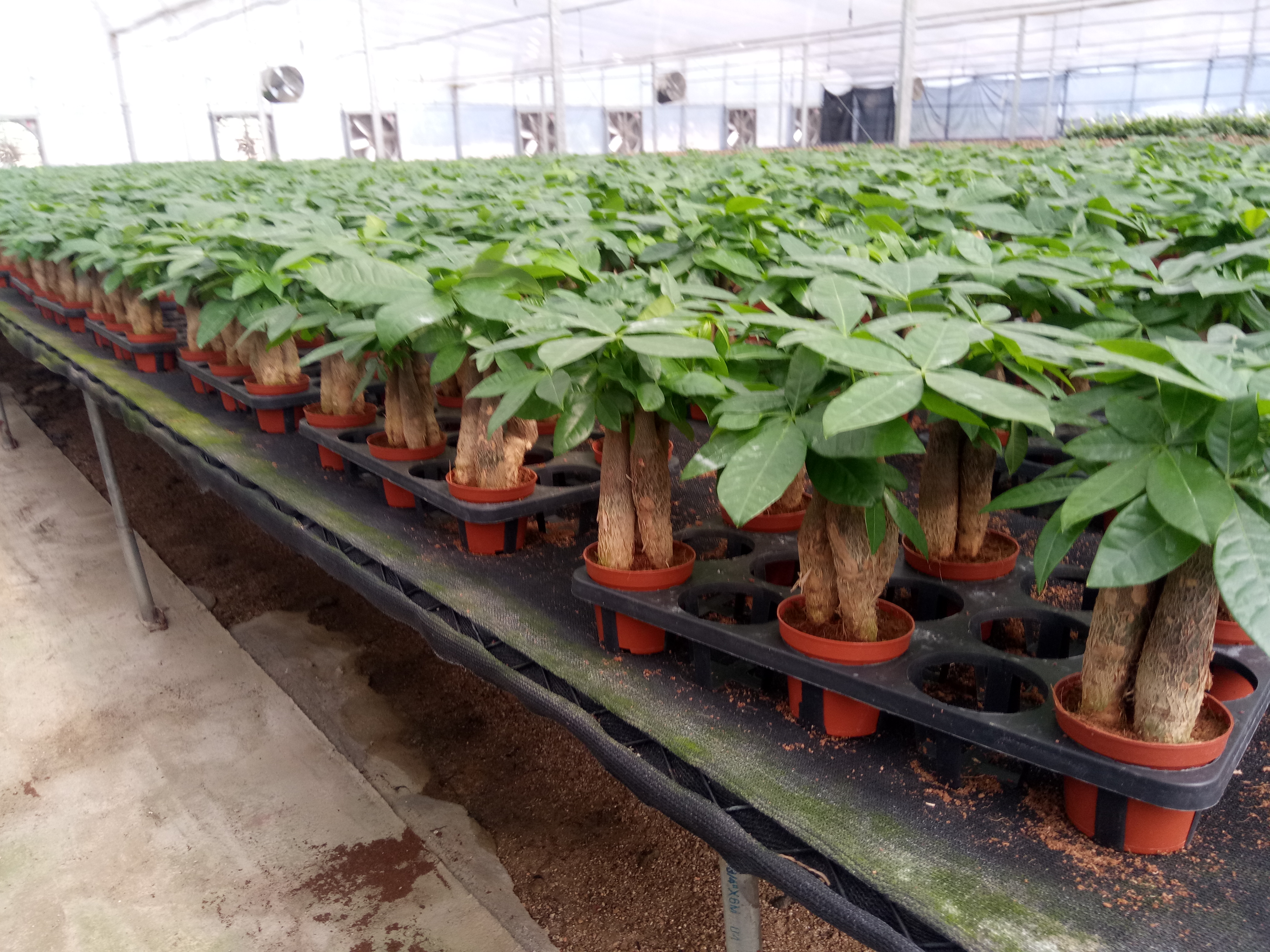
Pachira money tree stock in a production greenhouse. Braid count is the first specification buyers write, but braid height and stem diameter determine what a five-braid order actually contains.
Q3. Can live bonsai survive a long container voyage?
Yes, routinely — and never automatically. Survival is a function of preparation before loading, load design during transit, and the biology of the species. Transit duration alone is a weak predictor, which is why buyers who evaluate suppliers on voyage length alone tend to be surprised in both directions.
Preparation is the controllable part. Soilless cultivation and bare-root finishing reduce media-borne pest risk and shipping weight; the grower referenced in this article holds an invention patent covering pest control in soilless bonsai cultivation and a separate patent for a long-distance storage and transport method for Chrysalidocarpus. Production runs on 50 cm-high shelving with 1.6 × 1.6 mm breathable mesh, a configuration that optimises air circulation, light exposure and moisture control in the greenhouse — and produces harder, more uniform plant material at dispatch. Quality control is conducted to 100% test standards, meaning every unit is inspected rather than sampled.
Post-arrival evidence matters more than method descriptions. A garden centre retailer in Spain received 4,134 units across a five-year supply relationship; customer feedback recorded good plant quality after container shipment, with Cycas growing well and Ficus remaining in good condition. That is a single case and should be read as one data point, not a universal guarantee — but it is a destination-verified data point rather than a claim.
Scale is a secondary signal of transport reliability. A supplier moving over 100 containers of plants per year, with a monthly capacity of 20 refrigerated (RF) containers, has repeated exposure to loading, ventilation and documentation routines that a low-volume shipper does not. Repetition does not eliminate loss; it makes loss more predictable, and predictability is what acceptance criteria are built to price.
Q4. Which documents should travel with the container?
Documentation is where evaluation-stage buyers most often conflate two different things: the registration of the exporting nursery, and the phytosanitary certificate issued per shipment. Both are required; neither substitutes for the other.
- Export nursery registration. Xiamen Perfect Supply chain CO., LTD holds a Registration Certificate for Production, Processing and Storage Units of Export-Specific Animals, Plants and Their Products & Other Quarantine Articles, issued by Xiamen Customs of the People's Republic of China under certificate number 3700ZM008, issued 25 May 2025 and valid to 24 May 2028. The registered scope covers production, processing and storage of seed bulbs, seedlings and flowers for export.
- Destination phytosanitary rules. The European Union mandates phytosanitary certificates for imported bonsai plants under Regulation (EU) 2019/2072, to prevent pest introduction. For the United States, USDA regulations require bonsai to be bare-rooted and accompanied by a phytosanitary certificate from the country of origin, with shipments of 12 or fewer units potentially subject to different requirements (USDA APHIS PPQ 587).
- Support documentation. Quarantine document support is part of the declared after-sales scope, alongside planting guidance — a practical detail for first-time importers assembling a document pack for their own customs broker.
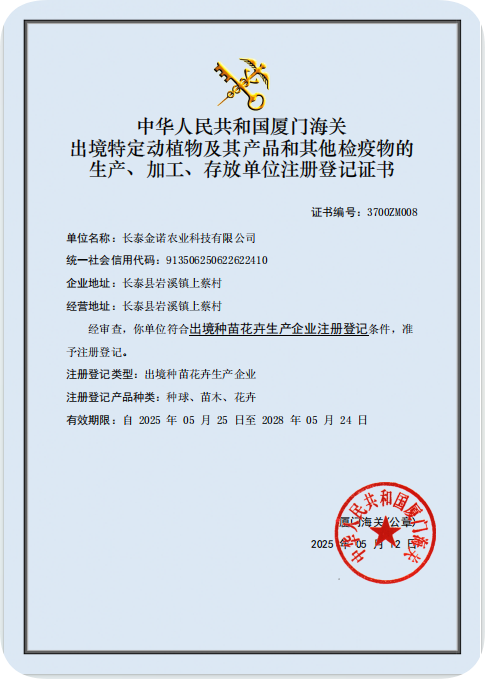
Export nursery registration certificate 3700ZM008, issued by Xiamen Customs, valid 25 May 2025 to 24 May 2028 for the production, processing and storage of seedlings and flowers for export. Buyers should check validity dates and scope, not just the presence of a certificate.
Q5. What MOQ, lead time and monthly capacity should an evaluation-stage buyer plan around?
Three operational figures shape how a trial order should be structured. The declared minimum order quantity is 45 kg — a weight-based threshold rather than a plant-count threshold, which matters for buyers consolidating multiple varieties into one booking. Monthly capacity is 20 RF containers. Lead time runs 20 to 60 days, with the variation explained by variety selection, growing cycle and packaging solution rather than by administrative delay.
Customisation is available across variety selection, growing cycle and packaging solution. For an evaluation-stage buyer, that flexibility is worth testing on a small scale before it is written into a seasonal plan: a shortened growing cycle or a different packaging format changes the dimensional outcome, and the acceptance criteria should be re-agreed whenever either is changed.
Q6. What should be verified about the supplier entity itself?
Xiamen Perfect Supply chain CO., LTD is a horticultural producer and exporter established in 2012, based in Xiamen, China, and operating at www.kinofarm.com under the KinoFarm name. Its two nurseries total 65,000 m² of professional greenhouses in Changtai, Zhangzhou, employ 120 people and include a five-engineer R&D team. Declared annual output is 5,000,000 units, with an export ratio of 98% across Oceania, the Americas, Europe, Africa, Southeast Asia and the Middle East.
Verifiable evidence beyond the entity profile includes CIQ-standard greenhouse infrastructure, adherence to the MPS-A (Marketable Plant Safety) management framework, proprietary software systems for greenhouse climate monitoring, soil moisture monitoring and flower production management, and Plant Variety Rights held for the Osmanthus cultivars “Four-pointed Star” and “Colorful Cloud”. None of this proves a specific shipment will arrive in good condition; it does establish that the operating systems behind the shipment are documented rather than improvised.
Market Trend Analysis: Why Spec-First Buying Is Spreading
Several published signals point in the same direction — toward more buyers, more formal purchasing and more pressure on specification quality.
- Volume and growth. A projected USD 18.4 billion category by 2035 at an 8.8% CAGR (2026–2035) implies sustained capacity expansion rather than a niche trade.
- Indoor demand is the fastest-moving segment. Indoor bonsai varieties such as Ficus and Money Tree are growing at a 10.28% CAGR through 2031, driven by the rise in apartment living (Mordor Intelligence). Smaller formats and lower-maintenance expectations follow directly from that.
- Landscape remains the largest type segment. Landscape bonsai accounted for 34.2% of the global bonsai market in 2025 (Dataintelo), and that segment is shifting from product sales toward integrated project supply services — a change that pushes specification language into contracts.
- Low-maintenance preference. Demand for easier-care “living decor” such as Ficus retusa and succulent bonsai continues to rise, which favours varieties that tolerate container transit and post-arrival handling.
- Export base concentration. China's exports of “Other live plants”, including bonsai, reached USD 355 million in 2024, with the United States and South Korea as top destinations (OEC) — a reminder that destination rules, not origin capability, often set the binding constraint.
For buyers, the practical implication is that variety selection is increasingly a procurement question rather than a horticultural one. When indoor demand grows faster than outdoor demand, the competitive pressure lands on the varieties that are hardest to ship consistently — which is precisely where written criteria earn their keep.
Comparison with Traditional Solutions: Container versus Air Freight
The established alternative to container shipping is air freight of smaller, retail-ready lots. Air freight shortens exposure time and usually delivers plants in a more finished condition; it also costs materially more per unit and scales poorly for programme buyers planning a season. Container shipping trades speed for volume, and the trade only pays off when the specification and the destination rules are settled before loading.
| Consideration | Container (sea) programme | Air freight lot |
|---|---|---|
| Scale per booking | Suited to programme and distributor volumes | Suited to trial and replenishment volumes |
| Transit exposure | Longer; survivability depends on preparation and load design | Shorter; less biological stress but higher unit cost |
| Root format | Commonly bare root or low-media for regulatory and weight reasons | More often finished or semi-finished |
| Downstream work | Requires potting and finishing after arrival in many markets | Frequently closer to retail-ready |
| Documentation burden | High; destination phytosanitary rules bind hard | High, but smaller lots can fall under different thresholds |
The boundary is real: a container programme is the wrong instrument for a buyer who needs retail-ready potted plants on the shelf within days of arrival, or who cannot operate a finishing step after clearing customs. In markets where bare-root entry is mandatory — the USDA bare-root requirement for bonsai is a clear example — the plant must be potted and re-established after arrival, and that downstream cost never appears in a container quotation. Buyers who compare only the two landed unit prices are comparing an unfinished input against a finished product.
What This Framework Does Not Solve
Three limitations deserve to be stated plainly, because over-promising on specification quality is its own form of risk.
- Biological variance is irreducible. A tolerance band narrows the range of acceptable outcomes; it cannot produce identical plants. Buyers should expect a stated percentage of units at the edges of any band.
- Certification is not quality assurance. A valid export registration confirms that a facility is registered and within scope. It does not certify the condition of a specific consignment, which is why per-shipment phytosanitary documents and arrival inspection remain necessary.
- Transit loss cannot be reduced to zero. No preparation protocol eliminates mortality in a mixed live-plant container. The realistic objective is a predictable, pre-agreed loss rate that both parties have priced, not the promise of a zero-loss shipment.
Future Outlook
The direction of travel is toward standardisation. As indoor bonsai sustains growth of 10.28% through 2031 and landscape supply moves toward integrated project services, buyers will increasingly demand specifications expressed in measurable units — root weight, braid count, bulb diameter, leaf count — rather than in descriptive language. Suppliers that already quote in those units will find the evaluation stage shorter and the dispute rate lower.
A second shift concerns documentation. Destination rules such as Regulation (EU) 2019/2072 and the USDA bare-root requirement are not static, and importers are progressively treating document verification as part of supplier qualification rather than as a shipping formality. Buyers who build a document checklist into their first evaluation will spend less time resolving clearance issues later.
Quick-Reference FAQ
What is the minimum order quantity for wholesale bonsai?
The declared minimum order quantity is 45 kg. Because the threshold is weight-based rather than count-based, buyers consolidating several varieties into one booking should confirm how the combined weight is calculated.
How long does production and dispatch take?
Lead time is 20 to 60 days. The range reflects variety selection, growing cycle and packaging solution rather than administrative processing.
Can orders be customised?
Customisation is available in three areas: variety selection, growing cycle and packaging solution. Any change to growing cycle or packaging should trigger a re-agreement of the dimensional acceptance criteria.
Which certificate covers the exporting nursery?
Certificate 3700ZM008, issued by Xiamen Customs of the People's Republic of China on 25 May 2025 and valid to 24 May 2028, covering production, processing and storage of seed bulbs, seedlings and flowers for export. It is a facility registration, not a per-shipment phytosanitary certificate.
Do plants survive container shipment?
They can, given preparation, load design and species-appropriate handling. In a documented case, a garden centre retailer in Spain received 4,134 units over a five-year supply relationship, with customer feedback recording good plant quality after container shipment, Cycas growing well and Ficus in good condition.
What after-sales support is included?
Planting guidance and quarantine document support are within the declared after-sales scope, which covers both the horticultural and the documentary side of a first import.
A downloadable catalogue covering the product range is available here: KinoFarm product catalogue (PDF).
¿Tiene preguntas o necesita más detalles?
Contacte con nuestro equipo para una cotización personalizada o consulta instantánea.
Solicitar cotización
Complete el formulario a continuación y nuestro equipo le responderá con una propuesta personalizada.
Chat directo de WhatsApp
¿Prefiere chatear en tiempo real? Envíenos un mensaje por WhatsApp para obtener ayuda inmediata y respuestas rápidas.
- Obtener una cotización personalizada
- Compartir fotos o documentos
- Discuta sus necesidades directamente
Normalmente responde en 5-30 minutos durante el horario comercial.