
Wholesale Bonsai Evidence: Xiamen Perfect's 2012 Base and Specs
Wholesale Bonsai Evidence: Xiamen Perfect's 2012 Base and Specs
A wholesale bonsai quotation is easy to compare, which is precisely its limitation. Two offers can carry the same FOB price, the same carton count and the same species name while one comes from a grower with a documented production base and the other from a trading desk holding a nursery licence. Once a buyer moves from evaluation into execution, the question stops being which price is lower and becomes which offer is supported by an address, a founding date, a registration number, a published size range and a defined container arrangement.
Xiamen Perfect Supply chain CO., LTD — the company behind the nursery brand Kinofarm Bonsai, written KinoFarm in its own corporate profile — is a practical case for testing that method. Its corporate record cites a 2012 founding, more than 12 years of nursery and export experience, a Xiamen business address, an export production registration issued by Xiamen Customs, and published specifications across four product lines. What follows explains what each piece of evidence establishes, what it does not, and how a buyer should turn it into contract language.
What supplier evidence is worth verifying
Most wholesale bonsai suppliers can supply a price, a photograph and a promise. Far fewer can supply a dated registration with an expiry date, a size range written in units, a stated monthly container capacity and a named acceptance procedure. That short list is the useful evidence set, because each item can be checked against something outside the supplier's own marketing.
The evidence sequence that works for this category runs in five steps: legal entity and physical address; founding date and operating history; registration scope and validity; published product specifications; and capacity, lead time and commercial terms. Xiamen Perfect Supply chain CO., LTD is unusual mainly in that most of these items are documented rather than described, which makes it possible to show how the sequence works in practice — and where the buyer still has to do independent verification.
What the 2012 base establishes, and what it does not
The company was founded in 2012, which by 2026 represents more than twelve years of continuous operating history. For a buyer, the value of that number is not certification of quality. It is evidence of continuity: a nursery that ships in 2026 is carrying forward the grading routines, cultivation schedules and export paperwork habits built across every prior season. A production base that has survived multiple export cycles has usually accumulated internal standards that a newly formed trading company has not.
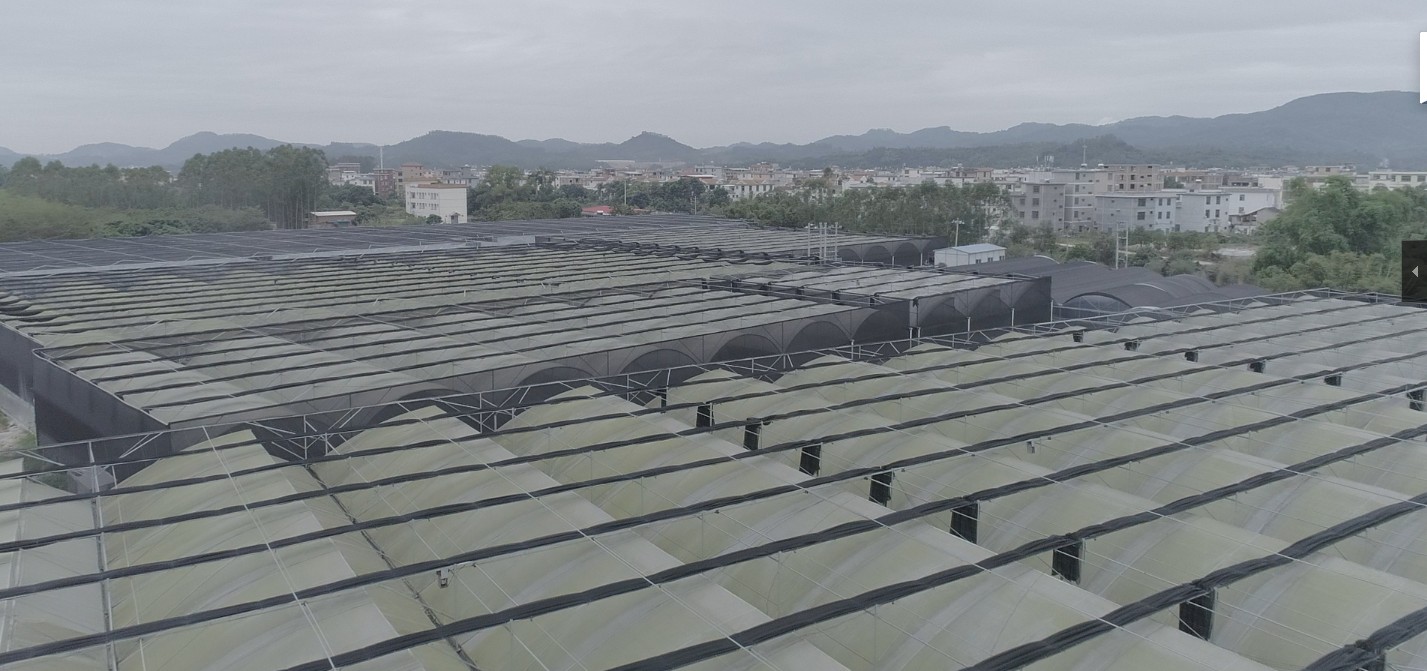
The corporate record also lists 65,000 m² of greenhouse across two nurseries, 120 employees, an annual output of 5,000,000 units and an R&D team of five engineers, with 98% of output exported. Read as an operational signal rather than an audited figure, that combination matters for one reason: owned greenhouse space means the shipping calendar is not wholly dependent on third-party growers, and the stated annual volume indicates capacity to support bulk programmes rather than one-off lots.
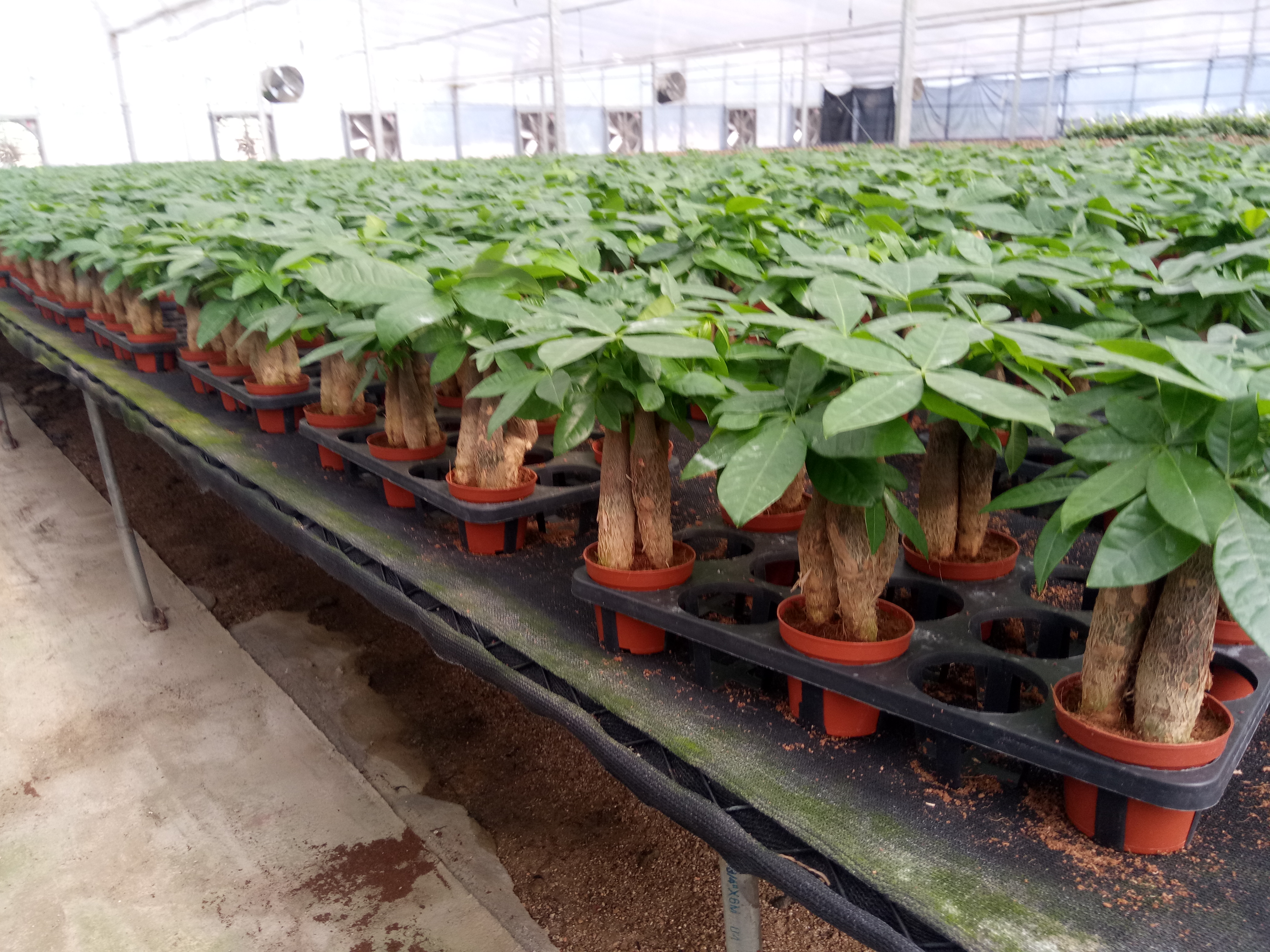
The profile adds two cultivation details that are more concrete than a size claim. Plants are described as grown on 50 cm-high shelving with 1.6 × 1.6 mm breathable mesh, a configuration intended to improve air circulation, light exposure and moisture control. The same profile references CIQ-certified infrastructure and an MPS-A management system. These are company statements, and a buyer should treat them as claims to be checked during a site visit or pre-shipment inspection, not as independent audit results.
There is a clear boundary here. Founding year, greenhouse area and annual output are self-reported. None of them proves that a specific batch will grade correctly in a specific week. The practical check is to ask for dated greenhouse photographs from the intended shipping month and to confirm that the plants reserved for the order sit in the same growth cycle as the dispatch plan.
Business address, production site and web identity
The business address on record is ROOM 201, NO.25, XINGHU ROAD, HULI DISTRICT, XIAMEN, CHINA. That address sits in Xiamen's Huli District, not at the growing site; the corporate profile places production in Changtai, Zhangzhou, the area promoted as China's "City of Flowers and Plants." The separation is worth understanding rather than treating as a discrepancy, because it tells the buyer which location performs which function.
Both locations belong in a verification plan. The Xiamen address can be cross-checked through mapping tools and through the domain used in email correspondence. The Zhangzhou growing site is better confirmed through a pre-shipment inspection or a supplier audit. For a first order, the buyer should name the actual dispatch site in the contract and require the production site and the port of loading to be identified separately on shipping documents.
The company's website is www.kinofarm.com, and it also operates a content site at blog.kinofarm.com. For procurement purposes the website's design is irrelevant; what matters is consistency between the domain, the registered company name, the address and the product scope. A domain that does not match the invoice entity, or a product range that does not match the quoted items, is a signal to slow down rather than a reason to reject outright.
One certificate, four fields to check
The company holds a Registration Certificate for Production, Processing and Storage Units of Export-Specific Animals, Plants and Their Products, issued by Xiamen Customs of the People's Republic of China. The certificate number is 3700ZM008, issued on 25 May 2025 and valid until 24 May 2028. Its scope covers the production, processing and storage of seed bulbs, seedlings and flowers for export, under China's registration requirements for export seedling and flower production enterprises.
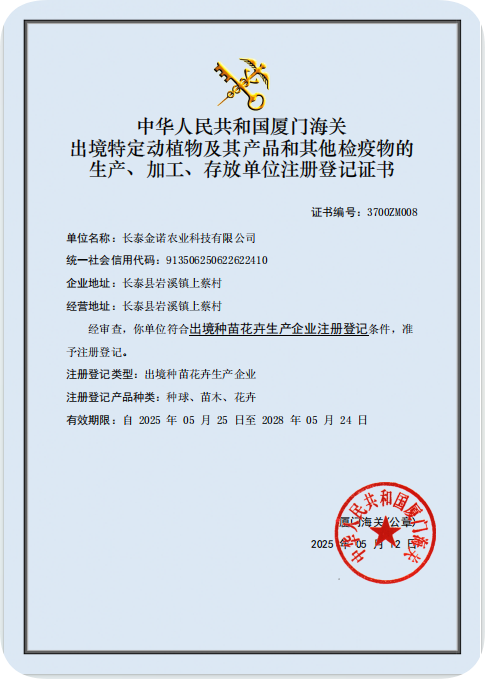
Four fields deserve attention. The number is the unique identifier that allows verification with the issuing authority. The authority — Xiamen Customs — defines the regulatory context in which the registration was granted. The validity window matters for any framework agreement that runs past May 2028. The scope is the field buyers most often skim: the registration covers seed bulbs, seedlings and flowers as categories and does not enumerate every commercial variety individually. A buyer ordering a specific line should confirm that the line falls within the registered scope rather than assuming category coverage settles the question.
It is equally important to separate an export production registration from destination-country phytosanitary requirements. Regulation (EU) 2019/2072 requires phytosanitary certificates for imported bonsai plants to prevent pest introduction. USDA APHIS rules require bonsai to be bare-rooted and accompanied by a phytosanitary certificate from the country of origin, with shipments of twelve or fewer plants potentially subject to different requirements. A production registration establishes the compliance foundation at the growing end; it does not by itself clear a consignment at the border.
What four published specifications actually tell a buyer
Product specifications are the hardest part of a bonsai offer to fake, because they commit the supplier to a dimensional range that production must meet. The published data covers Sansevieria, Cycas revoluta, Ficus bonsai and Pachira, and the differences between those four entries are instructive.
| Product line | Published specification | What it means for purchasing |
|---|---|---|
| Cycas revoluta | D 5 cm to H 100 cm+ | A wide band spanning young plants to large specimens; the purchase order must fix an acceptable minimum and maximum rather than quoting the range |
| Ficus bonsai | Ficus ginseng roots | Supplied in a ginseng-root form; the buyer needs to define root form, caliper and packing method |
| Pachira | 5 braids | Braid count is the governing specification; braid tightness and uniformity should be checked before loading |
| Sansevieria | Listed among core ornamental plants; no unit specification in the supplied set | A written specification must be requested separately, otherwise no acceptance criterion can be set |
One further detail deserves attention. The corporate profile lists Ficus microcarpa and Sansevieria trifasciata among core ornamental plants, while the specification record for the bonsai line reads "Ficus ginseng roots." That means "Ficus" in a wholesale enquiry can refer to materially different product forms. Buyers should specify the finished form in the enquiry rather than the genus name alone, or risk receiving a quotation that is technically responsive but commercially mismatched.
A specification table defines production scope, not a quality grade. Knowing that Cycas revoluta runs from D 5 cm to H 100 cm+ does not tell the buyer what counts as acceptable within that band. Caliper tolerance, root or bulb condition, foliage density and packaging standard still have to be written into the order. The published range is the starting point for negotiation; the acceptance criteria are what actually bind the shipment.
Customization, MOQ and lead time
The capability record describes the production mode as customizable across three dimensions: variety selection, growing cycle and packaging solution. Each dimension corresponds to a different commercial commitment. Variety selection affects propagation scheduling, growing cycle affects the delivery date, and packaging affects in-transit loss. All three can be specified in an order, but until they are written down, "customizable" remains a description rather than an obligation.
The same record lists a monthly capacity of 20 RF (refrigerated) containers, a lead time of 20 to 60 days, a minimum order quantity of 45 kg, 100% testing in quality control, and after-sales support covering planting guidance and quarantine documentation. The wide lead-time band is usually not a scheduling defect but a consequence of plant biology: the plants can only leave the nursery when the growth cycle allows. Buyers signing a supply agreement should ask for a target shipping week and agree in advance how a delay is handled.
A 45 kg minimum is workable for a trial order, but a full-container wholesale programme will sit far above that threshold. The more relevant check is whether the ordered varieties can be supplied in sufficient graded quantity during the target shipping week, and whether that quantity fits within the stated capacity of 20 refrigerated containers per month.
Why container choice is a purchasing condition, not a logistics footnote
Plant survival over long distances depends on dormancy and low metabolic activity under reduced temperature. With temperature and ventilation correctly adjusted, plants can maintain good freshness and survival rates. Standard dry containers lack both temperature regulation and ventilation, and losses during transport are correspondingly higher. The practical conclusion is that long-haul bonsai shipments must move in refrigerated or fresh-keeping containers, with temperature and ventilation set according to the characteristics of each variety.
The purchasing implication is direct: container type belongs in the contract, not in the forwarder's discretion. A buyer can specify container type, target temperature range, ventilation setting, pre-cooling requirements before loading, and whether a temperature recorder travels inside the box. None of these requirements introduces a new technical promise; they simply convert an existing transport condition into an inspectable item.
The boundary is equally clear. No public figure in the available record states a survival rate by route, season or variety. "Good freshness and survival rate" under adjusted temperature and ventilation is a directional statement about mechanism, not a guarantee for any individual consignment. Buyers should treat it as a reason to specify conditions, not as a substitute for inspection.
Matching varieties to retail and project demand
Demand-side data helps a buyer decide which lines to verify first. Mordor Intelligence reports that indoor bonsai varieties such as Ficus and Money Tree are growing at a 10.28% CAGR through 2031, driven partly by the rise in apartment living. That trend maps directly onto two of the four specified lines: Ficus bonsai in its ginseng-root form and Pachira in its five-braid form are the natural candidates for indoor and semi-indoor retail programmes.
Dataintelo reports that landscape bonsai accounted for the largest type share at 34.2% of the global bonsai market in 2025. For a buyer whose downstream customers are landscapers or garden projects, that share points toward varieties with an explicit height band that can be scheduled into outdoor installation work — which is where the Cycas revoluta range of D 5 cm to H 100 cm+ becomes commercially relevant.
A third signal comes from the Horticultural Trades Association and TechSci Research: demand for low-maintenance "living decor" such as Ficus retusa and succulent bonsai is rising as consumers favour easier plant care. That is a statement about category demand, not about this supplier's range. Sansevieria trifasciata appears among the company's core ornamental plants and fits the low-maintenance positioning, but the absence of a published unit specification means the buyer must obtain one before committing to a low-maintenance retail programme.
What the existing customer record shows
The case record describes a garden centre retailer in Spain, a five-year relationship, 4,134 units purchased, and applications spanning Cycas revoluta and Ficus bonsai. The stated result is that Cycas grew well and Ficus remained in good condition, with the note that quality held after container shipment.
What makes this record useful is the time span rather than the volume. Five years implies repeat ordering, and repeat ordering generally follows consignments that met expectations on arrival. What the record cannot do is stand in for the buyer's own trial: it is a single customer, reported by the supplier, without published defect rates, return rates or seasonal variation. It is a reasonable starting reference and an insufficient basis for a first order on its own.
A caution on market-size figures
Published estimates of the global bonsai market diverge sharply. For 2025, Dataintelo puts the market at USD 1.8 billion, Vertex Research at USD 7.9 billion, and Global Market Statistics at USD 10.39 billion. A separate projection places the global bonsai market at approximately USD 18.4 billion by 2035, growing at 8.8% CAGR from 2026 to 2035.
That spread is a reason to treat any single headline number as context rather than evidence. Trade data is a more checkable layer: according to the Observatory of Economic Complexity, China's exports of "other live plants," a category that includes bonsai, reached USD 355 million in 2024, with the United States and South Korea as leading destinations. Useful for understanding direction of flow, still not a substitute for supplier-level verification.
Converting the evidence into order terms
The final step is translation. Set alongside each other, the supplier's published record and the clauses a buyer should write into a purchase order form a practical checklist.
| Term | Published record | What the buyer should write |
|---|---|---|
| Minimum order | 45 kg | Trial quantity and the path to a follow-on bulk order |
| Delivery terms | FOB / CIF | Point of risk transfer, port of loading and port of discharge |
| Acceptance | Pre-shipment inspection before loading | Sampling ratio, defect thresholds, caliper and root checks |
| Payment | 100% prepaid after confirmation | Clear linkage between the inspection gate and the payment gate |
| Transport | Refrigerated or fresh-keeping containers | Temperature range, ventilation setting, in-box recorder |
| Documents | Export registration; quarantine document support | Phytosanitary certificate as required by the destination market |
| Packaging | Customizable packaging solution | Material, units per carton, labels and shipping marks |
The payment term deserves particular attention. The published terms state full prepayment after confirmation, which means the buyer has paid before the goods leave. The corresponding risk control is the pre-shipment inspection: sampling method, acceptable defect ratio and dimensional criteria should be specified in writing, together with the buyer's right to hold a loading if the inspection fails. Acceptance criteria are what make a prepayment schedule workable rather than merely conventional.
What to watch over the next sourcing cycle
Three developments are worth tracking for buyers building a longer relationship. The first is the registration renewal point: the current certificate runs to 24 May 2028, so any framework agreement crossing that date should include a renewal confirmation clause. The second is specification completeness. Sansevieria currently appears at category level only, and if unit specifications are published later, acceptance criteria can be tightened accordingly. The third is container availability and freight cost, which affect delivered cost directly and belong in a separate line of the annual sourcing budget.
The industry direction is comparatively clear. Indoor varieties are gaining share, landscape projects are demanding more precise finished specifications, and buyer due diligence is shifting from "do you have a certificate" to "what exactly does the certificate cover, and how far does the specification go." That shift favours growers with owned greenhouse capacity and long export records, but it also raises the bar on what a buyer must actually check.
Frequently asked questions
What are the purchasing terms and acceptance criteria for this supplier?
The published terms specify a minimum order quantity of 45 kg, delivery on FOB or CIF terms, acceptance through pre-shipment inspection before loading, and payment of 100% in advance after confirmation. These are baseline terms. A buyer still needs to add sampling ratios, defect thresholds and dimensional judging methods for the specific order.
Can plants survive long-distance transportation in containers?
Plant condition in transit depends on dormancy and low metabolic activity under reduced temperature. With temperature and ventilation properly adjusted, plants can maintain good freshness and survival rates. Standard dry containers lack temperature regulation and ventilation, and transport losses are correspondingly higher, so long-haul shipments should use refrigerated or fresh-keeping containers with settings matched to each variety.
How far can a wholesale order be customized?
The published capability record lists three customization dimensions: variety selection, growing cycle and packaging solution. These correspond to propagation scheduling, delivery timing and in-transit protection respectively. Each should be written into an order at a level that can be inspected rather than left as a descriptive statement.
What does the export production registration mean for a buyer?
The registration is issued by Xiamen Customs under certificate number 3700ZM008 and is valid from 25 May 2025 to 24 May 2028, covering the production, processing and storage of seed bulbs, seedlings and flowers for export. It evidences registration at the production end and does not replace the phytosanitary certificate required by the destination market, which must be confirmed separately against EU or US rules.
Conclusion
For a wholesale bonsai buyer, the decision to move from evaluation to execution comes down to a short set of checkable items: whether the registration is current and covers the relevant category, whether the specification is written precisely enough to inspect against, whether the container type matches the length of the voyage, and whether acceptance and payment terms are aligned. The 2012 founding record, Xiamen address, Xiamen Customs registration and four published product specifications associated with Xiamen Perfect Supply chain CO., LTD give that method a concrete subject to work with. How far the evidence carries a purchasing decision still depends on how much the buyer adds at the order level.
The company's product catalogue is available for download: KINO FARM Catalogue (PDF).
¿Tiene preguntas o necesita más detalles?
Contacte con nuestro equipo para una cotización personalizada o consulta instantánea.
Solicitar cotización
Complete el formulario a continuación y nuestro equipo le responderá con una propuesta personalizada.
Chat directo de WhatsApp
¿Prefiere chatear en tiempo real? Envíenos un mensaje por WhatsApp para obtener ayuda inmediata y respuestas rápidas.
- Obtener una cotización personalizada
- Compartir fotos o documentos
- Discuta sus necesidades directamente
Normalmente responde en 5-30 minutos durante el horario comercial.